
A 2021 manufacturing case study measured exactly this problem. Before any changes, workers took 59 seconds to locate three basic tools — a spanner, a screwdriver, and a drill bit. After installing a color-coded shadow board, that dropped to 18 seconds.
That's the promise of 5S paired with visual management: less searching, fewer errors, and a shop floor where anyone can see what's normal and what's not at a glance. This article breaks down what 5S actually means, how visual management makes it stick, real examples you can put to work, and how manufacturers are now pairing these principles with real-time digital tools.
Key Takeaways
- 5S organizes the workspace; visual management keeps the standard visible and enforceable
- Shadow boards, floor marking, and Andon signals cut search time and reduce errors
- Digital dashboards extend 5S from static whiteboards to real-time machine and ERP data
- Cross-shift consistency and faster problem detection deliver the biggest paybacks
- Successful rollouts start with operator input, not top-down mandates
What Is 5S? The Five Pillars Explained
5S traces back to the Toyota Production System in postwar Japan, built to eliminate muda (waste) by creating workspaces where problems can't hide. Each of the five S's builds on the last, moving a shop from cluttered to controlled.
The Five Pillars
- Sort (Seiri) — Remove anything from the work area that isn't needed for the current job. If it hasn't been touched in months, it doesn't belong at the workstation.
- Set in Order (Seiton) — Give every remaining tool, fixture, and material a designated spot. If you have to hunt for it, it's not organized yet.
- Shine (Seiso) — Clean and inspect the workspace and equipment regularly. A quick wipe-down often catches a loose bolt or a leaking line before it turns into a breakdown.
- Standardize (Seiketsu) — Document how the first three steps should look, so the process repeats the same way on every shift, not just when the day-shift lead happens to be around.
- Sustain (Shitsuke) — Audit and reinforce the standard over time. Skip this step, and most 5S programs slide back into clutter within a few months.

Why This Matters on a CNC Floor
Precision manufacturing has almost zero tolerance for ambiguity. A misplaced fixture, a mixed-up tool offset, or a missing gauge doesn't just cost search time. It can throw off part accuracy or blow a cycle-time target entirely.
In a high-mix, low-volume machine shop running dozens of changeovers a week, 5S keeps setups repeatable and scrap rates low—especially when a new hire would otherwise load the wrong offset table because nothing was clearly labeled.
What Is Visual Management in 5S?
5S defines what an organized workspace should look like. Visual management is what makes that standard visible without anyone having to explain it out loud. It's the use of signs, colors, boards, and indicators that let any operator, new or experienced, recognize normal versus abnormal conditions in seconds.
This is the mechanism that actually makes the Standardize and Sustain steps of 5S work. A written procedure sitting in a binder doesn't stop bad habits from creeping back. A shadow board with an outline for every tool does, because a missing tool is obvious the moment you glance at it.
More Than Just Signage
Visual management goes beyond labels on shelves. When engineered well, status, location, and expectations are clear without a verbal instruction or a trip to document control:
- A red light means stop
- An empty outline on a shadow board means a tool is missing
- A green indicator on a job board means the part is on schedule
Why Visual Cues Beat Verbal Instructions
A 2014 MIT study found that people could accurately identify images they'd never seen before after viewing them for just 13 milliseconds, far faster than the 100-millisecond threshold earlier research had suggested. Humans process visual information almost instantly.
That speed advantage matters on the floor. In shops where operators rotate across multiple workcenters in a single week, a color-coded board or status light removes the guesswork that verbal handoffs and tribal knowledge tend to introduce. That cuts onboarding time and the error rate that comes with it.
5S Visual Management Examples and Tools
5S visual management takes many forms on the shop floor. Some are as simple as a strip of tape; others are dedicated boards tracking quality and output in real time.
- Shadow boards and color-coded tool control: Foam cutouts or painted outlines show exactly where each tool belongs. A missing wrench or micrometer is obvious at a glance, not discovered mid-setup.
- Floor marking and tape: Colored tape and paint define walkways, forklift lanes, hazard zones, and staging areas. Yellow typically marks caution zones; red marks danger areas.
- Red tag systems: During the Sort step, teams attach red tags to items of uncertain value. If nobody claims a tagged item within a set window, it gets removed or relocated.
- Kanban and task boards: Cards or magnets move across a board to show job status, from queued to in-process to complete, without anyone opening a spreadsheet.
- Andon-style alerts: Lights or alarms flag a problem the moment it happens, whether that's a jam, a quality issue, or a machine waiting on material.
- KPI and status boards: Daily boards track output, first-pass yield, and audit scores, so a supervisor walking the floor knows performance without asking.

The same principles show up at the machine, not just in the aisle.
A Machining-Specific Example
Picture a workcenter status indicator that shows which job is running, what tooling applies, and which spec revision governs the part. In a paper-based shop, that's a job traveler clipped to the router sheet, moving from operation to operation with the part.
The problem: paper travelers get lost, coffee-stained, or left at the wrong workcenter, and someone eventually runs a job against an outdated print revision. Visual management solves the visibility half of that problem. It does not, on its own, keep job, tooling, and revision data current at the workcenter in real time. That gap is what digital visual management closes.
Beyond the Whiteboard: Digital Visual Management for Modern Manufacturers
Traditional whiteboards and paper 5S boards work, until they don't. They require someone to manually erase and rewrite status, and they have no connection to what a machine, ERP system, or labor record actually shows. A kanban card can say a job is "in process" long after the machine finished and sat idle for twenty minutes.
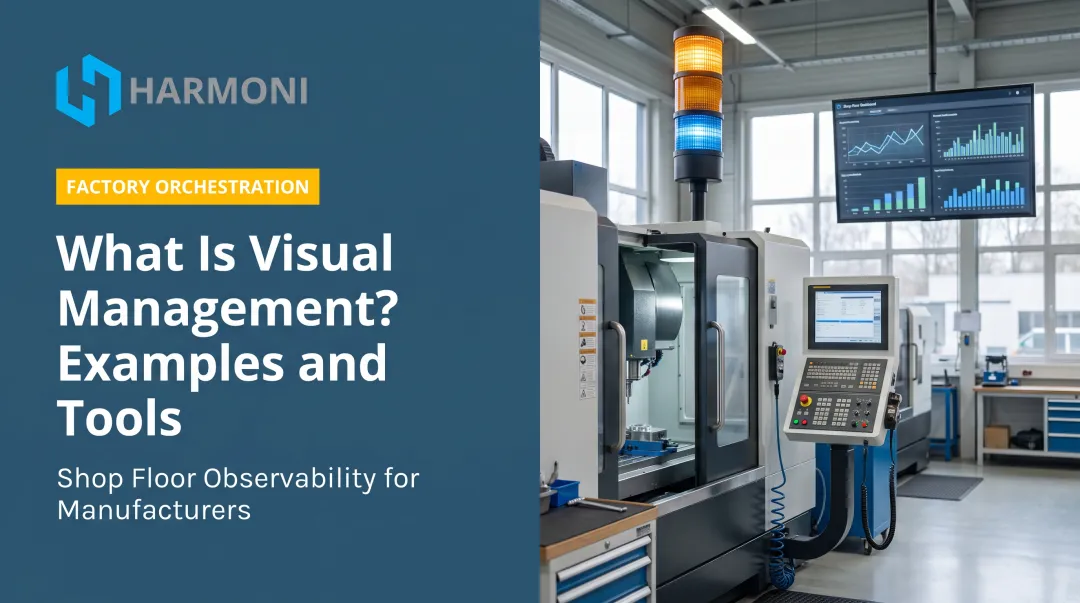
Mid-to-large manufacturers are increasingly pairing 5S visual principles with real-time digital dashboards that unify machine status, operator activity, and ERP job data into a single view. Instead of a static board someone updates once a shift, the display updates itself continuously from the equipment already running the shop.
How Harmoni Extends 5S Into Real Time
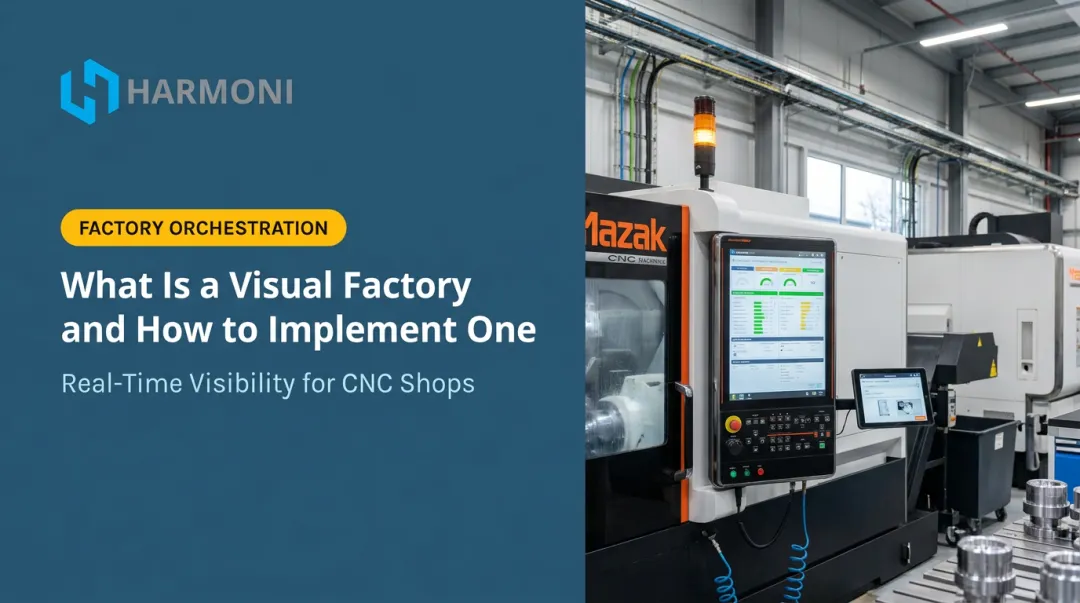
Harmoni's factory orchestration platform is built around this idea. Long-range RFID tags on employee badges and job paperwork let the system automatically detect who's at a workcenter and which job they're running, with no badge swipe or manual login.
As the operator approaches the machine, Harmoni loads the correct CNC program, surfaces the right work instructions and quality checksheet, and starts time tracking on its own.
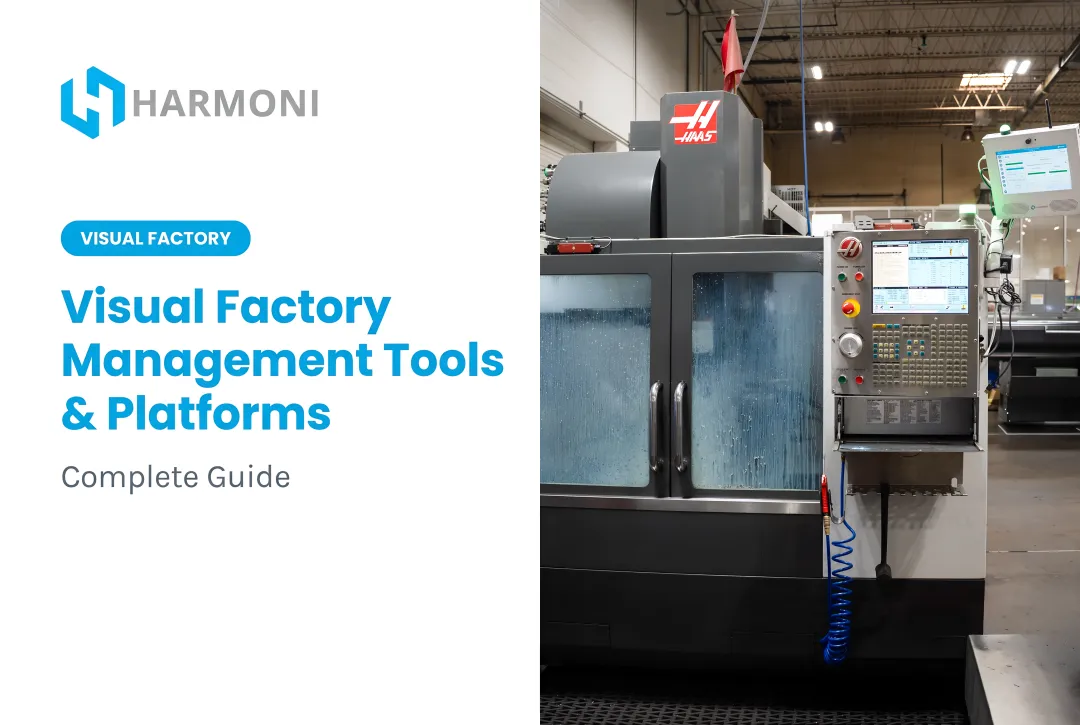
That machine-side terminal functions like a digital job traveler that never goes missing and never shows an outdated revision. It connects natively to major CNC controls and ERP systems, so what's on screen always matches the floor and the business system:
- CNC controls: Mazak, Haas, Fanuc, Heidenhain, Siemens, DMG MORI, Makino, and Fadal
- ERP systems: Epicor, Infor, JobBoss, ABAS, and ODOO
Harmoni's Visual Factory module adds andon-style stack lights at each machine. Unlike a standard andon light that only shows whether a spindle is spinning, these lights reflect real-time OEE performance:
- Green: running at expected performance, no action needed
- Yellow: performance slipping, an early warning before it becomes a real problem
- Red: poor OEE, even if the machine is technically running
A manager walking the floor doesn't need to open a laptop to know which machines need attention. And because Harmoni deploys onto existing equipment (no machine replacement, no new servers), shops typically go live in weeks rather than months.

Benefits of Combining 5S and Visual Management
5S and visual management deliver gains you can measure on the floor—lead time, scrap, WIP, and productive hours.
Efficiency and Flow
A custom electric motor producer cut lead time by 50% and dropped work-in-process from 105 units to 5 after a combined lean and visual management program, per a 2024 NIST MEP case study. NIST doesn't isolate visual management alone, but the boards kept standards consistent across shifts.
Harmoni customers see similar gains when physical 5S meets real-time visibility: one shop cut scrap by 22% in two months, and WessDel recovered 17 productive hours per employee after tightening shop floor execution.
Safety and Consistency
Shared visual cues protect people and keep every shift working the same way:
- Color-coded floor marks and hazard zones expose blocked walkways and pinch points before someone gets hurt
- Every operator sees the same signals, so consistency no longer depends on who trained the new hire
- Problems surface when they happen—not in a shift-change conversation two hours later
Tips for Successful 5S Visual Management Implementation
Build It With Operators, Not For Them
5S programs that get imposed from the top rarely stick. Ask the people running the machines what slows them down, and let them help design the shadow board or status board layout. They'll spot workflow gaps that a walkthrough audit misses.
Keep Boards Practical, Not Pretty
A laminated, color-coordinated board looks great in a photo, but if it's mounted where nobody walks past it, it's useless. Put boards and indicators right at the point of work, where operators glance at them without detouring.
Tie Boards to Real KPIs
A 5S board that only tracks "audit score" eventually gets ignored. Connect it to metrics the business already cares about — downtime, first-pass yield, on-time delivery. When operators see that a cleaner setup station correlates with fewer changeovers running long, the program stops feeling like busywork.

Frequently Asked Questions
What is visual management in 5S?
Visual management is the use of visual signals such as boards, colors, lights, and markings that let anyone recognize normal versus abnormal conditions in a process without asking or checking documentation. It's what makes 5S standards visible and enforceable on the floor.
What are the 5 pillars of 5S?
The five pillars are Sort (remove unneeded items), Set in Order (organize what remains), Shine (clean and inspect), Standardize (document the routine), and Sustain (audit to maintain it).
What are examples of 5S visual management?
Common examples include shadow boards for tool control, floor marking and tape for walkways and hazard zones, red tag systems for sorting, kanban or Andon boards for job status, and KPI dashboards tracking output and quality.
What is the difference between 5S and visual management?
5S is the overall methodology for organizing a workspace and eliminating waste. Visual management is the toolset used to make those 5S standards visible, understandable, and sustained across every shift.
How does visual management improve safety on the shop floor?
Color-coded markings and indicator lights flag hazards, blocked pathways, and unsafe conditions the moment they occur. That visibility lets workers react before an incident happens, not after.
Can visual management be digital instead of physical boards?
Yes. Many manufacturers now pair physical 5S boards with real-time digital dashboards and platforms like Harmoni, which combine machine, ERP, and operator data into one live view instead of a manually updated board.