Introduction
A batch gets scrapped. A machine has been running bad parts for two hours. A supervisor finds out at shift end — not when it happened. This scenario plays out in machine shops and manufacturing facilities every day, and it's exactly the problem industrial Software as a Service is built to solve.
Industrial SaaS refers to cloud-delivered, subscription-based software purpose-built for manufacturing operations. Unlike general business software, it connects directly to machines, sensors, operators, and ERP systems to turn shop floor data into real-time decisions.
This article covers what industrial SaaS actually is, how it differs from traditional manufacturing software, the key benefits manufacturers are realizing, real-world use cases, and what to evaluate before adopting a platform.
Key Takeaways
- Industrial SaaS is cloud-delivered software built for manufacturing — connecting directly to machines, sensors, and shop floor workflows, not just business users
- Unlike on-premise systems, it updates automatically, scales without hardware upgrades, and shifts IT maintenance off your team
- Core benefits include real-time operational visibility, predictable subscription costs, and tighter alignment between software spending and measurable production outcomes
- Integration complexity, data readiness, and change management are the most common barriers to realizing full value
What Is Industrial Software as a Service?
Industrial SaaS is cloud-delivered application software designed specifically for manufacturing operations — accessed via recurring subscription rather than a one-time license purchase. The category covers functions like manufacturing execution (MES), predictive maintenance, quality control, machine monitoring, and factory orchestration.
More Than a Web App
The defining characteristic that separates industrial SaaS from general enterprise SaaS is its dependence on real-world operational data. These platforms connect to machines, PLCs, sensors, ERP systems, and shop floor workflows — they aren't standalone web applications managing business records. A CRM stores contact data. An industrial SaaS platform ingests spindle speed, cycle time, scrap counts, and operator activity simultaneously.
The delivery model follows the standard SaaS pattern:
- The vendor owns, hosts, and maintains the platform
- Updates push automatically — no IT intervention required
- Manufacturers pay on a recurring basis, with no servers or on-premise infrastructure to manage
That infrastructure-free model is only possible because of what's happened at the hardware layer.
The Role of IIoT and Cloud Connectivity
Inexpensive sensors, high-speed connectivity, and scalable cloud storage now make it feasible to collect machine data at the volume manufacturing environments generate. Industrial SaaS platforms sit on top of this infrastructure and turn raw machine signals into dashboards, alerts, and OEE reports that operators and plant managers can act on immediately.
The market reflects this momentum. According to Grand View Research's June 2025 analysis, the global manufacturing operations management software market is valued at approximately $19.0 billion in 2025 and projected to reach $76.71 billion by 2033 — a 19.1% CAGR. While this figure includes both cloud and on-premise deployments, the cloud segment is the primary growth driver.
How Industrial SaaS Differs from Traditional Manufacturing Software
The Legacy Model's Limitations
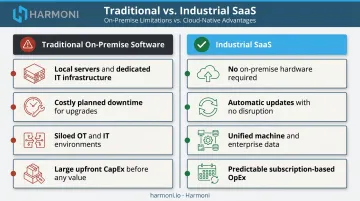
Traditional manufacturing software — on-premise ERP, SCADA systems, locally hosted MES — was built for a different era. It typically requires:
- Local installation and dedicated server infrastructure maintained by internal IT
- Planned downtime windows for upgrades, often involving vendor involvement and significant cost
- Separate, siloed environments where OT (plant floor equipment and controls) and IT (enterprise software) rarely communicate
- Large upfront capital expenditures for licenses and hardware before a single operator benefits
The result is fragmented data. Production data sits in one system, quality records in another, machine performance in a third — and pulling them together requires manual effort, if it happens at all. The update cycle makes this worse.
The Update and Maintenance Difference
With on-premise systems, every upgrade is a project. Validation, downtime scheduling, and IT coordination consume resources manufacturers would rather direct at production. Industrial SaaS eliminates that cycle — the vendor manages infrastructure and pushes updates automatically, meaning manufacturers always run the current version without disruption.
That shift in how software is maintained connects directly to a deeper structural change: how plant floor systems and enterprise software relate to each other.
IT/OT Convergence
Legacy systems were designed when operational technology (plant floor controls and equipment) and information technology (enterprise software) were completely separate disciplines managed by separate teams. PwC's industrial IT/OT convergence research describes this shift as combining legacy environments with newer technologies rather than replacing them outright — a realistic picture of where most manufacturers actually are.
Industrial SaaS platforms are built specifically to bridge these two worlds, connecting machine data, ERP workflows, and operator activity in a single system where each informs the other.
Aligned Business Incentives
The commercial model matters too. With traditional one-time software sales, vendor and customer interests diverge after the contract is signed. The subscription model changes that dynamic. A vendor that must earn renewal every year has a direct financial incentive to ensure the platform keeps delivering measurable value — which drives better product development and more responsive customer support.
Key Benefits of Industrial SaaS for Manufacturers
Real-Time Operational Visibility
Industrial SaaS platforms pull data from machines, operators, and enterprise systems simultaneously. Plant managers get a live view of production performance — not a report from yesterday's shift. Problems surface while they can still be corrected, not after a batch is scrapped or a delivery commitment is missed.
Predictable Cost Structure
The cost model shift from CapEx to OpEx matters for mid-size manufacturers especially. On-premise deployments require upfront spending on software licenses, servers, database infrastructure, installation, and ongoing maintenance — before production value is realized. Industrial SaaS replaces that with a predictable recurring subscription, eliminating large hardware refresh cycles and making multi-year budgeting reliable.
Scalability Without Hardware Procurement
Adding a new machine, workcenter, or facility to an on-premise system typically triggers hardware and configuration work. With industrial SaaS, scaling means provisioning access within the platform — no new servers required. This makes the model particularly well-suited to manufacturers expanding operations or adding capabilities incrementally.
Continuous Improvement Through Automatic Updates
Because the vendor manages the platform, new features, analytics enhancements, and security patches reach all customers automatically. Manufacturers benefit from ongoing R&D investment without tracking software versions internally or coordinating upgrade projects.
Measurable Connection to Production Outcomes
Industrial SaaS platforms track operational metrics directly:
- Machine uptime and availability
- Scrap rates and quality yields
- Cycle time and throughput
- Labor utilization by workcenter
- Job costing accuracy against quoted hours
That data trail makes it possible to connect software spending to measurable production improvements — something ERP systems alone rarely provide at the shop floor level.
Examples of Industrial SaaS in Manufacturing
Predictive Maintenance
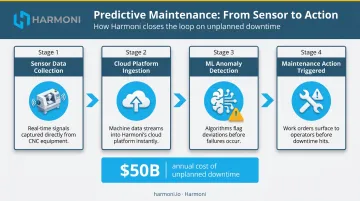
Cloud-connected sensors on CNC machines, motors, and production equipment feed data to SaaS platforms that use machine learning to detect anomalies before they become failures. The business case is significant: Deloitte estimates that unplanned downtime costs industrial manufacturers approximately $50 billion annually. Predictive maintenance is one of the most mature and widely adopted industrial SaaS use cases because the financial impact of avoiding even one unplanned failure is immediately quantifiable.
Factory Orchestration
Factory orchestration platforms represent an emerging category that sits between ERP systems, machines, and operators, coordinating people, processes, and engineering requirements in real time. Rather than replacing MES or ERP, these platforms operate as an execution layer that connects them.
Harmoni is a purpose-built factory orchestration platform designed for discrete manufacturers: CNC machining shops, aerospace and defense parts manufacturers, and precision job shops. Core capabilities include:
- Automatically detects which employee is at a workcenter and which job they're running via long-range RFID
- Loads the correct CNC programs, work instructions, and quality checksheets to that machine automatically
- Converges machine data, operator activity, and ERP workflows into a single unified view for plant managers
The WessDel case study offers a concrete example: Harmoni's installation was completed in less than one week, and internal time studies confirmed that operators who had been spending an average of 11 minutes per ERP transaction on shared terminals were redirected to productive manufacturing time immediately after go-live.
Quality Control and Compliance Documentation
Quality-focused industrial SaaS ingests sensor and vision system data to flag defects mid-production, automate inspection steps, and generate traceability records. This is especially relevant in regulated industries where compliance demands detailed production documentation:
- Aerospace and defense: AS9100D requires documented evidence of production processes and quality events
- Healthcare manufacturing: ISO 13485 mandates traceability throughout the production lifecycle
A SaaS platform that captures this data automatically at the point of production removes the documentation burden from operators and generates audit-ready records without extra steps.
What to Consider Before Adopting Industrial SaaS
Integration Complexity and Data Readiness
Industrial SaaS is only as valuable as the data it can access. Before committing to a platform, manufacturers should assess whether their machines, ERP systems, and shop floor workflows can connect to it — via APIs, native integrations, or data connectors.
That connectivity question is harder than it sounds.
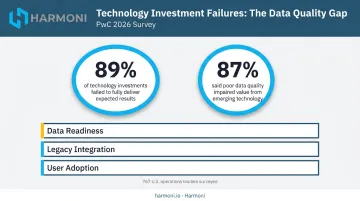
The challenge is real. PwC's 2026 Digital Trends in Operations Survey, covering 767 U.S. operations and supply-chain leaders, found 89% said technology investments had not fully delivered expected results, and 87% said poor data quality had impaired their ability to extract value from emerging technology. Data readiness, legacy integration, and user adoption consistently rank as the primary barriers.
Key integration questions to answer upfront:
- Which ERP and MES systems need to connect, and does the vendor support them natively?
- What machine controls are in use, and how does data flow from the shop floor to the cloud?
- Is master data (part numbers, routings, job structures) clean enough to support automation?
Security, Data Ownership, and Compliance
Industrial SaaS platforms process sensitive production data — job schedules, proprietary CNC programs, customer specifications. Security evaluation should include:
- How the vendor handles data residency and storage location
- What happens to production data if the subscription ends
- For defense contractors: whether the platform meets DFARS 252.204-7012 requirements
- Whether cloud storage of Controlled Unclassified Information (CUI) meets FedRAMP Moderate or equivalent standards as required under CMMC
Harmoni addresses this directly with a Government Cloud deployment option for defense and aerospace customers handling CUI in ITAR- and CMMC-regulated environments.
Change Management and Workforce Adoption
Technology deployment is rarely the hardest part — getting operators, supervisors, and plant managers to change entrenched habits usually is. Plan for:
- Structured onboarding before go-live, not after
- A phased rollout that starts with the highest-value use case and expands from there
- Clear communication to operators about what the platform does — and what it doesn't do — regarding monitoring and accountability
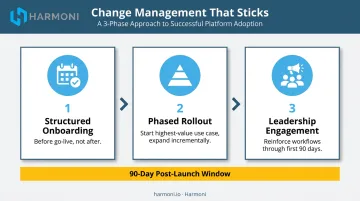
Adoption barriers don't disappear after training. Plant leadership needs to stay visibly engaged — reinforcing new workflows, addressing resistance directly, and tracking usage metrics — through at least the first 90 days post-launch.
Frequently Asked Questions
How is industrial SaaS different from regular enterprise SaaS?
Regular enterprise SaaS (CRM, HR, accounting tools) manages business data and processes. Industrial SaaS connects directly to physical machines, sensors, PLCs, and shop floor systems, making it dependent on real-time operational technology data rather than business records. The platform is built specifically for manufacturing execution, not back-office functions.
What are examples of industrial SaaS products?
Key categories include predictive maintenance platforms, cloud-based MES, factory orchestration software (a newer category focused on coordinating machines, operators, and ERP workflows in real time), quality control SaaS, and machine monitoring tools. Some focus on specific verticals like aerospace, automotive, or medical devices, while others serve broader discrete manufacturing environments.
Is AI replacing industrial SaaS?
AI is becoming embedded within industrial SaaS, not replacing it. Modern platforms use machine learning for predictive maintenance, anomaly detection, and process optimization. AI is a core feature of industrial SaaS, not a competing delivery model.
How does industrial SaaS pricing typically work?
Pricing is usually subscription-based, structured per user, per machine connected, per site, or by usage volume. This replaces the large upfront software licensing and server costs associated with traditional on-premise manufacturing software deployments.
What should manufacturers look for when evaluating industrial SaaS platforms?
Assess integration compatibility with your existing ERP and machine controls, deployment speed, data security practices, and vendor support model. Prioritize platforms that surface measurable operational outcomes — not just dashboards — and confirm out-of-the-box compatibility with your specific machines before committing.