Here's the catch a lot of shops run into: they've automated individual machines, added a robot cell here, a new CNC there, but operators still hunt for job packets, walk between stations for approvals, and supervisors often learn about a bad part after the whole batch is already scrapped.
This guide covers the types of manufacturing process automation, their real benefits and tradeoffs, and a newer layer of technology, factory orchestration, that ties machines, ERP systems, and people together so less falls through the cracks.
Key Takeaways
- Automation spans five categories, from fixed assembly lines to IIoT-connected smart factories
- Manufacturers using smart-manufacturing tools report 10%–20% higher output and 7%–20% productivity gains
- Machine-level automation alone doesn't fix wasted operator time or shop floor blind spots
- Orchestration platforms coordinate ERP, machines, and people without replacing existing systems
- Piloting on one workcenter reduces risk before a plant-wide rollout
What Is Manufacturing Process Automation?
Manufacturing process automation is the use of technology, software, and machines to carry out production tasks with minimal human intervention. The goal is consistency, not just speed: parts made the same way, every time, whether it's first shift Monday or last shift Friday.
Most shops start with machine-level automation, single pieces of equipment like robots, CNC controls, or programmable logic controllers (PLCs) that automate one task. A robotic arm loading a press. A CNC lathe cutting to spec without a hand on the dial. These are the visible, easy-to-point-to wins.
Process automation is a different animal. It's the coordination layer above individual machines, covering how jobs get scheduled, how data moves between systems, and how machines, software, and people work together across an entire production run. A shop can own a dozen automated machines and still lack process automation if nothing ties them together.
The scale of adoption backs up why this distinction matters. Factories worldwide installed 542,000 industrial robots in 2024 alone, more than double the number installed a decade earlier. That's a lot of machine-level automation going in. The harder question is whether all those machines, plus the ERP system, plus the people running them, actually work together on the floor.
Types of Manufacturing Process Automation
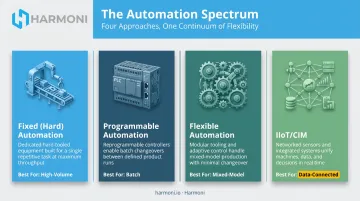
Most manufacturers rely on one or more of five automation types. Which one fits depends on production volume, how often product specs change, and how much variability exists between jobs.
Fixed (Hard) Automation
Built for high-volume, repetitive work. Think automotive transfer lines running the same weld or stamping sequence thousands of times a day.
- Delivers high speed and tight consistency
- Struggles with product changes: reconfiguration is slow and expensive
- Best suited to shops with stable, long-run production
Programmable Automation
Common in batch production. Equipment runs on PLCs or coded instructions and gets reprogrammed between batches. A CNC job shop switching part programs between customer orders is a typical example.
- Fits electronics manufacturing and CNC job shops
- Handles moderate product variety without new hardware
- Setup and reprogramming still add time between runs
Flexible Automation
An extension of programmable automation that cuts changeover downtime for mixed-model production. A precision shop moving from aerospace brackets to automotive brackets without retooling shows this in action.
- Well suited to precision manufacturers and CNC shops running varied, low-volume jobs
- Supports frequent product switches without major reconfiguration
- Requires more sophisticated control software upfront
Industrial Internet of Things (IIoT) and Computer-Integrated Manufacturing (CIM)
IIoT connects machines and sensors so they share data in real time. CIM goes further, linking design, engineering, and production systems into one coordinated environment. Together, they form the digital backbone that modern automation depends on.
Most mid-to-large manufacturers, particularly in CNC, aerospace, and precision manufacturing, run a mix of all five types across different workcenters. That mix creates a new problem: coordinating equipment that was never designed to talk to each other.
Key Benefits of Manufacturing Process Automation
The case for automation isn't theoretical. Manufacturers implementing smart-manufacturing tools report 10%-20% higher output, 7%-20% higher employee productivity, and 10%-15% more unlocked capacity, according to Deloitte's 2025 Smart Manufacturing survey of executives at large US manufacturers.
The gains tend to show up in five specific places:
- Efficiency and throughput – Automated systems run continuously with reduced cycle times, instead of stopping every time a human needs a break or gets pulled to another task.
- Quality and error reduction – Consistent, repeatable execution cuts scrap and rework, with McKinsey documenting a 90% improvement in defect detection at Ford after automation upgrades.
- Worker safety – Automating hazardous or physically demanding tasks reduces injury risk and frees skilled operators for higher-value work like inspection and process improvement.
- Real-time visibility – Automated data capture flags problems while they're happening, not after a job finishes and the scrap is already cut.
- Labor utilization and job costing – Cutting non-productive tasks, like searching for job details or walking between stations, gives manufacturers a truer picture of what a job actually costs to run.
That last point matters more than most shops realize. You can't fix job costing accuracy with a faster machine. You fix it by knowing where operator time actually goes.
Challenges of Implementing Manufacturing Automation
Automation pays off, but it's not free and it's not instant.
High upfront investment. New equipment, software, and infrastructure cost real money, and ROI isn't always immediate. McKinsey pegs typical automation payback at one to three years, though that timeline shrinks as robot costs continue to drop.
Integration complexity. Connecting new automation to legacy ERP or MES systems, and to a shop floor mix of Haas, Mazak, Siemens, and Fanuc equipment, is rarely plug-and-play. This is a real gap: 70% of manufacturers still enter operational data manually, largely because their systems don't talk to each other.
Workforce upskilling. Operators need training to work alongside automated systems, not just perform tasks manually. Expect a short-term productivity dip during that transition. Deloitte found that 69%-72% of manufacturers report moderate-to-significant difficulty hiring for the IT, OT, and data roles automation now requires.
None of these challenges are reasons to skip automation. They're reasons to plan for it properly, since poor planning is usually where implementation problems begin.
Beyond Machine Automation: Why Factory Orchestration Is the Missing Layer
Here's what a lot of shops discover after automating machines: the coordination problem doesn't go away. Operators still lose time walking to find the right program. Supervisors still discover execution inconsistencies after the fact. ERP data, MES data, and what's actually happening at the machine still live in three separate worlds.
Factory orchestration is an emerging category of industrial technology built to close that gap. It sits between ERP systems, MES systems, machines, and operators, coordinating execution in real time instead of after the fact.
Harmoni, a factory orchestration platform built for CNC machining, aerospace, and precision manufacturers, works this way in practice:
- RFID-driven identification automatically detects which operator is at which machine and pulls up the correct job, program revision, and work instructions, no manual lookup required
- Centralized command centers at each workcenter guide operators through engineering requirements and digital checksheets instead of relying on paper travelers
- Unified dashboards combine machine data, operator activity, and ERP workflows so problems surface as they happen, not at end-of-shift review
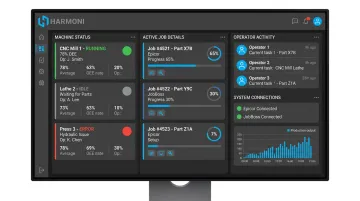
One customer, WessDel, a California CNC shop running on Epicor, deployed Harmoni in under a week. The platform worked with their ERP "out of the box," according to owner Bob Dorricott.
The shop recovered an average of 17 productive hours per employee per month previously lost to manual ERP transactions, landing a 5X return on their ongoing platform cost.
That's the point of orchestration: it doesn't replace ERP or MES systems. It layers on top of environments already in place, including:
- Epicor
- JobBoss
- Siemens
- DMG MORI
- Fanuc
The result: accountability, error prevention, and accurate job costing without ripping out systems already invested in.
How to Successfully Implement Manufacturing Automation
Getting automation right is less about buying the fanciest equipment and more about sequencing the rollout correctly.
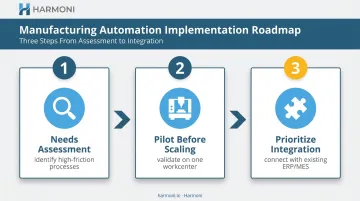
- Start with a needs assessment. Identify the highest-error, highest-friction, or highest-risk processes on your floor first; these are your best candidates for automation or orchestration, and they'll show ROI fastest.
- Pilot before scaling. Test on a single workcenter or product line. Validate that the ROI holds up and that operators actually adopt the new workflow before committing to a plant-wide rollout.
- Prioritize integration-friendly solutions. Choosing tools that connect with your existing ERP, MES, and machine infrastructure cuts implementation risk, cost, and disruption to production that's already running. Harmoni, for example, retrofits to existing CNC equipment and integrates natively with ERPs like Epicor and JobBoss, so shops avoid new hardware costs.
Shops that skip the pilot step often overcorrect later, either rolling back a rushed deployment or discovering compatibility issues only after they've committed budget plant-wide.
Frequently Asked Questions
What is the difference between automation and orchestration in manufacturing?
Automation handles individual tasks or machines, like a robot loading a CNC lathe. Orchestration coordinates people, machines, ERP systems, and engineering data across the entire shop floor in real time.
What industries benefit most from manufacturing process automation?
CNC machining, aerospace, defense, automotive, and precision manufacturing see outsized benefits. Tight tolerances, complex job routing, and high consequences for error make consistency non-negotiable in these sectors.
How much does manufacturing automation cost to implement?
Costs vary widely by automation type and scale, from a single robotic cell to a full IIoT rollout. Weigh upfront investment against labor savings, error reduction, and the productivity gains automation typically delivers.
Can small and mid-sized manufacturers benefit from automation?
Yes. Flexible automation and orchestration tools now scale down to smaller shops, with faster deployment options that reduce the cost and complexity barriers that once favored only large manufacturers.
What is the typical ROI timeline for manufacturing automation?
Timelines depend on automation type and process complexity. Full equipment overhauls can take one to three years to pay back, while orchestration layers often show measurable gains within weeks.
Does automation replace human workers in manufacturing?
Generally, no. Automation shifts labor from repetitive manual tasks toward oversight, quality control, and skilled roles. OECD research estimates that roughly 9% of jobs across industries are fully automatable, leaving most roles focused on oversight and skilled tasks.