Introduction
CNC machine monitoring software has always promised visibility. But for years, that promise translated into dashboards full of data that someone had to interpret, act on, and manually relay to the next system. In 2026, that model is breaking down — and something more useful is replacing it.
Modern monitoring platforms now capture machine status, cycle times, OEE, and operational data automatically from CNC controllers and connected devices. That part isn't new.
What's changed is what happens next. That data feeds AI models that flag early failure signatures, flows into ERP systems without manual entry, and reaches operators at their workcenters with job-specific context already loaded.
Deloitte estimates unplanned industrial downtime costs $50 billion annually across industries. For CNC shops specifically, the cost shows up in scrapped parts, spindle rebuilds, missed deliveries, and quoted work that ends up losing money. Monitoring software in 2026 is built to attack each of those pain points directly.
This article covers the five trends defining CNC monitoring software right now, what's driving them, and what they mean for manufacturers planning their next investment.
Key Takeaways
- AI-driven predictive analytics is now a baseline expectation — shops use it to catch failure signatures before unplanned downtime hits
- The biggest 2026 shift is from machine-only monitoring to full factory orchestration: machine data, operator activity, and ERP context unified in a single view
- Multi-protocol connectivity (MTConnect, OPC-UA, FOCAS) is now a baseline requirement for mixed-machine fleets
- Edge computing enables sub-second local alerting, critical for high-value-part machining
- Quality and compliance tracking is moving inside the monitoring platform, not sitting next to it
Trend 1: AI-Powered Predictive Analytics Moves from Buzzword to Standard Feature
For most of the last decade, "AI in manufacturing" was a conference slide topic. In 2026, it's a checkbox buyers expect to see on every serious monitoring platform.
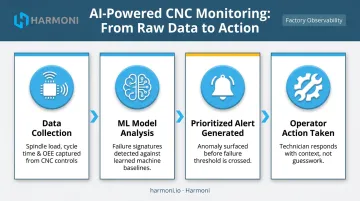
The shift isn't cosmetic. Earlier monitoring tools collected spindle load readings and cycle time data and left human analysts to find the patterns. Current platforms use machine learning models trained on that same data to detect failure signatures automatically and surface them as prioritized alerts rather than raw graphs:
- Gradual spindle bearing degradation tracked through defect frequency signatures
- Tool wear drift visible in load current trending across hundreds of cycles
- Cycle time anomalies that indicate process deviation before scrap occurs
What This Looks Like on the Shop Floor
A spindle bearing entering Stage 2 degradation produces defect frequencies audible to sensors long before any operator hears anything. An AI model tracking those frequency signatures flags the bearing for scheduled replacement before a mid-program failure scraps a high-value part. Similarly, spindle load current that trends steadily upward over 200 cycles signals tool wear drift — the platform catches it, the operator changes the insert, the process continues.
The business case is real. A McKinsey Lighthouse case involving a European automotive plant documented 25% less unplanned downtime on critical assets and 5% less rework after deploying smart analytics for predictive maintenance. That's a single case, not a universal CNC benchmark — but it points at the right mechanism.
Manufacturers no longer want to know what happened — they want to know what to do and when. Earlier software delivered data. 2026 platforms are expected to deliver the decision.
IDC forecasts that by 2026, more than 40% of manufacturers with production-scheduling systems will upgrade to AI-driven capabilities — a sign that AI-assisted decision-making is becoming a standard operational layer, not an experimental one.
Trend 2: Factory Orchestration — Converging Machine, Operator, and ERP Data Into One View
This is the most consequential shift in CNC monitoring software right now.
Machine-only monitoring tells you a spindle ran for 4.2 hours. It doesn't tell you which job was on it, which operator was running it, whether that operator had the right work instructions, or whether the actual runtime matched what was quoted. Those gaps are where production errors and cost overruns live.
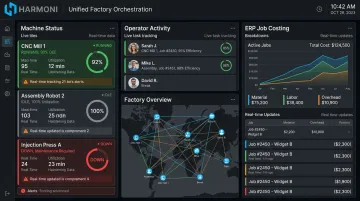
The most advanced 2026 platforms combine machine performance signals with operator activity — who is at which machine, what job they're running, how long each step is taking — and ERP-level context like work order status, job costing, and scheduling. The result replaces the daily end-of-shift scramble with a live operational picture — one that shows actual status, not yesterday's approximation.
How It Works in Practice
At each workcenter, operators receive the right job instructions, tooling requirements, and quality checkpoints at the moment they're needed — pulled automatically from the ERP and matched to the job in queue. Simultaneously, machine status flows back into the ERP without manual entry: labor time charged, quantities logged, scrap recorded.
That closed loop affects every role on the floor:
- Supervisors get a live view of every workcenter without walking the floor
- Engineers can tie process deviations to specific programs, tools, or operators
- Finance sees actual job costs — real machine runtime plus real operator labor — instead of estimates
Where Harmoni Fits
This is the category Harmoni has built its platform around. As a factory orchestration platform, Harmoni sits between ERP systems, shop floor equipment, and operators — connecting machine data, RFID-tracked operator activity, and ERP workflows into a single operational view. The platform integrates with machine brands including Fanuc, Haas, Mazak, DMG MORI, Siemens, and Heidenhain, and with ERP platforms including Epicor, Infor, JobBoss, ABAS, and ODOO.
The practical outcome Harmoni captures that traditional monitoring misses: actual cycle time versus ERP-estimated cycle time, per job, per operator, automatically. That's the data that makes quoting more accurate, scheduling more realistic, and underpriced work visible.
Trend 3: Multi-Protocol Connectivity Becomes Table Stakes for Mixed-Machine Fleets
Ask any job shop manager about their machine fleet and you'll hear the same story: a mix of newer machining centers alongside older equipment from different brands, acquired over years of growth. A Fanuc controller from 2019 sitting next to a Haas from 2011 next to a Mazak from 2024.
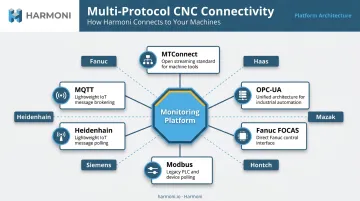
Previously, monitoring that mixed fleet meant either running separate tools for different machine types or absorbing expensive custom integration work. In 2026, that's no longer acceptable. Multi-protocol connectivity — supporting MTConnect, OPC-UA, Fanuc FOCAS, Modbus, and MQTT under one platform — has shifted from a differentiator to a baseline expectation.
Why This Matters Now
The protocol ecosystem has matured to the point where broad support is achievable, and buyers know it. MTConnect, the open manufacturing data standard, now connects more than 250,000 devices across 50+ countries, with contributions from over 500 machine builders, integrators, and users. OPC UA has earned commitment from AWS, Google Cloud, IBM, Microsoft, SAP, and Siemens as the standard for edge-to-cloud data exchange.
The reshoring wave is amplifying this pressure. Manufacturers expanding existing facilities are acquiring mixed-vintage equipment, not starting fresh with uniform fleets. A monitoring platform that can't normalize data from a 2010-era machine alongside a 2024 machining center in the same dashboard loses relevance fast.
The platforms earning the strongest adoption share a few common traits:
- Hardware-agnostic edge devices that connect to equipment regardless of age or brand
- Broad protocol libraries covering MTConnect, OPC-UA, FOCAS, Modbus, and MQTT
- Unified dashboards that normalize data across controllers into a single view
- No machine replacement required — the software adapts to the existing floor
Trend 4: Edge Computing Brings Real-Time Decision-Making to the Machine Level
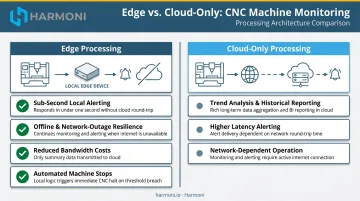
Cloud-based monitoring handles trend analysis and historical reporting well. But when a spindle load spike demands a response in under a second, routing that signal through the cloud first isn't fast enough.
2026 monitoring platforms are increasingly processing data at the edge — at the machine or a local gateway — rather than routing every signal through the cloud before generating an alert. The result is sub-second response times for critical anomalies, and alert capability that survives network outages.
Practical Implications
For high-value-part machining, edge-native alerting isn't just convenient — it's commercially necessary. A spindle failure mid-program on a complex aerospace component doesn't leave time for a cloud round-trip. Edge processing catches the spindle load spike locally and stops the machine before the part is ruined.
For lights-out operations, edge processing enables automated responses even when no operator is present. Local alerting, machine stops, and data buffering continue regardless of connectivity status.
For data costs, edge devices filter and summarize data before cloud upload — transmitting aggregated insights rather than raw signal streams. At scale, that difference in bandwidth consumption becomes a significant line item.
Global edge computing spending is projected to grow from roughly $261 billion in 2025 to nearly $380 billion in 2028 at a 13.8% CAGR, with manufacturing identified as a major sector driving that growth. For shops evaluating monitoring platforms now, edge capability is worth treating as a baseline requirement rather than a premium add-on.
Trend 5: Quality and Compliance Monitoring Becomes Embedded, Not Bolted-On
For aerospace, defense, medical device, and automotive manufacturers, OEE tracking is necessary but not sufficient. These shops face customer and regulatory audits that require demonstrated in-process control — not just inspection results at the end.
2026 monitoring platforms are responding by embedding quality checkpoints directly into the operator workflow. Rather than a separate quality system that captures data after production, the monitoring platform prompts inspections at defined intervals, logs results digitally, and ties everything to specific job numbers and operator IDs automatically.
What Embedded Quality Looks Like
Harmoni's approach is a useful illustration. The platform presents operators with a complete inspection plan before production begins — check frequency, target values, tolerances, measurement tools, and reference images. RFID identifies the operator and job automatically, so every checksheet entry is tied to the correct production record without manual tagging. Multifactor authentication (including facial recognition) creates a verified audit trail for each entry.
The result is a complete, job-linked quality record — without paper forms, without manual data entry, without end-of-shift reconciliation.
For AS9100 and ISO 13485 compliance, the implications are concrete. AS9100 production control requirements include:
- Verification evidence for production and inspection steps
- Traceability linking records to specific jobs and operators
- Record integrity that survives an audit without reconciliation gaps
A monitoring platform that captures this data automatically positions manufacturers to meet these requirements without building a separate documentation process around it. AS9100 is technology-neutral and doesn't mandate automated CNC monitoring, but continuous digital monitoring is one of the most practical ways to produce the evidence these standards require.
What's Driving These CNC Monitoring Software Trends
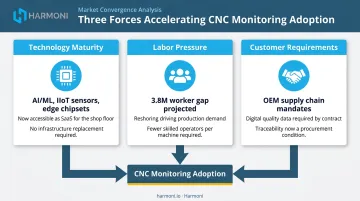
These five trends aren't developing in isolation. Three converging forces are pushing them simultaneously.
Each force is distinct, but they're reinforcing one another across the industry:
Technology has caught up. AI/ML maturity, affordable IIoT sensor hardware, and improved edge computing chipsets have made advanced analytics accessible as out-of-the-box platform features. Capabilities that required dedicated data science teams five years ago now ship in SaaS subscriptions.
Labor pressure is intensifying. Deloitte and the Manufacturing Institute project a net need for up to 3.8 million US manufacturing workers from 2024 through 2033, with 1.9 million positions potentially unfilled if workforce challenges persist. The Reshoring Initiative recorded 244,000 US manufacturing jobs announced in 2024 alone. Shops are being asked to produce more with fewer skilled operators, and monitoring software that automates status tracking and cuts manual reporting time is one of the few practical levers available.
Customer requirements are cascading down the supply chain. OEM customers in aerospace, defense, and automotive are requiring digital quality data from their suppliers as a condition of contract renewal. Continuous monitoring is shifting from a voluntary investment to a commercial necessity.
How These Trends Are Impacting Manufacturing Operations
Operational Impact
Real-time monitoring with AI-driven alerts compresses the time between when a problem starts and when it gets addressed. The McKinsey automotive case noted earlier — 25% less unplanned downtime, 5% less rework — illustrates the mechanism. A separate case from a European white-goods plant documented an 11% OEE increase after implementing machine-alarm aggregation and real-time dashboards.
More recently, Coastal Machine and Supply reported a 46% utilization increase on one five-axis machine during the first two months of 2026 after connecting Datanomix monitoring with ProShop ERP and operator incentives. Individual cases, not industry averages — but the numbers show what's actually achievable when monitoring closes a real visibility gap.
Business Impact
Accurate job costing is now one of the clearest financial benefits. Platforms that automatically capture actual machine runtime and actual operator labor time per job — rather than relying on ERP estimates — give manufacturers data they can use to requote work accurately, identify systematically underpriced jobs, and make scheduling decisions on real numbers rather than assumptions.
Monitoring software that demonstrates time-to-value within weeks is also being treated differently at the budget level — as a capital deployment decision with measurable ROI, not an IT overhead cost.
Workforce Impact
The operator's role is changing. In 2026 environments, operators are no longer measured by utilization alone or left managing paper-based processes. Instead, they:
- Receive digital work instructions automatically at the machine
- Complete quality checksheets digitally, in real time
- See their own performance reflected in live dashboards
The transition isn't frictionless. Richards Industries' monitoring rollout initially encountered what the company described as a "Big Brother" reaction from operators. Management responded by explaining that the system measured processes rather than policing individuals, and by involving operators in improvement work using the data. OEE moved from 38% into the mid-50% range — and operator buy-in was a prerequisite for getting there.
Future Signals for CNC Machine Monitoring Software
The trends covered above are still evolving — and several signals point to where monitoring software is heading next.
AI-generated digital process twins that automatically benchmark every job's expected cycle time and machine behavior from historical data, flagging deviation in real time without manual target-setting. Sikorsky's adoption of digital twins for CNC machining preparation delivered 48% less phase-two validation time and a 10-week lead-time reduction for a main gearbox — a concrete measure of what this capability produces at scale.
Natural language interfaces that let supervisors query machine performance data ("Which machines had the most unplanned stops last week on aluminum jobs?") — reducing the technical barrier to acting on monitoring data without requiring a data analyst.
Convergence of monitoring, MES, and orchestration. As platforms deepen ERP and MES integration, the competitive differentiator shifts from raw data volume to operational context: which platform actually helps operators and managers act on what they see.
Conclusion
CNC machine monitoring software in 2026 is no longer a single-purpose data collection tool. AI analytics, factory orchestration, multi-protocol connectivity, edge computing, and embedded compliance monitoring are collectively raising the bar for what a monitoring platform must deliver.
The shops that will benefit most aren't necessarily the ones with the newest machines. They're the ones that treat monitoring as a foundational operational layer — connecting machines, operators, and enterprise systems in real time to reduce scrap, improve throughput, and build the documented process control that wins preferred supplier status.
The data is already coming off your machines. The question is whether your platform is turning it into decisions — or just storing it. If you're evaluating what that platform should look like, Harmoni's factory orchestration platform is built for exactly this layer of the shop floor.
Frequently Asked Questions
What is CNC machine monitoring software and what does it do in 2026?
CNC machine monitoring software automatically captures machine status, cycle times, OEE, and operational data from CNC controllers and connected devices. In 2026, leading platforms have expanded beyond raw data collection to connect machine data with operator activity and ERP systems — providing a unified production view that supports real-time decision-making across the shop floor.
How is modern CNC monitoring software different from earlier solutions?
Earlier platforms collected data and waited for humans to analyze it. Current platforms deliver AI-driven predictive alerts, real-time dashboards, and automatic integration with ERP and operator workflows. Today, the deliverable is the insight itself — operators and supervisors get actionable recommendations pushed to them, not raw readings to interpret on their own.
Can CNC machine monitoring software integrate with ERP systems?
Yes — ERP integration is a standard capability in leading 2026 platforms, enabling automatic job costing, work order updates, and scheduling feedback without manual data entry. Harmoni, for example, connects to major ERP systems including Epicor, Infor, JobBoss, ABAS, and ODOO, pushing actual machine runtime and labor time directly into job costing records.
What protocols does CNC machine monitoring software use to connect to machines?
The most common protocols are MTConnect, OPC-UA, Fanuc FOCAS, Modbus, and MQTT. Leading platforms support multiple protocols simultaneously, allowing mixed fleets of modern and legacy CNC machines from brands like Fanuc, Haas, Mazak, Siemens, and Heidenhain to appear in a single unified dashboard — no separate tools required per machine brand.
What ROI can manufacturers expect from CNC machine monitoring software?
Documented results include a 25% reduction in unplanned downtime (McKinsey automotive case), an 11% OEE increase (European manufacturing case), and a 46% utilization improvement on a specific five-axis machine (Coastal Machine, 2026). ROI compounds when machine data, labor visibility, and job costing are captured together — replacing estimated costs with actual numbers across every job.