Key Takeaways
- Connected manufacturing links machines, systems, people, and data into a real-time operational ecosystem — replacing siloed, manual workflows
- It runs on three foundational layers: data collection, system connectivity, and operational intelligence
- 70% of manufacturers still collect data manually, creating a measurable gap between current state and connected operations
- Factory orchestration closes the critical handoff gap between ERP systems, machines, and operators
- Cybersecurity, legacy equipment, and workforce adoption are the implementation challenges most likely to derail a rollout
What Is Connected Manufacturing?
Production environments have grown more complex — more machines, more SKUs, more operators — while the tolerance for errors, delays, and wasted capacity has shrunk. Yet most factories still run on manual data collection, paper travelers, and end-of-shift reports. The gap between what's operationally possible and what's actually happening on the shop floor is measurable — and costly.
Connected manufacturing addresses this directly. It's the practice of linking machines, systems, people, and data across a production environment so they operate as a coordinated, real-time ecosystem rather than as separate islands of activity. Where traditional manufacturing relies on disconnected software tools and delayed reporting, connected manufacturing creates a shared operational picture that updates continuously.
Three foundational layers make it work:
- Data — captured from machines, sensors, operators, and software systems in real time, not at end of shift
- Connectivity — between ERP, MES, SCADA, quality systems, and shop floor controls so information flows without manual re-entry
- Intelligence — analytics, dashboards, and automated workflows that turn raw data into decisions
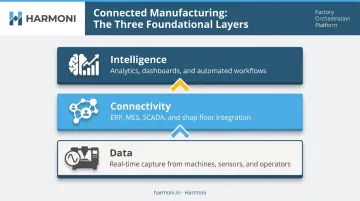
Connecting machines alone isn't enough, though. According to the Manufacturing Leadership Council, 70% of manufacturers still collected data manually in 2024, and only 33% of factory-floor employees were responsible for data-driven decisions.
That gap persists even in facilities with significant technology investments. The machines may be instrumented, but the operators running them are still working from printed travelers or verbal handoffs — outside the information loop entirely. True connected manufacturing closes that gap: operators, supervisors, and planners all work from the same live operational picture, not a delayed one.
Key Technologies Behind Connected Manufacturing
No single tool delivers connected manufacturing. It's a layered architecture where each component plays a distinct role.
Machine-to-Machine (M2M) Communication
IIoT sensors, PLCs, edge computing devices, and SCADA systems form the foundation. These technologies allow machines to exchange status data, trigger alerts, and coordinate actions without human intervention. Predictive maintenance, automated quality checks, and real-time cycle monitoring all depend on this layer functioning reliably.
Edge computing matters here because it reduces dependence on remote infrastructure — processing happens close to the machine, keeping latency low and data actionable.
Machine-to-Human (M2H) Communication
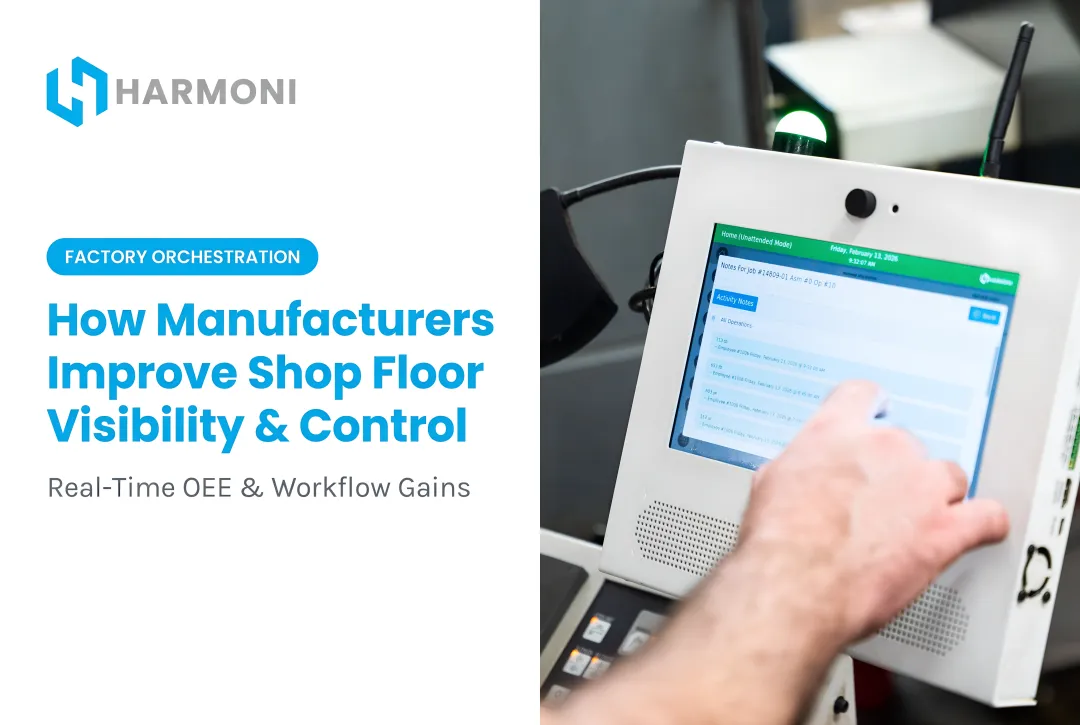
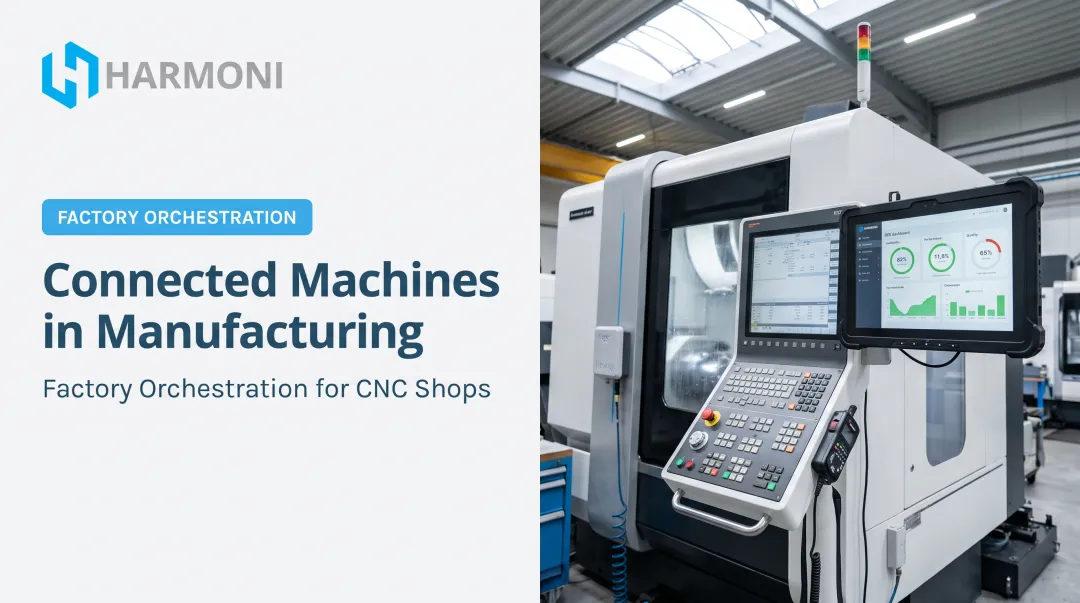
Raw machine data is useless if it never reaches the people who can act on it. HMIs, tablets, and operator-facing dashboards translate machine signals into actionable guidance at the point of work — covering alerts, digital work instructions, job status, and performance metrics.
Platforms like Harmoni take this further with machine-side operator command centers that use RFID auto-detection to surface the right job instructions, CNC program data, and quality checksheets the moment an operator approaches a workcenter. No manual lookup, no paper traveler.
Human-to-Human (H2H) Communication
This is the most overlooked layer. Digital shift handovers, shared dashboards, and connected supervisor views ensure that operators, maintenance teams, quality staff, and managers coordinate from the same real-time information — rather than chasing answers across shifts or departments.
Harmoni's approach surfaces exception alerts directly to supervisors, who can respond from any device without walking the floor. That kind of coordination at scale requires shared infrastructure, not informal communication.
Software Integration and Intelligence
ERP, MES, and quality systems need to exchange data automatically — job schedules, engineering specs, production actuals, and labor records — without manual re-entry or lag. A stack where systems coexist but don't communicate creates the same visibility gaps connected manufacturing is designed to eliminate.
Cloud computing, AI, and analytics tools sit on top of that integration layer — and adoption is accelerating. Deloitte's 2025 Smart Manufacturing survey found 57% of large US manufacturers already using data analytics and cloud platforms at the facility level, with AI/ML at 29%.
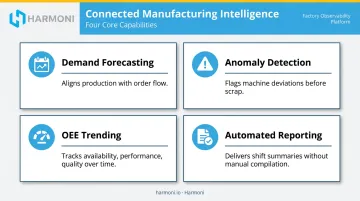
These tools put connected data to work in concrete ways:
- Demand forecasting — aligns production schedules with actual order flow
- Anomaly detection — flags deviations in machine behavior before they cause scrap
- OEE trending — tracks availability, performance, and quality over time
- Automated reporting — delivers shift and production summaries without manual compilation
Benefits of a Connected Manufacturing Environment
The business case for connected manufacturing is grounded in operational outcomes that manufacturers can measure against their own baselines.
Real-Time Visibility
When machines, operators, and systems share live data, supervisors identify bottlenecks and quality deviations while there's still time to correct them, not hours after the shift ends. This shift from reactive to proactive management is the foundational benefit everything else builds on.
Productivity and Throughput Gains
Deloitte's survey of large US manufacturers reported average improvements of 10–20% in production output and 7–20% in employee productivity following smart manufacturing investments. The gains come from consistent sources across facilities:
- Reduced idle time between jobs
- Eliminated paper-based steps
- Better job sequencing
- Faster response to production exceptions
WessDel, a Harmoni customer, documented 17 productive hours gained per employee per month after implementation. That result came from eliminating manual time tracking, paper-based job selection, and redundant data entry across the shop floor.
Quality and Scrap Reduction
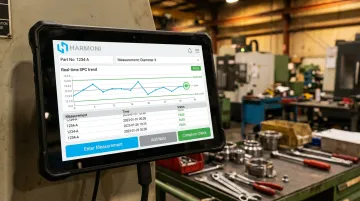
Continuous data collection from machines and operators makes it easier to catch process deviations early. Harmoni's digital quality checksheets provide real-time SPC-style trend graphing, so operators and supervisors see measurements drifting toward out-of-tolerance conditions while parts can still be saved, not after scrap has already accumulated.
The results are measurable. One Harmoni customer reduced scrap by 22% in two months following implementation. Machine Specialties, Inc. (MSI), a precision aerospace, defense, and medical parts manufacturer, achieved near-elimination of part count errors across their shop floor after deploying Harmoni's RFID-driven job tracking.
Maintenance and Uptime
When machine health data flows automatically, reactive repair cycles give way to predictive ones. Real-time OEE monitoring across Availability, Performance, and Quality dimensions lets maintenance teams see degradation trends before failures occur, rather than responding after unplanned downtime has already disrupted the schedule.
The Role of Factory Orchestration in a Connected Plant
Most manufacturers already have an ERP system, CNC machines, and some form of monitoring software. The persistent problem is that these layers rarely communicate well in real time. ERP schedules exist in one world; shop floor execution happens in another.
Factory orchestration fills that gap. It sits between ERP systems, machines, and operators, continuously reconciling planned orders with actual machine state, labor, materials, and quality data, then coordinating the next executable action. Gartner describes the MES/MOM layer as managing, monitoring, and synchronizing real-time physical production execution. Factory orchestration operates at this level, with a tighter focus on closing the handoff between systems and people.
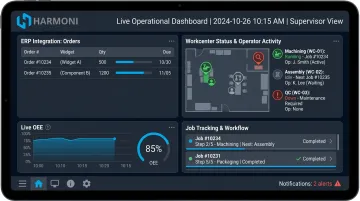
Harmoni was built specifically for this coordination role. The platform brings machine data, ERP workflows, and operator activity together in a unified real-time view through:
- Long-range RFID auto-detection of employees and jobs at each workcenter, triggering automatic delivery of the correct work instructions, CNC program, and quality checksheets without manual steps
- Bidirectional ERP integration with Epicor, Infor, Infor Visual, ECI JobBoss/JobBoss2, ABAS, and ODOO, pushing job data, labor actuals, and quality records between systems automatically
- Live dashboards accessible from any device — giving supervisors and operators the same operational picture simultaneously
Companies invest in ERP upgrades and machine sensors, then still see execution failures because the handoff between those systems and the people doing the work remains manual, inconsistent, or invisible. Orchestration automates the non-productive steps: retrieving work orders, loading the right CNC program, recording job completion. It then enforces process control at the point of work.
WessDel reported a 5X return on ongoing Harmoni costs and a 10% reduction in delinquent jobs — outcomes that reflect what happens when execution gaps close at scale.
Common Implementation Challenges and How to Address Them
Connected manufacturing projects rarely fail because of the technology itself — they stall on integration complexity, security exposure, and operator buy-in. Here's how to address each.
Legacy Equipment and Integration Complexity
49% of manufacturers cite outdated legacy equipment as a digital transformation hurdle, per Manufacturing Leadership Council data. Older machines often lack native connectivity, and forcing new software onto fragmented systems creates additional silos rather than solving the original problem.
The practical approach:
- Prioritize high-impact assets first rather than trying to connect everything simultaneously
- Use edge gateways or protocol translators to extract machine signals from older controls
- Select platforms that integrate with existing ERP and MES systems rather than requiring full replacement
Harmoni deploys without machine replacement — the platform retrofits to existing equipment across Mazak, Haas, Fanuc, Heidenhain, Siemens, DMG MORI, Makino, and Fadal controls, new and old alike.
Cybersecurity in a Connected Environment
More connectivity between OT and IT systems creates new exposure. IBM X-Force reported that manufacturing accounted for 27.7% of cybersecurity incidents in 2025 — the most-targeted industry for the fifth consecutive year.
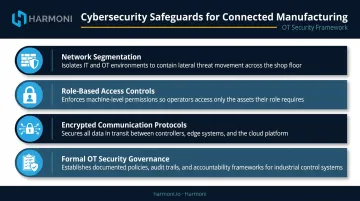
Key safeguards before expanding connectivity:
- Network segmentation between IT and OT environments
- Role-based access controls at the machine level
- Encrypted communication protocols
- Formal security governance review covering OT asset inventory and recovery design
For defense manufacturers, Harmoni offers a Government Cloud deployment option aligned with ITAR, CMMC, and DFARS requirements for handling Controlled Unclassified Information.
Workforce Adoption
Even well-designed systems stall when frontline operators view them as added burden. Deloitte found 35% of manufacturers naming worker adaptation as a top concern in digital transformation — and the root cause is usually tools that were designed for office users, not shop floors.
What works:
- Start with a focused pilot area where results will be visible quickly
- Use interfaces built for the shop floor, not adapted from back-office software
- Demonstrate tangible time savings early so workers experience the benefit before skepticism sets in
Harmoni's machine-side interface reduces labor collection to a few screen taps, triggered automatically by RFID detection — fewer steps for the operator at every interaction.
The Future of Connected Manufacturing
Two near-term developments will reshape what connected manufacturing can do.
Private 5G will expand reliable real-time data transfer across larger facilities and multi-site operations. ABI Research forecasts manufacturing private 5G spending above $8.7 billion by 2030 — covering radio infrastructure, edge hardware, and professional services. For facilities with mobile assets, hard-to-wire equipment, or high-density machine layouts, 5G removes the connectivity constraints that currently limit real-time data capture.
AI and machine learning are moving from pilots toward operational scale. Manufacturing Leadership Council data shows 22% of manufacturers already scaling AI or operating it at scale, with another 42% actively piloting. As these tools mature, they enable automated process adjustments that reduce human reaction time on routine issues to near zero — with continuous improvement across:
- Demand forecasting accuracy as more historical data accumulates
- Anomaly detection speed on the shop floor
- Predictive quality control before defects reach inspection
Manufacturers who build connected infrastructure now — integrating machines, systems, and operators into a coordinated real-time environment — will absorb AI-driven capabilities faster than competitors still running manual workflows and disconnected data. The window for low-disruption adoption is narrowing as customer expectations and competitive pressure accelerate.
Frequently Asked Questions
What is connected manufacturing?
Connected manufacturing is the integration of machines, systems, people, and data across a production environment to enable real-time visibility, coordination, and decision-making. Traditional factory operations collect data manually, run systems in silos, and leave supervisors learning about problems only after output is already affected.
What technologies enable connected manufacturing?
The core layers include:
- IIoT sensors and PLCs for machine-to-machine communication
- HMIs and operator-facing apps for machine-to-human interaction
- Cloud platforms for data storage and analytics
- ERP and MES integration layers that connect systems across the operation
What are the main benefits of connected manufacturing?
Real-time visibility, reduced unplanned downtime, improved product quality, lower scrap rates, and faster decision-making are the most consistently documented operational benefits. Deloitte research found large manufacturers reporting 10–20% output improvements and 7–20% labor productivity gains following smart manufacturing investment.
How does connected manufacturing relate to Industry 4.0?
Connected manufacturing is the practical implementation of Industry 4.0 principles — using digital technologies to integrate physical operations with data-driven systems. Industry 4.0 defines the vision; connected manufacturing describes the operational model that gets factories there.
What is the difference between connected manufacturing and smart manufacturing?
Smart manufacturing uses AI, automation, and analytics to optimize processes. Connected manufacturing focuses on integration and real-time data flow between systems, machines, and people. In practice, the two are inseparable: the integration layer has to exist before any intelligence layer can act on it.
What is factory orchestration and how does it fit into connected manufacturing?
Factory orchestration is a coordination layer that sits between ERP systems, MES software, machines, and operators, keeping real-time data, digital workflows, and human actions synchronized. It closes the gap most connected environments still struggle with: the inconsistent handoff between what the ERP schedules and what the shop floor actually executes.