
Introduction
Manufacturing margins are tight, and the pressure keeps building. Labor costs for private-industry manufacturing now average $44.17 per hour when wages and benefits are combined — and that's before factoring in the quality documentation demands from aerospace, defense, and automotive customers who expect first article inspection compliance as a baseline, not a differentiator.
Despite that pressure, many production teams are still making decisions based on end-of-shift reports, operator estimates, and floor walks. Problems surface after they've already cost something — a scrapped batch, a missed delivery, a job that quietly lost money.
Remote machine monitoring changes that dynamic. It gives production teams live visibility into what's happening on the floor while there's still time to act. This article covers what those capabilities actually deliver — and where the cost accumulates when monitoring isn't in place.
Key Takeaways
- Remote machine monitoring gives production teams live visibility into machine status without relying on floor walks or self-reported data.
- Manufacturers using predictive over reactive maintenance strategies experience 52.7% less unplanned downtime and 78.5% fewer defects.
- Accurate job costing requires machine-level data tied to actual work orders, not ERP estimates or operator-reported times.
- Monitoring value multiplies when machine data connects to operator activity and ERP workflows for full production context.
- Running without monitoring compounds costs over time: reactive maintenance, inaccurate pricing, and growing overhead as you scale.
What Is Remote Machine Monitoring?
Remote machine monitoring is the continuous collection and delivery of machine performance data so production teams can see what every machine is doing without walking the floor. That data typically includes spindle utilization, cycle times, downtime events, and active alarms.
It applies most commonly across:
- CNC machining centers with multiple controllers and high job changeover frequency
- Multi-shift production environments where floor conditions change between shifts without documentation
- Large machine fleets where manual floor walks can't realistically capture activity across dozens or hundreds of machines simultaneously
Remote machine monitoring is the foundation for faster decisions, better maintenance scheduling, and production reporting that reflects what actually happened. Shops that treat it as a data collection exercise miss most of the value.
Modern monitoring platforms connect to machines through standardized protocols. The most common paths for CNC environments include:
- MTConnect — open standard supported natively by many modern controllers
- FANUC FOCAS2 — direct interface for Fanuc 0i, 30i, 31i, and 32i controls
- Siemens SINUMERIK OPC UA — native protocol for Siemens/Sinumerik-equipped machines
- HEIDENHAIN DNC/StateMonitor — primary path for Heidenhain-controlled equipment
These cover both modern controllers and legacy equipment that would otherwise require external sensors to extract data.
Key Advantages of Remote Machine Monitoring
The advantages below are grounded in operational impact. Each one addresses a specific gap that manufacturers deal with when running on gut feel, spreadsheets, or delayed reporting — and each connects to metrics production teams already track: uptime, scrap rate, labor cost, cycle time, and job profitability.
Real-Time Visibility into Shop Floor Operations
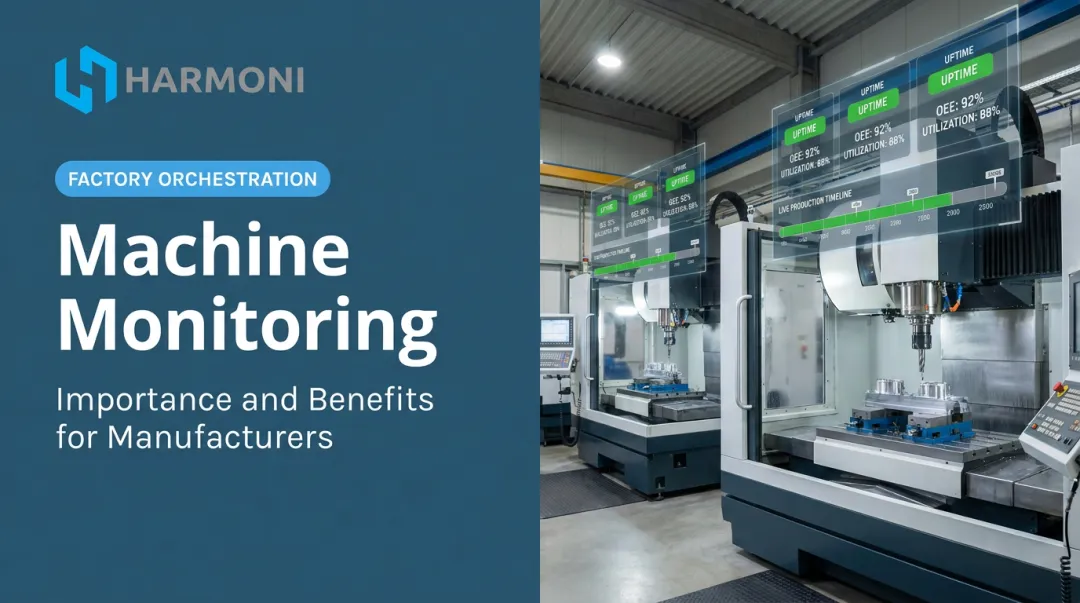
Remote machine monitoring gives production managers a live view of every machine's status — running, idle, in cycle, alarmed, or down — without a floor walk or a report from the operator.
Sensors and machine integrations stream data continuously to a centralized dashboard, surfacing utilization rates, active jobs, and downtime reasons as they happen. The operational cost of lag here is real: when a machine goes idle for 30 minutes before anyone notices, that time is gone. The shift doesn't get it back.
With live data, a production supervisor can:
- Redirect work to available machines before the schedule slips
- Reassign operators to cover unexpected downtime
- Escalate a machine issue during the shift, not at the morning standup
The utilization gap between high-performing and average CNC shops illustrates what this visibility enables. Modern Machine Shop's Top Shops benchmarking has shown a consistent 10-point spread in median spindle utilization — 75% for top performers vs. 65% for the rest. That gap closes when supervisors have current information to act on.
KPIs impacted: Machine utilization rate, OEE (Overall Equipment Effectiveness), idle time per shift, on-time delivery rate, supervisor response time to downtime events.
When it matters most: High-mix, low-volume CNC environments where job changeovers are frequent; multi-shift operations where the incoming shift manager inherits conditions they couldn't see.
Platforms like Harmoni go a step beyond raw machine status by combining live machine data with operator activity and ERP job data in a unified view — so "the machine stopped" translates immediately to context: which job, which operator, what's at risk for the customer.
Reduced Unplanned Downtime Through Predictive Maintenance
By continuously monitoring machine health signals (vibration patterns, spindle load, temperature, alarm frequency), remote monitoring enables maintenance teams to detect early signs of failure before a breakdown occurs.
Instead of running fixed maintenance schedules or waiting for an operator to report a fault, monitoring systems generate alerts when machine behavior deviates from its normal operating baseline. That window between anomaly detection and actual failure is where planned intervention becomes possible.
The numbers make the case for acting early. NIST-linked research estimates U.S. manufacturing maintenance costs and losses at $222 billion per year, including $105 billion in lost sales attributable to maintenance failures. Establishments with the highest reliance on reactive maintenance had 3.3 times more downtime than those that didn't. Manufacturers prioritizing preventive and predictive approaches saw 52.7% less unplanned downtime and 78.5% fewer defects.

For precision manufacturers, the scrap risk compounds this. An unplanned failure mid-run on a complex aerospace or defense part doesn't just lose cycle time; it can scrap material worth thousands of dollars and trigger a cascade of schedule disruptions for a customer who has zero tolerance for delivery variance.
KPIs impacted: Mean Time Between Failures (MTBF), Mean Time to Repair (MTTR), planned vs. unplanned maintenance ratio, scrap rate from machine faults, maintenance labor costs.
When it matters most:
- Operations running high-value, long-cycle jobs where a mid-run failure is catastrophic
- Facilities with aging machine populations where wear patterns are less predictable
- Contract manufacturers on tight delivery windows where unplanned downtime creates customer-level exposure
Accurate Job Costing and Production Accountability
Remote machine monitoring captures actual machine run time, cycle counts, and downtime events at the job level, giving operations teams the data to compare estimated vs. actual performance and understand where time is actually going.
Rather than back-calculating from ERP estimates or relying on operator-reported times, monitoring systems record exactly when each job started, how long it ran, when it stopped, and why. That creates a factual record tied to specific work orders.
If a shop consistently underestimates run time on a particular part family, it's systematically underpricing those jobs. Without machine-level data tied to work orders, there's no reliable way to catch it. The error accumulates undetected across months of quoting.
Accurate job data unlocks three things for different parts of the organization:
- Estimators can quote with confidence, using actual cycle times as the basis rather than assumed standards
- Operations managers can identify which jobs or part families consistently erode margin
- Executives can make better decisions about which work to pursue and where capacity is actually constrained

Harmoni's approach to this connects machine run time directly with operator labor records and ERP job data — so job costing reflects what happened on the floor, not what was planned in the system. One customer achieved a 22% reduction in scrap in two months as a direct result of accurate job-to-program matching and real-time quality monitoring. WessDel, another Harmoni customer featured in Modern Machine Shop, gained 17 productive hours per employee per month by eliminating manual time-tracking and reduced delinquent jobs by 10%.
KPIs impacted: Actual vs. estimated cycle time variance, job profitability by part number, labor cost per job, quote accuracy rate, production reporting time per shift.
When it matters most: High-mix job shops where margin varies significantly across part families; operations preparing for growth where pricing accuracy is a competitive factor; facilities where ERP data and floor reality consistently tell different stories.
What Happens When Remote Machine Monitoring Is Missing
Without real-time machine monitoring, manufacturers operate on delayed, incomplete, or self-reported data. The consequences are direct:
- Problems are discovered after the fact. Scrap, missed deadlines, and quality escapes surface at inspection or customer delivery — not during production when correction was still possible.
- Maintenance stays reactive. Equipment runs until it fails, repairs happen under pressure, and the maintenance team spends most of its time on emergencies rather than prevention.
- Job costing stays inaccurate. Estimates are based on assumed cycle times. Without machine-level actuals, there's no reliable way to know whether a job made money or lost it until the books are closed — often too late to adjust pricing or quoting behavior.
- Scaling gets harder. Adding machines, shifts, or product lines without visibility means proportionally more management overhead, more floor walks, and greater dependence on individual operators to self-report accurately.
How to Get the Most Value from Remote Machine Monitoring
Remote machine monitoring pays off when it's embedded into how the shop actually runs — not treated as a passive data feed. Three conditions determine whether that happens:
****1. Connect machine data to jobs, operators, and schedules. Raw machine signals — idle, running, alarmed — only matter when tied to what job is running, who's running it, and what the schedule expects. Platforms that connect machine data with ERP workflows and operator activity close the gap between "the machine stopped" and "here's what that means for this job and this customer."
****2. Route alerts to the right person in real time. Dashboards and alerts are only valuable if the right person sees them in time to change an outcome. Floor supervisors need real-time alerts and clear ownership for responding to exceptions — not a report they review the following morning.
****3. Review trended data — not just today's shift. Single-shift visibility is useful. Trended data across weeks and months reveals which machines, jobs, or operators are systematically underperforming — and exposes root causes that don't surface in day-to-day reporting.

A shop with six months of accurate machine data is in a different position for quoting, maintenance planning, and capacity decisions than one operating on estimates.
Conclusion
The real value of remote machine monitoring isn't just the alerts — it's knowing what's happening while there's still time to act. Catching a slowdown before it becomes a missed delivery, stopping a failure before it pulls other jobs with it, building a data record solid enough to make better decisions on costs, capacity, and quality. Each of those outcomes on its own justifies the investment.
And those outcomes compound. A shop running on real-time machine data for six months has something genuinely valuable: an accurate operational baseline. That baseline improves quoting, tightens maintenance planning, and gives every level of the organization a shared, factual picture of the floor — one nobody has to argue about at the end of a shift.
The value grows as the data matures and the team builds the habit of acting on what it surfaces — not waiting for the next end-of-shift report to confirm what already went wrong. For manufacturers ready to turn that real-time visibility into full shop floor orchestration, Harmoni's platform connects machine data, operator activity, and ERP workflows in one unified system.
Frequently Asked Questions
How does remote monitoring work?
Remote monitoring works by connecting machines to sensors or their native controllers, which continuously stream performance data — cycle status, alarms, utilization rates — to a centralized platform accessible from any device. Production and maintenance teams can see what every machine is doing without walking the floor.
What is an example of remote monitoring in manufacturing?
A CNC shop monitoring 30 machines through a dashboard that shows each machine's current state (running, idle, alarmed), active job, and cycle count. When a machine goes idle unexpectedly mid-shift, a supervisor receives an alert, investigates, and recovers the lost time before the shift ends.
What is the difference between remote monitoring and condition monitoring?
Condition monitoring specifically tracks machine health signals — vibration, temperature, spindle load — to detect wear and predict failures. Remote monitoring is the broader practice of observing machine activity, production performance, and operational status from a distance. Condition monitoring is typically one component within a remote monitoring system.
What are the key benefits of remote machine monitoring for manufacturers?
The three core benefits are real-time visibility into production performance, the ability to catch machine issues before they cause failures or scrap, and accurate job-level data that supports better costing, scheduling, and operational accountability.
Can remote machine monitoring integrate with ERP or MES systems?
Yes. Modern monitoring platforms connect machine data with ERP work orders and MES workflows. That connection turns raw machine signals into job-level context — enabling accurate job costing, automated reporting, and real-time schedule adherence.
What types of machines can be monitored remotely?
Most CNC machining centers, mills, lathes, EDMs, and other production equipment can be monitored through direct controller connections using protocols like MTConnect, FANUC FOCAS, or Siemens SINUMERIK OPC UA — or through external sensors for legacy equipment.