Introduction
Most mid-to-large manufacturers today are drowning in data. Machine controllers stream cycle times, ERP systems hold job orders and cost targets, and production tracking tools log shift activity. Yet a plant manager can still end the week unable to explain why a specific job ran 30% over cost or why efficiency dropped on Tuesday's second shift.
Collecting data is not the same as having intelligence. Volume was never the issue — context, connection, and the ability to act on what the data shows are.
McKinsey's research on discrete manufacturing found that 70% of manufacturers had started Industry 4.0 pilots — yet only 29-30% were capturing value at scale. The gap between having data and acting on it is where most implementations stall.
This article defines manufacturing intelligence, breaks down its core components, explains the measurable benefits it delivers, and identifies the step most manufacturers miss between visibility and execution.
Key Takeaways
- Manufacturing intelligence (MI) converts raw operational data into real-time decisions that improve shop floor outcomes.
- The three data layers that matter: machine/process data, operator/labor data, and enterprise/ERP data.
- Most MI programs stall at visibility — they surface problems but provide no mechanism to route the right response.
- Effective MI requires a unified view of machines, operators, and ERP workflows — not three separate dashboards.
- Define specific operational goals first; technology choices follow from there.
What Is Manufacturing Intelligence?
Most manufacturers have data. What they lack is the ability to act on it while production is still running. Manufacturing intelligence (MI) is the practice of collecting, analyzing, and using operational data to drive decisions in real time — turning raw machine output and process events into information that actually changes what happens on the shop floor.
Understanding MI requires knowing what it isn't. A sensor network, a dashboard, and an ERP module are each components — useful on their own, but not MI. Manufacturing intelligence is what happens when those components combine to make data contextually meaningful and usable at the point of decision, whether that decision belongs to a machine operator or a plant manager.
The Data-to-Wisdom Progression
A useful framework for understanding what true MI looks like:
| Level | What it is | Example |
|---|---|---|
| Data | Raw readings, counts, events | Machine cycle time: 4.2 minutes |
| Information | Organized into reports | Average cycle time this shift: 4.8 minutes |
| Knowledge | Patterns identified across data | Cycle times run 15% long on second shift, Machine 7 |
| Wisdom | The right action at the right time | Supervisor adjusts feed rate before scrap accumulates |
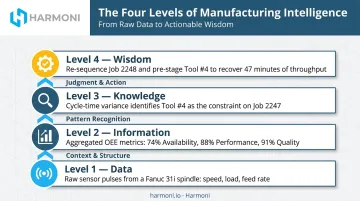
Most manufacturers are stuck somewhere between information and knowledge. Reports exist. Dashboards exist. But the connection between a pattern and a corrective action — taken while production is still underway — is missing.
Closing that gap is what manufacturing intelligence is built to do. The sections below break down how MI works, what it requires, and why the difference between a monitoring tool and a true MI capability matters for production outcomes.
The Core Components of Manufacturing Intelligence
Data Collection
MI draws from three primary data source categories:
- Machine and process data — IoT sensors, PLC outputs, CNC controller readings, cycle times, machine states (running, idle, fault)
- Operator and labor data — manual inputs, job assignments, time-on-task, activity logs
- Enterprise data — ERP job orders, engineering specifications, quality logs, material records
The richest MI environments integrate all three layers. Machine output data alone cannot explain why a job ran over time, why a part was scrapped, or whether the operator was working from the correct revision. The human and enterprise layers provide the context that makes machine data meaningful.
Platforms like Harmoni pull this off using long-range RFID to automatically identify operators and associate them to jobs and workcenters — then feed that data directly into ERP systems like Epicor, Infor, and JobBoss. That produces a continuous, automated flow of labor data — no manual entry, no paper travelers required.
Data Processing and Contextual Analysis
Raw data only becomes actionable when processed with context. A machine running 12% slower than target is just a number — until it's cross-referenced with the job it's running, the operator assigned, the current tool life, and the production schedule. That intersection is what tells a supervisor whether to adjust the program, swap the tool, or pull the operator off the job.
Analytics platforms handle that cross-referencing automatically, cleaning, structuring, and correlating data across sources so engineers and supervisors don't have to manually connect the dots across fragmented systems.
Visualization and Real-Time Dashboards
Processed data must be surfaced through role-appropriate views:
- Operators — current job status, alerts, work instructions, quality check prompts
- Supervisors — OEE, throughput, deviation flags, machine utilization
- Executives — aggregate performance against targets, cost trends, capacity indicators
The "real-time" requirement is non-negotiable. Dashboards that refresh every 24 hours are production reporting, not manufacturing intelligence. True MI delivers visibility while there is still time to act.
Predictive Analytics
MI goes beyond describing what happened. By identifying patterns in historical data, MI systems can:
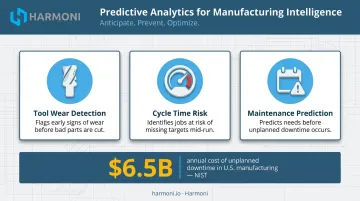
- Flag early signs of tool wear before a bad part is cut
- Identify jobs at risk of missing cycle time targets mid-run
- Predict maintenance needs before unplanned downtime occurs
NIST's economic study of discrete manufacturing machinery maintenance estimated a $6.5 billion perceived benefit from adopting additional predictive maintenance through reduced downtime — an economy-level finding that confirms why predictive capability matters far beyond reactive reporting.
Key Benefits of Manufacturing Intelligence
Real-Time Production Visibility
MI enables plant managers and supervisors to identify performance gaps, bottlenecks, and process deviations as they happen. When a machine on the floor deviates from target cycle time, a supervisor with real-time MI sees it immediately, not in Friday's summary report.
This matters because the cost of a problem compounds with time. A scrap event caught during a run affects one part. The same issue discovered at end-of-shift may have affected an entire batch.
Quality Improvement and Defect Reduction
By monitoring machine performance, process parameters, and operator activity together, MI enables earlier detection of quality issues: closer to their source, before defects compound into significant scrap or rework.
ASQ's cost of quality framework distinguishes between internal failure costs (defects caught before shipment) and external failure costs (defects that reach the customer). The closer a defect is caught to its origin, the lower the total cost.
A 2023 systematic review in the Journal of Manufacturing Systems confirmed that automated in-line inspection enables earlier detection and feedback, supporting exactly that mechanism within zero-defect manufacturing approaches.
Harmoni's digital quality checksheets put this into practice: operators enter inspection measurements at the machine in real time, and the system displays trend graphs showing when values are beginning to drift out of tolerance. Before scrap is generated, not after.
Accurate Job Costing and Labor Accountability
For custom, precision, and high-mix manufacturers, job cost estimation is notoriously difficult. MI closes that gap by connecting actual machine cycle times, operator activity, and material consumption to individual job orders, making job cost reporting a reflection of reality rather than a post-run estimate.
At Machine Specialties, Inc. (MSI), a precision aerospace and defense parts manufacturer, Harmoni's integration with Epicor ERP automated labor tracking entirely and eliminated paper travelers. The shop shifted from tracking spindle time only to tracking earned hours, giving operations and finance a true picture of job profitability for the first time.
Operational Consistency and Error Prevention
MI surfaces deviations from standard processes in real time. That means supervisors intervene before errors compound, work instructions stay enforced across shifts, and informal operator practices stop driving variability.
A practical example: Harmoni's operator command center automatically delivers the correct CNC program, work instructions, and revision for each job, detected via RFID before the operator touches the screen. Wrong revisions, wrong programs, and missed steps are blocked before they happen.
From Data to Action: Why MI Requires More Than Dashboards
Here's the problem that most MI implementations don't solve: many manufacturers invest in sensors, MES platforms, and dashboards — and still discover problems after production is complete.
Visibility into what happened is not the same as coordinating what should happen next.
The Execution Gap
Most MI programs struggle with the same gap: detecting a problem is only half the equation. Routing the correct response — the right job to the right operator at the right machine — is where data alone falls short. Instructions, corrections, and interventions need to flow back down to the floor in real time, while there is still time to act.
McKinsey found that 70% of discrete manufacturers started Industry 4.0 pilots, but only 29-30% captured value at scale. The technology was deployed. The execution layer wasn't. That's the execution gap.
Factory Orchestration as the Missing Layer
Factory orchestration is what closes this gap. Rather than simply reporting what already occurred, an orchestration platform sits between ERP systems, MES systems, machines, and operators — actively coordinating execution on the shop floor while production is underway.
Harmoni operates exactly this way. The platform combines real-time machine data with operator activity and ERP job workflows to:
- Automatically surface the correct job, program, and work instructions at each machine
- Route real-time quality alerts while a run is still active
- Feed actual cycle times and labor data back into the ERP without manual entry
- Give supervisors live exception alerts — not daily summaries
The distinction matters. Passive MI reports on what already happened — too late to change it. Orchestrated MI routes the right response while the run is still active, which is the only point at which the outcome can actually change.
Best Practices for Building Manufacturing Intelligence
Start with Operational Goals, Not Technology
Before selecting or deploying any platform, define the specific decisions or outcomes you want to improve:
- Reduce scrap on a specific line
- Improve on-time job completion rates
- Eliminate idle operator time between job transitions
McKinsey's discrete manufacturing research found that 41% of manufacturers reported unclear business value from their pilots as a barrier to scaling. That ambiguity almost always traces back to the same root cause: the technology was deployed before the operational outcomes were defined.
Unify Data Sources to Eliminate Silos
MI built on fragmented data produces fragmented intelligence. When machines report to one system, operators to another, and jobs to a third, contextual analysis becomes nearly impossible.
Prioritize integrations that connect:
- Machine data (cycle times, machine states, OEE)
- Operator activity (labor time, job assignments, quality entries)
- ERP workflows (job orders, cost targets, schedules)
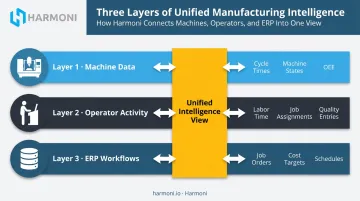
One unified view — rather than three dashboards requiring manual reconciliation — is what transforms raw data into actionable intelligence.
Implement Iteratively and Validate with Frontline Operators
Start with one production line or workcenter, demonstrate measurable results, then expand.
Involve operators and shift supervisors from the beginning — they're the ones who must act on it daily, and their input shapes whether the system actually works. A platform built without operator usability in mind will generate data that sits unused. Platforms like Harmoni are designed around this principle, placing machine-side command centers directly in front of operators rather than routing insights through management layers first.
Frequently Asked Questions
What is enterprise manufacturing intelligence?
Enterprise manufacturing intelligence (EMI) refers to MI applied at enterprise scale — aggregating operational, quality, and process data across multiple facilities or production lines into a centralized view that enables enterprise-wide visibility, compliance tracking, and strategic decision-making. It is an industry application category, not a formally standardized term in ISA-95.
What is intelligent manufacturing?
Intelligent manufacturing is the broader application of AI, IoT, robotics, and real-time analytics to make manufacturing processes adaptive and self-optimizing. Manufacturing intelligence is the foundational data and analytical layer that makes autonomous or semi-autonomous decision-making possible.
What is the difference between manufacturing intelligence and a MES?
A manufacturing execution system (MES) manages production execution — work orders, scheduling, traceability. Manufacturing intelligence is the analytical layer that converts MES data (and data from other sources) into operational insights. The two are complementary: MI sits alongside or on top of MES to add real-time visibility and analytical depth.
What types of data does manufacturing intelligence collect?
The three primary categories: machine and process data (sensor readings, cycle times, machine states from CNCs and PLCs), operator and labor data (activity logs, job assignments, time-on-task, quality entries), and enterprise data (ERP job orders, engineering specifications, quality and inspection records).
How does manufacturing intelligence reduce scrap and production errors?
By monitoring process parameters, machine performance, and operator activity in real time — and cross-referencing them against expected standards — MI enables supervisors to detect deviations and intervene before defects accumulate. That means catching a drift in tolerance mid-run versus discovering the quality issue only after the run is complete.