This guide covers what lean manufacturing is, where it came from, its five core principles, the eight types of waste it targets, the key tools used to implement it, and the benefits manufacturers can realistically expect.
Key Takeaways
- Lean manufacturing eliminates waste across the entire production system — not just inventory or costs
- Five sequential principles (Value → Value Stream → Flow → Pull → Perfection) form its operating framework
- Eight categories of waste (TIMWOOD+U) cover every major source of non-value-adding activity
- Tools like VSM, Kanban, 5S, and Poka-Yoke translate lean principles into daily shop floor practice
- Digital platforms now deliver the real-time visibility lean requires — making continuous improvement measurable at scale
What Is Lean Manufacturing?
Lean manufacturing is a production philosophy centered on maximizing customer value while systematically eliminating waste. In lean terms, "waste" is any activity that consumes time, labor, or material without producing something the customer is willing to pay for.
That definition, drawn from the Lean Enterprise Institute and NIST's continuous improvement model, carries a straightforward logic: if the customer doesn't value it, stop doing it.
More Than a Cost-Cutting Program
Lean is not a one-time efficiency drive. It's a cultural operating system that demands participation from every level of the organization — shop floor operators, supervisors, engineers, and executives alike. Organizations that treat lean as a one-time project consistently revert to old habits within months.
These two terms get conflated regularly, but lean and just-in-time (JIT) are not the same:
- Just-in-time (JIT) is a production-control method: make and deliver only what is needed, when needed, in the quantity needed. NIST explicitly identifies it as one lean methodology.
- Lean is the broader management system. JIT supports lean — it doesn't define it.
The Origins of Lean Manufacturing
Lean's lineage spans nearly a century:
- 1913 — Henry Ford demonstrated integrated flow production at Highland Park, combining interchangeable parts, standard work, and moving conveyance on a single line
- Post-WWII Japan — Taiichi Ohno, working within severe resource constraints, developed the Toyota Production System (TPS) around replenishment pull, takt time, and visual control. LEI's history of lean identifies Ohno as TPS's primary architect
- 1950s–1970s — Shigeo Shingo taught 79 courses at Toyota and developed the setup-reduction framework later called SMED; his role was influential but distinct from Ohno's TPS development
- 1988 — John Krafcik formally named the approach "lean production" in the MIT Sloan Management Review
- 1996 — James Womack and Daniel Jones published Lean Thinking, codifying the five principles that manufacturers worldwide still use as the definitive framework
Lean didn't emerge from a single breakthrough — it accumulated across decades, each contributor solving a real constraint the previous one left open. Understanding that lineage matters when applying lean principles today, because the "why" behind each tool is inseparable from the problem it was originally built to fix.
The 5 Core Principles of Lean Manufacturing
Womack and Jones didn't just describe lean — they sequenced it carefully. The five principles are a progressive framework, not a checklist. Each one depends on the previous.
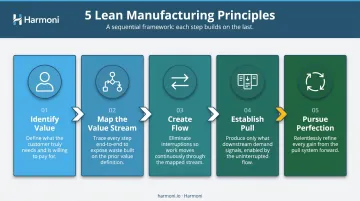
Principle 1: Identify Value from the Customer's Perspective
Value is defined entirely by the customer — what they need, what they'll pay for, and at what quality level. Convenience for the manufacturer is irrelevant to that definition.
In practice, this means using structured tools — customer surveys, returns analysis, warranty data, and Voice of Customer programs — to establish exactly which product features and production steps matter. Everything else is a candidate for elimination.
Principle 2: Map the Value Stream
Once you know what the customer values, you chart every step in your production process — from raw material to finished product — and label each step as:
- Value-adding (the customer pays for this)
- Necessary non-value-adding (required for operation, but not directly valued)
- Pure waste (eliminate immediately)
This is Value Stream Mapping (VSM). It gives operations teams a visual tool to identify bottlenecks, redundant handoffs, and idle periods that inflate lead times without benefiting anyone.
Principle 3: Create Flow
With waste identified and targeted, the goal is to make value-adding steps move continuously. No batching, no waiting, no queues. Products flow from one stage to the next without interruption.
Creating flow often requires physical changes: rearranging workstations, reorganizing the shop floor layout, cross-training workers so bottlenecks don't form at individual operators. A production cell that flows smoothly is entirely different from one organized around departmental functions.
Principle 4: Establish a Pull System
A pull system produces only what downstream demand requires, when it requires it. This contrasts with a push system, which schedules production against forecasts and inevitably generates excess inventory when those forecasts miss.
Pull is the mechanism that makes JIT operational. Production activity is triggered by real demand signals, not pre-set targets. When an aerospace supplier named Island Components introduced Kanban and one-piece flow, their WIP fell from 717 to 156 pieces — a 78.2% reduction documented by NIST. That's pull working as designed.
Principle 5: Pursue Perfection Through Continuous Improvement (Kaizen)
No process is ever fully optimized. Kaizen — the practice of making incremental improvements continuously — is what keeps lean alive after the initial transformation.
The best improvement ideas frequently come from front-line workers, not management. Operators see inefficiencies daily that analysts miss entirely.
Organizations that build structured channels for surfacing those observations sustain their lean gains. Those that don't tend to watch efficiency improvements erode within a few years.
The 8 Wastes of Lean Manufacturing
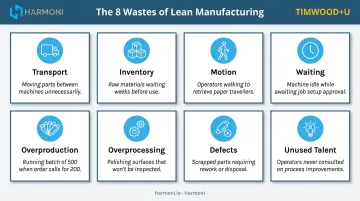
Toyota originally identified seven wastes — called muda (the Japanese term for non-value-adding activity). Later lean practitioners added an eighth. Together they're often remembered as TIMWOOD+U:
| Waste | What It Looks Like |
|---|---|
| Transport | Moving materials or parts between locations unnecessarily |
| Inventory | Excess raw materials, WIP, or finished goods tying up capital and floor space |
| Motion | Operators walking, reaching, or repositioning without adding value |
| Waiting | Idle time while operators wait for machines, materials, approvals, or the prior step |
| Overproduction | Making more than current demand requires — hiding quality problems downstream |
| Overprocessing | Extra finishes, redundant inspections, or features the customer didn't ask for |
| Defects | Non-conforming parts requiring rework or scrap — consuming labor and material twice |
| Unused Talent | Failing to act on the knowledge, observations, and ideas of shop floor workers |
The Three Broader Waste Categories
Beyond individual waste types, lean practitioners recognize three systemic conditions that generate waste:
- Muda — non-value-adding process activity (the eight wastes above)
- Mura — unevenness from fluctuating demand or inconsistent workloads
- Muri — overburden from pushing machines or workers beyond their designed capacity
Addressing only muda while ignoring mura and muri produces limited results. A line that eliminates motion waste but runs at inconsistent pace still creates quality and flow problems. Sustainable lean improvement targets all three.
Research consistently shows that value-creating steps account for as little as 5–10% of total value-stream activity in a typical manufacturing operation. That ratio is why lean practitioners find significant room for improvement even in shops that already feel efficient.
Key Lean Manufacturing Tools and Techniques
Lean principles require practical tools to execute. Broadly, they fall into two categories: tools that help you see and plan (VSM, Kanban), and tools that enforce quality and consistency on the shop floor (5S, Poka-Yoke, Andon, SMED).
Value Stream Mapping and Kanban
Value Stream Mapping is the foundational planning tool. It documents the current state of production — every material and information flow from order to delivery — and helps teams design a leaner future state. Without VSM, improvement efforts target symptoms rather than the underlying system.
Kanban makes pull production operational. It's a visual signaling device that authorizes production or replenishment only when downstream demand requires it. No signal, no production. This simple mechanism prevents overproduction and keeps inventory levels tied to actual consumption.
5S and Total Productive Maintenance (TPM)
5S — Sort, Set in Order, Shine, Standardize, Sustain — is the workplace organization method that creates a stable, visual, and standardized environment. It's the prerequisite for reliable flow. A disorganized shop floor can't sustain lean, regardless of how sophisticated the planning tools are.
Total Productive Maintenance (TPM) extends equipment care to operators, training them to detect early signs of machine issues before breakdowns occur. Platforms like Harmoni support TPM objectives directly — real-time machine monitoring, OEE tracking across Availability, Performance, and Quality, and digital checksheets for structured operator-driven inspection at the machine level.
When a performance indicator drops, operators can escalate to maintenance immediately through the platform's shop floor communications system — preventing minor issues from becoming unplanned downtime.
Poka-Yoke, Andon, and SMED
Poka-Yoke (error-proofing) designs processes so that mistakes are physically impossible or immediately detectable at their source. In CNC machining environments, this can take a digital form: Harmoni's platform automatically ties the correct job, part, and revision to the correct CNC program, preventing the wrong program from running on the wrong part — one of the most common sources of scrap in precision manufacturing.
Andon is the alert system that empowers operators to signal a problem the moment it occurs, stopping the line rather than passing a defect downstream. Its power comes from making abnormal conditions visible immediately — supporting Jidoka, the TPS principle of autonomous defect detection and process stop.
SMED (Single-Minute Exchange of Die) reduces equipment changeover time to under ten minutes by separating setup tasks that must happen while the machine is stopped from those that can be done in advance. Shorter changeovers enable smaller batch sizes and faster response to changing demand — a 2023 automotive-headlamp study cut changeover time from 489.7 to 198.3 seconds and raised effective working time from 63.4% to 84.7% as a result.
Digital Tools and Factory Orchestration
The individual tools above address specific waste sources — but lean's full potential requires coordination across all of them simultaneously. Traditional ERP and MES tools provide planning and recording functions; they don't manage what's happening on the shop floor right now.
Factory orchestration platforms fill that gap. Harmoni connects operators, machines, engineering requirements, and ERP workflows in real time through RFID-driven automation. When an operator approaches a machine, the system automatically:
- Identifies the employee and active job
- Loads the correct CNC program
- Surfaces current work instructions and digital checksheets
- Begins tracking labor time — with no manual input required
This removes the motion and waiting waste that lean targets — at the process level, not by asking operators to be more disciplined. At WessDel, a single time-tracking transaction that previously took 11 minutes per employee was reduced to seconds after implementing Harmoni — recovering 17 productive hours per employee per month and generating a 10% reduction in late deliveries.
Visual Factory andon-style indicator lights communicate real-time OEE conditions across the shop floor. Green means production is running within expected parameters; yellow signals slipping performance; red flags poor conditions requiring immediate attention. This gives supervisors the instant visual read that lean's flow management depends on.
Benefits of Lean Manufacturing
Operational Improvements
- Reduced lead times through smoother production flow and elimination of waiting and batching
- Lower inventory costs through JIT and pull-based scheduling that ties stock levels to actual demand
- Improved quality through earlier defect detection, error-proofing, and standardized processes
These gains compound. A manufacturer that cuts lead time by removing waiting waste also reduces WIP, which reduces defect escape risk, which reduces rework costs. The improvements reinforce each other as lean culture deepens.
A concrete example: Carlyle Johnson Machine Company, an aerospace, medical, and military component manufacturer, raised first-pass yield from 10% to 90% and cut lead time from 43 to 5 days after implementing lean. Outcomes vary by facility, process maturity, and implementation depth, but the directional pattern is consistent.
Financial and Competitive Benefits
Leaner operations lower the cost of production without sacrificing quality. The downstream effects are competitive:
- More consistent on-time delivery performance
- Stronger customer satisfaction and retention
- Capacity to price competitively without margin erosion
Sustainability Benefits
Lean's waste-reduction logic extends to environmental impact. McKinsey's analysis of lean applied to energy efficiency estimates it can help reduce CO₂ emissions by 10–15% — though actual results depend on implementation scope. Material scrap reduction, a direct outcome of defect and overproduction elimination, also lowers raw material consumption measurably.
The same waste-reduction logic applies to the workforce. Lean organizations that involve operators in improvement processes report higher engagement — workers who see their observations acted on stay invested in outcomes. That involvement doesn't just extract value from operators; it creates it alongside them.
Frequently Asked Questions
What are lean manufacturing systems?
A lean manufacturing system is the integrated set of principles, tools, and cultural practices — developed through the Toyota Production System — that an organization uses to continuously eliminate waste and deliver maximum value to the customer. It covers everything from how value is defined to how problems are escalated and solved on the floor each day.
What are the 8 types of lean manufacturing waste?
The eight wastes lean manufacturing targets are Transport, Inventory, Motion, Waiting, Overproduction, Overprocessing, Defects, and Underutilized Talent — commonly remembered by the acronym TIMWOOD+U. Each is a category of non-value-adding activity that consumes resources the customer never asked for.
What are the 4 pillars of lean manufacturing?
Lean is most often defined by five principles, but the four foundational pillars — the 4 Ps — frame how organizations sustain it: Purpose (the strategic rationale), Process (how work is designed and standardized), People (engaging every employee in improvement), and Performance (measuring results to sustain gains).
What are the 5 lean manufacturing tools?
Five foundational lean tools, and what each targets:
- Value Stream Mapping — visualizes the end-to-end production process
- Kanban — manages pull-based scheduling to prevent overproduction
- 5S — organizes and standardizes the workplace
- Poka-Yoke — error-proofs processes at the source
- Kaizen events — structured workshops for rapid, targeted improvement
How long does lean manufacturing take to implement?
There's no fixed timeline. Initial 5S and VSM work can begin within weeks; cultural transformation — the part that sustains lean over time — takes years. Many manufacturers see meaningful operational improvements within the first 6–12 months of focused effort, with gains accelerating as lean practices become embedded in daily operations.