Introduction
A machining center trips an alarm at 2 a.m. By the time the morning shift discovers it, four hours of production are gone — along with the parts that were running when it happened. No warning. No data trail. Just lost time and a scramble to recover the schedule.
This scenario plays out constantly in mid-to-large manufacturing facilities still running on reactive maintenance and manual reporting. Siemens' 2024 research across large industrial plants found an average of 27 lost production hours per month per plant — hours that connected machine monitoring could have caught before they became stoppages.
IoT-based machine monitoring changes the equation. Instead of finding out a machine failed, you see it trending toward failure. Instead of guessing at utilization, you have live data.
What follows covers what IoT machine monitoring is, how the technology works end-to-end, the concrete benefits it delivers, and what to look for when choosing a platform.
Key Takeaways
- IoT machine monitoring replaces reactive maintenance with continuous, sensor-driven visibility into equipment health
- Real-time OEE tracking exposes availability, performance, and quality losses as they happen — not after the shift ends
- Predictive maintenance can reduce unplanned downtime by 15–50%, according to Deloitte analysis
- Legacy machines can be retrofitted without replacement — no new equipment required
- Platforms that connect machine data, operator activity, and ERP context outperform standalone dashboards
What Is IoT-Based Machine Monitoring?
IoT-based machine monitoring uses connected sensors, edge devices, and software to continuously collect and analyze machine performance data in real time. Unlike periodic data logging or end-of-shift manual entry, it's a live, always-on feed from equipment to the systems that manage production.
IIoT vs. General IoT Monitoring
General IoT monitoring covers everything from smart thermostats to fleet tracking. Industrial IoT (IIoT) machine monitoring is purpose-built for manufacturing floors. It tracks parameters specific to production equipment:
- Machine state (running, idle, fault, setup)
- Spindle utilization and cycle time
- Temperature and vibration
- Power consumption and current draw
- Alarm and fault codes
These aren't abstract data points. Each one maps directly to a production outcome — whether a part is being made, whether it's being made correctly, and whether the machine will keep running tomorrow.
Why This Matters Now
That data matters because manufacturers are finally acting on it at scale. The Manufacturing Leadership Council's 2025 Smart Factories survey found that 46% of manufacturers reported IIoT sensor networks in production were scaling or already at scale. Yet the same survey found that 49% cited legacy equipment as a primary smart-factory roadblock — meaning a large share of manufacturers are actively trying to connect machines that weren't built for connectivity. That gap — between wanting real-time visibility and actually getting it from a 20-year-old CNC — is where implementation approach makes or breaks the outcome.
Core Components of an IoT Machine Monitoring System
Sensors and Edge Devices
Every IIoT system starts at the machine itself. Sensors attach to or embed within equipment to capture raw operational signals:
- Temperature sensors monitor motor and spindle heat
- Vibration sensors detect bearing wear and imbalance
- Current transformers measure power draw as a proxy for machine load
- Cycle counters track part completions
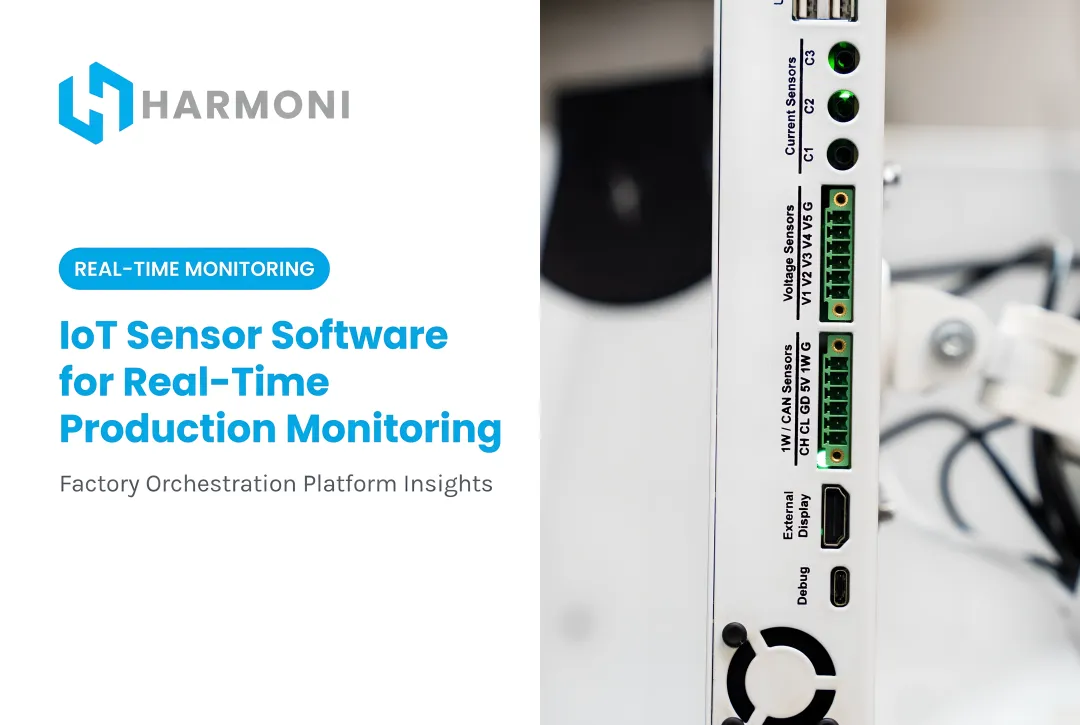
Raw sensor signals aren't transmitted directly to the cloud. Edge computing devices sit between the sensor and the network, digitizing analog signals, filtering noise, and pre-processing data locally. This reduces bandwidth requirements and enables faster local alerting before data ever reaches a central server.
Connectivity and Data Transmission
Once processed at the edge, machine data travels to a central system via one of several paths:
| Method | Best For |
|---|---|
| Wired Ethernet | High-reliability environments, permanent installations |
| Wi-Fi | Flexible layouts, newer facilities |
| Cellular (4G/5G) | Remote equipment, multi-site operations |
| OPC-UA | Interoperability between industrial devices and enterprise systems |
| MTConnect | CNC machine data standardization |
| MQTT | Lightweight messaging over constrained networks |
OPC-UA and MTConnect are particularly important for manufacturing. OPC-UA provides semantic interoperability from field devices through MES and ERP. MTConnect defines standard data tags for CNC machines, giving adapters a common language for translating proprietary control outputs.
Cloud and On-Premise Data Infrastructure
Data from multiple machines flows into a central repository — cloud-hosted, on-premise, or hybrid. This layer does two things: stores the real-time stream for immediate alerting, and retains historical records for trend analysis.
Cloud deployments offer faster implementation and lower infrastructure overhead. On-premise options suit manufacturers with strict data residency requirements.
Defense contractors handling Controlled Unclassified Information (CUI) often require government-specific cloud configurations. Harmoni, for example, provides a dedicated Government Cloud deployment for ITAR and CMMC-aligned customers.
Analytics and Alerting Engine
The analytics engine compares incoming data against defined thresholds and operational baselines to turn raw signals into decisions:
- Rule-based alerting triggers when a parameter crosses a threshold — spindle temp exceeds 80°C, for instance
- Pattern-based detection identifies anomalies relative to a machine's normal behavior even when no threshold is breached
- AI-driven analytics learn from historical patterns to predict failures before measurable degradation begins
Most production deployments start with rule-based alerting and add more sophisticated detection as the data history grows.
Dashboards and Operator Interfaces
The final layer surfaces insights to the right people at the right time:
- Real-time dashboards give floor managers machine-by-machine status at a glance
- Andon-style visual indicators provide instant shop floor cues without requiring a screen
- Alert notifications reach maintenance teams the moment an anomaly is detected
- Exception reports give operations leadership the data needed for scheduling and capacity decisions
Visibility only creates value when the right person sees the right signal at the right moment. That's what the interface layer is designed to ensure.
How IoT Machine Monitoring Works: The Data Flow
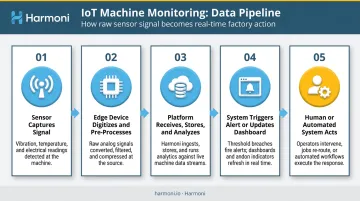
The end-to-end flow is straightforward, even if the underlying technology isn't:
- Sensor captures a signal — vibration, temperature, current, or cycle event
- Edge device digitizes and pre-processes — filters noise, formats data, forwards to the network
- Platform receives, stores, and analyzes — compares data to thresholds and historical baselines
- System triggers an alert or updates a dashboard — in real time or near-real time
- A human or automated system acts — maintenance is dispatched, an alert is acknowledged, a dashboard updates
Real-Time vs. Near-Real-Time
The speed of the feedback loop determines how useful the data actually is. True real-time monitoring (sub-second latency) catches a fault before a part is scrapped. Near-real-time (seconds to minutes) is sufficient for most predictive maintenance use cases but may miss rapid fault sequences on high-speed equipment.
Integration With ERP and MES
Machine data in isolation answers "is the machine running?" — it can't tell you what job was running, how many parts were completed, or what the schedule impact looks like.
ERP integration closes that gap. When machine monitoring connects to systems like Epicor, Infor, or JobBoss, a stoppage event carries full production context: the work order, the operator, and the part count at time of fault.
Harmoni links machine state data to ERP job records and operator RFID identification, so every event carries complete operational context. That means engineers and supervisors can act on a fault immediately — with the job history and downstream schedule impact already in front of them, not pieced together after the fact.
Key Benefits of IoT Machine Monitoring for Manufacturers
Predictive and Condition-Based Maintenance
Fixed maintenance schedules are blunt instruments. Replacing a bearing every 2,000 hours works fine until the bearing fails at 1,400 — or runs perfectly to 3,500. Continuous monitoring of vibration, temperature, and power draw lets maintenance teams act on actual wear signals rather than calendar entries.
Deloitte's analysis of predictive maintenance across industrial assets found potential reductions of:
- 10–40% in total maintenance cost
- 15–50% in unplanned downtime
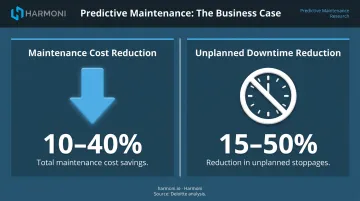
Both numbers represent substantial margin impact for manufacturers operating on tight tolerances.
Real-Time OEE Visibility
Overall Equipment Effectiveness (OEE = Availability × Performance × Quality) is manufacturing's core efficiency metric. Most shops calculate it after the shift, which means problems discovered at 4 p.m. were visible in the data at 10 a.m. — if anyone had been looking.
Real-time OEE monitoring surfaces availability losses (unplanned stops), performance losses (slow cycles), and quality losses (out-of-tolerance parts) as they occur. Managers can intervene during the shift rather than analyzing what went wrong after it ends.
Platforms like Harmoni go further by combining machine data with operator activity and ERP job data in a unified view. That context tells managers who was running the machine, which job was active, and what the downstream schedule impact looks like — not just that a stoppage occurred.
Accurate Job Costing and Labor Visibility
Post-production cost reporting relies on estimates and operator memory. Time-stamped machine data tied to specific jobs and operators replaces guesswork with actuals:
- Actual cycle times vs. estimated cycle times
- Setup durations captured automatically, not self-reported
- Idle periods attributed to specific jobs and shifts
WessDel, a precision aerospace and defense machining shop using Harmoni, reduced ERP transaction time from 11 minutes per transaction to seconds using RFID-enabled machine-side automation — recovering 17 productive hours per employee per month in the process.
Capacity Planning and Bottleneck Identification
Historical machine utilization data gives schedulers a clear picture of where constraints actually live. That visibility supports decisions like:
- Identifying which machines are at capacity versus consistently idle
- Pinpointing the equipment constraining throughput
- Determining where a second shift or additional machine would have the most impact
Implementation Challenges and How to Address Them
Legacy Machine Integration
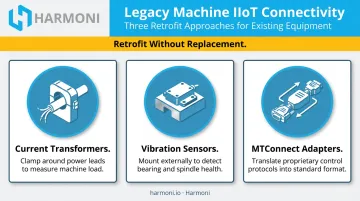
Most shop floors run older CNC equipment without native digital outputs. The machines work fine — they just don't speak IIoT. Retrofit approaches solve this without equipment replacement:
- Current transformers clamp around power leads to measure load as a proxy for machine state
- Vibration sensors mount externally to detect bearing and spindle health
- MTConnect adapters translate proprietary machine control protocols into a standard format
Manufacturing USA documented digitizing analog air-pressure data and capturing cutting load, on/off state, and power consumption from a legacy mill — at sub-second intervals — without touching the original control. MTConnect supports third-party adapters that normalize proprietary outputs from older controls — including Haas, Fanuc, and Mazatrol.
Harmoni's terminals include built-in MTConnect drivers and support for RS232, Ethernet, USB, and CAN bus — covering the range of interfaces found on both new and decades-old CNC equipment.
Cybersecurity and Data Governance
Once machines are connected, the network becomes part of the risk equation. Connecting them to IT infrastructure expands the attack surface in ways legacy OT environments never faced. NIST SP 800-82 Rev. 3 identifies IT-OT convergence as a source of expanded risk — with potential consequences for equipment, safety, and operations. Recommended safeguards include:
- Network segmentation between OT and IT environments
- Encrypted data transmission for all machine-to-platform communication
- Least-privilege access controls and multi-factor authentication
- Continuous event logging for audit and incident response
Defense manufacturers face additional requirements under the 2024 CMMC final rule, which classifies OT and IIoT as Specialized Assets. At CMMC Level 2, any asset capable of processing, storing, or transmitting CUI must appear in the asset inventory, System Security Plan, and network diagram.
Change Management and Staff Adoption
Technology alone doesn't fix operations — people have to use it. The most common failure mode isn't a technical integration problem.
It's alerts that get ignored because nobody updated the response workflow, or dashboards displaying data nobody was trained to interpret.
Effective adoption requires:
- Operator-level training tied to their specific daily tasks
- Clear escalation paths when alerts fire
- Supervisor accountability for dashboard review
- Early wins communicated broadly to build confidence in the system
Harmoni's operator interfaces are designed to surface the right information at the machine — work instructions, job assignments, quality checksheets. Harmoni's operator interfaces surface the right information directly at the machine — work instructions, job assignments, quality checksheets. This reduces the learning curve by meeting operators where they work, rather than requiring them to navigate a separate system.
Choosing the Right IoT Machine Monitoring Solution
Key Evaluation Criteria
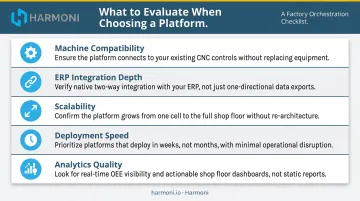
When comparing platforms, mid-to-large manufacturers should assess:
- Machine compatibility — does it support your specific CNC controls (Fanuc, Haas, Mazak, Siemens, etc.) natively or via adapters?
- ERP integration depth — can it connect machine events to work orders, operators, and job costs in your specific ERP?
- Scalability — does the platform handle dozens of machines across multiple facilities without performance degradation?
- Deployment speed — can it deliver insights in weeks, not a six-month implementation?
- Analytics quality — does it do more than display data, or does it detect anomalies and generate actionable alerts?
Point Solutions vs. Orchestration Platforms
A point-solution machine monitoring tool collects machine data and displays it. Useful, but it's a narrow slice of what's actually happening on a shop floor.
A factory orchestration platform like Harmoni sits between machines, operators, and ERP systems to improve execution, not just visibility. The difference shows up in outcomes. Knowing a machine stopped matters far less than knowing:
- Which job was running at the time
- Which operator was assigned to that machine
- How many parts had been completed
- What the downstream schedule impact looks like
All of that surfaces automatically, without anyone making a call or pulling a report.
For manufacturers running high-mix, low-volume production with complex job costing requirements, the orchestration layer is where the measurable ROI lives.
Deployment and Vendor Selection
Prioritize vendors who can demonstrate:
- Rapid deployment — productive insights within weeks of installation, not months
- Integration experience with your specific ERP and machine control types
- Published case studies with measurable outcomes (downtime reduction, throughput improvement, cost savings)
- A clear upgrade path as your monitoring needs mature
WessDel's president noted that Harmoni was "seamlessly working with Epicor out of the box" with "no issues communicating with machines, new and old" — including legacy equipment that other platforms require replacing.
Frequently Asked Questions
What data does an IoT machine monitoring system collect?
Common data points include machine state (running/idle/fault), cycle counts, spindle speed, temperature, vibration, power consumption, and alarm codes. The specific parameters depend on the machine type, the sensors deployed, and the platform's integration with the machine's native control outputs.
Can IoT machine monitoring work with older or legacy CNC machines?
Yes. Retrofit sensors — current transformers, vibration sensors, and temperature probes — add monitoring capability without replacing equipment. Protocol adapters like MTConnect translators normalize proprietary control outputs from older Fanuc, Haas, and Mazatrol controls into a standard data format that modern platforms can ingest.
How is IoT machine monitoring different from a traditional SCADA system?
SCADA is primarily control-focused — it monitors and issues commands to industrial processes, typically within a closed, site-specific architecture. Modern IIoT machine monitoring is cloud-connected, analytics-driven, and designed for visibility and predictive insight rather than direct machine control. The two can coexist, serving different layers of the operational stack.
What is the typical ROI of implementing IoT-based machine monitoring?
ROI comes primarily from reduced unplanned downtime, lower total maintenance costs, and improved throughput. Deloitte analysis points to 10–40% total maintenance cost reduction and 15–50% unplanned downtime reduction as achievable ranges. Look for vendors with published case studies that provide baseline-to-outcome comparisons rather than generic percentage claims.
How long does it take to implement an IoT machine monitoring system?
Modern cloud-based platforms deploy and begin delivering operational insights within weeks when working with a vendor experienced in your machine control types and ERP platform. Complex multi-site rollouts take longer, but early machines should be producing data — and value — well before the full deployment is complete.
What is the difference between IoT machine monitoring and a Manufacturing Execution System (MES)?
MES manages production scheduling, work orders, quality records, and process routing. IoT machine monitoring focuses on real-time equipment data — what machines are doing and how they're performing. Most manufacturers use both together, with machine monitoring data feeding into MES workflows and giving production management real-time equipment context.