
McKinsey's research on industrial manufacturers found that companies accumulate mountains of data from machine alarms, timestamps, and operator logs, yet most of it sits untouched and unanalyzed. For mid-to-large manufacturers running CNC machining, aerospace, defense, or precision production, that's not just a missed opportunity. It's a liability.
Disconnected machines and siloed ERP or MES systems force teams into manual data collection. Manual entry leads to errors, unplanned downtime, and blind spots that only show up after a bad batch ships. This guide breaks down what connected machines are, how they talk to each other, the benefits worth chasing, common roadblocks, and why connectivity alone still leaves gaps that orchestration is built to close.
Key Takeaways
- Connected machines stream real-time data via sensors, edge devices, and protocols such as MQTT and OPC UA
- Manufacturers using predictive maintenance saw 52.7% less unplanned downtime than reactive-only shops
- Automation and connectivity solve different problems: a machine can run automated cycles without sharing any data
- Legacy CNC equipment can be retrofitted with sensors and gateways instead of replaced
- Orchestration platforms tie machine data to operator activity and ERP jobs, explaining why delays happen
What Are Connected Machines in Manufacturing?
A connected machine is industrial equipment fitted with sensors and network connectivity that pushes real-time operating data to a supervisory platform, dashboard, or analytics system. Instead of running in isolation, the machine becomes a live data source.
That model breaks from standalone, PLC-controlled equipment that ran as an island. Under Industry 4.0 and the Industrial Internet of Things (IIoT), machines, people, and physical assets link into one digital ecosystem.
NIST describes this as connecting machines, people, and physical assets into an integrated digital ecosystem that generates, analyzes, and communicates data. In some cases, connected systems act without waiting on a human decision.
The Core Components of a Connected Machine
Three layers make connectivity work:
- Sensors — measure vibration, temperature, current draw, cycle counts, and other physical parameters at the machine level
- Local controllers or edge devices — PLCs and microcontrollers that pre-process raw signals before they're transmitted anywhere
- A connectivity layer — the network and protocol that pushes processed data to a dashboard, MES, or ERP system

Types of Manufacturing Equipment That Can Be Connected
Almost any programmable shop floor asset qualifies:
- CNC mills, lathes, and multi-axis machining centers
- Industrial robots and other PLC-driven production cells
- Controls from builders such as Haas, Mazak, DMG Mori, Fanuc, Siemens, and Heidenhain
- Legacy machines with no native connectivity, retrofitted with external sensors and gateways instead of replaced
That last point matters more than it sounds. Plenty of shops assume connectivity means buying new machines. It doesn't.
How Do Connected Machines Communicate?
Machine-to-machine (M2M) communication converts physical signals such as current draw, vibration, and spindle load into digital data that travels across a network to wherever it's needed.
Common Industrial Protocols
Four protocols dominate shop floor communication:
- MQTT: a lightweight publish/subscribe messaging standard published by OASIS, built for one-to-many data distribution over TCP/IP
- OPC UA: a platform-independent, service-oriented architecture from the OPC Foundation designed for machine-to-machine and machine-to-enterprise interoperability
- Modbus TCP/IP: an older but still widely used protocol that wraps Modbus messages in a dedicated header for transmission over standard networks
- MTConnect: an open, royalty-free standard built for CNC machine tools and manufacturing equipment data
Older, proprietary CNC controls add complexity here. Many weren't designed to speak any of these protocols natively, which is why translation layers matter so much in real deployments.
Edge Computing and the Missing Context
Edge devices and gateways aggregate and filter machine data before it hits central systems, cutting latency and bandwidth demand. But raw machine-to-system communication is only half the picture.
Data that stays disconnected from operator activity and ERP job information tells you what happened on a machine. It doesn't tell you why. That gap is exactly where orchestration platforms come in, and we'll get there shortly.
Adoption is accelerating regardless. Deloitte's 2025 survey of 600 executives at large U.S. manufacturers found that 46% were already using IIoT solutions at the facility or network level. For most manufacturers, shop-floor connectivity is now an expected baseline—not a competitive edge on its own.
Key Benefits of Connected Machines in Manufacturing
Connectivity pays off in ways that compound across a shop floor:
- Real-time visibility: machine status and production performance across every workcenter, replacing next-day reporting with live data
- Predictive maintenance: analyzing vibration, temperature, and cycle-count trends to flag failures before they cause downtime
- Fewer production errors and scrap: automated data capture at the machine replaces manual entry, where most mistakes creep in
- More accurate job costing: actual machine run-time ties directly to job records instead of estimates
- Better labor visibility: correlating machine activity with operator assignments in real time
- Faster bottleneck detection: spotting constraints and quality issues as they happen, not after the run finishes

Predictive maintenance deserves a closer look. NIST's survey and analysis of maintenance strategies across U.S. manufacturers found that shops relying more heavily on predictive and preventive maintenance had 52.7% less unplanned downtime and 78.5% fewer defects than reactive-maintenance-heavy peers.
Among shops already doing planned maintenance, those leaning on predictive techniques specifically saw 18.5% less unplanned downtime and 87.3% fewer defects compared to preventive-only approaches.
Job costing is where connectivity pays off fastest for aerospace and defense shops. Harmoni's customer WessDel, a San Jose-based aerospace and defense manufacturer, saw this play out directly. Tying actual machine cycle data to job records instead of estimates contributed to 17 productive hours gained per employee per month and a 10% reduction in delinquent jobs.
Connected vs. Automated Machines: What's the Difference?
These two terms get used interchangeably. They shouldn't be.
Automated machines perform pre-programmed tasks with minimal human intervention. A PLC-driven robotic arm that repeats the same weld cycle all day is automated. It may or may not be networked.
Connected machines share real-time data about what they're doing. A machine can be fully automated and completely disconnected, running its programmed cycle with zero data ever leaving the control.
The distinction matters practically:
- Automation reduces manual effort in executing a task
- Connectivity shares data about that execution in real time
- A machine can be one without the other, or neither, or both
The most valuable machines on a modern shop floor are both. Automated execution paired with real-time visibility gives you efficiency and the data to prove, improve, or troubleshoot it.
Common Challenges to Achieving Machine Connectivity
Connectivity sounds simple on paper. In practice, three obstacles show up repeatedly.
Data variety. Fanuc, Haas, Siemens, Heidenhain, Mazak — each control speaks a different language, generating incompatible data formats that need normalization before use.
Legacy equipment. Automation World reports that manufacturing-system upgrade cycles average 15 to 20 years, meaning most shop floors run a mix of decades-old and current-generation machines. Legacy protocols often can't cross firewalls without transformation, which is why retrofit sensors and adapter layers exist.
Data without context. Connected machines produce data. Data alone doesn't explain a delay. Without linking machine activity to operator actions and ERP job details, you still can't answer why a job ran long or a batch scrapped.
Those gaps show up in the numbers. A 2025 Deloitte survey found only 45% of manufacturers use an architecture standard for scaled deployments, and just 54% use a unified data model. Most shops are still figuring out how to normalize, connect, and contextualize machine data.
Beyond Connectivity: Why Orchestration Closes the Gap
Connected machines generate raw data. On their own, they still leave a gap: without coordinating that data with ERP workflows and operator actions, manufacturers lack the full picture needed to actually act.
Factory orchestration is the layer that sits between ERP systems, MES, machines, and operators—unifying machine data, operator activity, and ERP workflows into one real-time view. This is the approach Harmoni pioneered as a category distinct from standalone machine monitoring.
How It Works at the Workcenter Level
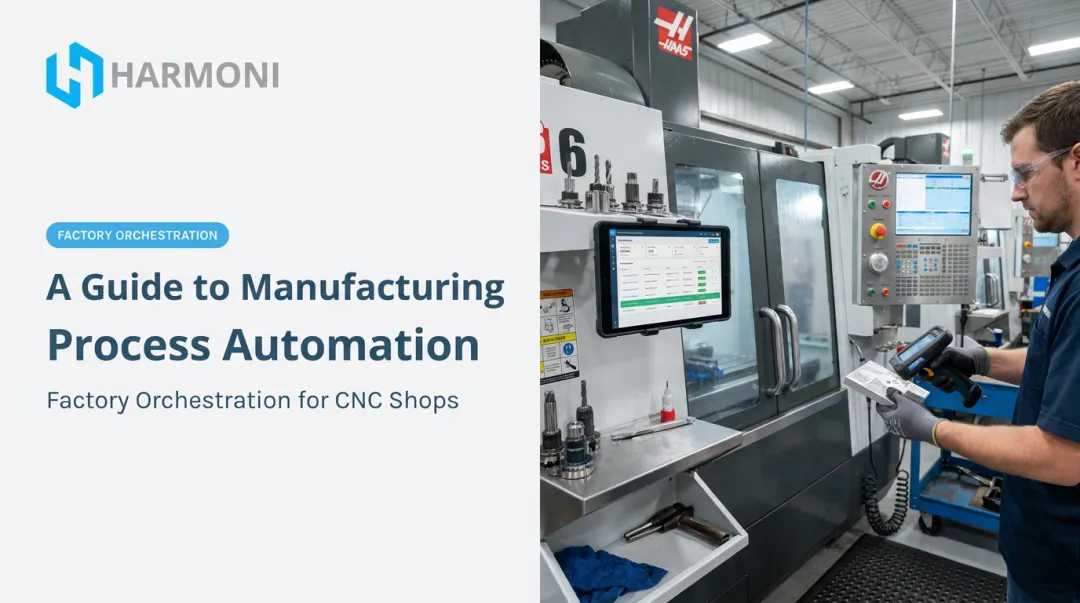
Harmoni deploys long-range RFID-enabled command centers at each machine. When an operator walks up, the terminal automatically:
- Identifies who the operator is and which job they're working on
- Starts time-and-attendance tracking at the machine, skipping the shared ERP kiosk entirely
- Loads the correct CNC program, offsets, and tool data for that exact part revision
- Surfaces the right work instructions and begins capturing cycle data

No badge swipes. No manual clock-ins. WessDel's own time study found operators were spending an average of 11 minutes per ERP transaction at shared terminals before switching to Harmoni — time that converted directly into productive machine time once eliminated.
Because Harmoni pairs operator labor with actual spindle time and classifies downtime by specific reason: changeover, breakdown, material wait, or quality hold, teams can finally answer why a delay happened, not just that it did.
This orchestration layer works alongside existing ERP and MES systems (Epicor, Infor, Infor Visual, ECI JobBoss/JobBoss2, ABAS, ODOO) rather than replacing them. It also connects to legacy and current-generation CNC controls without requiring machine replacement.
That changes the rollout timeline. Where full MES implementations often take 6 to 18 months, Harmoni deployments—including WessDel's—have gone live in under a week.
Frequently Asked Questions
How do machines communicate?
Machines convert sensor signals into digital data and send it over industrial protocols such as MQTT, OPC UA, or Modbus to a central system. Older controls often need a translation layer before they can share that data.
What are automated machines?
Automated machines run tasks using pre-programmed logic or controllers, like PLCs or robotics, with minimal human involvement. Automation doesn't automatically mean the machine shares data or connects to any network.
What is the difference between machine connectivity and machine monitoring?
Connectivity is the technical ability of a machine to transmit data. Monitoring is what you do with that data afterward, collecting it, analyzing trends, and acting on it through dashboards and reports.
What industries benefit most from connected machines?
CNC machining, aerospace, defense, precision manufacturing, automotive, and healthcare manufacturing see the biggest returns. Tight tolerances, complex job costing, and high downtime costs make visibility especially valuable in these sectors.
How long does it take to connect a factory's machines?
Timelines vary based on scope and how much legacy equipment is involved. Modern retrofit sensors and orchestration platforms can often go live within weeks, sometimes days, rather than the months a full system overhaul requires.
Do connected machines require replacing existing equipment?
No. Most legacy machines can be retrofitted with sensors and gateways instead of replaced, which is what makes connectivity accessible even for older CNC and production equipment already on the floor.