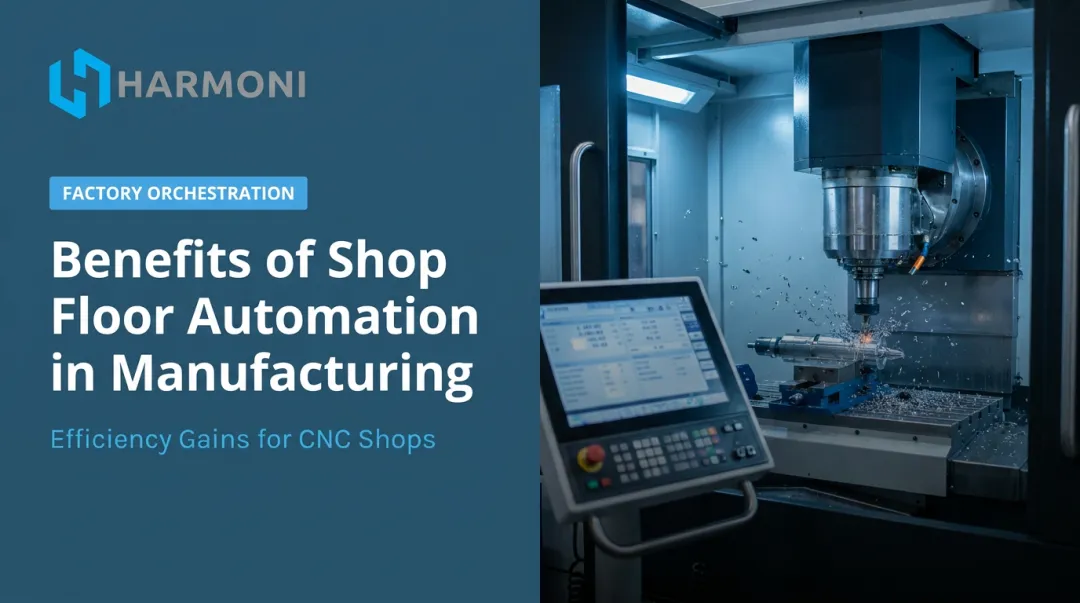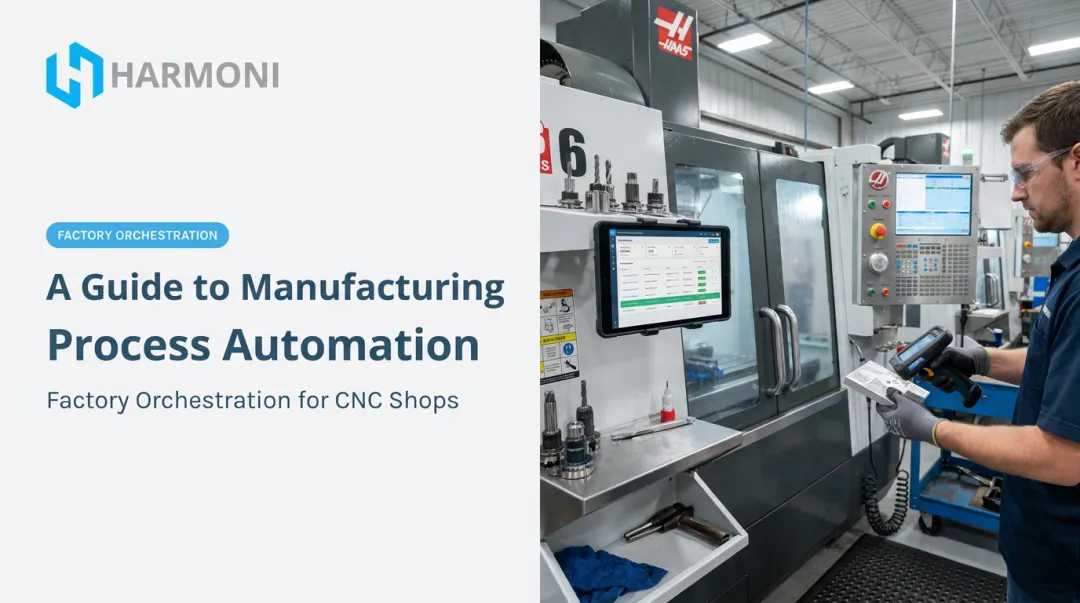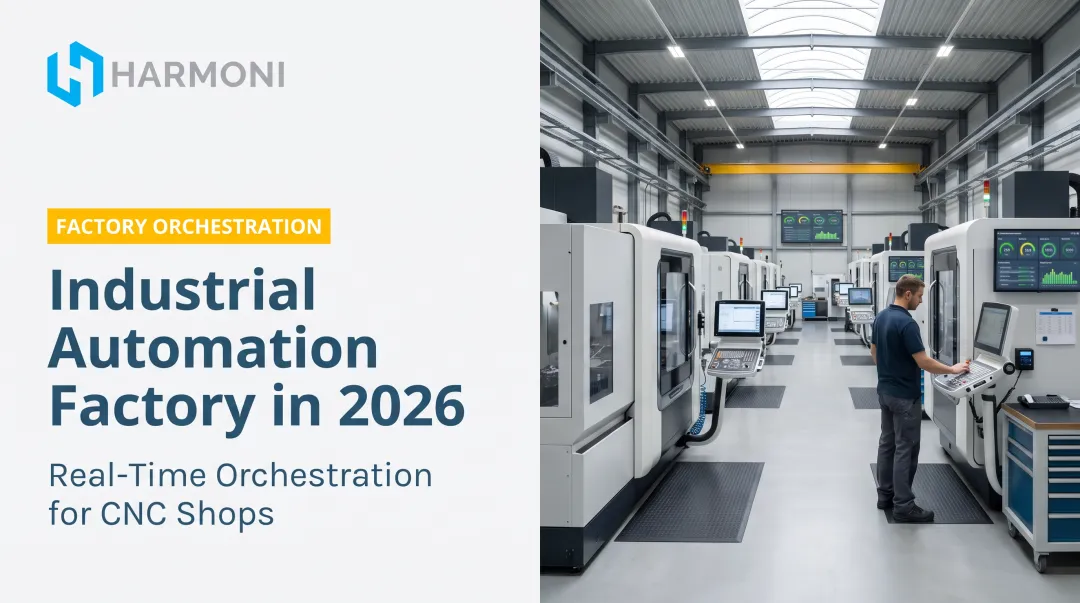

Here's the frustrating part: many plants already run ERP and MES systems. Yet operators still hunt for job specs, machines sit idle between changeovers, and scrap keeps showing up on the report nobody wants to read. The systems plan and track production, but they don't coordinate people, machines, and workflows in real time.
This guide breaks down what manufacturing process automation actually means in 2026, the benefits worth chasing, a step-by-step rollout plan, and the emerging shift toward full factory orchestration that's changing how shops close that execution gap.
Key Takeaways
- Flexible, software-driven automation is winning in high-mix shops.
- A structured rollout (analyze, prioritize, set KPIs, pilot, scale) beats buying tech first.
- Factory orchestration unites ERP, MES, machines, and operators, closing execution gaps.
- CNC, aerospace, defense, and healthcare manufacturers see the highest automation ROI.
What Is Manufacturing Process Automation in 2026?
Manufacturing process automation is the use of control systems, robotics, sensors, and software to run production tasks with minimal human intervention. That's the textbook version, and it still holds true.
But it's incomplete. The International Society of Automation distinguishes discrete manufacturing (assembling distinct, countable products like automobiles or CNC-machined parts) from continuous processing, the kind found in chemical plants and oil refining. Discrete shops are where most of this guide lives.
What's changed by 2026 is scope. Automation no longer means machines running unattended. It means coordinating data between ERP and MES systems, shop floor machines, and the humans standing at them. That coordination gap is exactly where orchestration platforms are stepping in, and we'll get there shortly.
The Three Traditional Types of Manufacturing Automation
Manufacturing automation historically falls into three buckets:
- Fixed automation: dedicated equipment built for high-volume, repetitive tasks with almost no flexibility. Think automotive stamping lines.
- Programmable automation: reprogrammable controls suited for batch runs, but requiring reconfiguration between product changeovers.
- Flexible automation: software-driven changeovers with little to no downtime between batches, common in CNC and precision job shops.
Each type trades flexibility for throughput, or vice versa. Most discrete manufacturers today are pushing toward flexible automation because product mix keeps changing faster than fixed lines can adapt.

Why 2026 Is a Turning Point for Automation Adoption
The labor math doesn't work anymore without automation. U.S. manufacturing could need as many as 3.8 million net new employees between 2024 and 2033, and roughly 1.9 million of those jobs could stay unfilled if the skills gap isn't addressed.
This is a hiring problem shops are living with right now, and it's the single biggest reason automation adoption is accelerating heading into 2026.
Key Benefits of Automating Manufacturing Processes
Eliminates Wasted Operator Time
Manual job lookups, paperwork, and shared terminals eat into productive hours before a single part gets cut. In shops relying on shared terminals, operators lost an average of 11 minutes per ERP transaction on tasks like clocking in, clocking out, and changing over jobs. Moving those transactions to the machine removed that friction from every shift change.
Improves Execution Consistency and Reduces Errors
Scrap and rework are classic internal failure costs under the American Society for Quality's Cost of Quality framework. Every inconsistent setup or missed revision adds to that pile. Digital checksheets and work instructions displayed directly at the machine catch problems before they escalate into scrap.
Real-Time Visibility Into Production
Real-time visibility means:
- Managers see machine efficiency and job progress from any device, not just at end-of-shift
- Exception alerts flag problems as they happen, not after a shipment bounces back
- Operators see off-tolerance trends in checksheet data before quality issues compound
Accountability and Labor Visibility
RFID-based tracking ties specific operators to specific jobs, machines, and durations automatically. No more guessing who ran what, or reconciling paper time cards against ERP records at month-end.
Accurate Job Costing
When real operator and machine time flows directly into ERP job costs, those costs reflect what actually happened on the shop floor. That's a different number than the one built on manually logged hours.
Step-by-Step Guide to Implementing Automation in Your Plant
Automation success depends less on the technology you buy and more on how you roll it out. Skip the structure, and even good tools underperform.
Step 1: Map and Analyze Current Shop Floor Processes
Document existing workflows across departments and shifts. Bottlenecks and manual steps hide in the gaps between systems, not inside any single one.
Step 2: Identify High-Impact Processes for Automation
Prioritize repetitive, error-prone tasks first:
- Job tracking and changeovers
- Manual data entry
- Machine monitoring and status checks
These deliver the fastest, most visible ROI.
Step 3: Define Clear Goals and KPIs
Set measurable targets before implementation, not after. OEE, cycle time reduction, scrap rate, and labor utilization all work well as baseline metrics.
Step 4: Select the Right Automation and Orchestration Technology
Decide whether you need standalone automation tools or a broader orchestration layer connecting ERP, MES, machines, and operators. Choosing technology compatible with your existing ERP and CNC controls, rather than ripping and replacing, cuts integration risk substantially. Factory orchestration platforms such as Harmoni retrofit onto existing machines and integrate with ERPs like Epicor and JobBoss, avoiding costly hardware swaps.
Step 5: Pilot Before Scaling Plant-Wide
Test on a single workcenter or line first. NIST's manufacturing extension research notes many companies plan for 12-18 months to reach full production, though a first system or process alone can take several months to structure. A tight pilot lets you resolve issues before that clock starts running plant-wide.
Step 6: Train Employees and Monitor Continuously
Hands-on training paired with real-time dashboards keeps momentum going after launch. Adoption doesn't have to be all-or-nothing, either. Many shops start with one module, such as machine monitoring, then expand as operators get comfortable with the system.

Beyond Automation: The Rise of Factory Orchestration in 2026
Here's the gap traditional automation leaves open: ERP systems plan production, MES tracks it, but neither fully coordinates real-time execution between people, machines, and engineering requirements on the floor. A perfectly planned schedule still falls apart if an operator can't find the right revision or a machine sits idle waiting on a program.
Factory orchestration is the emerging answer. Harmoni pioneered this category with a platform that sits between ERP, MES, machines, and operators, built on three pillars:
- Automation: RFID-driven workflow automation, automated CNC program loading, native ERP integration
- Process control: digital work instructions, engineering revision control, digital quality checksheets
- Observability: real-time machine data collection, OEE monitoring, shop floor dashboards
RFID-based automatic detection of nearby employees and jobs, paired with a command center at each workcenter, gives operators job context without manual lookups. The correct program, revision, and work instructions simply show up when the right person stands at the right machine.
That contextual handoff also arrives fast: unlike large-scale ERP or MES rollouts that stretch across quarters, orchestration platforms like Harmoni's are built to deploy in weeks, not months, delivering measurable improvements in execution consistency early enough to matter.
Industry Applications and Automation Trends to Watch in 2026
CNC Machining and Precision Manufacturing
Connecting machine data from CNC controls with ERP job costing eliminates the guesswork in labor tracking. Instead of estimating spindle time, shops see actual cycle performance tied directly to real jobs.
Aerospace, Defense, and Healthcare Manufacturing
These sectors carry traceability and quality demands that generic automation doesn't address. Revision control, digital checksheets, and machine-level security matter as much as throughput here — a scrapped aerospace part costs far more than the material.
Automotive Manufacturing
Automation drives consistency across high-volume lines while supporting the quick changeovers that varying part specifications demand across a shift.
The AI and IIoT Wave
Adoption is accelerating fast. Deloitte's 2025 Smart Manufacturing survey puts hard numbers behind the shift at the facility level:
- 57% of manufacturers now use data analytics
- 46% use industrial IoT
- 29% use AI or machine learning
- Average gains reported: 10-20% in production output, 7-20% in employee productivity
Advanced production scheduling ranked as a top investment priority for 35% of respondents over the next two years.

Frequently Asked Questions
What is manufacturing process automation?
It's the use of control systems, robotics, and software to run production with minimal manual intervention. The goal is faster, more consistent output with fewer quality escapes.
What is the difference between factory automation and process automation?
Factory automation covers manufacturing and assembling discrete, countable products through machines and work cells. Process automation controls continuous or batch operations, such as chemical or oil refining.
How much does it cost to automate a manufacturing plant?
Cost varies widely by scope and technology choice. Phased implementations and SaaS platforms deployable in weeks typically reduce upfront investment compared to capital-intensive, plant-wide overhauls.
How long does it take to implement automation in a plant?
Targeted solutions can go live in weeks. Plant-wide systems often take several months to a year or more, depending on integration complexity and the number of workcenters involved.
What is factory orchestration and how is it different from MES or ERP?
Orchestration sits between ERP/MES and the shop floor, coordinating real-time data across machines and operators. Harmoni, for example, works this way: ERP handles planning and MES logs production, while orchestration executes the coordination in real time on the floor.
What skills do employees need to work with automated systems?
Basic technical literacy, comfort with machine operation and troubleshooting, and familiarity with real-time dashboards cover most of it. Formal programming knowledge isn't usually required for operator-facing roles.