
What makes scrap expensive isn't that it's inevitable. It's that its root causes — poor decisions, visibility gaps, and systemic disconnects — go unaddressed until they've already done the damage.
This guide examines scrap reduction across three dimensions: decisions made before production, controls applied during production, and systemic factors that surround production. Each requires different interventions, and conflating them is one of the most common reasons scrap reduction initiatives deliver short-term gains that quickly erode.
Key Takeaways
- Scrap costs compound at every production stage — finished components cost far more to scrap than raw blanks
- The biggest scrap drivers are process instability, documentation failures, operator error, and inadequate maintenance
- Real-time monitoring is the most direct lever for catching deviations before a full batch is lost
- Effective reduction requires changes at three levels: upstream decisions, active floor controls, and systemic context
- Sustainable results depend on cross-functional accountability and continuous improvement — not one-time fixes
How Scrap Costs Accumulate in Manufacturing
Most scrap discussions focus on the moment a part gets rejected. The actual cost problem starts much earlier.
Every production stage adds accumulated value to a workpiece — raw material cost, machine time, tooling wear, labor, and overhead. When a part is scrapped at the finished stage, all of that accumulated investment is lost.
As Modern Machine Shop notes, scrap reduction deserves significantly more attention when raw materials are costly, prior machining operations are numerous, or cycle times are long. The later a defect is caught, the more expensive the loss.
The Hidden Cost Layers
The problem is that many scrap costs don't appear on a scrap report at all. They hide in:
- Rework hours spent correcting parts that slipped through first inspection
- Extra inspection time triggered by elevated reject rates
- Rush purchasing to replace scrapped parts and hold delivery schedules
- Inflated job cost estimates that never isolate scrap as the root cause
Energy consumption, material handling, disposal, and quality assurance expenses are additional scrap-cost elements that rarely show up in standard job cost reports. That invisibility drives inaction — if leadership can't see the full cost, the urgency to fix it stays low.
These hidden layers also explain why scrap rarely gets fixed through a single corrective action. The costs are distributed across too many line items to trigger an obvious alarm.
Why Scrap Builds Gradually
Scrap events rarely announce themselves. They build through specific triggers: a cutting tool crossing a wear threshold, a weld-zone temperature drifting outside its tested range, an operator referencing a drawing from the previous revision. Each event is small. The cost only becomes visible when these events cluster or compound — by which point multiple jobs may already be affected.
This gradual accumulation is why real-time visibility matters. By the time shift-end inspection surfaces a pattern, several jobs worth of material and labor have already been lost.
What Drives Scrap in Manufacturing
Scrap originates from two distinct points: upstream decisions made before production starts, and real-time execution failures that emerge mid-run. Which category dominates depends on the type of manufacturer and the maturity of its process controls.
The Main Categories of Scrap Drivers
| Driver | Description |
|---|---|
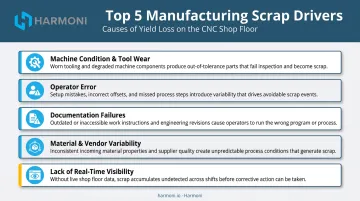
| Machine condition and tool wear | Tool wear affects surface roughness, dimensional integrity, milling force, and residual stress — all scrap precursors |
| Operator error | Incorrect offset calculations, wrong program selection, or misread setup instructions |
| Documentation failures | Operators working from outdated BOMs, wrong revision levels, or handwritten travelers |
| Material and vendor variability | Inconsistent incoming material — tensile strength, alloy composition, or cutting tool quality |
| Lack of real-time visibility | Process deviations that go undetected until inspection or shift end |
High-Mix vs. High-Volume: Different Risk Profiles
In high-mix, low-volume environments — CNC machining shops, precision job shops, aerospace components — the dominant risks are setup errors, operator interpretation of specs, and inadequate job handoff between shifts. Every new job is a fresh opportunity for setup error, and the infrequency of each run means operators have less repetition to catch drift before it becomes scrap.
In high-volume environments, the primary risks shift to equipment drift and process parameter instability. A weld-zone temperature that drifts 50°F off-target — as in the Tenneco case where a 1.32% defective rate on steel tubing was traced to process parameter variation — can affect thousands of parts before anyone catches it.
Knowing which profile fits your shop tells you where to focus — and which controls will actually move the needle on scrap rates.
Cost-Reduction Strategies for Manufacturing Scrap
Scrap reduction strategies are not interchangeable. Their effectiveness depends entirely on where scrap originates in a specific operation. The three strategy groups below reflect three distinct origin points: upstream decisions, active floor management, and the systemic context surrounding production.
Strategies That Reduce Scrap by Changing Decisions
These approaches target decisions made before or around production begins.
Several upstream decisions consistently generate scrap before a single part is cut. Addressing them in sequence:
Design for Manufacturability (DFM): Many scrap events are baked in at the design stage — tolerances tighter than the process can reliably hold, geometries requiring excessive setup time, or material specifications that are difficult to source consistently. NIST research confirms that design-phase decisions account for a disproportionate share of total product cost, and that the cost of design changes escalates steeply once production has begun. Reviewing designs through a manufacturability lens before the first part is cut eliminates an entire category of avoidable scrap.
Incoming material variability is a structural scrap driver that's easy to overlook because it doesn't originate on the shop floor. Three practices close the gap:
- Certify materials to verified specifications before they enter the queue
- Audit vendors on a scheduled basis, not just after a quality event
- Track scrap events back to specific material lots to identify problematic suppliers before they affect production at scale
Communication failures cause a separate category of avoidable scrap. An operator working from last quarter's work instruction, a spec change that didn't reach the floor in time, a handwritten job traveler misread between shifts — these are all preventable. Platforms like Harmoni address this by ensuring that only the current, system-verified version of a work instruction, CNC program, or part revision reaches the operator. As Harmoni documents directly: "Gone are the days of printing work instructions for the wrong part or an old revision."
Training based on intuition and "feel" introduces variability — especially with high turnover in CNC environments. Programs built around real machine data, standardized procedures, and measurable benchmarks reduce setup errors and first-piece scrap rates more reliably than experience-based knowledge transfer alone.
Strategies That Reduce Scrap Through Active Floor Management
These approaches focus on catching deviations before they produce a defective part.
Real-Time Shop Floor Visibility and Monitoring
Scrap reduction stalls when managers can only see what happened after a shift ends. Real-time dashboards and machine monitoring allow teams to detect process drift, abnormal cycle times, and part rejections while production is still running. Harmoni's platform brings machine data, ERP workflows, and operator activity into a unified view — so a supervisor can act on a quality issue while the job is still on the machine, not after a batch is already scrapped.
Quality Magazine reports that real-time SPC using live quality data can help manufacturers reduce scrap, waste, defects, and rework — and the Tenneco case study demonstrates what that looks like in practice: a 50% scrap rate reduction on steel tubing after applying DMAIC, process capability analysis, and statistical controls to a 1.32% average defective rate.
Process Control Through Digital Work Instructions
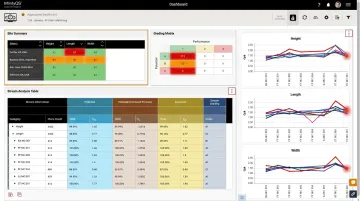
Delivering the right instructions to the right operator at the right step — automatically — eliminates the interpretation errors that drive scrap in complex jobs. Harmoni's approach ties work instructions directly to specific parts, revisions, operations, and machines, so the operator never has to locate, verify, or retrieve documentation manually. The system presents only the approved, current version.
Condition-Based Maintenance and Tool Monitoring
NIST research found that high reliance on reactive maintenance was associated with 16 times more defects than low reactive-maintenance operations. Predictive maintenance strategies produced an 87% lower defect rate compared to preventive maintenance alone. The practical implication: moving beyond fixed maintenance schedules to condition-triggered interventions — using load, temperature, and vibration data — catches problems before they produce defective parts rather than after.
Scrap Tracking and Structured Root Cause Analysis
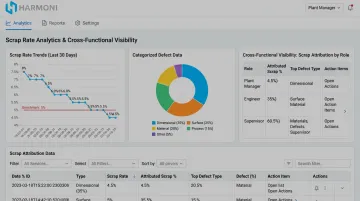
Without categorized, real-time scrap data tied to specific machines, operators, jobs, and shifts, improvement efforts lack direction. Harmoni captures scrap quantities and reasons directly at the machine HMI and matches them to the specific machine cycles recorded — a precision that matters for accurate OEE calculations and for identifying exactly when and where scrap occurred. One Harmoni customer reduced scrap by 22% in two months after implementation.
Strategies That Reduce Scrap by Changing the Context Around Production
These approaches address the information gaps and organizational structures that surround production.
ERP-to-Floor Integration
One of the most persistent scrap drivers in mid-to-large manufacturers is the gap between what lives in the ERP — job specs, revision levels, routing instructions — and what actually reaches the operator. Harmoni's bi-directional ERP integration with systems like Epicor, Infor, JobBoss, and ABAS closes this gap by ensuring operators work from current, system-verified information rather than what was printed at job setup.
Cross-Functional Scrap Ownership
Scrap is commonly treated as a quality department problem. Root causes span engineering, maintenance, scheduling, and procurement. Making scrap metrics visible across functions — and assigning accountability at the team level, not just the QC department — creates the sustained pressure that drives meaningful reduction. Harmoni's role-based dashboards surface scrap data to plant managers, supervisors, engineers, and schedulers simultaneously, all working from the same underlying data.
Continuous Improvement Using Scrap Data as the Input
One-time scrap reduction initiatives typically deliver short-term gains that erode without a structured system to sustain them. Embedding scrap rate analysis into regular operations reviews — using Lean or Six Sigma frameworks — ensures that scrap trends are monitored continuously and that gains are reinforced rather than reversed. That requires the data infrastructure to already be in place: categorized scrap events, accurate cycle-level attribution, and trend visibility over time — before the first improvement meeting, not after.
Conclusion
Manufacturing scrap becomes expensive not because it's inherent to production, but because its root causes go unaddressed. The path to reduction is diagnosing where scrap originates in your specific operation — upstream in decisions, in execution, or in the systems surrounding production — and applying the right interventions at each level.
The manufacturers who sustain the lowest scrap rates treat real-time visibility, process control, and cross-functional accountability as ongoing operating disciplines. Sustaining those disciplines over time is what separates shops that fix scrap once from shops that stop generating it.
Harmoni's factory orchestration platform is built around exactly those three levels — automation, process control, and real-time observability. Request a free demo at harmoni.io/demo to see how it applies to your operation.
Frequently Asked Questions
How can scrap reduction software help reduce scrap costs?
Scrap reduction software gives manufacturers real-time visibility into defects and process deviations as they happen, enabling faster intervention before losses compound. Advanced platforms like Harmoni integrate machine data, operator activity, and ERP workflows to identify root causes and prevent recurrence, rather than recording losses after the fact.
What is a good scrap rate in manufacturing?
Acceptable scrap rates vary by industry and process complexity. APQC benchmarks show top performers at 0.6% of sales and bottom performers at 2.2%. A more useful measure is whether your scrap rate is declining consistently and whether root causes are identified and resolved.
How do you calculate scrap rate in manufacturing?
The standard formula: scrap rate = unusable units ÷ total units produced. A more complete calculation incorporates the dollar value of scrapped material plus rework labor, energy, handling, and quality assurance costs — costs that most job costing systems underreport.
What are the most common causes of scrap in manufacturing?
The most cited causes are tool wear not caught before it produces defects, operator error from unclear or inconsistent instructions, process parameters drifting out of tolerance, material quality issues from vendors, and engineering changes that don't reach the shop floor in time.
How does real-time monitoring help prevent manufacturing scrap?
Real-time monitoring detects process deviations (abnormal cycle times, machine faults, out-of-tolerance conditions) while production is still running, enabling intervention before a full batch is scrapped. Without it, most scrap events surface during inspection or at shift end — when the material, machine time, and labor are already lost.