
Most manufacturers know this data exists. Far fewer know how to capture it, make sense of it, and turn it into decisions that actually improve production.
This guide breaks down what machine data really is in a manufacturing context, the types you'll find on a typical shop floor, and the five biggest ways it gets used. We'll also cover why raw machine data alone usually isn't enough, and what it takes to unlock its full value.
Key Takeaways
- Equipment, sensors, and systems generate machine data automatically, without any manual entry
- Shop floors generate it nonstop, from CNC controllers, PLCs, sensors, and robotic arms
- Key uses include OEE tracking, predictive maintenance, scrap reduction, and accurate job costing
- Combining raw machine data with operator and ERP data makes it actionable
What Is Machine Data in a Manufacturing Context?
Machine data is the digital exhaust produced by the computer processes and automated activity of industrial equipment on the shop floor. MESA International, the manufacturing standards body, defines manufacturing data as production-process information collected either manually or through sensors and automation, drawing a clear line between automatically captured machine data and manually recorded human data, according to its guide on information in manufacturing.
That distinction matters. Machine data is generated automatically and continuously. It captures a definitive, timestamped record of every action and event, whether or not anyone is around to see it happen.
Machine-Generated vs. Human-Generated Data
The difference shows up constantly on a real production floor:
| Data Type | Example | Characteristic |
|---|---|---|
| Human-generated | Operator manually logs a scrap count at the end of a shift | Subjective, often delayed by hours |
| Machine-generated | CNC controller logs an alarm code the instant it fires | Objective, granular, immediate |
Neither type is "wrong." But when a decision needs to happen fast, machine data is the one you can trust to be accurate.
Structured vs. Unstructured Machine Data
Machine data also comes in different formats:
| Format Type | Example |
|---|---|
| Structured | PLC register reporting part count or cycle time in a consistent format—easy to store, query, and chart |
| Unstructured | Free-text alarm messages or error logs that vary between machines and vendors |
Think of machine data as the black box recorder for your production process. It captures what happened, when it happened, and how it happened, whether that's a spindle overload or a five-second pause between parts.
The Key Types of Machine Data on the Factory Floor
Generic IT machine data, like server or website logs, comes from a handful of predictable sources. Manufacturing machine data doesn't work that way. It comes from dozens of industrial sources, each speaking its own dialect.
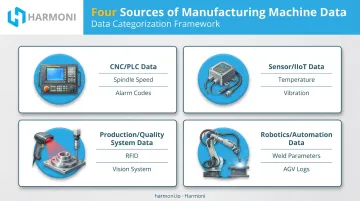
CNC Machine and PLC Data
Machine controllers from Haas, Fanuc, Siemens, and Mazak all expose operational data, though the exact fields and access methods vary by brand and model. Common data points include:
- Program number and operational mode (running, idle, alarm)
- Spindle speed and feed rate
- Tool numbers and tool change events
- Alarm and error codes
- Cycle time and machine on/motion time
Fanuc's MT-LINKi, for example, pulls alarm history, spindle motor temperature, and feed-rate overrides directly from the controller. Haas exposes similar data through its NGC Q-command interface, including part counters and last cycle time.
Sensor Data (IIoT)
Sensors added to equipment or the surrounding environment fill in the gaps controllers can't see:
- Temperature and vibration
- Pressure and humidity
- Power consumption
- Fluid and coolant levels
Vibration and temperature readings are especially valuable for spotting bearing wear or motor strain before a breakdown. Gradual shifts in a baseline pattern often show up long before a failure does.
Production and Quality System Data
Supporting shop floor systems generate their own streams:
- Barcode scanner inputs
- RFID tag reads from parts, tools, and personnel
- Coordinate Measuring Machine (CMM) reports
- Vision system pass/fail outputs
Harmoni uses RFID tag reads to automatically capture who's working which job at which machine, without a manual login step.
Robotics and Automation Data
Automated equipment adds a fourth layer:
- Robot arm position and path data
- Weld parameters
- Pick-and-place cycle counts
- Error logs from automated guided vehicles (AGVs)
What Is Machine Data Used For? Top 5 Manufacturing Applications
Collecting machine data is only step one. The real value shows up when you apply it to specific production problems.
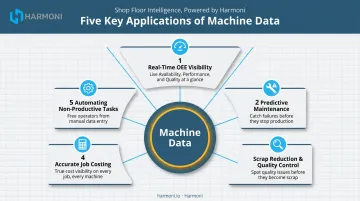
Gaining Real-Time Production Visibility (OEE)
Machine data supplies the raw inputs for Overall Equipment Effectiveness, calculated as Availability x Performance x Quality. ASQ cites 85% as a common automotive-industry benchmark, though that figure isn't a universal target for every industry.
- Availability: Track uptime, downtime, and alarm states automatically, no manual logs required
- Performance: Compare actual cycle times against ideal cycle times to catch slowdowns
- Quality: Correlate machine parameters with quality-system data (like CMM reports) to trace defect root causes
Enabling Predictive and Proactive Maintenance
Reactive maintenance means fixing things after they break. Predictive maintenance means catching problems before they do, using sensor trends like rising vibration or climbing motor temperature.
A NIST survey on manufacturing machinery maintenance found that shops relying more heavily on predictive and preventive maintenance reported 52.7% less unplanned downtime and 78.5% fewer defects than shops that leaned on reactive approaches. That's an observed association, not a guaranteed outcome, but it's a compelling reason to watch the trend lines.
Example: Tracking a motor's power draw and temperature over weeks can reveal when bearing wear is accelerating, letting maintenance get scheduled during planned downtime instead of an unplanned line stop.
Reducing Scrap and Improving Quality Control
When a batch fails inspection, machine data lets you go back and look at exactly what happened during that run: tool wear, spindle temperature, axis load.
Instead of guessing at what went wrong, you can pinpoint the specific anomaly, whether that's a tool that should've been swapped two cycles earlier or a spindle running hotter than normal. Once that root cause is confirmed, the same data helps set tighter process limits for the next run, so the same defect doesn't reappear on future batches.
Achieving Truly Accurate Job Costing
ERP systems typically rely on standard costs, which are estimates. Machine data gives you actuals: real cycle times, real setup times, real downtime for a specific job run.
That gap between estimated and actual cost is exactly where profitable-looking jobs turn unprofitable without anyone noticing. This is one of the reasons Harmoni's platform ties machine cycle time and operator labor records together, so job costs reflect what actually happened on the floor rather than a standard-cost assumption.
Automating Non-Productive Tasks
Machine data can trigger workflows without waiting on someone to notice a problem. When a machine hits a specific alarm state, a connected system can:
- Create a maintenance ticket automatically
- Notify a supervisor by text
- Update the production schedule
These automated responses close the gap between a problem occurring and someone addressing it, which is often where hours of downtime pile up unnoticed.
The Big Challenge: Why Raw Machine Data Isn't Enough
Here's the part most manufacturers run into eventually: collecting machine data is one thing, but the raw feed by itself is often more noise than signal.
NIST frames big data around scale and three defining properties, and shop floors run into all of them fast:
- Volume: A single CNC machine can generate thousands of data points per minute. Multiply that across dozens of machines and the deluge becomes hard to manage without the right architecture.
- Variety: Fanuc, Haas, Mazak, and Siemens controllers all format data differently, with different field names and interfaces. Standardizing across a mixed fleet is genuinely difficult.
- Velocity: Data streams in real time. If it isn't processed quickly, it's useless for the decision that needed it five minutes ago.
But volume, variety, and velocity aren't even the biggest obstacle. Context is.
Raw machine data tells you what a machine is doing. It doesn't tell you why. It doesn't know who's operating it, what job it's supposed to be running, or whether that job is ahead or behind schedule.
A machine sitting idle could mean a lunch break, a materials shortage, or a five-alarm problem. The raw data alone can't tell the difference.
How Factory Orchestration Unlocks the Value of Machine Data
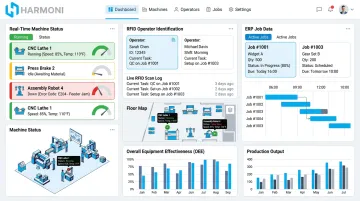
Closing the context gap is exactly the problem factory orchestration platforms exist to solve. Rather than treating machine data as its own isolated stream, an orchestration layer sits between machines, people, and business systems like ERP and MES, pulling every stream together into one coherent picture.
Here's what that looks like in practice, using Harmoni's approach as the model:
- Machine status data confirms Machine #5 is idle
- RFID-based operator identification confirms operator John Doe is logged in at that workcenter
- ERP job data confirms Job #123 is scheduled to run there next
Combined, those three streams turn a vague alert into a specific, actionable insight: Machine #5 is idle because John Doe is waiting on materials for Job #123. A supervisor can act on that immediately, instead of walking the floor trying to figure out what's actually happening.
This is the shift from raw data to actionable intelligence. Harmoni's platform is built around three pillars designed to make that shift possible:
- Automation: RFID-driven workflow automation and automatic CNC program loading
- Process control: Digital work instructions, engineering revision control, and quality checksheets
- Observability: Real-time machine data collection, OEE monitoring, and shop floor dashboards
At Machine Specialties, Inc. (MSI), a shop running Epicor ERP alongside a fleet of CNC machines, that combination gave operators direct access to job data, work instructions, and quality checksheets at every machine. The result replaced paper travelers with real-time, contextualized information across the shop floor.
Machine data on its own is a record of what happened. Paired with operator and ERP context, it becomes something a supervisor can actually act on.
Frequently Asked Questions
What is machine data?
Machine data is information automatically generated by computer systems and industrial equipment without human input. It creates a real-time, objective record of operations, from spindle speeds to alarm codes.
What are examples of machine data?
Common examples include CNC alarm codes, sensor temperature and vibration readings, PLC cycle counts, tool change events, and robot arm position data. Each comes from a different piece of shop floor equipment.
Is machine data big data?
It can be. A single machine's output might not qualify on its own, but aggregated data from an entire factory typically hits the volume, variety, and velocity thresholds that define big data.
How is machine data different from IIoT data?
IIoT data, mostly from networked sensors, is one type of machine data. Machine data is the broader category, also covering data from machine controllers like PLCs and CNCs, plus quality and production systems.
What's the first step to start collecting machine data on the shop floor?
Start with a high-value machine, then decide which metrics matter most (uptime and downtime are a good starting point). Finally, choose a platform that connects to its specific controller.
How does machine data improve production scheduling?
Real-time status and accurate cycle times let scheduling systems adjust dynamically when downtime or performance shifts occur. That produces production plans based on what's actually happening, not what was estimated weeks earlier.