
Introduction
Physical keys are on their way out. Most modern facilities now run on digital credentials, cards, fobs, or even phones that unlock doors with a tap. RFID made that shift possible, and it's moving well past simple door entry into industrial territory.
Facility and plant managers know the pain points well:
- Lost keys mean expensive rekeying
- Terminated employees keep access until someone swaps the locks
- Incidents often leave no record of who was where, or when
This guide breaks down how RFID access control works, the frequency ranges that determine read distance, and the core benefits over mechanical locks. We'll also cover a use case most access control guides skip: on the shop floor the same RFID technology does more than record who passed through a door. A read at the workcenter identifies the operator, pulls in the ERP job context, and triggers the next correct step—turning an access event into an execution signal instead of another log entry.
Key Takeaways
- RFID replaces mechanical keys, so you can issue or revoke access centrally without rekeying locks
- Choose frequency by range need: centimeters for door credentials, several meters for industrial tags
- Encrypted HF credentials cut cloning risk common with older 125 kHz cards
- The same RFID logic now identifies operators and jobs at CNC machines
- Platforms like Harmoni turn shop-floor RFID data into real-time production dashboards
What Is an RFID Access Control System?
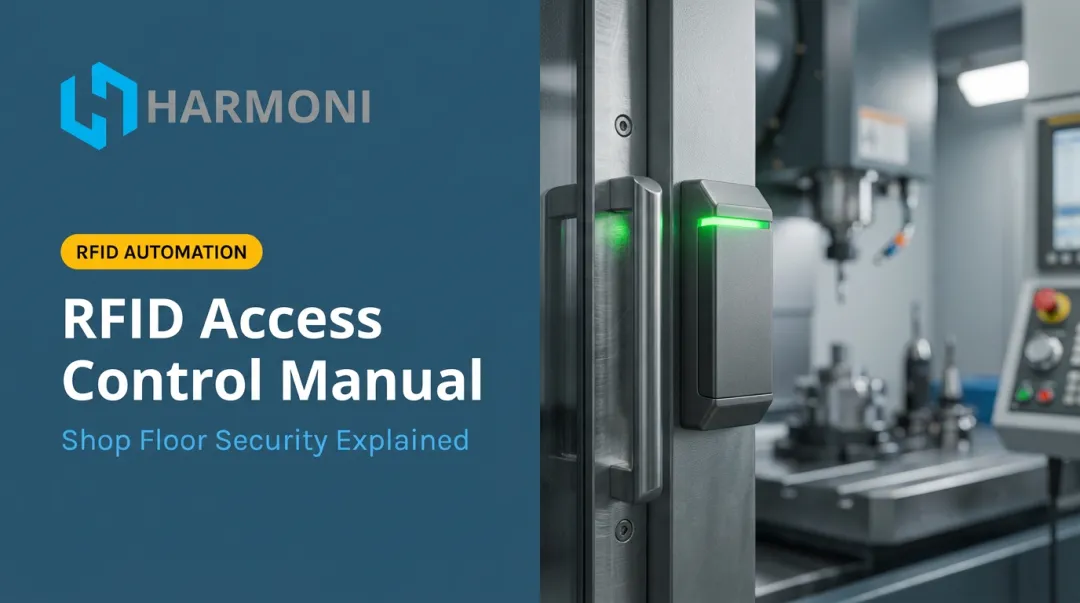
An RFID access control system uses wireless credentials—tags, cards, fobs, or smartphones—to grant or deny entry without a physical key. Because credentials are digital, administrators can issue or revoke access instantly from a central system rather than swapping out locks.
The mechanics are simple. Each credential contains a small chip and antenna storing a unique ID number. When that credential comes near a reader, the reader detects the signal, verifies the ID against its access list, and sends a signal to unlock the door if access is authorized.
Passive vs. Active RFID
There are two main categories of RFID, and the difference comes down to power source.
Passive RFID has no internal battery. It draws power entirely from the reader's electromagnetic field, so you hold a card or fob close to the reader for it to work. This is the technology behind most standard door access cards and key fobs.
Passive credentials are practical because they are:
- Cheap to produce at scale
- Maintenance-free (no battery to replace)
- Durable enough to last for years
Active RFID contains its own battery and actively broadcasts a signal rather than waiting to be powered by a reader. That built-in power source allows for a much longer read range, which is why active tags show up in vehicle gate access and asset tracking rather than standard office doors.
Semi-passive RFID (battery-assisted passive) sits in the middle: a battery powers onboard electronics or sensors, but the tag still relies on the reader to start communication. These show up more in industrial sensor applications than in everyday door access.

RFID Frequency Ranges: How Far Can RFID Actually Be Read?
Read distance isn't just about whether a tag has a battery. Frequency band matters more. Three bands dominate access control and industrial tracking, and each behaves very differently.
| Band | Frequency | Typical Read Range | Common Uses |
|---|---|---|---|
| LF | 125 kHz | A few inches | Legacy key fobs, older facilities |
| HF | 13.56 MHz | 3–6 in (7–15 cm) | Secure door access, NFC / mobile |
| UHF | ~900 MHz | ~10 ft / 3 m (passive) | Gates, parking, shop-floor tracking |
Low Frequency (LF) – 125 kHz
LF credentials work at near-tap distance, just a few inches. They're common in legacy key fobs still in use at older facilities. The catch: HID's history of access credentials notes that these 125 kHz proximity cards were never encrypted, which makes them relatively easy to clone or spoof. Short range doesn't mean secure.
High Frequency (HF) – 13.56 MHz
HF is the current standard for secure door access and mobile or NFC credentials. According to NIST's guidelines for securing RFID systems, typical HF read ranges fall between roughly 7 and 15 centimeters (about 3–6 inches), sometimes stretching closer to a meter depending on the credential type.
HF supports real encryption standards like MIFARE, which is why it has replaced LF in most new installations.
Ultra-High Frequency (UHF) – 900 MHz
UHF trades close-range precision for distance. NIST's research places typical UHF operating range around 3 meters (about 10 feet) for passive systems, with battery-powered active tags capable of reaching much farther.
That's why UHF shows up in vehicle gate access, parking systems, and long-range tracking of people or equipment across large facilities.
In manufacturing environments, that same reach lets a system detect an approaching operator without requiring them to stop and badge in.
Key Benefits of RFID Access Control
Compared to mechanical locks, RFID solves persistent operational headaches:
- Issue or revoke access from one dashboard instead of rekeying physical locks, cutting admin time and locksmith costs
- Log every credential read automatically for investigations and compliance reviews
- Deactivate a missing card in seconds; a missing mechanical key means changing every lock it opens
- Run passive credentials for years with no batteries or routine replacement
- Scale the same reader-and-controller setup from one door to a multi-building campus
Mechanical keys offer none of this. A stolen or copied key creates ongoing risk with zero visibility into who used it or when.
RFID Beyond the Door: Real-Time Visibility on the Manufacturing Floor
Most RFID guides stop at building entry. But in manufacturing, RFID tracks more than who entered the building—it shows who's working on what, and whether it's the right job.
Manual clock-ins, paper travelers, and whiteboard job boards still run a lot of shop floors. Operators walk to a shared kiosk to badge in, dig through paperwork to confirm the right part revision, then hope the CNC program they load actually matches. Every one of those steps is manual, and every one is a chance for wasted time or a costly mix-up.
How RFID Detection Works at the Workcenter
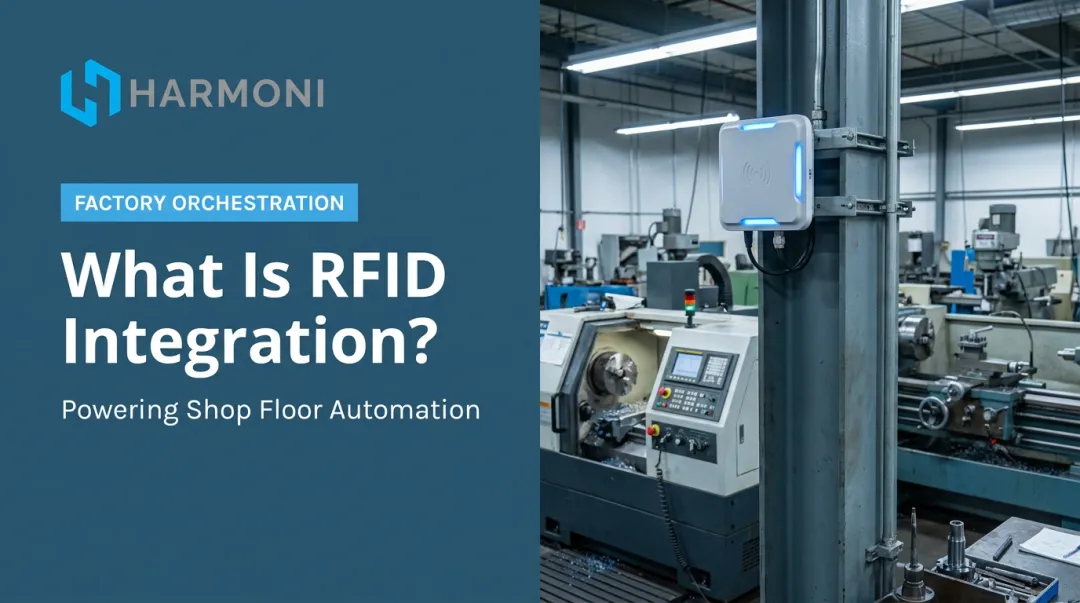
Harmoni's factory orchestration platform applies long-range RFID directly at the machine level rather than just the door. The flow works like this:
- Apply inexpensive RFID tags to employee badges and job paperwork (travelers or work orders)
- As an operator approaches the machine, the Harmoni terminal reads both tags automatically—no badge swipe or manual login
- The system cross-references the job against the connected ERP (Epicor, Infor, Infor Visual, ECI JobBoss/JobBoss2, ABAS, or ODOO) and pulls the correct work order, part revision, and operations
- The terminal loads the correct CNC program, offsets, and tool data, then surfaces matching work instructions and setup sheets

If an operator is clocked onto multiple jobs at once, the terminal shows a separate tab for each one, so there's never ambiguity about which program to run.
From Door Logs to Full Production Visibility
Traditional access systems stop at an entry/exit log. Harmoni's RFID detection instead feeds real-time dashboards that combine three data streams into one view:
- Machine data – cycle states, OEE across availability, performance, and quality, downtime classification
- ERP workflow data – job costing, scrap, capacity planning, on-time delivery
- Operator activity – time-and-attendance, labor charged per job, quantities completed and scrapped
That combination matters because it prevents the classic shop-floor mistake: the right operator loading the wrong program, or labor time getting charged to the wrong job. For jobs that need tighter control, Harmoni adds facial recognition as a second authentication step. ITAR and CMMC-aligned environments rely on this layered approach in particular.
The results are measurable. In one deployment at WessDel, a CNC shop, this kind of RFID-enabled automation delivered 17 productive hours gained per employee per month and a 5X ROI just from eliminating manual ERP transaction time. That installation, including RFID-enabled machine monitoring and ERP integration, went live in under a week.
Manufacturers typically see these gains:
- Eliminates wasted operator time walking to shared terminals
- Improves execution consistency across shifts
- Prevents scrap by matching the right operator to the right job automatically
- Enables accurate job costing across CNC machining, aerospace, defense, and automotive production
None of this requires ripping out existing equipment. Harmoni connects to CNC controls from Mazak, Haas, Fanuc, Heidenhain, Siemens, DMG MORI, Makino, and Fadal, and typically deploys in weeks rather than the months a full MES or ERP overhaul would take. You can see how it fits a specific shop floor by requesting a demo.
How to Choose the Right RFID Access Control System
Before comparing vendors, get clear on what problem you're actually solving.
Start with the use case. Is this purely physical security for doors, or does it also need to support labor tracking and production visibility on a shop floor? Those are different problems with overlapping technology.
Evaluate integration requirements:
| Goal | What to check |
|---|---|
| Building security | Compatibility with existing door hardware, controllers, and wiring |
| Production orchestration | Native integration with your ERP (Epicor, Infor, JobBoss, ABAS, ODOO) and CNC controllers |
| Compliance (ITAR/CMMC) | Multi-factor authentication support and government cloud options |
Factor in cost and scalability. For standard commercial door access, expect roughly $2,000 to $5,500 per door installed. That typically includes:
- Reader, controller, lock hardware, cabling, and labor
- Individual card readers at $250 to $500
- Credentials at $5 to $15 each
For industrial deployments tied to labor tracking or production orchestration, weigh integration costs against labor and error-reduction savings. A shop recovering 17 hours of productive time per employee per month, as in the WessDel example above, pays back an integration cost quickly.
ROI improves further when RFID replaces manual data entry across the production floor—not only when it secures a door.
Frequently Asked Questions
What is an RFID entry system?
An RFID entry system is a wireless access setup where a nearby reader detects a tag, card, or fob and either grants or denies entry based on the credential's assigned permissions. It can replace mechanical locks and keys for controlled doors and gates.
What are the two main types of RFID entry systems?
Passive RFID has no battery and draws power from the reader, making it common in door access cards. Active RFID has its own battery and broadcasts a signal, giving it a much longer range used in vehicle and asset tracking.
How far away can RFID entry systems be read?
Range depends on frequency band. LF and HF door credentials read from a few centimeters to about a meter. UHF systems used for vehicles or industrial tracking can reach several meters—farther still with active tags.
Can RFID cards be cloned or copied?
Older, unencrypted 125 kHz LF cards can be cloned fairly easily with inexpensive scanners. Modern encrypted HF credentials, such as MIFARE DESFire, use AES and 3DES encryption that significantly reduces that risk.
Is RFID access control more secure than traditional keys?
RFID improves on mechanical keys through instant credential revocation and automatic audit trails. That said, actual security still depends on the credential type—encrypted HF beats unencrypted LF every time.
Can RFID be used for more than security in a manufacturing environment?
Yes. Beyond securing doors, RFID can automatically identify operators and jobs at CNC workcenters, feeding that identity data into factory orchestration platforms such as Harmoni for accurate job costing, labor tracking, and real-time shop floor visibility.