
What Is IoT in Manufacturing?
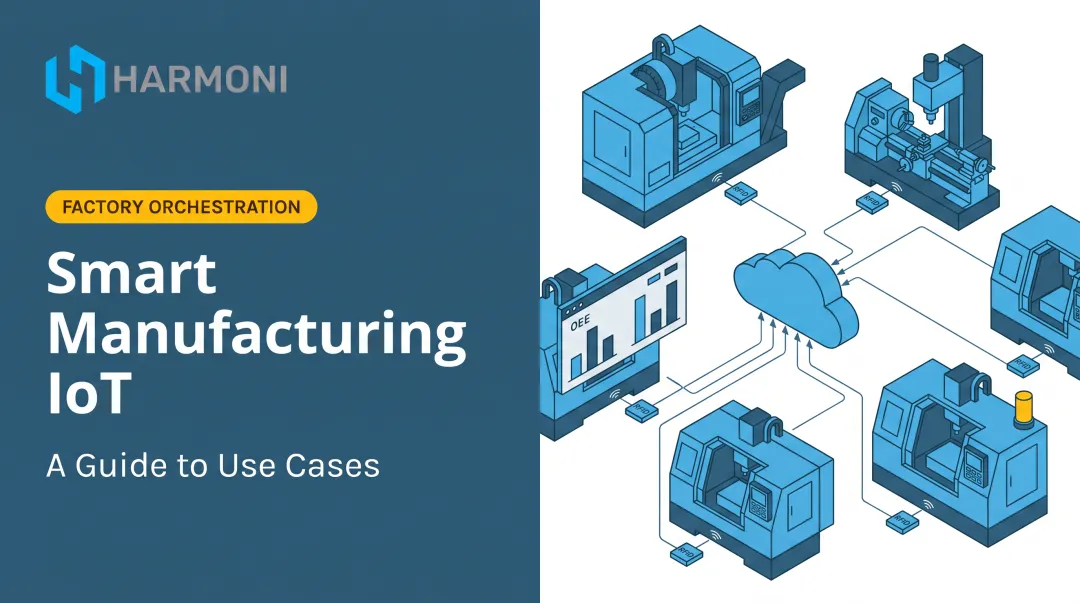
IoT in manufacturing — more precisely called IIoT, or Industrial IoT — refers to the network of interconnected sensors, machines, and devices that collect and exchange real-time data to enable automation, visibility, and smarter decision-making across the factory floor and supply chain.
The distinction from consumer IoT matters. A smart thermostat losing connection is an inconvenience. A sensor failure on a CNC spindle or a quality system going dark mid-production run carries real operational and financial consequences. Industrial applications demand a fundamentally different level of precision, reliability, and security.
The investment numbers reflect that reality. According to Grand View Research, the global IIoT market was valued at $483.2 billion in 2024 and is projected to reach $1,693.44 billion by 2030 — a 23.3% CAGR. Manufacturers have moved past the pilot phase. IIoT is now core infrastructure.
Key Takeaways
- IIoT connects machines, operators, and systems to deliver real-time visibility into production performance and equipment health
- The highest-impact use cases are predictive maintenance, machine monitoring, inline quality control, safety monitoring, and asset tracking
- Sensors generate data, but that data only drives results when it reaches the right person with enough context to act on it
- Mid-to-large manufacturers in CNC machining, aerospace, and defense stand to gain the most — where downtime and quality failures carry the steepest costs
Top IoT Use Cases in Manufacturing
Predictive Maintenance
Traditional maintenance falls into two costly traps: fixing equipment after it breaks (reactive), or replacing parts on a calendar schedule regardless of actual condition (preventive). Neither approach is optimal.
IoT sensors change the equation by continuously monitoring machine parameters — temperature, vibration, electrical draw, cycle counts — and flagging anomalies before they cascade into failures. A bearing running hot at 2 AM gets flagged before the shift supervisor arrives. A spindle showing abnormal vibration triggers a work order before it causes scrap.
The U.S. Department of Energy reports that predictive maintenance programs can:
- Eliminate 70–75% of breakdowns
- Reduce downtime by 35–45%
- Deliver a 10x return on investment
- Produce 8–12% cost savings over purely preventive approaches

For manufacturers running precision equipment — five-axis machining centers, grinding machines, EDM — those numbers translate directly to protected revenue.
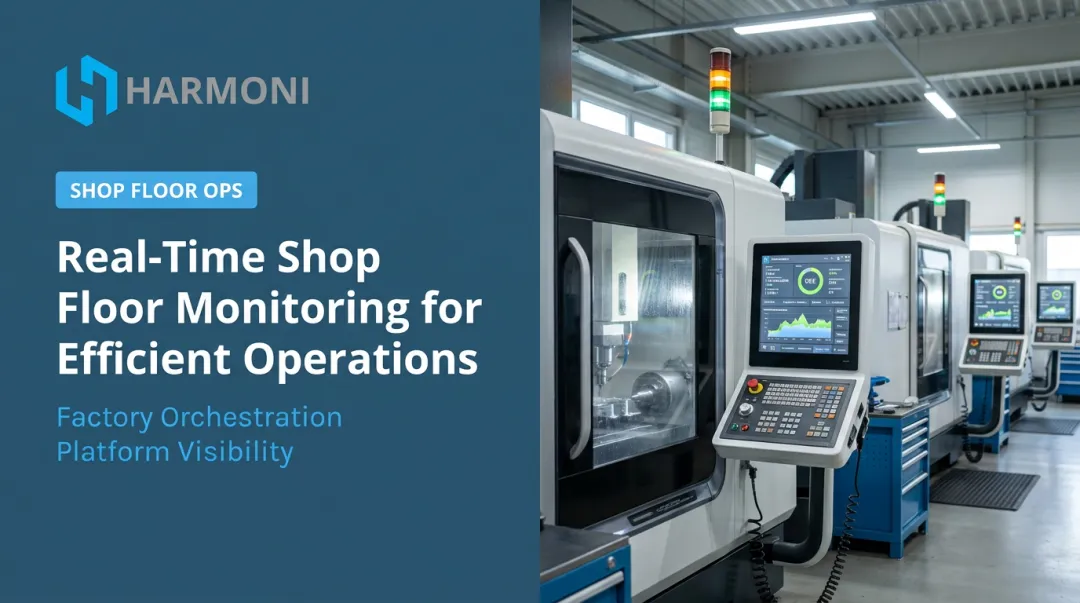
Real-Time Machine Monitoring and OEE Tracking
Most manufacturers don't have an accurate picture of how their equipment actually performs. Clipboard-based tracking and end-of-shift reports capture a sanitized version of reality, not what's actually happening at the machine.
Connected machines automatically report uptime, cycle times, idle periods, and throughput — feeding OEE calculations in real time rather than reconstructed after the fact. OEE (Overall Equipment Effectiveness) measures three things:
- Availability — is the machine running when it should be?
- Performance — is it running at its rated speed?
- Quality — are the parts coming off good?
Industry benchmarks put OEE at 85%, but most manufacturers operate closer to 60% — a 25-point gap representing idle time, slow cycles, and defects that simply aren't visible without connected data.
Real-time dashboards give supervisors instant visibility into which machines are running, producing, idle, or faulted. That shifts intervention from reactive ("we lost two hours this shift") to in-the-moment ("machine 7 has been idle for 20 minutes — what's happening?").
Inline Quality Control and Defect Detection
Finding defects at final inspection is expensive. At that point, the labor, material, and machine time are already spent. IoT-connected measurement tools — vision cameras, scales, calipers, temperature and humidity probes — check specifications at each production stage, catching non-conformance before it compounds.
McKinsey documented a Jabil case where tablet-based work instructions and real-time process analytics produced a 10%+ increase in production yield and a 60% reduction in manual-assembly quality issues within four weeks.
IoT also enables poka-yoke applications — error prevention at the source:
- Pick-to-light systems that guide operators to the correct component
- Weight-verification sensors that confirm assemblies before moving forward
- Torque-monitoring tools that flag under- or over-torqued fasteners in real time
In aerospace, defense, and medical manufacturing, these systems also generate the time-stamped, traceable inspection records that AS9100, ITAR, and ISO 13485 audits demand — turning quality enforcement into documented compliance evidence.
Worker Safety Monitoring
Manufacturing recorded 2.7 recordable injury and illness cases per 100 full-time workers in 2024, per the Bureau of Labor Statistics. IoT-enabled safety systems address this through continuous environmental and location monitoring:
- RFID and wearable sensors track worker location and proximity to hazardous zones
- Gas detection and temperature monitors alert supervisors before exposure reaches dangerous levels
- Noise sensors identify chronic exposure risks that manual checks miss
In aerospace and defense environments operating under AS9100, the compliance benefit compounds the safety benefit. IoT safety systems generate time-stamped, traceable records of worker exposure, location, and incident response — exactly the kind of documented evidence that audits require.
Asset and Inventory Tracking
On a busy shop floor, time lost searching for tooling, fixtures, raw material, or a specific job in process is invisible in traditional reporting — but real in its impact. RFID, GPS, and IoT sensors eliminate that friction by providing real-time location and condition tracking for:
- Raw materials and incoming inventory
- Work-in-progress at each operation
- Tooling and fixtures
- Finished goods awaiting shipping
Accurate real-time inventory data makes just-in-time production actually work. Stockouts get caught before they halt production. Supply chain visibility extends from supplier delivery through the shop floor to outbound shipping — a continuous thread rather than disconnected snapshots.

Remote Production Monitoring
Plant managers don't always have the option to be on the floor. IoT platforms allow operations teams to monitor machine status, production KPIs, and floor activity from any location.
Consider a practical example: a plant manager reviewing a remote dashboard at 6 AM notices that a machining center's cycle time has been climbing through the overnight shift. Cycle time creeping up on a finishing operation often signals a worn cutting tool or a cooling issue.
That observation — made remotely, before the day shift starts — allows intervention before the machine produces scrap or goes down. Without the remote view, the same situation gets discovered at end-of-shift review, after hours of substandard parts.
Key Benefits IoT Delivers on the Shop Floor
| Benefit | What It Looks Like in Practice |
|---|---|
| Reduced unplanned downtime | Predictive maintenance eliminates 70–75% of breakdowns; condition monitoring catches anomalies before they escalate |
| Higher throughput | Real-time OEE data exposes bottlenecks and idle equipment — supervisors act in the moment, not at end-of-shift |
| Better quality at lower cost | Inline defect detection reduces scrap and rework; fewer non-conforming parts reach final inspection or shipping |
| Lower operational overhead | Automated data collection replaces manual logging; IoT-enabled energy management (smart HVAC, equipment shutoff) reduces overhead without adding headcount |
The NIST manufacturing machinery survey found that establishments with stronger predictive and preventive maintenance practices had 52.7% less unplanned downtime and 78.5% fewer defects than comparison facilities. That's a meaningful signal, though it reflects correlation rather than controlled causation.
When IoT Data Meets the Shop Floor: The Orchestration Gap
Here's the problem that manufacturers rarely anticipate: IoT generates enormous volumes of machine data. Data alone doesn't change what happens on the floor.
A vibration sensor flagging an anomaly only matters if a maintenance technician gets the alert in time to act on it. A cycle time trending upward only drives intervention if a supervisor sees it while the shift is still running. Quality data captured at the machine only prevents shipping errors if it's linked to the specific job, revision, and operator who ran the part.
The Data Silo Problem
Most manufacturers operate with data scattered across disconnected systems:
- Machine monitoring data sits in one platform
- ERP job data and scheduling records live in another
- Engineering specs and revision-controlled documents exist in a third
- Operators have no unified view of any of it
Many manufacturers invest in IoT sensors and still struggle with missed steps, wasted time, and reactive decision-making. The sensors are working. The data just isn't reaching the people who need to act on it — with the context that makes action possible.
Factory Orchestration as the Connective Layer
The gap between IoT data and operational execution is what factory orchestration addresses. Rather than treating machine monitoring, ERP workflows, operator instructions, and engineering requirements as separate streams, orchestration platforms coordinate them into a unified real-time view at each workcenter.
Harmoni's factory orchestration platform is built specifically for this problem. By combining machine data with operator activity and ERP workflows — using long-range RFID technology to automatically identify nearby employees and active jobs — Harmoni creates operational context at the moment decisions need to be made.
Supervisors see not just what the machine is doing, but which operator is running it, which job is active, and whether the current operation matches the engineering revision on file.

For mid-to-large manufacturers in CNC machining, aerospace, and defense, that operational context is what converts raw IoT data into consistent execution — shift after shift. To see how it works in your environment, request a demo at harmoni.io/demo.
Common Challenges of Implementing IoT in Manufacturing
Cybersecurity and Network Risk
Every connected device expands the attack surface. Claroty's survey of 1,100 IT and OT security professionals found that 37% of ransomware attacks affected both IT and OT environments — and 12% of affected organizations had operations fully shut down for more than a week.
For defense and aerospace manufacturers, the stakes extend beyond operational disruption. DoD's CMMC framework classifies IoT and IIoT devices as Specialized Assets when they can process, store, or transmit Controlled Unclassified Information. Contractors handling CUI must address:
- Device authentication at the machine level
- Encrypted data transmission across the network
- Asset inventory and documentation in the system security plan
- Defined access control rules for every connected endpoint
Integration with Legacy Machines
Many shop floor machines predate modern connectivity standards. NIST notes that legacy components may not support current protocols like TLS 1.3, and that legacy network segmentation can actually limit IIoT deployment options. Connecting older equipment alongside ERP and MES systems requires middleware, protocol mapping, and careful planning to avoid creating new data silos instead of eliminating existing ones.
Some platforms address this by retrofitting to existing machines — connecting controls from Fanuc, Mazak, Haas, Heidenhain, Siemens, and DMG MORI — without requiring equipment replacement. Harmoni takes this approach, deploying in weeks against whatever machines a shop already runs.
Change Management and Workforce Adoption
IoT tools only deliver ROI if operators and managers use them consistently. This means:
- Interfaces that simplify the operator's job rather than adding complexity
- Phased rollouts that allow adjustment before full deployment
- Training that connects the tool to outcomes operators care about
Shops that invest in operator buy-in early — not just technical deployment — tend to see faster time-to-value and fewer post-launch reversions to manual workarounds.
Frequently Asked Questions
What is IoT in manufacturing?
IoT in manufacturing is a network of connected sensors, machines, and devices that collect and share real-time data to automate processes, monitor performance, and support decision-making across factory operations. In industrial contexts, it's commonly called IIoT (Industrial IoT) to distinguish it from consumer applications.
What is an example of IoT in manufacturing?
Two common examples: vibration sensors on CNC spindles that alert maintenance teams before a bearing fails, and RFID-enabled job tracking that shows supervisors exactly where each work order stands on the shop floor in real time, without manual check-ins or paper travelers.
Is IoT replaced by AI?
No — they're complementary. IoT provides the real-time data stream from machines and sensors; AI analyzes patterns within that stream to generate predictions and recommendations. In practice, IoT is the input layer that makes AI-driven anomaly detection and forecasting possible.
What are the biggest challenges of implementing IoT on the shop floor?
The three most common barriers are cybersecurity exposure from expanded connected attack surfaces, integration complexity with legacy equipment that predates modern connectivity standards, and change management — ensuring operators and managers actually use the tools consistently. Choosing the right platform partner significantly reduces risk across all three.
How does IoT data connect to ERP and MES systems in manufacturing?
IoT devices generate machine-level signals that must be translated and routed into ERP and MES systems via middleware, APIs, or orchestration platforms. Without that integration, the data stays siloed — disconnected from the job costing, scheduling, and quality records that drive real decisions.
What types of IoT platforms do manufacturers evaluate?
IoT Analytics identifies several platform families: connectivity and device management, data analytics, application enablement, and end-to-end platforms. In practice, manufacturers evaluate them primarily on ERP and MES integration fit, and whether they support the machine controls already on the floor.