
Introduction
Manufacturers collect more data today than at any point in history. Machines stream cycle times. Sensors track vibration and temperature. ERP systems log every transaction. Operators generate quality checks, scrap counts, and time cards by the hour.
Yet most plants still run on yesterday's information. A supervisor pulls a report from last shift to explain why a batch scrapped. A planner discovers a bottleneck after the delivery date has already slipped.
The core problem is disconnection. MES, ERP, and machine systems typically operate as separate silos. That gap creates blind spots that cause errors, downtime, and job costs that bear little resemblance to reality.
Unplanned downtime alone costs manufacturers a median of $125,000 per hour, according to a 2023 ABB survey of more than 3,200 plant-maintenance leaders worldwide (ABB, 2023).
This article breaks down what an industrial data platform actually is, how it's architected, the major types available, and where the concept runs into its limits on a real shop floor.
Key Takeaways
- One real-time source of truth unifies machine, ERP, and MES data across the plant
- Legacy batch architectures create hours- or days-long delays between a problem and its discovery
- Platform choice usually falls into four types: MES/SCADA-centric, cloud IIoT, lakehouse/unified namespace, or factory orchestration
- Predictive maintenance built on unified data can cut machine downtime 30% to 50% in typical deployments
- Orchestration connects unified data to shop-floor action; insight without execution still leaves downtime unfixed
What Is an Industrial Data Platform for Manufacturing?
An industrial data platform is the unified layer that collects, standardizes, contextualizes, stores, and delivers data from machines, sensors, MES, and ERP systems into a single accessible source of truth. Instead of pulling three different reports from three different systems, an operations manager sees one version of what's actually happening on the floor.
That role is different from a traditional data warehouse. Warehouses were built for retrospective financial and business reporting: closing the books, tracking quarterly trends, running month-end analysis. Industrial data platforms are built for something faster—high-frequency, real-time operational data that needs to be usable in seconds, not weeks.
Why Legacy IT/OT Stacks Fall Short on the Shop Floor
Most plants didn't design their systems to talk to each other. Machine data lives in one place, quality records live in another, and ERP transactions live somewhere else entirely. Nobody can see cause and effect across the three.
That separation shows up in predictable ways:
- Batch processing delays: Data moves on a schedule, so insights arrive hours or days after scrap is already made
- No shared context: A cycle-time spike rarely links to the ERP job or the operator running it
- Infrastructure that can't keep up: IIoT sensor volume has outgrown what many on-prem systems can process in real time

The cost of that lag is real. Unplanned downtime often runs into six figures per hour, and the bill grows every time the data that could have caught a problem shows up too late to act. A platform that only reports issues after the fact does not prevent the loss. It only records it.
The Core Architecture of a Modern Industrial Data Platform
A well-built industrial data platform isn't one piece of software. It's built in layers that move data from the shop floor up to the people making decisions, and skipping one layer usually means the whole system underdelivers.
Data Ingestion Layer
This layer captures data at the source: PLCs, sensors, IoT gateways, and enterprise systems. It typically relies on two industrial protocols:
- MQTT: a lightweight publish/subscribe messaging standard that decouples systems from one another, so a sensor doesn't need to know who's listening
- OPC UA: a platform-independent architecture that adds industrial semantics, structured information models, and built-in security like encryption and authentication
Together, they support both real-time streaming and scheduled batch integration, depending on what a given data source needs.
Contextualization and Storage Layer
Raw machine data on its own doesn't mean much. A cycle time of 42 seconds is meaningless until it's tied to a specific asset, job, operator, and production batch.
This layer enriches raw data with that metadata, often modeled on the ISA-95 hierarchy, the industry standard that organizes information from the physical process up through control systems, MES, and ERP.
The enriched data typically lands in a flexible data lakehouse structure, built to handle both structured tags and unstructured records like images or PDFs.
Analytics and AI Layer
This is where the platform starts paying for itself. Contextualized data feeds models for predictive maintenance, automated quality control, and yield optimization.
Predictive maintenance is the clearest example. By analyzing condition and operating data, it flags failure risk before a breakdown happens instead of after.
According to McKinsey research on manufacturing analytics, this approach typically yields 30% to 50% reductions in machine downtime. Actual results still depend on sensor coverage, asset criticality, and how quickly maintenance can respond once a model flags risk.
Governance and Security Layer
None of this works without guardrails. This layer covers data lineage, role-based access control, and pipeline observability. Those controls keep decision-feeding data trustworthy and limit who can see or change it.
For regulated industries like aerospace and defense, this layer carries extra weight. Programs handling Controlled Unclassified Information need to align with frameworks like NIST SP 800-171 and CMMC, and ITAR restricts who can even view certain technical data. In these environments, governance is a condition of doing business.

What Are the Major Types of Industrial Data Platforms?
Manufacturers evaluating solutions usually run into four broad categories. Each solves a different need, and most plants end up running more than one at the same time.
MES and SCADA-Centric Platforms
These platforms extend an existing MES or SCADA system, adding data collection and basic reporting on top of it. They're useful, but they typically stay tied to that one system's data model, so information doesn't flow easily to systems outside it.
Cloud-Based IIoT and Analytics Platforms
These platforms focus on pulling sensor and machine data into the cloud, then building dashboards, KPI tracking, and predictive analytics across multiple facilities. They're strong at connectivity and visualization across sites, though they generally don't handle deterministic, real-time machine control.
Data Lakehouse and Unified Namespace Platforms
Built around a centralized lakehouse or unified namespace architecture, these platforms unify structured and unstructured data for enterprise-wide AI and analytics use cases.
A unified namespace acts as a real-time semantic hub. It standardizes names, adds context like machine and location, and keeps a current-state view of the plant. That makes it a strong interoperability layer, though on its own it isn't designed to be a historian or a full analytics engine.
Factory Orchestration Platforms
This is the newest category, and one Harmoni pioneered. Factory orchestration does not sit alongside data platforms, ERP, and MES only to report on what happened. It sits on top of all three to coordinate people, machines, and workflows in real time.
When a machine goes down, you get more than a status flag. The system shows why it stopped, who is involved, and what needs to happen next.
Key Benefits of Implementing an Industrial Data Platform
The value shows up in a handful of places most manufacturers care about:
- Spot quality or performance issues while they happen, not after a batch or shift is finished
- Standardize execution across machines, operators, and shifts so variation stops driving up scrap
- Replace paper logs and tribal knowledge with objective, timestamped labor and process records
- Ground job costs in actual cycle times and labor hours by combining machine, ERP, and labor data
- Close the gap between theoretical capacity and real output by unifying availability, performance, and quality data
At WessDel, a San Jose aerospace and defense machine shop, operators spent an average of 11 minutes per ERP transaction before automation removed that work—time that had been distorting job costs for years.

Implementation Challenges to Plan For
Standing up an industrial data platform isn't just a technology purchase. Three challenges come up again and again.
Legacy equipment integration. A lot of shop floors run machines that are decades old, with controllers never built to talk to modern cloud or edge architectures. Getting them connected usually requires protocol adapters or edge gateways that translate older signal types into something a modern platform can ingest. The goal is connectivity without replacing the machine itself.
Data quality and standardization. A platform is only as useful as the data feeding it. Inconsistent naming conventions, missing context, or different standards across plants can quietly undermine analytics unless you establish governance from day one—not bolted on afterward.
Organizational alignment. This is the challenge that trips up the most rollouts. McKinsey has found that IT commonly reports through the CIO while OT, plant IT, and maintenance report through operations leadership (McKinsey, 2022). Those separate histories create real structural and cultural friction.
Without joint governance between IT, operations, and plant-floor teams, even a well-built platform ends up underused.
Where Harmoni Fits: Turning Platform Data into Shop-Floor Action
Even a perfectly built industrial data platform runs into the same wall eventually: the plan created in ERP and the schedule built in MES still have to survive contact with the actual shop floor. That gap between the plan and what really happens at the machine is the execution gap — and it's where most manufacturing improvement initiatives fail.
Harmoni's factory orchestration platform sits between ERP systems, MES systems, machines, and operators. It combines machine data with operator activity and ERP workflows to add the operational context raw data platforms typically lack: what happened, who was involved, and what needs to happen next.
How It Works at the Machine
Harmoni uses long-range RFID to detect nearby employees and jobs as an operator approaches a machine, with no badge swipe or keyboard entry. That detection opens a centralized command center at each workcenter, built on three pillars:
- Automation: RFID clock-in/out, automatic ERP transactions, and work-order retrieval so operators stop losing time at shared terminals
- Process control: Automated CNC program loading with revision control, digital work instructions, and quality checksheets that catch drift before it becomes scrap
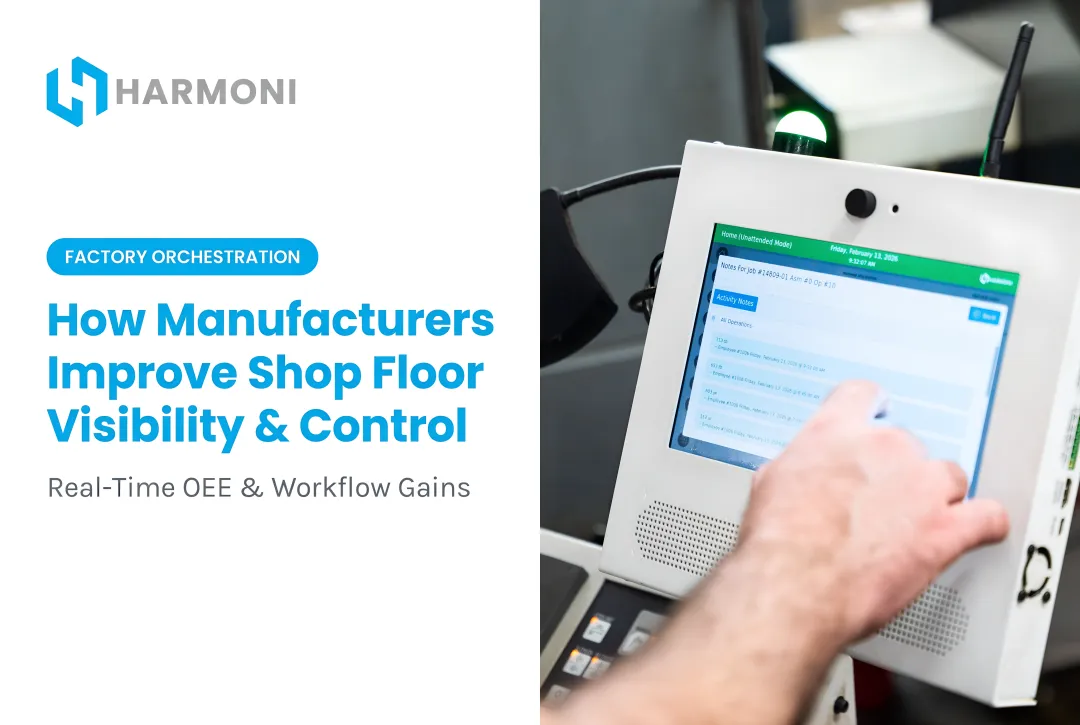
- Observability: Real-time OEE across availability, performance, and quality, shown on Visual Factory andon-style lights at the workcenter
Built for Shops That Can't Afford Downtime
Harmoni is built for mid-to-large manufacturers in CNC machining, aerospace, defense, automotive, and healthcare, where a scrapped part or missed revision carries real cost.
Native ERP integrations include:
- Epicor, Infor, and Infor Visual
- ECI JobBoss / JobBoss2, ABAS, and ODOO
Supported CNC controls include Mazak, Haas, Fanuc, Heidenhain, Siemens, DMG MORI, Makino, and Fadal.
Deployment typically takes weeks, not months. At WessDel, an aerospace and defense shop running Epicor, Harmoni was fully installed and connected to both new and old machines in less than a week. Within months, the shop had:
- Gained 17 productive hours per employee per month
- Achieved a documented 5X return on ongoing costs
- Cut delinquent jobs by 10%

Regulated shops need that same execution layer under tighter controls. For defense contractors handling Controlled Unclassified Information, Harmoni offers a Government Cloud option with multifactor machine authentication (RFID plus facial recognition or PIN). ITAR- and CMMC-sensitive programs stay locked down at the machine, not only at the network login screen.
Frequently Asked Questions
What are the major industrial data platforms?
The main categories are MES/SCADA-centric platforms, cloud-based IIoT and analytics platforms, data lakehouse and unified namespace platforms, and the newer factory orchestration category.
What is the difference between an industrial data platform and an MES?
An MES manages and executes production workflows directly on the floor: scheduling, quality, and traceability. A data platform is the underlying infrastructure that collects, stores, and contextualizes data across the MES, ERP, and machines feeding it.
How does an industrial data platform support Industry 4.0 initiatives?
It provides the unified, real-time data foundation that predictive maintenance, digital twins, and AI-driven optimization all depend on. Without it, these initiatives tend to stay disconnected pilots rather than plant-wide capabilities.
Can industrial data platforms integrate with legacy or older CNC machines?
Yes. Legacy and analog equipment can typically connect through edge gateways, protocol adapters, or retrofitted sensors, so older machines feed the same platform as newer ones without replacement.
How long does it typically take to implement an industrial data platform?
Timelines vary by scope, but modern platforms and orchestration layers often deliver measurable results within weeks. Harmoni, for example, has gone live at aerospace shops in under a week.
What is factory orchestration, and how is it different from a data platform?
Factory orchestration actively coordinates people, machines, and systems in real time. A data platform primarily collects and analyzes data; it doesn't directly manage what happens next on the floor.