
Introduction
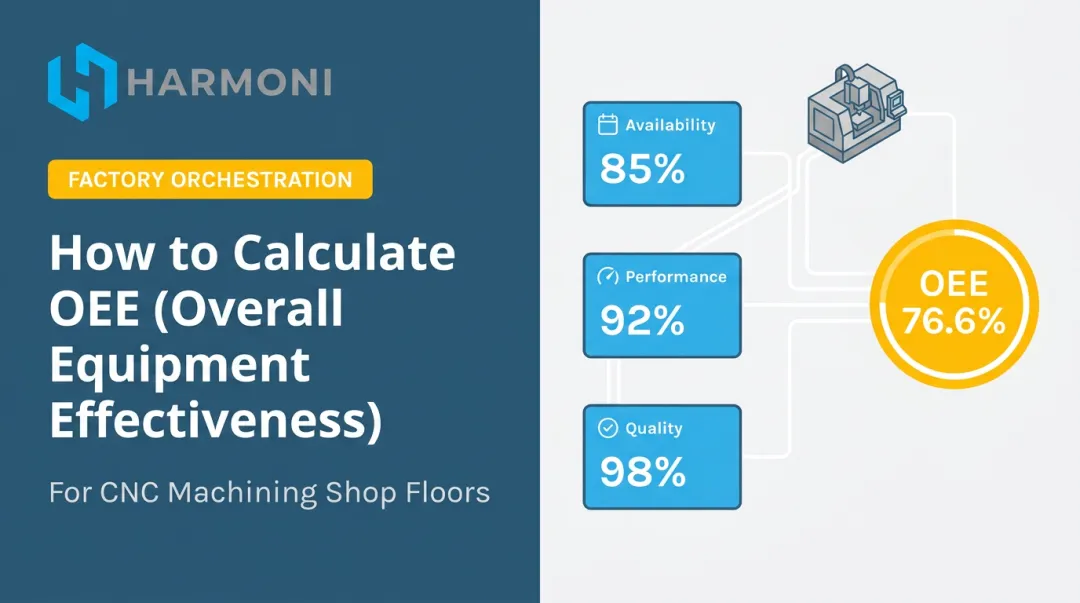
Plant managers and reliability engineers rely on three core metrics: Mean Time Between Failure (MTBF), Mean Time to Repair (MTTR), and Overall Equipment Effectiveness (OEE). All three are calculated from machine data, which is why they describe the symptom well and the cause poorly — the operator activity and ERP job context behind each stop are what make the numbers actionable rather than historical.
Whether you're running CNC machining centers, automotive stamping lines, or aerospace/defense parts production, these metrics answer the same fundamental question—how much production time are you actually losing, and why?
The problem isn't the formulas. It's how they're captured. Many shops still track failures and cycle times in spreadsheets, tribal knowledge, or systems that don't talk to each other. Calculations shift depending on who's working the shift. Reviews happen after a machine has already eaten a full production day.
That data gap is common. 70% of manufacturers still enter data manually, according to the Manufacturing Leadership Council's 2024 survey — a habit that makes consistent MTBF, MTTR, and OEE tracking nearly impossible to trust.
This guide walks through how to calculate, interpret, and act on these metrics under real shop-floor conditions—not just as textbook formulas.
Key Takeaways
- MTBF measures reliability, MTTR measures repair speed, and OEE measures overall effectiveness
- Cross-referencing all three finds root causes that no single metric reveals on its own
- Clean run-time data, standardized failure codes, and cycle-time baselines are prerequisites for using these metrics
- 85%+ OEE is the traditional benchmark, but trend direction matters more than the number itself
- Automated shop-floor data capture closes the accuracy gaps that manual tracking can't fix
When and Where to Use MTBF, MTTR & OEE
These metrics aren't universal. They work best on repairable production equipment running repeat jobs, not one-off prototypes or components you run to failure and replace.
When OEE Is the Right Tool
Use OEE when you need to understand a specific asset's or line's productive capacity. It's the go-to metric for:
- Planning realistic delivery windows
- Staffing decisions and shift balancing
- Line balancing across multiple work centers
When MTBF and MTTR Are the Right Tools
MTBF and MTTR fit assets that go through repeated repair cycles — CNC machines, stamping presses, robotic welding cells. The goal here is anticipating failure and speeding up recovery, not measuring throughput.
Common Misuses to Avoid
- Applying MTBF to non-repairable parts. MTTF (Mean Time To Failure) is the correct metric for run-to-failure components
- Comparing MTBF or OEE across dissimilar equipment. A five-axis mill and a manual lathe don't share a "good" number
- Ignoring operational context. High-mix/low-volume shops, multi-shift operations, and industry type all shift what "good" looks like. OEE varies widely, even within the same industry, so benchmark against your own baseline first
In practice, these metrics live at two levels: individual work-center troubleshooting, and rolled-up line or plant reporting for leadership and capacity planning.
What You Need Before Tracking These Metrics
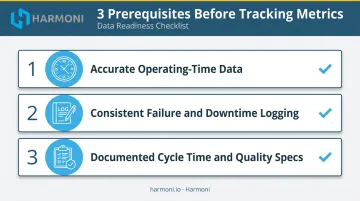
Before any of these numbers mean anything, three things need to be in place.
- Accurate operating-time data. MTBF and Availability calculations are meaningless if you're using calendar time instead of actual run hours. You need real numbers on run time versus idle or planned downtime.
- Consistent failure and downtime logging. Define failure codes once, and use them the same way across every shift and operator. Without this, MTTR and root-cause analysis stop being comparable.
- Documented cycle time and quality specs. Every job needs an ideal cycle time and a quality standard on record — otherwise the Performance and Quality components of OEE can't be calculated accurately.
Manual spreadsheet tracking is where most of this breaks down. MESA International notes that manual data entry carries a built-in risk of duplicate entries and errors. It also notes that manually gathered data doesn't share easily across departments, meaning the maintenance team and the ops team can end up working from two different versions of the truth.
This is a real, measurable cost. One Harmoni customer, WessDel, found that manual ERP transactions at shared terminals were taking operators an average of 11 minutes per transaction. That's time lost to data entry rather than production, with plenty of room for error along the way.
How to Use MTBF, MTTR & OEE for Manufacturing Improvement (Step-by-Step)
Using these three metrics correctly follows a sequence: calculate cleanly, cross-reference for root cause, then act. Skip a step, and you've turned real improvement levers into vanity numbers on a report nobody uses.
Step 1: Calculate Each Metric With Clean Data
Start with the formulas, applied against actual operating data:
- MTBF = Total Operating Time ÷ Number of Failures (use actual run time only, never calendar time)
- MTTR = Total Repair Time ÷ Number of Failures, where repair time includes diagnosis, repair, testing, and reinstallation, not just wrench time
- OEE = Availability × Performance × Quality:
- Availability covers run time versus planned production time
- Performance measures speed against ideal cycle time
- Quality measures good parts against total parts produced
Watch for these setup errors, which corrupt every calculation downstream:
- Inconsistent failure definitions between shifts (one operator logs a stoppage, another doesn't)
- Incorrectly excluding planned downtime from Availability math
- Estimating hours from memory instead of logging them as they happen
Step 2: Establish a Reporting Cadence
Not every metric needs daily attention. Review frequency should match production volatility and asset criticality.
Leading indicators, like preventive maintenance schedule compliance, deserve frequent, even per-shift, checks. Lagging indicators like MTBF and OEE tell you what already happened, so weekly review is often enough unless a machine is flagged as critical.
Step 3: Cross-Reference the Three Metrics to Find Root Causes
This is where the real diagnostic work happens. Pair OEE's Availability component against MTBF and MTTR to figure out whether you're losing time to frequent failures or slow recovery.
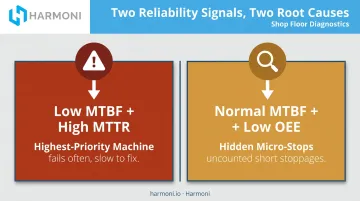
Two patterns show up constantly. Low MTBF paired with high MTTR flags your highest-priority machine, since it fails often and takes too long to fix. Normal MTBF with low OEE usually points to uncounted micro-stops that never get logged as formal failures.
That second pattern is worth flagging on its own. An "acceptable" MTBF that doesn't match a degraded OEE score almost always means short stoppages are slipping through the cracks of your logging process.
Step 4: Act on the Combined Insight
The corrective action depends entirely on what the cross-reference revealed:
- Low MTBF → preventive maintenance schedule adjustments
- High MTTR → spare-parts stocking or technician training
- Hidden losses in OEE → process or quality adjustments, not maintenance spending
The most common reason metrics tracking never improves outcomes is simple: nobody turns the insight into a scheduled, owned action item.
This is the gap a factory orchestration platform like Harmoni is built to close. It combines real-time machine data, RFID-tracked operator activity, and ERP job data into one dashboard, so availability losses and downtime causes surface while production is happening, not in a report reviewed a week later.
Step 5: Monitor Trends and Re-Baseline Regularly
Watch for these signals over time:
- Gradually declining MTBF: often an early sign of component wear
- Rising MTTR: usually points to a training gap or a spare-parts problem
- Stagnant OEE despite maintenance investment: a sign the money is going to the wrong asset
Re-baseline periodically. Job mix shifts, tooling changes, and equipment wear all shift what a realistic target number should be.
Best Practices for Using These Metrics Effectively
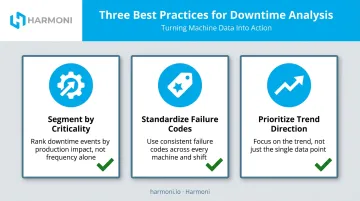
A few habits separate shops that actually improve from ones that just report numbers:
- Segment machines by criticality. Machines with low OEE, low MTBF, and high MTTR combined should get attention first — not the loudest machine in the meeting
- Standardize failure-code definitions. Get every shift and every plant using the same codes, so comparisons stay apples-to-apples
- Prioritize trend direction over a fixed benchmark. A shop moving from 55% to 65% OEE is improving faster than one stuck at 80% for two years
None of this requires new software to start, though real-time dashboards, like Harmoni's, make the weekly review cadence easier to sustain. What it requires is discipline: reviewing the numbers and acting on them, every single time.
Conclusion
Getting value from MTBF, MTTR, and OEE means consistent data capture paired with a defined process for turning numbers into action.
Treat these three metrics as one connected system, not three separate reports living in different folders. Real-time shop-floor visibility protects uptime, labor cost, and delivery commitments long before a missed shipment forces the conversation. Harmoni's factory orchestration platform brings this visibility together automatically, connecting machine, labor, and ERP data in real time.
Frequently Asked Questions
What are MTBF, MTTR, MTTF, and OEE?
MTBF measures average time between failures on repairable equipment; MTTR measures average repair time; MTTF applies to non-repairable components run to failure. OEE measures overall production effectiveness through Availability, Performance, and Quality.
What does an MTBF of 100,000 hours mean?
It's a statistical average based on historical operating data — the typical run time between failures across a population of similar equipment. It's not a guarantee that any single machine will run exactly that long before failing.
What is considered a good OEE score in manufacturing?
85%+ is historically cited as "world-class" for discrete manufacturing, a benchmark traced back to Seiichi Nakajima's original TPM research. "Good" still varies by industry and equipment type, so compare against your own baseline too.
How do MTBF and MTTR affect overall equipment availability?
Availability follows the relationship Availability = MTBF ÷ (MTBF + MTTR). A machine with a high MTBF and low MTTR has high inherent availability; either number moving the wrong way drags availability down.
How often should manufacturers review these metrics?
It depends on production volatility and asset criticality. Leading indicators warrant per-shift or daily checks, while lagging indicators like MTBF and OEE are often reviewed weekly unless a machine is flagged as critical.
Can MTBF, MTTR, and OEE be tracked automatically instead of manually?
Yes. Real-time data capture through connected machines and platforms like Harmoni removes manual entry errors and lets teams review performance while production is happening, rather than reconstructing it after the fact.