
Introduction
Walk onto any machine shop floor and you'll find lathe work instructions taped to machines, buried in binders, or increasingly, displayed on screens at the workcenter. They're the backbone of consistent turning operations: the difference between an operator who repeats a proven setup and one who's guessing at tool height from memory.
Writing them well is harder than it sounds. Pack in too much detail and operators skip the document entirely, relying on what they remember from last time. Too little, and critical steps get missed on a new part number or a different shift.
Regulated sectors treat this as more than good practice. Under AS9100D, aerospace and defense manufacturers need documented evidence that every planned production and inspection operation was completed. The International Aerospace Quality Group clarifies this in its guidance on clause 8.5.1(n).
There is a further limit worth naming early: a document describes the setup, but it cannot confirm the right revision reached the machine, that the operator followed it, or that the job matches what the ERP released. That gap between the written instruction and the executed one is where scrap and rework start. This guide covers how to build lathe work instructions that operators actually use — and how tying them to the machine, the operator and the ERP job turns documentation into process control, not paperwork that exists to satisfy an auditor.
Key Takeaways
- Write instructions before first-run or complex jobs, and whenever tolerances, materials, or operators change
- Collect prints, routing, tooling/fixtures, and a revision process before drafting steps
- Sequence steps to match the real job: setup, run, monitor, shut down
- Visual, machine-specific instructions outperform generic text tied to no actual parameters
- Digital delivery at the point of work beats static paper for both adherence and traceability
When Should You Create and Use Lathe Work Instructions?
Not every job needs a formal instruction set. An experienced operator running a part they've made fifty times doesn't need a step-by-step document. They need a print and a quick check on revision level.
Instructions deliver the most value for:
- New part numbers where no institutional memory exists yet
- Tight-tolerance work where a small deviation creates scrap
- Multi-operator or multi-shift jobs where consistency across people matters more than speed
- Training scenarios where a new hire has no frame of reference
One common mistake undermines all of this: copy-pasting a generic instruction template across dissimilar jobs. Operators quickly learn the document doesn't reflect what's actually happening at the machine, and they stop reading it. Once that trust breaks, even a well-written instruction for a different job gets ignored too.
Production volume, part complexity, and regulatory requirements should all shape how much detail goes in. NIMS' Level II Turning: Chucking standard, for example, requires a detailed process plan identifying critical dimensions along with required speeds and feeds. That level of specificity simply isn't necessary for a low-tolerance, high-familiarity run.
Where Lathe Work Instructions Are Commonly Used in Practice
On the shop floor, these documents show up at four points:
- First-piece setup: confirming the machine, tooling, and fixture match what's documented before running production
- In-process inspection: giving inspectors a reference point for what "correct" looks like mid-run
- Shift handoffs: so the incoming operator picks up exactly where the last one left off
- Quality audits: providing evidence that the documented method was followed
Aerospace, defense, and precision manufacturing environments tend to run tightly controlled, revision-locked instructions with formal sign-off. Lower-volume job shops often use lighter, more flexible formats, which is appropriate as long as the format still matches the job's actual risk.

What You Need Before Writing Lathe Work Instructions
Writing an instruction before gathering the right inputs almost guarantees it will be wrong, vague, or both. Four things need to be in hand first:
- Engineering prints, tolerances, and material specs — without these, you can't specify accurate speeds, feeds, or in-process checks
- Tooling, fixture, and workholding requirements — prevents operators from guessing at setup configuration on the fly
- Input from an experienced machinist or process engineer — keeps the sequence grounded in how the job actually runs, not just a theoretical order of operations
- A version control or revision system — stops an outdated instruction from being followed on the floor after a design change
That last point is where a lot of shops get burned. A print gets revised, the paper instruction in the binder doesn't, and an operator runs the old spec without knowing it.
Harmoni closes that gap. Long-range RFID detects the operator, job, and part revision at the workcenter, then surfaces only the current approved documentation (prints, routing data, setup sheets, and CNC programs) from connected ERP systems like Epicor, JobBoss, or Infor.
Operators never have to hunt for the right revision. The system already knows which one applies.
How to Write and Use Lathe Work Instructions (Step-by-Step)
Instructions should follow the same order as the actual job. Skipping steps in the document, or writing them out of sequence, is a common cause of setup errors and scrap. That holds true even when every individual step is technically correct.
Setup and Preparation
The instruction needs to specify workholding method (chuck, collet, or faceplate), how the workpiece gets centered, and exact tool selection and positioning. Vague setup steps are where most documentation failures start.
Common gaps to avoid:
- Omitting tool height or angle specifications
- Leaving out clamping torque values
- Assuming the operator will "figure out" fixture orientation from the print alone
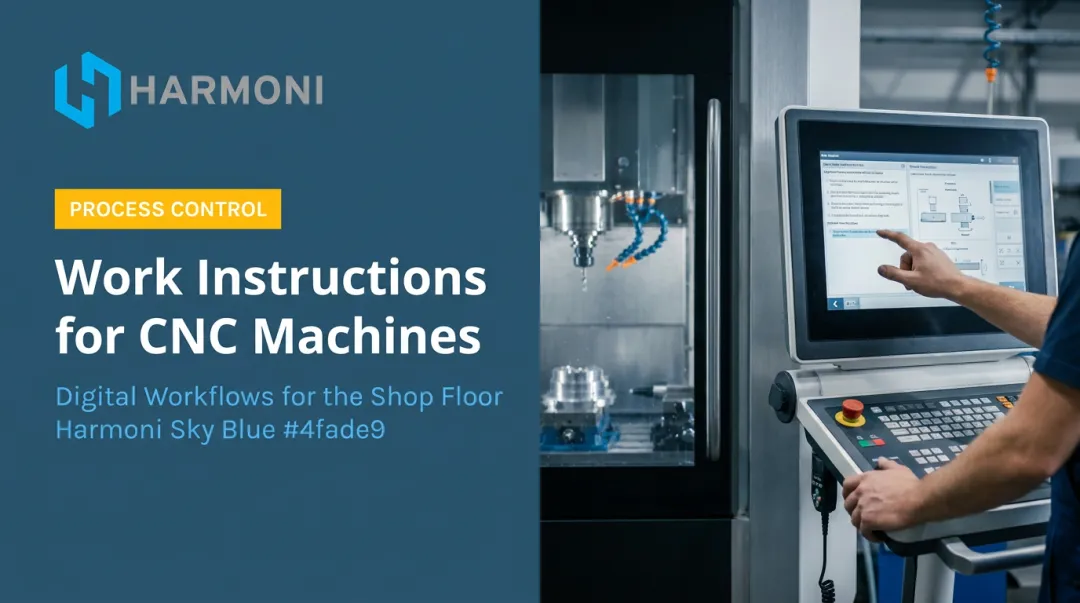
Systems like Harmoni's terminal-based command center reduce this risk by displaying setup sheets, annotated images, and even video directly at the machine the moment the operator and job are detected. No manual retrieval required.
Initiating the Job
Once setup is confirmed, the instruction should state the spindle start sequence, when coolant activates, and the initial spindle speed.
Be explicit about whether a value is fixed or a range. If speed depends on material lot or hardness variation, say so directly: "Set spindle speed to 800–950 RPM depending on material certification," not just "set appropriate speed." Ambiguity here forces operators to guess, which defeats the purpose of writing the instruction at all.
Operating the Lathe Correctly
This is where the instruction earns its keep. Define cutting depth, feed rate, and the pass sequence: roughing passes before finishing passes, with distinct parameters for each.
Document operating limits clearly:
- Maximum depth of cut per pass
- Feed rate ceiling tied to tool life expectations
- Any pass-count minimums required to hit finish specifications
These limits should connect directly to part quality outcomes, not just machine capability. A lathe can often run faster than the instruction allows. The limit exists because of tolerance or tool-wear consequences, and the instruction should make that reasoning visible.

Monitoring During the Cut
The instruction should require specific in-process checks: dimensional measurements at defined intervals, visual tool-wear inspection, and confirmation that coolant flow is consistent.
It should also flag warning signs and the response expected:
- Chatter or unusual noise: reduce speed or check workpiece rigidity before continuing
- Visible tool wear or chipping: stop and inspect the insert before the next pass
- Dimensional drift: halt production and notify a supervisor rather than continuing to run
Digital checksheets make this easier to enforce. Harmoni's checksheet module displays check frequency, tolerance bands, and suggested measurement tools right at the machine.
Its Visual Factory andon-style indicators shift from green to yellow or red as performance drifts outside expected bands, giving operators a real-time signal before a problem compounds into scrap.
Shutting Down and Completing the Job
The instruction should close out with spindle shutdown, coolant shutoff, part removal, and a cleanup sequence — in that order.
Skipping documented shutdown steps isn't just sloppy; it has real consequences. For hazardous-energy scenarios like maintenance or clearing a jam, OSHA's lockout/tagout standard requires a documented procedure covering shutdown, isolation, and verification steps, and specifically calls out orderly shutdown as necessary to avoid creating additional hazards.
Beyond safety, an incomplete shutdown routine often means final inspection gets skipped too, letting a bad part slip through.
Best Practices for Effective Lathe Work Instructions
A handful of habits separate instructions that get followed from ones that get ignored:
- Use visuals: photos or diagrams for setup and tool positioning communicate faster than paragraphs of text
- Write single-action steps: "Set spindle speed to 900 RPM" beats a sentence that buries the instruction in context
- Map parameters to real controls: tie every setting to the knobs, screens, and inputs the operator will actually touch
- Build in revision control: an updated instruction should replace the outdated one immediately, not next shift
That last point is where digital delivery matters most. Paper instructions can't update themselves. A printed sheet from three revisions ago looks identical to a current one.
Delivering instructions digitally at the point of work, with supervisors able to see in real time whether steps were followed, is the problem factory orchestration platforms like Harmoni are built to solve. They combine instruction delivery with live machine and operator data.
One documented example: beryllium manufacturer WessDel used Harmoni's real-time data visibility to identify production bottlenecks, reducing downtime and contributing to a measurable revenue increase. Visibility into execution, not just better-formatted documents, is what drives results.
The goal isn't a beautifully organized binder. It's consistent execution and a traceable record that the documented sequence actually happened. If you want to see how that looks in a real shop environment, Harmoni offers a free demo.

Conclusion
Effective lathe work instructions match the documented sequence to how the job actually runs at the machine. Cover setup, initiation, operation, monitoring, and shutdown in the order operators experience them, and leave out detail that doesn't serve that sequence.
Treat these documents as living tools that protect quality, safety, and cost. Revisit them when tooling changes, when a quality issue surfaces, or when an engineering change order lands — not just once at job launch and never again.
Frequently Asked Questions
What is a lathe machine work instruction?
It's a documented, step-by-step guide covering setup, operation, and shutdown for a specific lathe job or part number. It exists to make execution repeatable regardless of which operator runs the job.
How detailed should lathe work instructions be?
Detail should scale with part complexity, tolerance requirements, and operator experience. A tight-tolerance aerospace part needs far more specificity than a simple, high-familiarity run.
Who is responsible for creating lathe work instructions?
Typically a process or manufacturing engineer drafts the instruction, with direct input from an experienced machinist who knows how the job actually runs on the machine.
Do lathe work instructions need to include safety procedures?
Yes. PPE requirements, lockout steps, and guarding should be embedded at the relevant point in the sequence, not tacked on as a separate afterthought at the end.
How often should lathe work instructions be updated?
Update triggers include tooling changes, recurring quality issues, and engineering change orders. Any of these can make an existing instruction inaccurate or unsafe to follow.
Can digital tools replace paper-based lathe work instructions?
Yes. Digital work instructions improve traceability and give supervisors real-time visibility into whether documented steps were actually followed, which static paper cannot match.