
Batch reports tell you what went wrong three hours ago. End-of-shift logs tell you what went wrong yesterday. Manual kaizen tracking tells you what went wrong last week, once someone finally updates the spreadsheet. Every one of these creates decision lag, and decision lag is where continuous improvement quietly stalls out.
This article connects real-time monitoring directly to lean's core pillars, maps it to the eight wastes, and shows what it actually looks like on a CNC shop floor.
Key Takeaways
- Real-time monitoring turns lean's diagnostic tools into live data streams instead of after-the-fact whiteboard reviews
- Event-driven capture reinforces JIT, TPM, and kaizen by exposing waste the moment it occurs
- Each of the eight wastes maps to a specific, trackable signal : a scrap alert, a downtime code, an idle-time log
- Successful rollouts start with one pilot line, not a plant-wide deployment on day one
What Is a Real-Time Monitoring System for Lean Manufacturing?
A real-time monitoring system continuously captures machine, operator, and quality data the instant it's generated, then delivers it to the people who need it: not at shift end, not at the weekly production meeting, but now. It's built to feed lean's core requirement: immediate feedback loops, not delayed reporting. Capturing the data is the first half. The second is acting on it in context — joining the signal to the ERP job, the operator and the machine it came from, so the response happens on the floor rather than in next week's review.
Event-driven versus polling-based is the distinction that matters most here:
- Event-driven systems react the moment a cycle completes, a part gets scrapped, or a quality check fails
- Polling-based systems check status at fixed intervals, leaving blind spots between checks. A machine can sit idle for four minutes and never show up in a report

Kaizen and standardized work both assume problems are visible and correctable the moment they happen. Manual tracking breaks that assumption before it even gets started.
Conventional value-stream mapping suffers from the same problem: it's typically conducted infrequently and relies on estimated processing times rather than measured ones, according to IndustryWeek's 2023 analysis of lean and technology.
None of this means paper kanban cards, manual andon pulls, or whiteboards were wrong. Real-time monitoring doesn't replace lean's visual management philosophy. It digitizes it, so the same signals travel faster and reach more people at once.
How Real-Time Monitoring Supports Core Lean Pillars
Lean's pillars were designed around a simple idea: catch problems close to where they happen. Real-time data just removes the delay between the catch and the correction.
Just-In-Time
JIT means producing only what's needed, when it's needed. That principle collapses fast when nobody notices production is running ahead of or behind pace until the shift is nearly over.
Live cycle-time tracking compared against a planned production rate lets teams catch overproduction or shortages before they compound across a job. The mismatch shows up in the moment, not during month-end reconciliation.
Total Productive Maintenance
TPM is about shifting maintenance from reactive to predictive. Unplanned downtime is expensive at scale. Siemens estimates it costs the world's 500 biggest companies $1.4 trillion annually, equal to 11% of their revenue, according to Siemens's 2024 True Cost of Downtime report.
Real-time monitoring flags abnormal machine states the instant they drift out of range, giving maintenance teams a chance to act before a minor issue becomes a breakdown.
Kaizen
Kaizen events run on data. Teams need an accurate baseline and a fast way to prove improvement. Live dashboards give improvement teams instant before/after evidence instead of waiting weeks for someone to compile spreadsheets from three different logbooks.
Standardized Work
Lean requires consistent adherence to a defined work sequence and cycle time. Digital work instructions and operator terminals surface deviations from standard timing as they happen, not during a supervisor's end-of-shift walk.
Value Stream Mapping
Traditional VSM is a snapshot, accurate for the hour it was drawn. Real-time data keeps the "current state" map continuously updated, revealing bottlenecks as they shift from one shift to the next instead of waiting for the next mapping exercise.
Eliminating the 8 Wastes with Real-Time Data
Defects, overproduction, waiting, non-utilized talent, transportation, inventory, motion, and extra-processing. These eight wastes are the shared vocabulary between lean training and shop floor reality. The problem is that most of them stay invisible without continuous capture.
Real-time monitoring gives each waste a specific, trackable signal:
| Lean Waste | Trackable Real-Time Signal |
|---|---|
| Defects | Scrap-rate alerts, out-of-tolerance quality trends |
| Overproduction | Cycle-time vs. planned rate variance |
| Waiting | Availability and downtime logs by reason code |
| Non-utilized talent | Operator idle-time and labor-vs-spindle tracking |
| Transportation | Job movement and workcenter transition logs |
| Inventory | WIP counts tied to ERP job status |
| Motion | Manual step elimination and terminal activity |
| Extra-processing | Cycle deviation vs. standard work sequence |

OEE (Availability × Performance × Quality) is the formula that connects these qualitative waste categories to hard numbers. The calculation has anchored lean measurement for decades. What's changed is how fast the inputs arrive.
The payoff is real. A McKinsey case study on real-time production monitoring and scheduling helped an automotive manufacturer cut die-manufacturing time by 47% by combining digital manufacturing with lean process discipline.
One overlooked detail: manual logs almost never catch microstops, the sub-five-minute interruptions that quietly eat performance all shift long. Lean's own TPM framework classifies minor stops as one of the six major equipment losses. If your data collection can't see them, that waste category stays permanently undercounted.
A Real-World Example: What This Looks Like on the Shop Floor
Picture a CNC job shop running a mix of aerospace and precision parts. An operator walks up to a machine, and long-range RFID tags on their badge and the job paperwork are read automatically — no badge swipe, no walk to a shared kiosk.
Within seconds:
- The operator clocks in automatically at that workcenter
- The correct CNC program loads for the detected part revision
- Digital work instructions and setup sheets appear on the terminal screen
- Cycle time data starts streaming from the machine control in real time
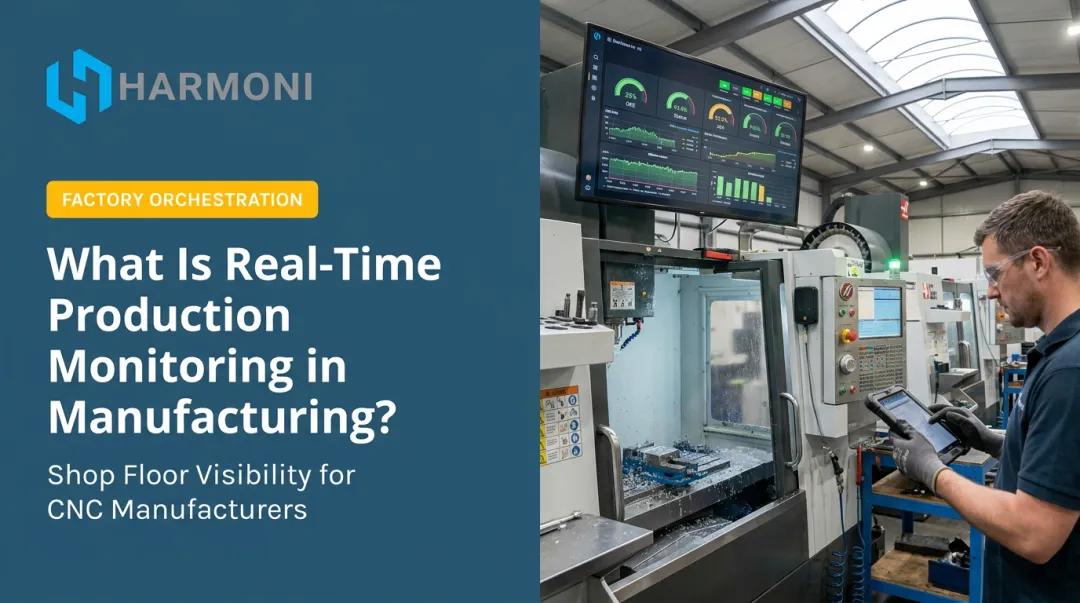
- A dashboard flags any deviation from the planned cycle instantly
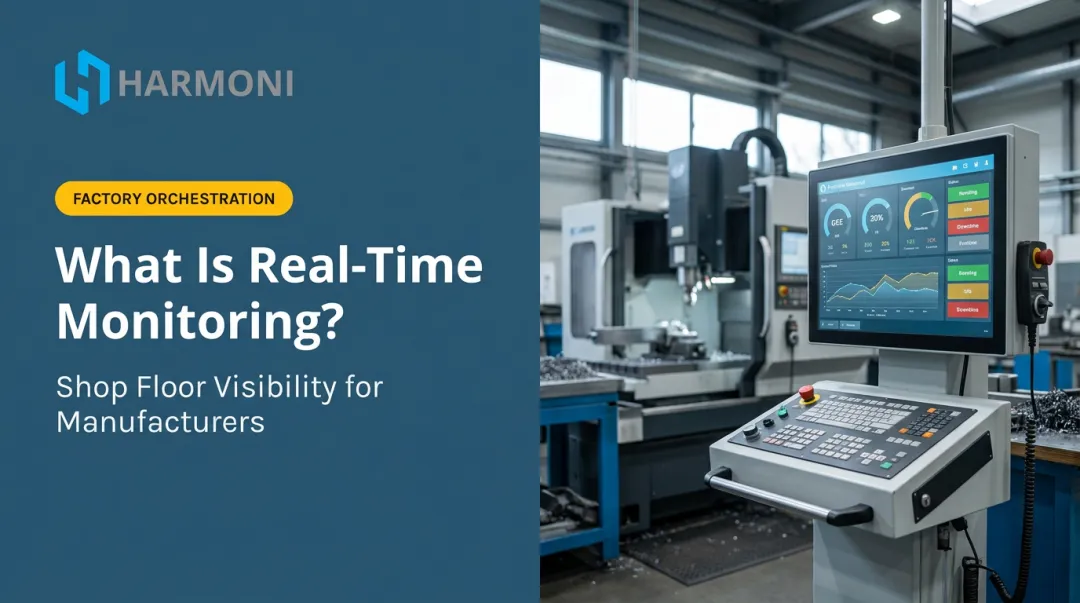
Harmoni's three pillars — automation, process control, and observability — work together at one workcenter. Rather than three separate systems, the operator sees one centralized command center: live job data, digital work instructions, quality checksheets, and machine status in one screen.
It's Lean's andon principle, running digitally instead of on a pull cord.
This isn't theoretical. WessDel, a San Jose-based machine shop, implemented Harmoni's RFID-driven platform and gained 17 productive hours per employee per month with a 5X ROI, largely by eliminating time lost to manual ERP transactions that previously ate 11 minutes per entry.
As owner Bob Dorricott put it: "I was impressed by how easy the Harmoni system was to install... it was seamlessly working with Epicor out of the box."
Another shop using the same platform reduced scrap by 22% in just two months by catching quality drift before parts hit the scrap bin.
Key Components & Getting Started
Rolling out real-time monitoring doesn't require ripping out existing equipment or replacing your ERP. It requires three layers working together.
Data Collection Layer
- Direct machine connections — PLC/CNC protocols including Fanuc FOCAS, Siemens OPC UA, and MTConnect
- Retrofit sensors for legacy equipment — power-line sensors that detect machine state on equipment with no native connectivity
- RFID/badge identification — automatic operator and job detection without manual check-in
Software and Integration Layer
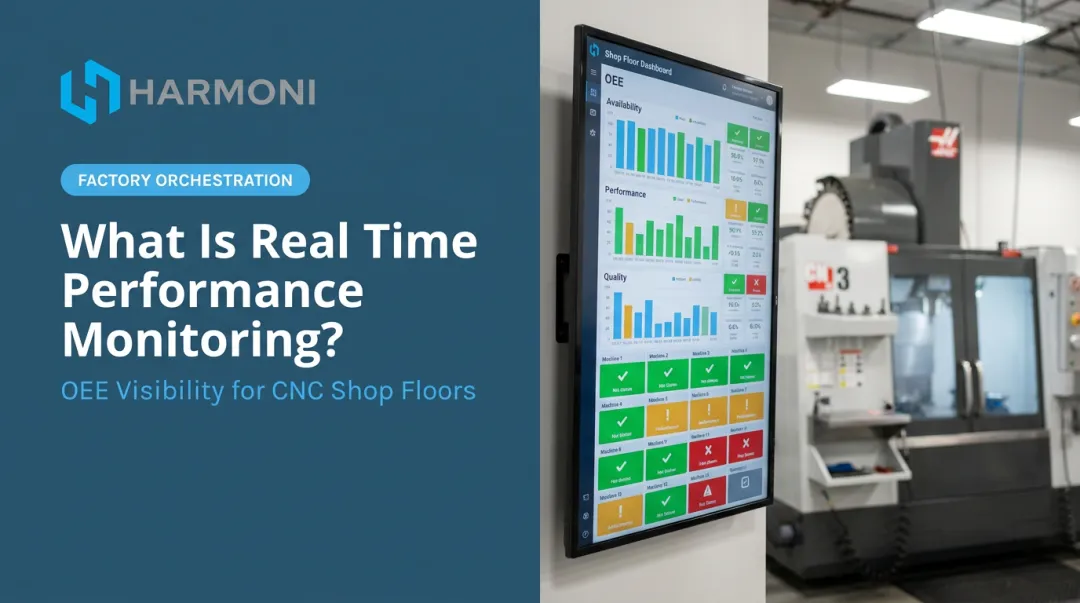
- Live dashboards — track OEE, cycle time, and downtime by reason code
- Automated alerts — fire the moment a deviation occurs
- ERP integration — bi-directional sync with Epicor, Infor, JobBoss, and Odoo so job costing reflects real shop activity
Implementation Roadmap
- Pick one bottleneck line or workcenter — not the whole plant
- Define two to three KPIs tied to a specific lean initiative, such as reducing changeover waste
- Prove value in weeks, then scale — many deployments start delivering usable data within hours of installation
- Layer in features progressively — labor tracking first, then work instructions, program loading, and quality checksheets

Technical setup is only half the work. Adoption hinges on how the system is framed to operators. Position it as fewer manual logs and clearer instructions, and it sticks. Frame it as surveillance, and you'll fight the rollout every step of the way.
Frequently Asked Questions
What is an example of a real-time monitoring system for lean manufacturing?
A CNC shop where RFID badges identify the operator and job at each machine, cycle times stream live from the control, and a dashboard flags deviations the moment they occur. That live loop is the core of real-time monitoring for lean manufacturing.
What are the main pillars and techniques of lean manufacturing?
Core lean pillars include JIT, TPM, kaizen, standardized work, and value stream mapping. Real-time monitoring strengthens each one by feeding accurate, live data into daily decisions and improvement cycles.
How is real-time monitoring different from traditional lean tools like andon boards?
Manual andon pulls depend on someone noticing a problem and physically acting on it. Real-time systems detect the deviation automatically and alert the right people the instant it happens.
Can real-time monitoring work alongside existing kaizen or 5S programs?
Yes. It complements these programs rather than replacing them, supplying the live baseline and before/after data kaizen teams need for faster, evidence-based decisions.
How quickly can a manufacturer implement a real-time monitoring system?
Pilot deployments on a single line or workcenter can show measurable results within weeks, not quarters. Some setups start collecting usable data within hours of installation.
Does real-time monitoring replace the need for lean training and culture?
No. Monitoring supplies the data, but sustained improvement still depends on trained teams and a continuous-improvement culture that actually acts on what the data shows.