
Introduction
Most manufacturing operations run on several software systems at once — an ERP handling orders and financials, often an MES tracking production, machine monitoring dashboards pulling data from the floor. The problem isn't a shortage of software. It's that these systems rarely talk to each other cleanly, and the people running production are left making decisions based on information that's already hours old.
According to a 2024 Manufacturing Leadership Council survey, 53% of manufacturers cite coordinating data across systems and formats as their single biggest barrier to data-driven decisions — and 70% still collect data manually. Those aren't technology problems. They're integration problems.
The term "manufacturing platform" covers a wide range of software solutions, from broad enterprise systems to specialized shop floor layers. Understanding the distinctions matters — because choosing the wrong category of tool means solving the wrong problem. What follows breaks down what a manufacturing platform actually is, the major types, and what to evaluate before committing.
Key Takeaways
- A manufacturing platform integrates data, machines, people, and processes into a unified system for visibility and control
- Platform types range from ERP and MES to IIoT and newer orchestration layers, each solving a distinct operational problem
- The right platform connects systems already in your facility — no rip-and-replace required
- Real-time shop floor visibility, not end-of-shift reports, is the defining benefit of modern manufacturing platforms
What Is a Manufacturing Platform?
A manufacturing platform is a software framework that connects data, processes, machines, and people across an entire manufacturing operation into one unified system. It sits between the physical shop floor and the digital systems that manage it — bridging planning, production, and quality under a single layer of coordination.
Platform vs. Point Solution
The key distinction is scope. A point solution solves one narrow problem in isolation: a tool that tracks downtime, or one that stores work instructions. A platform connects multiple systems simultaneously — ERP, MES, machines, sensors, and operators. The value comes from those connections, not from any individual feature.
Why Mid-to-Large Manufacturers Feel This Most
Most manufacturers don't run one platform — they run several that don't communicate cleanly. As operations scale across product lines, machines, and facilities, the gaps between systems compound:
- Operators work without real-time context on job status or priorities
- Job costing depends on manually entered time data that's often inaccurate
- Quality problems surface after production rather than during it
- Plant managers review yesterday's data to make today's decisions
No single existing system — ERP, MES, or machine monitoring — fully solves any of these on its own. A manufacturing platform addresses them together by connecting the data, people, and workflows that currently exist in silos.
What Does a Manufacturing Platform Do?
Manufacturing platforms vary in scope, but most perform some combination of four core functions.
Collecting and Surfacing Data
At the most basic level, platforms collect data from machines, sensors, operators, and business systems, then make that data accessible for monitoring and decision-making. What separates a useful platform from an expensive dashboard is timing. Post-shift reports tell you what went wrong. Real-time visibility lets you respond while it's still happening.
Coordinating People, Machines, and Systems
Modern platforms go beyond data collection. They actively coordinate how operators, machines, and enterprise systems work together, delivering the right information to the right person before a problem develops.
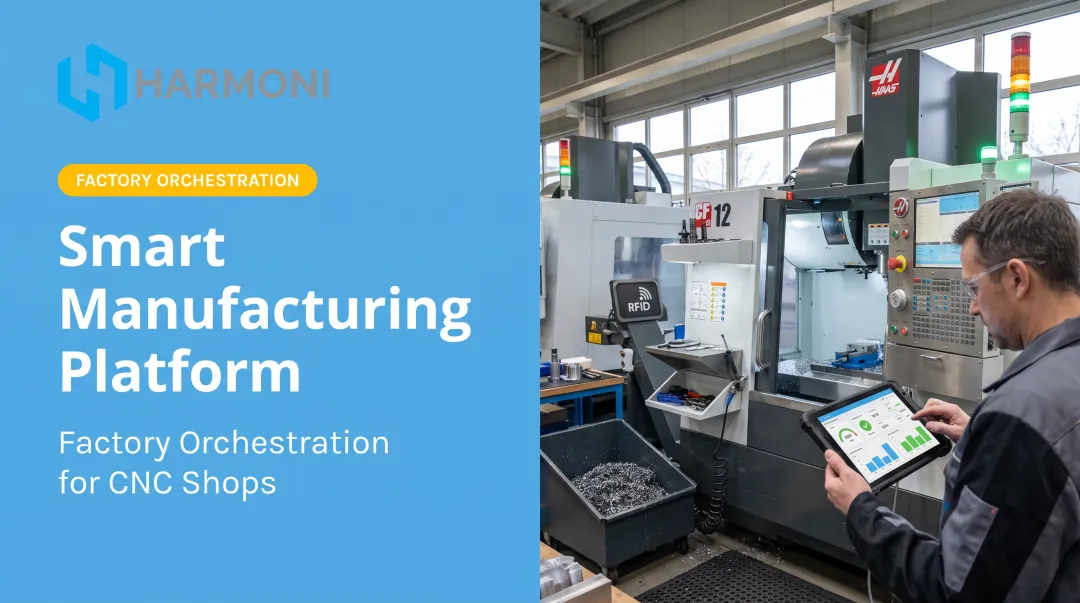
When an operator walks up to a machine, a well-designed platform surfaces the correct work instructions, the CNC program tied to that specific part revision, and the job's current status — no manual lookup required.
Automating Non-Productive Tasks
Too much shop floor time disappears into administrative overhead: manual time entry, paper-based job tracking, locating the current revision of a drawing. Platforms automate these steps, reducing operator burden and the risk of human error. One Harmoni customer — WessDel — found that a single time-tracking transaction took 11 minutes per employee before automation. After implementation, that time was eliminated, recovering 17 productive hours per employee per month.
Enabling Process Control and Error Prevention
The most impactful platforms don't just record what happened — they prevent problems from happening. This means:
- Surfacing correct work instructions before production starts
- Flagging deviations from expected cycle times or quality parameters in real time
- Preventing operators from proceeding past errors or incomplete checkpoints
- Locking the correct CNC program to the correct part revision to eliminate wrong-program errors

Scrap rates and rework costs drop sharply when the platform enforces the process — not just records it.
Types of Manufacturing Platforms
Manufacturing platforms fall into several distinct categories, each addressing a different layer of the operation. Most manufacturers run more than one type simultaneously, so each system's data rarely stays within its own walls.
Enterprise Resource Planning (ERP) Systems
ERP is the business management layer. It handles orders, scheduling, inventory, financials, and job costing. ERP is strong at planning and record-keeping — it knows what jobs are supposed to happen and when.
What ERP typically doesn't do well: real-time shop floor visibility. ERP data is only as accurate as what operators manually enter, which introduces lag and error into critical decisions like quoting, scheduling, and capacity planning.
Common manufacturing ERP platforms include Epicor, Infor, ABAS, and ECI JobBoss/JobBoss2.
Manufacturing Execution Systems (MES)
MES is the production management layer — tracking work-in-progress, managing work orders, and recording production data. It bridges planning (ERP) and execution on the floor.
MES adds more granularity than ERP, but most systems require significant configuration and still don't fully account for real-world operator behavior or machine variability. As LNS Research defines it, MES coordinates, controls, monitors, and tracks production in real time — but the gap between what MES plans and what actually happens on the floor remains a persistent challenge.
Industrial IoT (IIoT) and Machine Monitoring Platforms
IIoT platforms connect machines and sensors to capture utilization, cycle time, and fault data. They answer the question: is my equipment running?
A 2020 SME study found IIoT adoption had tripled since 2018, yet the Manufacturing Leadership Council found that 53% of manufacturers still couldn't coordinate data across systems effectively. Machine monitoring surfaces insights in dashboards. It doesn't always translate those insights into action on the floor.
Factory Orchestration Platforms
Factory orchestration is a newer category that sits between ERP, MES, machines, and operators to improve real-time execution. Unlike systems that operate in isolation, an orchestration platform coordinates people, processes, machines, and engineering requirements simultaneously, catching problems as they happen rather than after the fact.
Harmoni pioneered this category. Using long-range RFID, the platform auto-detects nearby employees and jobs at each workcenter and triggers automated workflows without manual input:
- Loads the correct CNC program automatically
- Surfaces the right work instructions and setup sheets
- Captures labor time against the active job
- Pushes accurate data back into the ERP in real time

Its three core pillars — automation, process control, and observability — are delivered through machine-side command centers at each workcenter.
Key Benefits of Using a Manufacturing Platform
Improved Labor Visibility and Job Costing Accuracy
A manufacturing platform creates a real-time picture of who is working on what, where time is spent, and whether production is on track. For job shops and contract manufacturers, the stakes are direct: inaccurate labor data flowing into ERP produces inaccurate job costs, which undermines quoting accuracy and profitability analysis.
Automated time capture eliminates the lag and error that come with operator self-reporting. When labor data is collected continuously and pushed directly into ERP, job costing reflects what actually happened on the floor.
Reduction in Production Errors and Scrap
Platforms that enforce process control prevent mistakes before they result in scrapped parts or costly rework. Key controls include:
- Guided work instructions delivered at the machine
- Real-time error flagging before the cut is made
- Revision-locked program assignments to prevent outdated file use
- Enforced quality checkpoints tied to job completion
One shop using Harmoni reduced scrap by 22% within two months of deployment.
Faster, More Informed Decision-Making
When machine data, operator activity, and ERP workflows are unified in a single view, plant managers can identify problems while they're happening. NIST estimates discrete manufacturing downtime at 8.3% of planned production time — a target that only moves when visibility is continuous, not retrospective.
How to Choose the Right Manufacturing Platform
Identify Where Your Operation Has the Most Friction
Different platform types solve different problems:
- Planning gaps → ERP is the right layer
- Production tracking gaps → MES addresses this
- Machine visibility gaps → IIoT/machine monitoring helps
- Real-time execution and coordination gaps → Factory orchestration fills this

Start by identifying your most expensive operational failure point. That determines which layer deserves the most attention. Once you know which layer to prioritize, the next question is whether a platform can actually connect to the systems already running in your facility.
Evaluate Integration Depth, Not Just Feature Lists
A platform's value depends on how well it connects with systems already running in your facility — ERP, machine controls, quality systems — without requiring those systems to be replaced. Ask vendors specifically:
- Which ERP systems does this integrate with natively?
- Which machine controls are supported, and does my existing equipment qualify?
- Is the data flow bidirectional, or only one direction?
- What does integration actually require from our team to implement?
Harmoni, for example, integrates natively with Epicor, Infor, Infor Visual, ECI JobBoss/JobBoss2, ABAS, and ODOO. It also connects to CNC controls from Mazak, Haas, Fanuc, Heidenhain, Siemens, DMG MORI, Makino, and Fadal — without requiring machine replacement or modification.
Prioritize Rapid Deployment and Early Results
Be skeptical of platforms that require full implementation before delivering any operational value. The right solution deploys in weeks, delivers measurable improvements quickly, and can scale use case by use case. A realistic benchmark: your team should see measurable shop floor impact within the first 30–60 days, not after a multi-quarter rollout.
Frequently Asked Questions
What is a manufacturing platform?
A manufacturing platform is a software system that integrates data, machines, people, and processes across a manufacturing operation. Rather than managing one narrow function, it provides unified visibility and control — connecting what happens on the shop floor with the systems that plan, track, and manage production.
What is an example of a manufacturing platform?
Examples span several categories: ERP platforms like Epicor or Infor handle business planning and financials; MES platforms track production execution; IIoT platforms like MachineMetrics monitor machine utilization. Factory orchestration platforms like Harmoni go a step further — coordinating people, machines, processes, and ERP transactions in real time at the shop floor level.
What are the three types of manufacturing systems?
The three most commonly referenced types are ERP (enterprise planning and financials), MES (production execution and tracking), and SCADA/IIoT (machine and process monitoring). Modern operations increasingly add a fourth layer — factory orchestration — to coordinate all three in real time during production.
How is a manufacturing platform different from an ERP or MES?
ERP manages business planning and financials. MES tracks production execution. A manufacturing platform — particularly an orchestration layer — connects those systems with machines and operators in real time, filling the gap between what systems plan and what actually happens on the floor during a shift.
What is a factory orchestration platform?
A factory orchestration platform coordinates people, machines, systems, and engineering requirements during production. It sits between ERP and MES to improve how operators execute jobs and how managers gain real-time visibility into shop floor performance.