Introduction
Smart manufacturing stopped being a buzzword the moment shops started feeling real pressure from three directions at once: fewer skilled workers, thinner margins, and customers demanding tighter quality documentation than ever before.
That pressure is measurable. Deloitte and the Manufacturing Institute project US manufacturers may need as many as 3.8 million additional workers between 2024 and 2033, with roughly half of those roles potentially going unfilled.
Aerospace primes, defense contractors, automotive tier suppliers, and precision machine shops feel this gap first because their work demands experience that takes years to build.
Smart manufacturing often gets framed as a technology story about sensors and algorithms. The real test is more practical: fewer parts scrapped, less machine idle time, and job costs that reflect what actually happened on the floor.
This article breaks down what smart manufacturing actually means, why it matters in practice, and how manufacturers capture its value instead of collecting dashboards nobody checks.
Key Takeaways
- Smart manufacturing connects machines, data, and people for real-time decisions, not next-shift reports
- It delivers fewer errors, less downtime, and visibility manufacturers didn't have
- Treat it as an ongoing practice, not a one-time purchase, for compounding gains
- Skipping it means reactive firefighting, inconsistent execution, and capped scalability
What Is Smart Manufacturing (Brief Context)
According to NIST, smart manufacturing is the convergence of operating technologies (OT) and information technologies (IT) working together in a real-time, integrated fashion. In plain terms: machines and sensors generate data, software analyzes it, and that intelligence drives faster decisions on the floor.
You'll see it most in environments where consistency and traceability aren't optional:
- CNC machining shops running high-mix, low-volume jobs
- Aerospace and defense manufacturers working under AS9100 requirements
- Automotive suppliers managing IATF 16949 documentation
- Precision manufacturing operations where a single missed tolerance affects an entire batch
One point often gets lost in the technology conversation: smart manufacturing is a mechanism, not the end goal. A shop doesn't win by installing sensors. It wins when those sensors lead to fewer scrapped parts, faster job costing, and supervisors who catch problems before they compound. Technology for its own sake doesn't move any of those numbers.
Key Advantages of Smart Manufacturing
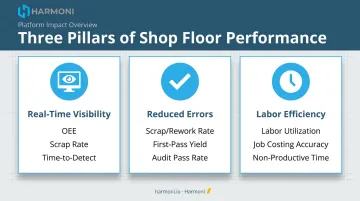
The advantages below aren't abstract. They map directly to metrics manufacturers already track: OEE, scrap rate, labor utilization, and job costing accuracy. If a smart manufacturing initiative doesn't move one of these, it's not delivering value yet, no matter how impressive the dashboard looks.
Real-Time Visibility Into Production Performance
Real-time visibility means seeing what's happening on the floor as it happens, not reconstructing it from a shift-end report written by memory.
Connected machines, operator activity, and ERP data combine into unified dashboards that flag problems the moment they occur. Instead of a supervisor learning about a tolerance drift at 6 PM, they see it at 2:14 PM, while there's still time to act.
Why this matters:
- Catching an issue mid-production stops scrap from compounding across an entire batch, rather than discovering the whole lot is bad after the fact
- McKinsey's 2024 lighthouse-facility review found Agilent reduced its defect rate by 49% in four months using real-time anomaly detection
- Supervisors make faster calls because they're not waiting on someone to walk the floor or file a report
KPIs impacted: OEE, scrap rate, machine utilization, time-to-detect for quality issues.
When it matters most: High-mix, low-volume shops, where one missed anomaly can ripple across multiple jobs and customer deliveries at the same time.
Reduced Errors and Improved Execution Consistency
This advantage is about standardizing how a job gets executed, regardless of who's running the machine, what shift it is, or how long that operator has been on the job.
Automating manual, non-productive steps, things like job lookups, paper travelers, and manual data entry, removes the exact moments where human error creeps in.
Why this matters:
- Inconsistent execution is a leading driver of rework and scrap in mid-to-large shops, particularly across multiple shifts
- Consistency directly supports compliance readiness for regulated industries like aerospace, defense, and medical device manufacturing, where auditors expect documented, repeatable processes
- Machine Specialties, Inc. (MSI), a beryllium parts shop, added real-time monitoring and digital work instructions in 2024, nearly eliminating part-count errors on high-risk parts while Epicor integration eliminated paper travelers
KPIs impacted: Scrap/rework rate, first-pass yield, compliance audit pass rate.
When it matters most: Multi-shift operations or shops with high operator turnover, where tribal knowledge alone can't guarantee the same result twice.
This is precisely the gap Harmoni's factory orchestration platform is built to close. By coordinating people, machines, and ERP workflows in real time, execution stays consistent no matter who clocks in.
Improved Labor Efficiency and Accountability
This one's about the minutes operators lose every day, searching for the right job, hunting down paperwork, waiting for instructions, and giving those minutes back without adding headcount.
Automated job and employee detection, like long-range RFID tracking, plus a centralized interface at each workcenter, removes those non-productive steps from an operator's day entirely.
Why this matters:
- Recovering even a few minutes per job across a whole shop compounds into meaningful capacity gains over a month
- Job costing gets more accurate when it reflects actual time spent, not an estimate typed in after the fact
- At MSI, RFID-based tracking linked operators, equipment, and job accountability automatically, shifting how the shop measured profitability from spindle time to earned hours
KPIs impacted: Labor utilization rate, job costing accuracy, non-productive time percentage.
When it matters most: Job-shop or make-to-order environments, where dozens of jobs move through a single workcenter and manual tracking simply breaks down.
What Happens When Smart Manufacturing Is Missing or Ignored
Staying reliant on manual processes and disconnected systems creates specific, compounding problems that go far beyond falling behind on technology:
- Inconsistent execution across shifts and operators, since there's no shared source of truth for how a job should run
- Higher error and scrap rates that go undetected until after production, when it's too late to save the batch
- Reactive firefighting instead of catching issues early, because nobody knows there's a problem until a customer complains
- Rising operational costs from wasted labor time, rework, and re-inspection
- Difficulty scaling operations or delegating floor decisions, since managers can't trust data they don't have
None of these show up overnight. They accumulate quietly, shift after shift, until a shop realizes it's spending more time cleaning up mistakes than making parts.
How to Get the Most Value from Smart Manufacturing
Smart manufacturing only pays off when it's applied consistently across the floor, not piloted on one machine and left there. A dashboard nobody checks daily is just an expensive screen saver.
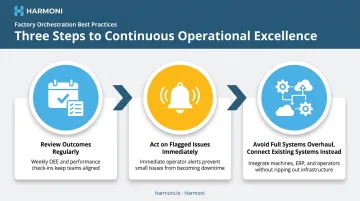
A few principles separate shops that see real gains from ones stuck in "pilot purgatory":
- Review outcomes regularly. Daily or weekly check-ins on OEE, scrap rate, and labor utilization keep insights connected to action, rather than buried in a monthly report nobody reads.
- Act on flagged issues immediately. An alert that a machine drifted out of tolerance means nothing if there's no process for someone to respond within minutes, not hours.
- Avoid a full systems overhaul. Ripping out an ERP or MES to "go digital" is expensive and disruptive. The better path connects existing systems rather than replacing them.
This is where a platform like Harmoni's factory orchestration layer fits. It sits between ERP, MES, machines, and operators, so insights translate into faster, more consistent action without forcing a shop to rebuild its tech stack from scratch.
Shops using it have gone live in weeks, not quarters, because it retrofits to equipment they already own, regardless of brand or age.
Conclusion
Smart manufacturing's real value comes from the control, clarity, and consistency it enables on the shop floor.
The advantages compound. Better visibility drives smarter decisions, which lead to cleaner execution and lower costs. Each step builds on the last.
Treat smart manufacturing as an ongoing operational practice, not a one-time software rollout. The shops seeing the biggest gains are the ones that unify people, machines, and systems in real time, then keep refining how they use that connection. Harmoni's platform enables exactly this, unifying machine data, operator activity, and ERP transactions into one live view.
Frequently Asked Questions
What are smart manufacturing solutions?
Smart manufacturing solutions typically include IoT sensors, machine monitoring software, ERP/MES integrations, and orchestration platforms. Together they connect floor data to decision-making in real time.
How does smart manufacturing work?
Sensors and connected machines collect data continuously. Software analyzes that data in real time, and the resulting intelligence drives automated or human decisions on the floor.
What industries benefit most from smart manufacturing?
High-mix, high-precision, and regulated industries such as CNC machining, aerospace, defense, automotive, and healthcare manufacturing see the biggest impact. Their strict quality and traceability requirements make connected data especially valuable.
Is smart manufacturing the same as Industry 4.0?
Not exactly. Industry 4.0 is the broader industrial movement, while smart manufacturing refers to the practical application of its technologies on the factory floor.
How is factory orchestration different from smart manufacturing?
Factory orchestration is a specific layer within smart manufacturing. Platforms like Harmoni coordinate people, machines, and systems in real time to improve execution, rather than just collecting or visualizing data.
How long does it take to see results from smart manufacturing initiatives?
Focused deployments, like real-time dashboards or an orchestration layer, can show measurable improvements within weeks. Broader digital transformation is a longer, ongoing journey.