The gap isn't a lack of technology. It's a lack of coordination between the technology that exists.
According to Mordor Intelligence, the industrial automation software market is projected to reach $43.87 billion in 2026, growing at a 7.45% CAGR — a figure that reflects how aggressively manufacturers are investing in software to close that gap.
This guide ranks the best factory automation software tools of 2026, explains what separates them, and helps manufacturers match the right tool to their specific operational needs — whether that's machine visibility, ERP integration, operator coordination, or something else entirely.
Key Takeaways
- Factory automation software spans SCADA, MES, IIoT, ERP-integrated platforms, and factory orchestration — choosing the wrong category is the costliest mistake buyers make.
- Top 2026 tools unify real-time visibility, machine-to-operator coordination, and ERP integration in one platform.
- Mid-to-large precision manufacturers need tools that work at the operator level, not only in the IT department or executive dashboard.
- IDC projects that by 2026, more than 40% of manufacturers will use AI-based tools to improve dynamic scheduling.
- Top picks in this guide: Harmoni, Ignition by Inductive Automation, Rockwell FactoryTalk, Siemens Insights Hub, and SAP Digital Manufacturing.
What Is Factory Automation Software?
Factory automation software connects machines, operators, and business systems to monitor, control, and optimize manufacturing production. It's not a single product category — it's an umbrella term covering several distinct types of platforms, each operating at a different layer of the factory.
The Key Software Categories
| Category | What It Does |
|---|---|
| SCADA | Supervises and monitors equipment; gathers real-time signals from machines |
| MES | Manages production execution — work orders, quality, genealogy, scheduling |
| Industrial IoT | Connects machines to data pipelines; collects telemetry and time-series data |
| ERP-Integrated MES | Ties shop floor execution directly to business planning and supply chain |
| Factory Orchestration | Coordinates people, machines, ERP workflows, and engineering requirements simultaneously in real time |
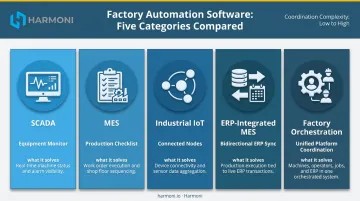
Each category solves a different problem. A SCADA platform that monitors equipment status won't solve an operator coordination problem. An ERP-integrated MES won't automatically eliminate manual steps at the workcenter level.
The tools ranked below were selected based on their fit for mid-to-large discrete and precision manufacturers — specifically platforms that drive measurable improvements in production execution, not just data collection.
Top Factory Automation Software Tools of 2026
Selection criteria: Real-time visibility capabilities, ERP and machine integration depth, operator-level usability, deployment speed, and demonstrated impact on production outcomes for discrete and precision manufacturers.
Harmoni
Harmoni pioneered the factory orchestration category: a platform built specifically for mid-to-large manufacturers that sits between ERP systems, MES platforms, CNC machines, and operators to coordinate production in real time. It's been featured in Modern Machine Shop and Crain's Cleveland Business. Native integrations cover major machine brands (Fanuc, Haas, Mazak, DMG MORI, Siemens) and ERP systems (Epicor, Infor, JobBoss2, ODOO, ABAS).
Where most platforms provide data, Harmoni provides coordination. Its three core pillars address the most common shop floor breakdowns:
- Automation — eliminates non-productive manual steps like labor tracking, time entry, and program loading
- Process control — enforces consistency through digital work instructions, engineering revision control, and digital quality checksheets
- Observability — delivers real-time dashboards combining machine data, operator activity, and ERP workflows in a unified view
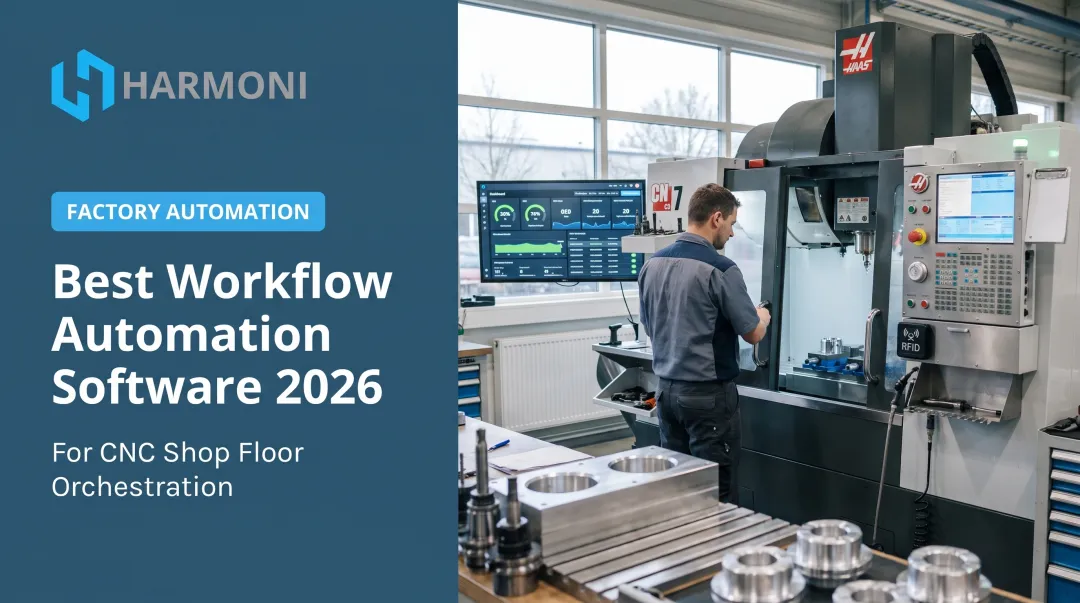
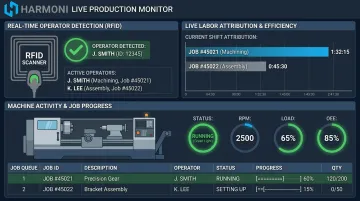
The RFID-based operator detection system automatically identifies employees and jobs at the workcenter — removing manual check-ins and enabling real-time labor attribution without operator effort. A documented WessDel case study showed that a time-tracking process previously requiring 11 minutes per transaction dropped to seconds, generating 17 productive hours per employee per month and a 5X return on ongoing platform costs.
Harmoni deploys in weeks without replacing existing machines or ERP systems — a critical advantage for mid-sized manufacturers who can't afford months-long implementations.
| Category | Details |
|---|---|
| Key Features | Factory orchestration, RFID operator detection, real-time dashboards, ERP and machine integration, automated task elimination, OEE tracking, digital work instructions, job costing accuracy |
| Best For | Mid-to-large CNC machining, aerospace, defense, automotive, and precision manufacturing operations needing real-time shop floor coordination |
| Deployment | Deploys in weeks; integrates with existing ERP and CNC ecosystems without replacing current systems |
Ignition by Inductive Automation
Ignition is a widely adopted industrial automation platform combining SCADA, HMI, and — through partner modules — MES functionality in a modular architecture. It's deployed across discrete manufacturing, food and beverage, and energy sectors, with a gateway-centric model that supports web and mobile access.
Its strength is flexibility. Ignition's Perspective module builds mobile-responsive HTML5 applications that run in any browser, and its scripting environment (Python via Jython) supports custom logic. Full MES capabilities, including OEE tracking and traceability, come from Sepasoft (an Inductive Automation technology partner) rather than the base platform — a distinction worth clarifying before scoping a deployment.
| Category | Details |
|---|---|
| Key Features | SCADA, HMI, partner-extended MES modules, real-time monitoring, alarm management, Python scripting, web-based visualization |
| Best For | Manufacturers needing a versatile, customizable SCADA/HMI platform with scalable MES capabilities |
| Deployment | Perpetual license (Standard and Edge); cloud editions available on AWS and Azure; modular pricing model |
Rockwell Automation FactoryTalk
FactoryTalk is Rockwell's enterprise portfolio spanning MES, analytics, IIoT, and design tooling — not a single monolithic product. For large-scale discrete and process manufacturers already invested in Rockwell control systems, it provides considerable depth across operational functions.
Key components include:
- FactoryTalk Metrics — OEE tracking and efficiency monitoring (note: Rockwell has announced a discontinuation date of September 2028 for this product)
- FactoryTalk Energy Manager — monitors water, air, gas, electricity, and steam consumption
- FactoryTalk InnovationSuite — combines analytics and IIoT capabilities powered by PTC's ThingWorx platform
- FactoryTalk Design Studio Copilot — uses generative AI to assist with PLC code creation and device configuration
Implementation requires dedicated automation staff and a multi-month timeline. This is a better fit for well-resourced enterprise teams with existing Rockwell infrastructure than for mid-sized shops without in-house technical resources.
| Category | Details |
|---|---|
| Key Features | MES, IIoT connectivity (via ThingWorx/PTC), OEE analytics, energy monitoring, multi-site deployment, AI design assistance |
| Best For | Large enterprise manufacturers with existing Rockwell infrastructure and complex multi-site operations |
| Deployment | Custom pricing (consultation required); cloud-hosted; substantial implementation investment |
Siemens Insights Hub
Formerly MindSphere, Siemens has evolved this offering into Insights Hub, now part of the Siemens Xcelerator platform. It connects Siemens and compatible equipment to analytics and monitoring applications, with strong time-series data ingestion (millisecond precision) and asset performance monitoring capabilities.
Insights Hub is most valuable for manufacturers already standardized on Siemens automation hardware. For mixed-vendor shop floors, integration requires additional configuration and shouldn't be treated as plug-and-play.
| Category | Details |
|---|---|
| Key Features | Industrial IoT data ingestion, time-series analytics, asset performance monitoring, OEE applications, role-based access, Siemens ecosystem integration |
| Best For | Manufacturers standardized on Siemens automation hardware seeking connected operational analytics |
| Deployment | Subscription-based via Siemens Xcelerator Marketplace; cloud-hosted |
SAP Digital Manufacturing
SAP Digital Manufacturing is a fully cloud-based MES designed for enterprises already running SAP S/4HANA. It connects shop floor execution directly to enterprise planning and supply chain workflows, with strong production order management, quality management, and manufacturing analytics capabilities.
Its primary advantage is tight, native ERP integration — data flows between the shop floor and SAP without custom middleware. The tradeoff is that it requires deep SAP expertise to implement and maintain, making it best suited for organizations with established SAP teams.
| Category | Details |
|---|---|
| Key Features | ERP-connected MES, production order management, quality management, manufacturing analytics, worker guidance, Industry 4.0 IIoT integration, S/4HANA native |
| Best For | SAP-centric enterprises needing tight ERP-to-shop-floor integration with quality management requirements |
| Deployment | Custom enterprise pricing; fully cloud-based; integrates with cloud or on-premises S/4HANA |
Key Features to Look for in Factory Automation Software
Not all platforms are built for the same buyer. Here's what matters most when evaluating options for a discrete or precision manufacturing environment.
Real-Time Shop Floor Visibility
Dashboards that show only machine status without operator context leave significant blind spots. A machine running at full speed while an operator stands idle waiting for a program is invisible to a machine-only monitoring tool. Look for platforms that surface machine status, operator activity, and production progress simultaneously.
ERP and Machine Integration Depth
Software that can't communicate bidirectionally with both the ERP system and shop floor machines creates data silos. Before purchasing, verify:
- Which specific ERP systems are supported (Epicor, Infor, JobBoss, SAP, etc.)
- Which machine protocols are used (OPC-UA, MTConnect, FANUC FOCAS, Mazatrol, etc.)
- Whether the integration reads data, writes data, or both
Operator-Level Usability
Many factory automation platforms are built for IT teams and management rather than the operators executing production. Platforms that deliver actionable guidance directly at the workcenter drive faster adoption and stronger execution than those confined to office dashboards.
Deployment Speed and Implementation Risk
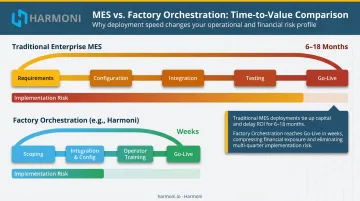
Enterprise MES and ERP-integrated systems routinely take six to eighteen months to implement. For mid-sized manufacturers, that timeline carries real operational and financial risk. Platforms designed to deploy in weeks without replacing existing systems present a lower-risk path to measurable improvement.
Scalability and Vendor Ecosystem Fit
- Scales with the operation: more machines, additional plants, expanded operator count
- Integrates with the ERP systems and machine brands already on the floor
- Delivers full value without requiring replacement of functional existing systems
How We Chose the Best Factory Automation Software
Tools were assessed on their applicability to discrete and precision manufacturers, not process industries or enterprise IT infrastructure. The evaluation prioritized operational outcomes — measurable improvements on the shop floor — over raw data collection capability.
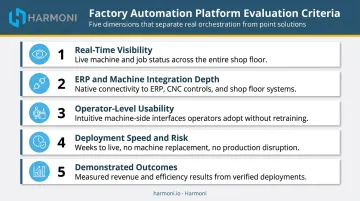
Each tool was scored across five areas that reflect where mid-to-large manufacturers actually lose time, money, and quality:
Scoring criteria weighted:
- Real-time visibility (machine + operator + ERP data combined)
- ERP and machine integration depth and bidirectionality
- Operator-level usability and adoption potential
- Deployment speed and implementation risk
- Demonstrated outcomes: error reduction, job costing accuracy, eliminated wasted operator time
Common buyer mistakes this evaluation accounts for:
- Choosing a connectivity-only platform and expecting full automation outcomes
- Selecting enterprise-scale tools without the IT resources to implement them
- Prioritizing management-level dashboards over operator-level usability
The tools ranked span different software categories: orchestration, SCADA, MES, IoT, and ERP-integrated platforms. The right choice depends on where a manufacturer's biggest operational gap lies — that's what this evaluation is built to surface.
Conclusion
Factory automation software in 2026 isn't a single category, and treating it like one is how manufacturers end up with expensive platforms that don't move the needle on the shop floor.
Manufacturers who match the right tool to their specific operational gap — whether that's visibility, ERP integration, operator coordination, or IoT connectivity — will see faster ROI than those who default to the biggest or most recognized name.
Before shortlisting vendors, assess:
- Deployment timelines relative to your operational capacity
- Integration depth with your existing ERP and machine ecosystem
- Whether the platform operates at the operator level or only at the management level
If your challenge involves wasted operator time, production errors, or lack of real-time shop floor visibility despite already running ERP and MES systems, Harmoni's factory orchestration platform addresses that layer directly. It deploys in weeks, integrates with your existing infrastructure, and connects machines, operators, and ERP workflows into a single coordinated view.
Book a free demo at harmoni.io/demo, or reach the team directly at sales@harmoni.io or (888) 341-4097.
Frequently Asked Questions
What is the best manufacturing automation software?
The best option depends on the operational gap being addressed. Ignition and FactoryTalk suit SCADA and HMI-focused needs, while platforms like Harmoni address the coordination layer between ERP systems, machines, and operators. Mid-to-large precision manufacturers often benefit most from an orchestration platform rather than another standalone MES added to an already complex stack.
What is the most used automation software in manufacturing?
Enterprise platforms like SAP Digital Manufacturing, Rockwell FactoryTalk, and Siemens Insights Hub are widely deployed at large organizations. SCADA platforms like Ignition are popular across mid-sized manufacturers. Adoption varies significantly by industry segment and existing technology ecosystem.
Which automation tool is in demand in 2026?
Tools offering real-time visibility, AI-assisted analytics, and tight ERP integration are seeing strong demand, particularly those that connect operator activity with machine data without requiring a full system replacement. Factory orchestration platforms and IIoT-connected MES tools are among the fastest-growing segments.
What is the difference between MES, SCADA, and factory orchestration software?
SCADA monitors and controls machines at the equipment level. MES manages production execution and tracking in the layer above. Factory orchestration platforms like Harmoni coordinate people, machines, ERP workflows, and engineering requirements simultaneously, acting as the operational layer that makes both ERP and MES work more effectively on the shop floor.
How do I choose the right factory automation software for my operation?
Start by identifying your primary operational gap: machine visibility, operator coordination, ERP integration, or production error reduction. Match that gap to the correct software category, then evaluate integration compatibility with your existing ERP systems and machine types before shortlisting vendors.
Can factory automation software integrate with existing ERP systems?
Most modern platforms offer ERP integration, but depth varies considerably. Some provide read-only data sync; others like Harmoni deliver real-time, bidirectional integration between the shop floor and ERP systems including Epicor, Infor, JobBoss2, ODOO, and ABAS, all without replacing those existing systems.