Introduction
Picture a plant manager sitting down Monday morning to review last week's production numbers. Buried in the spreadsheet: a 12-hour unplanned downtime event on the facility's busiest machining center — a bottleneck that rippled through three downstream jobs and pushed two customer orders past their due dates. The data arrived over the weekend. The problem happened Thursday afternoon.
Closing that gap — between when something goes wrong and when decision-makers find out — is exactly what manufacturing data reports are designed to do. That only works when the reports are structured right and delivered fast enough to act on.
Before going further, one clarification matters: "manufacturing data report" means two different things depending on context. In regulated industries, it refers to a formal compliance documentation package — the kind required for pressure vessels or structural steel fabrication. In everyday shop floor management, it refers to the operational performance reports and dashboards that plant managers use to run their facilities.
This article covers both definitions, then focuses on the operational context — what these reports contain, how they're generated, and why the timing and structure of the data determines whether they drive decisions or just document history.
Key Takeaways
- Manufacturing data reports serve two purposes: regulatory compliance documentation (MDR) and operational performance tracking.
- Operational reports capture OEE, cycle time, downtime, throughput, labor, and quality metrics in real or near-real time.
- 70% of manufacturers still use manually entered data as a primary information source, making data quality a widespread problem.
- Lagging, siloed data forces reactive decisions — shops learn about problems after the damage is done.
- Real-time, unified reporting turns shop floor data into something managers can actually act on.
What Is a Manufacturing Data Report?
The term covers two distinct document types that serve fundamentally different purposes.
The Operational Manufacturing Data Report
In day-to-day shop floor management, a manufacturing data report is a structured document or dashboard that captures, organizes, and presents production performance data. It pulls from machine activity, operator output, job progress, and quality metrics to give managers and engineers a clear picture of what's actually happening on the floor.
These reports serve plant managers, operations directors, and supervisors making daily and weekly production decisions. Common environments include:
- CNC machining centers and high-mix job shops
- Aerospace and defense parts manufacturers
- Automotive component plants
- Precision manufacturing and medical device operations
The Compliance Manufacturer's Data Report (MDR)
In regulated industries, an MDR is something else entirely. Often called the "birth certificate" of a fabricated component, it's a formal documentation package that records material certifications, fabrication methods, inspection results, and regulatory compliance evidence.
For pressure vessels, this means following ASME Boiler & Pressure Vessel Code Section VIII, Division 1, which requires a U-1 Manufacturer's Data Report form. The U-1A is an alternative form, but only for single-chamber vessels completely fabricated in a shop or field — the two forms aren't interchangeable.
For structural steel fabrication under AISC 303, the assembled record set functions similarly — covering traceability, inspection records, and conformity documentation throughout the project.
Compliance MDRs are used by quality engineers, inspectors, and regulatory bodies — not shop floor supervisors.
The rest of this article focuses on operational manufacturing data reports, where mid-to-large manufacturers have the most to gain from better data practices.
Types of Manufacturing Data Reports
Compliance-Focused Manufacturer's Data Reports
A compliance MDR assembles a traceable chain of evidence from raw material to finished component. Typical contents include:
- Mill test reports and material certifications
- Welding procedure specifications (WPS) and procedure qualification records (PQR)
- Welder qualification records
- Non-destructive testing (NDT) results
- Dimensional inspection records
- Third-party inspector sign-offs and manufacturer certificates
ASME's U-1 form, for example, captures manufacturer identity, vessel dimensions, material specifications, weld joint types, post-weld heat treatment data, hydrostatic test pressure, and both the manufacturer's and authorized inspector's signatures. Every field is a regulatory requirement — inspectors use this data to confirm a component meets engineering specifications before it ever reaches installation.
Operational Manufacturing Data Reports
Operational reports fall into four main categories, each targeting a different layer of shop floor performance:
Production Performance Reports
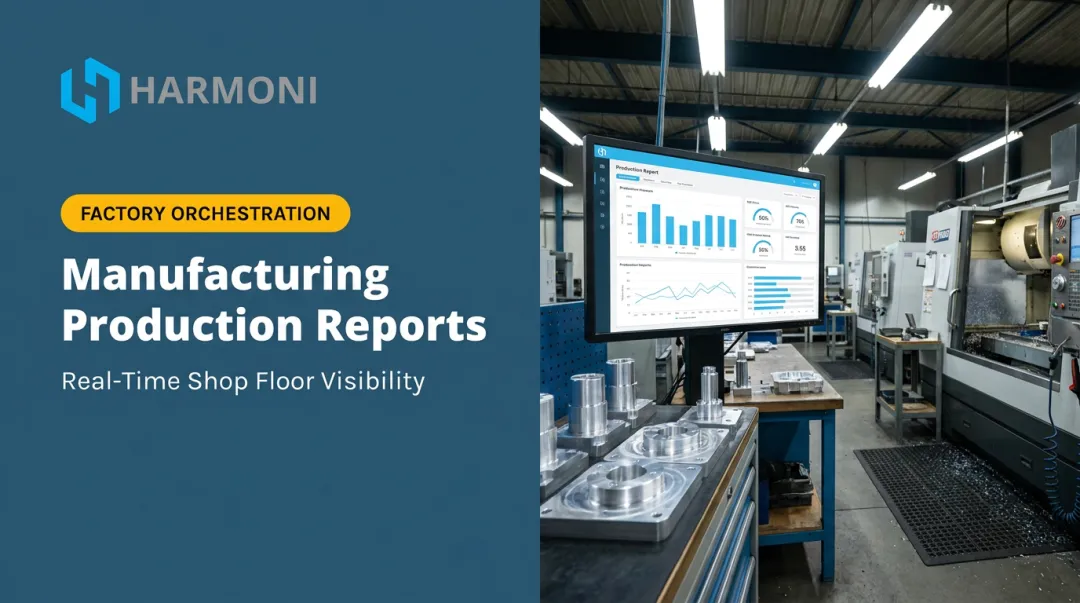
These track output vs. target, job completion rates, shift-by-shift production counts, and cycle times. In day-to-day shop floor management, they're the most frequently referenced reports.
Machine Utilization and OEE Reports
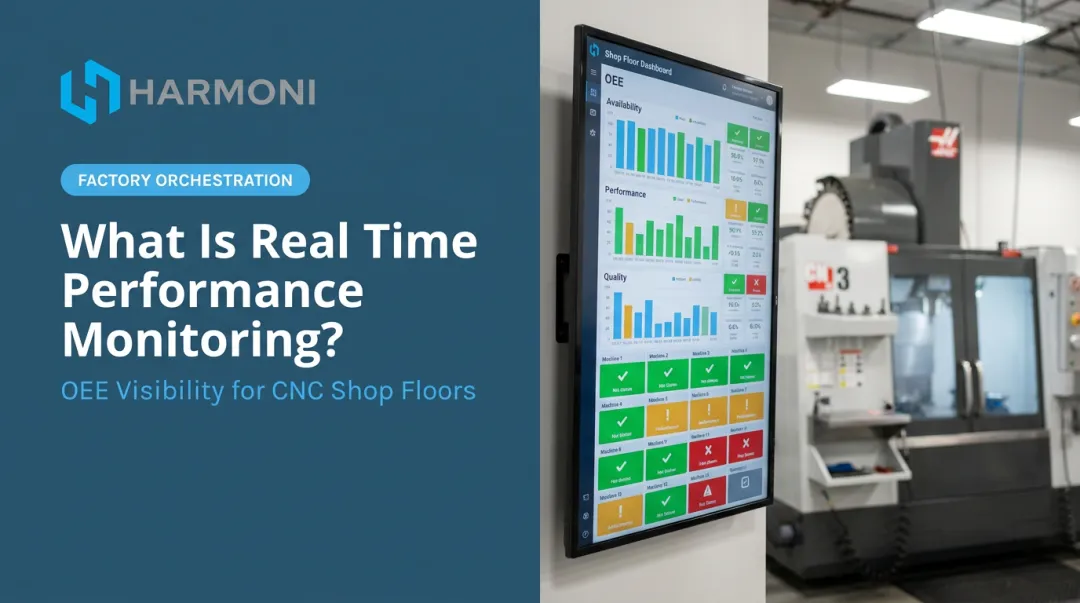
These break Overall Equipment Effectiveness into its three components — availability, performance, and quality — and pinpoint periods of planned and unplanned downtime by machine or work center.
Job Costing and Labor Reports
These compare estimated vs. actual hours per job, log operator time, and surface production cost variances. Without accurate shop floor data, job costing is frequently unreliable.
Harmoni addresses this directly by automatically combining machine cycle time with RFID-captured operator labor records — making actual vs. estimated cost comparisons meaningful rather than approximate.
Quality and Scrap Reports
These track defect rates, scrap quantities, rework hours, and first-pass yield by job, machine, or operator. For aerospace, defense, and medical manufacturing — where tolerances are tight and documentation requirements are strict — they're non-negotiable.
Key Metrics Found in Operational Manufacturing Data Reports
Cycle Time and Takt Time
Cycle time is the actual measured time required to produce one unit through a process or machine. Takt time is the rate at which parts must be produced to meet customer demand, calculated as available production time divided by units of customer demand in that period.
The gap between these two numbers tells you something critical: if cycle time exceeds takt time, the process can't keep pace with demand. If cycle time is well below takt time, there may be room to reduce batch sizes or reallocate capacity. Manufacturing data reports that surface both numbers together give managers a real signal of production health, not just a raw output count.
OEE (Overall Equipment Effectiveness)
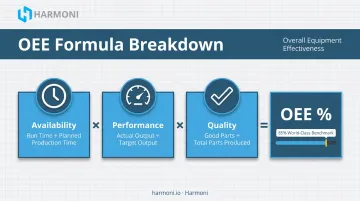
OEE is calculated as:
OEE = Availability × Performance × Quality
- Availability = Run Time / Planned Production Time
- Performance = (Ideal Cycle Time × Total Count) / Run Time
- Quality = Good Count / Total Count
According to OEE.com, 85% OEE is often cited as "world-class" — though the same source cautions that no single ideal score applies universally, and improvement against a plant's own baseline is more meaningful than chasing an industry benchmark.
OEE appears in virtually every operational manufacturing data report because it compresses machine health, operator performance, and quality into a single percentage that's easy to compare shift over shift.
Downtime Categorization
A well-structured report doesn't just record that a machine was down — it categorizes why. Common reason codes include:
- Mechanical failure
- Material shortage or wait
- Operator absence
- Changeover or setup
- Planned maintenance
- Quality hold
Distinguishing planned from unplanned downtime is especially important. Planned downtime (scheduled maintenance, changeovers) is manageable and forecastable. Unplanned downtime points to systemic problems: equipment reliability, supply chain gaps, or process inconsistencies. Those require root cause analysis, not just a logged timestamp.
Throughput and Schedule Adherence
Throughput measures good parts produced per unit of time. Schedule adherence measures the percentage of jobs completed on time relative to the production plan. Together, they tell managers which jobs are on track, which are slipping, and whether the floor can realistically meet delivery commitments before a problem reaches the customer.
Why Manufacturing Data Reports Matter for Shop Floor Performance
"You can't manage what you don't measure" sounds obvious. The harder truth: many shops measure plenty — they just measure it too late, in the wrong format, or in systems that never talk to each other.
The Real Cost of Delayed Data
Unplanned downtime is expensive. Siemens' 2024 True Cost of Downtime study — based on interviews with professionals at large industrial organizations — reported that automotive plants face approximately $2.3M per hour of unplanned downtime, with an idle production line at a large automotive plant costing an estimated $695M annually. Even at a fraction of that scale, the math on delayed reporting is punishing: every hour a problem goes undetected is an hour of avoidable loss.
That kind of loss rarely comes from a single catastrophic event — it compounds from small delays that go unreported long enough to become big ones.
Accountability and Visibility
Structured reports create a transparent record of what happened, when, on which machine, and by whom. That transparency enables two things: performance accountability and fair workload assessment. Without it, managers rely on gut feel and anecdote — neither of which holds up in a post-shift review or a customer conversation.
Strategic Decision-Making
Accountability answers what happened yesterday. Strategy requires knowing what's been happening for months. Trended reports surface patterns that single-shift data can't:
- Which machines are approaching end-of-life based on rising unplanned downtime?
- Which work centers are chronically overloaded relative to staffing?
- Which jobs consistently run over their estimated hours — and why?
These questions can't be answered from a single report. Shops that answer them reliably are the ones that have made structured data collection a standard practice — not a one-time initiative.
Common Challenges with Traditional Manufacturing Reporting
Most manufacturers know their reporting has gaps. The Manufacturing Leadership Council's 2024 Data Mastery survey found that 70% of manufacturers still use manually entered data as a primary information source, and 68% rely on Excel for analysis. Both figures point to the same root cause: reporting infrastructure that hasn't kept pace with shop floor complexity.
The three most common failure modes:
- Lagging data: Paper end-of-shift logs and weekly ERP reports reflect yesterday's production, not today's. Problems surface after the damage is already done.
- Siloed systems: Machine data, operator time records, ERP job data, and quality results live in separate systems with no automatic reconciliation. Assembling a complete picture requires manual effort, which adds delay and introduces inaccuracy.
- Human inconsistency: When operators manually log downtime reasons, data quality depends on individual interpretation. One operator codes a delay as "material shortage"; another calls it "waiting." That inconsistency makes trend analysis unreliable.
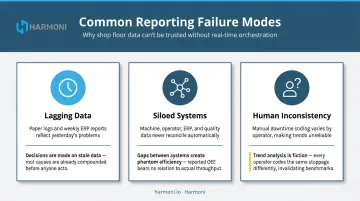
These gaps don't just frustrate reporting teams — they obscure the real-time picture that production decisions depend on.
From Data to Decision: How Real-Time Reporting Transforms Manufacturing Operations
Reactive vs. Proactive
Traditional end-of-day or weekly report reviews mean managers learn about problems after the shift ends — sometimes days later. Real-time manufacturing data reports update as events occur, allowing intervention while a problem is still in progress. A machine that starts losing performance at 2 PM can trigger an alert, a supervisor response, and a corrective action before the shift ends. That same event, discovered in Friday's weekly summary, is just a data point.
Unified Data Visibility
The most effective operational reports don't just pull from one source — they combine machine signals, operator inputs, and ERP job data into a single view. That unified view is where data reconciliation stops being a problem.
Harmoni's factory orchestration platform is built around exactly this architecture: machine data, RFID-captured operator activity, and ERP workflows flow into real-time dashboards that give plant managers a unified command view of their operation. One documented outcome illustrates the impact: WessDel reduced delinquent jobs by 10% and achieved a 5x return on ongoing platform costs — results that became possible once data from those three streams stopped living in separate silos.
Automation Reduces Reporting Burden
Manual data entry doesn't just introduce error — it introduces delay. When operators spend time at shared ERP kiosks logging labor transactions, that's time away from production and a lag between the event and the record. Automated capture eliminates both problems:
- Machine signal collection records equipment state, cycle counts, and runtime continuously — no operator input required
- RFID-based operator detection logs time and job assignment the moment a worker approaches a workcenter, with no manual steps
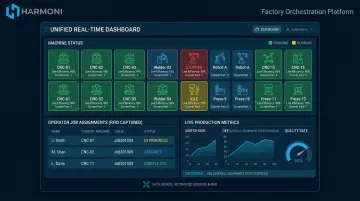
The result is data reliable enough to act on immediately, without double-checking.
Frequently Asked Questions
What is a manufacturing data report?
The term covers two distinct things. A compliance-focused MDR is a formal documentation package for regulated equipment like pressure vessels and structural steel. An operational manufacturing data report is a structured view of shop floor metrics — OEE, downtime, throughput, and labor — used by plant managers for daily production decisions.
What is a manufacturer's data sheet?
A manufacturer's data sheet — sometimes called a mill certificate or material test report — is a document supplied by a material or component supplier confirming the specifications, chemical composition, and mechanical properties of a delivered product. It's distinct from an MDR but is often included as supporting documentation within a full MDR package.
What data is typically included in a manufacturing production report?
Standard reports typically include:
- Units produced vs. target, cycle time, and job completion status
- Machine uptime/downtime by category and OEE
- Scrap and rework counts, and operator labor hours by job
- Advanced reports add schedule adherence, first-pass yield, and job cost variance
How often should manufacturing data reports be generated?
Frequency depends on the use case: real-time dashboards for shop floor visibility, daily summaries for shift supervisors, and weekly or monthly reports for operational planning. Most operations benefit from all three cadences running simultaneously.
What is the difference between a manufacturing data report and an MES report?
An MES report draws only from data the MES itself collects. A manufacturing data report is broader — it can pull from MES, ERP, machine controllers, and operator inputs simultaneously. That distinction becomes critical when data lives across multiple systems that don't automatically reconcile.