Introduction
A part comes off the machine scrapped. The operator didn't notice until final inspection, three hours later. By then, six more parts sat in the same bad batch.
This is the reality for most shops. 70% of manufacturers still collect production data manually, according to the Manufacturing Leadership Council's 2024 Data Mastery survey. Spreadsheets, paper travelers, and end-of-shift reports create blind spots that hide problems until it's too late to act.
Real-time process monitoring software closes that gap. This article covers what it is, how it works, the core benefits it delivers, and what to look for when evaluating a solution.
Key Takeaways
- Real-time monitoring captures machine, operator, and process data as it happens.
- Manufacturers use it to cut wasted time, prevent scrap, and boost accountability.
- The strongest systems unify machine, operator, and ERP data in one view.
- Fit depends on ERP/machine compatibility, deployment speed, and industry needs.
What Is Real-Time Process Monitoring Software?
Real-time process monitoring software is the continuous, automated observation of production machines, processes, and operator activity. It surfaces issues the moment they occur instead of days after a job wraps.
That distinction matters. Traditional reporting audits what already happened. Real-time systems flag deviations within seconds, giving teams a chance to act before the next part gets made, not just document the aftermath.
How Real-Time Process Monitoring Works
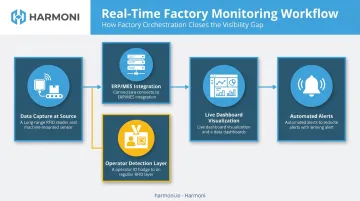
Machine signals and operator inputs get captured at the source, whether that's a spindle sensor, a control unit, or an RFID badge tap at a workcenter. That raw data then integrates with ERP or MES workflows and lands on live dashboards, with automated alerts firing when something deviates from plan.
Most standalone monitoring tools stop there. They'll tell you a machine is idle, but not why, or who was supposed to be running it.
Factory orchestration platforms add that missing layer. Harmoni, for example, uses long-range RFID to automatically detect which operator is working which job at which machine. That closes the gap between what the ERP thinks is happening and what's actually happening on the floor.
Examples of Real-Time Process Data in Action
What does this look like on an actual shop floor? A few examples:
- Live cycle-time tracking on a CNC machine, compared against ERP-estimated run time
- Automatic operator/job detection the moment someone badges into a workcenter, no manual clock-in required
- Instant scrap or downtime alerts routed to a supervisor as soon as a deviation is flagged
- Real-time labor comparisons, catching cases where an operator stays clocked onto a job long after the machine cycle finished
At WessDel, a beryllium and titanium alloy machine shop, manual ERP transactions like clocking in and job changeovers were eating 11 minutes per transaction. Harmoni's RFID automation dropped that to seconds, recovering roughly 17 productive hours per employee, per month.
Key Benefits of Real-Time Process Monitoring Software
Real-time monitoring pays off in ways that compound across a shop. Here's where the impact shows up most.
Eliminates wasted administrative time. Operators spend less time logging labor, walking to a shared terminal, or filling out paper travelers. That time goes back into actual production.
Improves execution consistency. When jobs are tracked the same way every time, variation between operators and shifts shrinks. Standard work becomes easier to enforce because managers can see whether it's actually happening.
Catches problems while they're still happening. Instant deviation alerts mean scrap gets caught after one bad part, not twenty. This matters more than most shops realize: top performers spend just 0.6% of sales on scrap and rework, while bottom performers spend 2.2%, according to APQC benchmark data. That's nearly a 4x gap driven largely by how fast problems get spotted.
Increases labor accountability. Automatic operator and job tracking gives managers a verified record of who worked on what, and for how long, without relying on self-reported time entries.
Enables genuinely accurate job costing. Estimated labor and machine time get replaced with timestamped, verified records. Few shops have that level of data today. A Gartner study reported by Quality Magazine found only 23% of manufacturers actively track Total Cost of Quality, meaning most are pricing jobs on estimates, not reality.
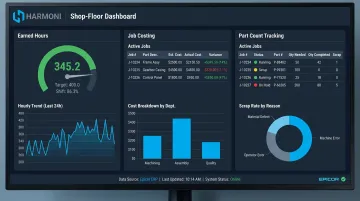
At Machine Specialties, Inc. (MSI), an aerospace, defense, and medical parts manufacturer, this shift meant moving from tracking raw spindle time to tracking earned hours across jobs. The change gave management real visibility into which jobs were actually profitable. MSI also saw a near-elimination of part count errors on complex, high-risk parts after automating labor tracking through Harmoni's Epicor integration.
What Does Real-Time Process Monitoring Track?
Comprehensive shop floor visibility comes from five data streams working together:
| Category | What It Covers |
|---|---|
| Machine state | Running, idle, or fault status in real time |
| Cycle counts and times | Actual run time vs. estimated time per part |
| Quality events | Good parts, scrap, and rework as they occur |
| Operator activity | Who's working which job, and for how long |
| Material and tool changes | Tool life, changeovers, and material consumption |
Tracking machine data alone leaves gaps:
- A machine can look "productive" on paper while an operator charges time to the wrong job
- A tool change can go undocumented until a part fails inspection
Industries with tight quality and traceability requirements, such as CNC machining, aerospace, defense, and automotive, typically need most or all five categories tracked together. A single missing thread, like an undocumented material lot, can break traceability for an entire audit. Harmoni's factory orchestration platform captures all five streams in one system, closing that gap before it reaches an auditor.
Real-Time Monitoring vs. Traditional Periodic Reporting
Periodic reporting has a built-in lag. Whether it's an end-of-shift summary or a paper traveler filled out after the fact, the information arrives too late to change the outcome.
That lag has a compounding cost:
- A scrap-causing deviation continues producing bad parts until the next scheduled check
- Missed delivery commitments stack up because problems surface after the job, not during it
- Labor hours get charged against the wrong jobs, distorting job costing for weeks
ERP and MES systems track transactions and orders well, but most were never designed to capture live shop-floor context. That's the specific gap a factory orchestration platform like Harmoni fills. It sits between the ERP, the machines, and the operators, unifying all three data streams into one real-time picture instead of three disconnected ones.
How to Choose the Right Real-Time Process Monitoring Software
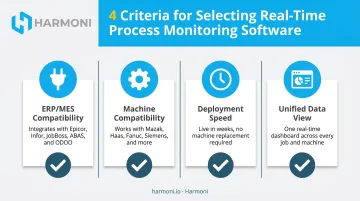
Not every monitoring tool fits every shop. A few criteria matter more than the feature list:
- ERP/MES compatibility. Confirm native integration with your existing system, whether that's Epicor, Infor, JobBoss, ABAS, or ODOO, so data flows both directions without manual re-entry.
- Machine compatibility. Look for support across your actual equipment mix, including older controls like Fanuc, Haas, Mazak, or Heidenhain, not just the newest machines on the floor.
- Deployment speed. A platform that requires months of custom configuration delays the ROI you're trying to capture.
- Unified data view. Machine, operator, and ERP data should live in one dashboard, not three separate logins.
Harmoni was built around this exact approach, combining automation, process control, and observability so manufacturers can deploy in weeks and start seeing measurable improvement almost immediately. One shop using the platform cut scrap by 22% in just two months.
The right solution should also scale across the industries most dependent on precision monitoring: CNC machining, precision manufacturing, aerospace, defense, automotive, and healthcare manufacturing, where traceability isn't optional.
Frequently Asked Questions
What is the real-time monitoring process?
It's continuous, automated data capture and analysis of machine and process states, surfacing issues within seconds instead of hours or days later. The goal is intervention while a job is still running, not after it's done.
What are examples of real-time processing?
Live cycle-time tracking on a CNC machine, automatic operator and job detection via RFID, and instant scrap or downtime alerts sent straight to a supervisor.
What are the 5 types of monitoring?
Machine state, cycle time and count, quality events, operator activity, and material or tool changes. Comprehensive visibility requires tracking all five together.
Is real-time process monitoring the same as an MES?
Not quite. It's usually a core function within, or alongside, an MES or ERP, focused specifically on live data capture and visualization rather than full order management or quality workflows.
How long does it take to implement real-time process monitoring software?
Timelines vary based on machine connectivity, integration complexity, and rollout scope. Modern orchestration platforms like Harmoni are built to deploy in weeks rather than the months typical of traditional MES rollouts.
What industries benefit most from real-time process monitoring?
CNC machining, aerospace, defense, automotive, and healthcare manufacturing see the biggest impact, since precision and traceability requirements make real-time visibility close to essential.