But automation isn't just robots welding parts on a line. Its real value shows up in smaller, daily wins: fewer scrapped parts, less time hunting for a program, job costs that actually reflect what happened on the floor.
This article breaks down what automation actually delivers, in measurable terms, not just the theoretical promise.
Key Takeaways
- Automation cuts wasted time, reduces errors, and boosts real-time shop floor visibility
- It spans physical robots to orchestration platforms linking people, machines, and ERP systems
- Skipping automation leads to inconsistent output, reactive firefighting, and inaccurate job costs
- Full value requires consistent use across shifts and workcenters, not a one-time install
What Is Automation in Manufacturing?
Automation is the use of technology, machinery, or software to perform manufacturing tasks with minimal manual intervention. That's the simple version.
In practice, it applies to three layers:
- Physical tasks — welding, assembly, material handling, CNC machining
- Coordination tasks — connecting ERP systems, MES platforms, machines, and operators so information moves without someone re-entering it
- Data tasks — capturing machine and production data automatically instead of relying on manual logs
View automation as a means to an outcome, not the goal itself. Efficiency and quality matter, but so does accountability for how the work gets done. Factory orchestration platforms like Harmoni extend automation past the machines themselves, coordinating the people running them, the systems tracking them, and the engineering requirements governing the work.
Key Advantages of Automation in Manufacturing
The advantages below focus on measurable, operational impact: cost, efficiency, quality, and risk. They compound hardest in CNC machining, aerospace, defense, automotive, and healthcare manufacturing, where consistency and traceability aren't optional.
Reduced Wasted Time and Improved Efficiency
Idle machine time, manual data entry, and operator waiting between jobs eat into throughput every single shift. Automation removes these gaps through automated scheduling, RFID-based job detection, and direct coordination between ERP work orders and machine availability.
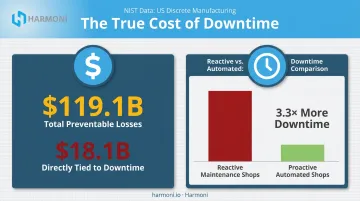
NIST estimated that preventable maintenance issues caused $119.1 billion in losses across US discrete manufacturing in a single year, including $18.1 billion tied directly to downtime. Shops relying heavily on reactive maintenance saw 3.3 times more downtime than those that didn't.
Removing manual steps and wait times has a direct effect on throughput. Faster job turnaround means shops can take on more work without adding headcount, which matters when hiring is already a challenge.
KPIs impacted:
- Overall Equipment Effectiveness (OEE)
- Machine utilization
- Cycle time
- Labor efficiency
Harmoni's platform handles this through long-range RFID that automatically identifies operators and job assignments as they approach a workcenter. Automated CNC program loading then pushes programs, offsets, and tool data straight to the machine. Operators stop walking to retrieve paperwork and stay focused on running parts. At WessDel, an aerospace and defense machine shop, this translated into 17 productive hours gained per employee per month and a 10% reduction in delinquent jobs.
This advantage matters most in high-mix, low-volume shops and multi-machine operations, where operators are splitting attention across several jobs at once.
Improved Consistency and Fewer Production Errors
Manual processes are only as consistent as the person running them. Automation standardizes execution so tasks happen the same way every time, regardless of who's on the machine that day.
This works through automated process controls, standardized work instructions delivered right at the workcenter, and system checks that catch mistakes before they turn into scrap. Fewer variables mean fewer surprises.
Why it matters: reducing variability lowers rework, scrap, and warranty costs. It also directly supports quality certifications. Regulated industries build entire audit processes around proving consistent execution, and automation generates that proof automatically instead of through paperwork someone fills out after the fact.
KPIs impacted:
- Scrap rate
- First-pass yield
- Rework hours
- Error rate
Harmoni's digital work instructions and digital quality checksheets replace paper travelers with an auditable digital record tied to each job. For manufacturers operating under AS9100, IATF 16949, or ISO 13485, that record matters during audits.
Harmoni also layers in multi-factor machine authentication, combining RFID badges, PINs, and facial recognition. This supports ITAR and CMMC access control requirements while generating the audit logs those frameworks demand.
This advantage is critical in tightly-toleranced CNC machining and regulated sectors like aerospace, defense, and healthcare manufacturing, where a single missed revision can mean a failed inspection.
Real-Time Visibility and Faster Decision-Making
End-of-shift reports tell you what already went wrong. Real-time data capture from machines, operators, and ERP systems tells you while it's still happening, which is the entire difference between prevention and cleanup.
Dashboards unify machine signals, operator activity, and job data so problems surface immediately, not hours later. Deloitte's 2025 survey of manufacturing executives found smart-manufacturing adopters reporting 10% to 20% gains in production output and 7% to 20% gains in employee productivity.
Catching an issue in real time stops a small problem from becoming an expensive one. It also enables accurate, live job costing instead of estimates built on incomplete or delayed data.
KPIs impacted:
- Downtime
- On-time delivery
- Labor visibility
- Job costing accuracy
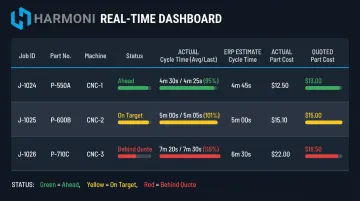
Harmoni pairs actual machine cycle times against ERP-estimated cycle times in real time, so managers see immediately whether a job is running ahead, on target, or behind quote. That comparison feeds directly into part cost performance reporting, not a spreadsheet reconciled a week later.
This matters most for multi-shift, multi-workcenter operations where labor and machine data would otherwise sit in separate, disconnected systems.
What Happens When Automation Is Missing or Ignored
Manual, disconnected processes create predictable operational drag. It doesn't show up all at once. It builds, shift after shift.
Common consequences look like this:
- Inconsistent results across shifts and operators
- Higher error rates and scrap from manual data entry and judgment calls
- Reactive firefighting instead of proactive problem-solving
- Rising costs over time from wasted labor and material
- Difficulty scaling production or delegating without losing control
These gaps compound fast, and without real-time coordination, manufacturers typically fall back on spreadsheets or end-of-shift reports. That approach produces inaccurate job costing and delayed accountability, since nobody knows a job's true cost until well after it has shipped. By then, the decision that would have fixed it is long gone.
How to Get the Most Value from Automation
Automation delivers the most value when it's applied consistently across shifts, workcenters, and job types. Running it on one line while the rest of the shop stays manual limits the return.
A few practices separate shops that see real gains from those that don't:
- Apply it everywhere it fits: Partial automation creates data gaps that undercut visibility
- Review outcomes regularly: Dashboards and reports need to be checked, not installed and forgotten
- Act on what the data shows: Spotting a bottleneck only creates value if it changes a process afterward
Point solutions that only monitor machines miss half the picture. Factory orchestration platforms like Harmoni sit between ERP systems, MES platforms, machines, and operators. They turn raw automation data into actionable visibility instead of isolated dashboards nobody checks. Acting on that data, not just collecting it, is what drives the return.
Conclusion
Automation's real value comes from tighter control and greater consistency across the shop floor, more than from faster machines alone. Fewer errors and better visibility feed directly into better planning, which drives lower costs. That compounding effect is where the biggest returns show up over time.
Treat automation as an ongoing practice that pairs technology with process discipline; a single equipment purchase won't deliver these results on its own. Manufacturers who request a demo typically start by identifying where their current process is losing the most time or accuracy, then build from there.
Frequently Asked Questions
What are the benefits of automation in manufacturing?
Automation delivers efficiency gains, fewer production errors, improved safety, and real-time visibility into shop floor performance. These practical benefits reduce wasted time and give managers accurate data for faster decisions.
What are the 5 D's of automation?
The established framework is actually three D's: dirty, dangerous, and dull work, according to the Association for Advancing Automation. Some organizations use a four-item variant adding "delicate," but no universal five-D standard exists.
What is the biggest advantage of automation in manufacturing?
Cost savings get the most attention, but consistency and reduced error rates typically deliver the most compounding long-term value. Fewer defects mean less rework, lower warranty costs, and stronger audit outcomes over time.
Does automation eliminate manufacturing jobs?
Automation shifts roles toward programming, oversight, and data analysis rather than eliminating the workforce. The Bureau of Labor Statistics (BLS) projects continued demand for machinery mechanics and maintenance workers specifically to support increasingly automated equipment.
How much does manufacturing automation cost to implement?
Costs vary widely by scope, from a single robotic cell to a full orchestration platform covering an entire shop. Software platforms like Harmoni, which retrofit existing equipment instead of replacing machines, often show faster ROI since deployment takes weeks rather than months.
What industries benefit most from manufacturing automation?
CNC machining, aerospace, defense, automotive, and healthcare manufacturing see the highest returns. These sectors face strict precision and compliance demands (AS9100, IATF 16949, ISO 13485) that automation directly supports.