Introduction
Every job that walks through the door is different. Different material, different tolerance, different routing, different deadline. That variability is what makes job shop manufacturing both valuable and genuinely hard to run.
Unlike a production line built for one part family, a job shop has to be ready for anything — a single aerospace bracket today, a 50-piece run of surgical components tomorrow, a custom tooling fixture the day after. Flexibility is the value proposition. Making that flexibility consistently profitable is the hard part.
This guide gives you a complete picture of job shop manufacturing in 2026 — what it is, how it compares to other production models, and where the real operational challenges live. More importantly, it covers the process workflows and technology strategies that separate high-performing shops from the ones always scrambling to catch up.
Key Takeaways
- Job shops produce high-variety, low-volume custom work using flexible equipment organized by function
- Scheduling complexity, accurate job costing, and shop floor visibility are the three dominant operational challenges
- ERP systems plan work but don't execute it — the gap between plan and reality is where margins disappear
- Factory orchestration platforms like Harmoni bridge ERP and the shop floor to close that execution gap
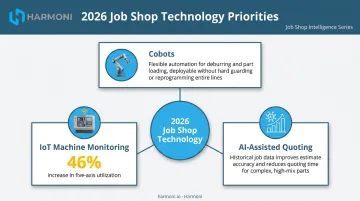
- 2026 technology priorities: machine monitoring, dynamic scheduling, cobots, and AI-assisted quoting
What Is Job Shop Manufacturing?
Job shop manufacturing is a production method built around customization rather than volume. Instead of running the same part repeatedly at high quantity, job shops produce small batches of unique parts or assemblies — tailored to specific customer specifications — across a constantly rotating mix of work.
A 2023 systematic review of 152 high-mix, low-volume manufacturing studies describes these environments as producing a high variety of products in small quantities, with routing that is often random or multidirectional to support customization. That multidirectional routing is the key structural difference from other production models.
The defining characteristics of a job shop:
- High product variety — no two jobs are necessarily alike
- Make-to-order workflows — production begins when an order arrives, not in anticipation of demand
- Non-linear routing — each job may travel a different path through the facility
- Frequent machine setups — changeover between jobs is constant
- Dependence on skilled, cross-functional operators
Physical layout follows a functional model: all milling machines in one area, all grinding equipment in another, all welding in a third. A 2025 MIT study of an aerospace job shop confirmed this directly, documenting departments grouped by similar process capabilities rather than by product line.
That arrangement maximizes flexibility, letting any job route through any relevant workcenter. The tradeoff is complex material flow and coordination demands that simpler production models don't face.
Job Shop vs. Machine Shop
These terms overlap significantly, but they aren't the same thing.
| Machine Shop | Job Shop | |
|---|---|---|
| Core focus | Machining only (milling, turning, drilling, grinding) | Multiple processes (machining, welding, assembly, finishing, heat treating) |
| Work type | Precision metalwork, tight tolerances | Full part lifecycle, from raw material to finished assembly |
| Defining trait | Metal removal expertise | Flexibility across manufacturing processes |
In practice, many CNC machining operations use the terms interchangeably. The distinction matters most when defining scope: a machine shop specializes in metal removal, while a job shop may coordinate an entire part's journey from raw stock to finished assembly.
Job Shop Manufacturing Examples and Industries
Job shops appear wherever custom specifications, low volumes, and tight tolerances make standard production lines impractical. The BLS reports 265,030 employees in machine shops (NAICS 332710) as of May 2023 — and that figure covers only one NAICS classification within a much broader sector.
Primary industries served:
- CNC machining and metal fabrication — shops produce custom parts to engineering drawings across industries
- Aerospace and defense — tight tolerances, strict revision control, low production volumes per part number, and ITAR/CMMC compliance requirements make the job shop model essential
- Medical device manufacturing — surgical implants, instruments, and device components require custom machining with full traceability
- Automotive customization — performance components, specialty parts, and low-volume production runs for OEM suppliers
- Tool and die making — injection molds, stamping dies, and forming tools are by nature one-off or small-run
- Prototype development — product development teams need first-article parts fast, in small quantities, before committing to volume production
What this looks like in practice:
An aerospace job shop receives an engineering drawing for a single titanium bracket with a 0.001" tolerance. The part routes through programming, 5-axis milling, deburring, CMM inspection, and anodizing — five different workcells, one unit.
A tool and die maker builds a custom injection mold for a medical device enclosure. The job involves EDM, precision grinding, CNC milling, and hand fitting — none of which follows a fixed sequence shared with any other job in the shop.
A precision machining shop runs 10 surgical implant components from a customer-supplied material certification. Each piece requires in-process inspection with documented results, and any engineering revision mid-run must be caught before the next piece starts.
Each scenario demands different tooling, different routing, and different compliance controls — often running in parallel with a dozen other jobs on the same floor. That operational complexity is exactly what makes job shop management its own discipline.
Job Shop vs. Other Manufacturing Models
Understanding where job shops fit in the production landscape clarifies both their strengths and their limits.
Production Model Comparison
| Dimension | Job Shop | Batch Production | Cellular Manufacturing | Mass Production |
|---|---|---|---|---|
| Batch size | Small (often 1–100 units) | Medium lots, standardized | Medium, within part families | Large, continuous |
| Product variety | Very high | Moderate | Low to moderate | Very low |
| Customization | Per-order | Limited | Within family | None |
| Routing | Variable, multidirectional | Functional departments | Co-located within cell | Fixed sequence |
| Setup frequency | Very high | Moderate | Low within family | Minimal |
| Flexibility | Maximum | Moderate | Limited to part family | Minimum |
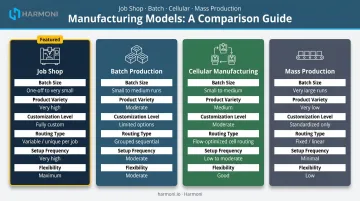
The table captures the structural differences at a glance — but the practical implications for each model deserve a closer look.
Job Shop vs. Batch Production
Batch production involves manufacturing a defined quantity of a standardized product before switching to the next run. Workflows are more predictable, and variety between batches is narrower. Job shops handle far greater structural variety — each incoming order can carry a completely different routing, material specification, and quality requirement from every other job currently on the floor.
Job Shop vs. Cellular Manufacturing
Cellular manufacturing groups dissimilar equipment into cells dedicated to a family of similar parts. According to manufacturing.gov's guidance on cellular manufacturing, this arrangement simplifies routing, supervision, and material flow — but only within the selected product family. Job shops serve too wide a variety of orders to make fixed cell dedication viable.
Job Shop vs. OEM
OEMs design, brand, and sell their own end products. Job shops are contract manufacturers producing custom parts to someone else's specifications — and many exist precisely to serve OEMs, handling components the OEM cannot cost-effectively run in-house at low volumes or with specialized processes.
Advantages and Challenges of Job Shop Manufacturing
Advantages
Flexibility is the core value proposition. A job shop can accept orders that mass producers cannot touch — a one-off bracket, a prototype assembly, a 15-piece run of custom components. That range of capability opens markets where customization is the baseline expectation, not an exception.
Other meaningful advantages:
- Custom work commands better margins than commodity production; customers pay for expertise and flexibility, not just parts
- Direct engagement on specifications builds repeat business from clients who need ongoing custom production
- Cross-functional work develops deep skills across materials, processes, and problem-solving that single-purpose environments rarely produce
- General-purpose machinery serves multiple job types, avoiding the high capital cost of dedicated production lines
Challenges
The same variety that creates opportunity creates operational complexity. Three challenges surface in nearly every high-mix shop.
Scheduling is the dominant pain point. Managing multiple concurrent jobs — each with different priorities, due dates, routings, and resource requirements — creates constant conflicts. A rush order for an aerospace customer competes with a long-running precision job that can't be interrupted at a critical operation. Resolving those conflicts in real time, without visibility into live machine and operator status, is where schedules break down.
Job costing accuracy is the silent margin killer. Because every job has different materials, labor hours, setup time, and routing, tracking costs accurately in real time is difficult. The gap between estimated and actual job costs often goes undetected until after the job ships — by which point the only way to recover is on the next order, assuming the quoting model gets corrected.
Shop floor visibility and communication are persistent execution problems. In a high-mix environment, operators need the right instructions, the right job priority, and real-time awareness of engineering changes — at their machine, not posted on a whiteboard updated at the start of the shift. When that information doesn't reach the operator reliably, the result is idle time, rework, and preventable scrap.
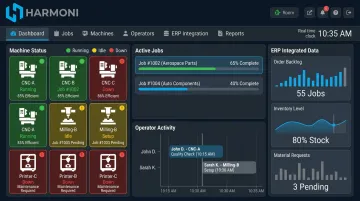
Closing that gap requires connecting machines, operators, and ERP data in real time — not end-of-shift reports. Harmoni's factory orchestration platform does exactly that: it sits between ERP systems, machines, and operators to coordinate what actually happens on the floor. RFID-enabled detection surfaces the right work instructions and job priorities at each workcenter automatically, while live dashboards unify machine, ERP, and operator data in a single view.
The result is a shop that catches problems while they're happening — not after the job ships.
The Job Shop Manufacturing Process
No two job shops run an identical process, but the major stages follow a consistent pattern from inquiry to closure.
Front-End Stages
- Customer inquiry and specifications — RFQ received with drawings, tolerances, materials, and quantity
- Quoting and cost estimation — time, material, and setup costs estimated; Modern Machine Shop's 2025 Top Shops data shows leading shops achieving a one-day quote time and a 19% higher quote-to-book ratio than peers
- Order confirmation — terms agreed, delivery committed
- Job planning — routing defined, work centers assigned, materials identified
- Material procurement — stock confirmed or purchased per job specifications
Production and Quality Stages
- Work order release — job packet issued to the shop floor with routing, instructions, and priority
- Sequential operations — job moves through relevant workcenters per routing
- In-process quality checks — critical dimensions verified at defined control points
- Rework if required — non-conforming work addressed before the job advances
- Finishing operations — painting, heat treating, coating, or other secondary processes as specified
Closing Stages
- Final inspection and quality approval — part verified against drawing and customer requirements
- Packaging and shipping — prepared per customer specification
- Invoicing and project closure — actual costs recorded and reconciled against estimate
- Customer feedback loop — results captured and fed back into quoting accuracy and process improvement
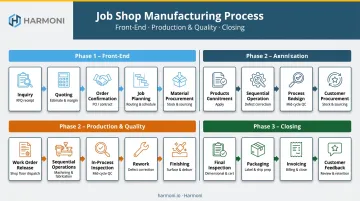
The closing reconciliation step is where job costing data either confirms your margin or exposes where it disappeared. Shops that capture accurate time, labor, and machine data throughout the process can compare actuals to estimates with confidence. Those relying on manual records or end-of-shift entries often discover the gap too late to act on it.
Technology and Strategies for Job Shop Success in 2026
ERP as the Planning Backbone — and Its Limits
ERP systems — JobBoss2, Epicor, Infor Visual, and similar platforms — are the operational foundation for most job shops. They handle quoting, work order management, scheduling, inventory, and job costing. For job shops running Harmoni, those ERP systems integrate natively, with data flowing automatically between the shop floor and the ERP without manual entry.
The core limitation is structural: ERP systems plan work. Execution is a different problem entirely. A work order released in JobBoss doesn't know that the mill it was scheduled to run on went down two hours ago, or that the operator assigned to the job called out today. The plan and the reality diverge constantly — and in a high-mix environment, that gap is where late deliveries and margin erosion originate.
Factory Orchestration: Closing the Execution Gap
Factory orchestration is the layer between ERP planning and shop floor reality. Platforms like Harmoni sit between ERP systems, machines, and operators to coordinate what actually happens — automatically.
What that looks like in practice:
- RFID detection identifies an operator as they approach a workcenter and immediately surfaces the correct job, work instructions, and CNC program for their machine
- Actual labor hours and machine cycle time are captured automatically and fed back into the ERP — no manual clock-ins, no paper travelers, no daily reconciliation
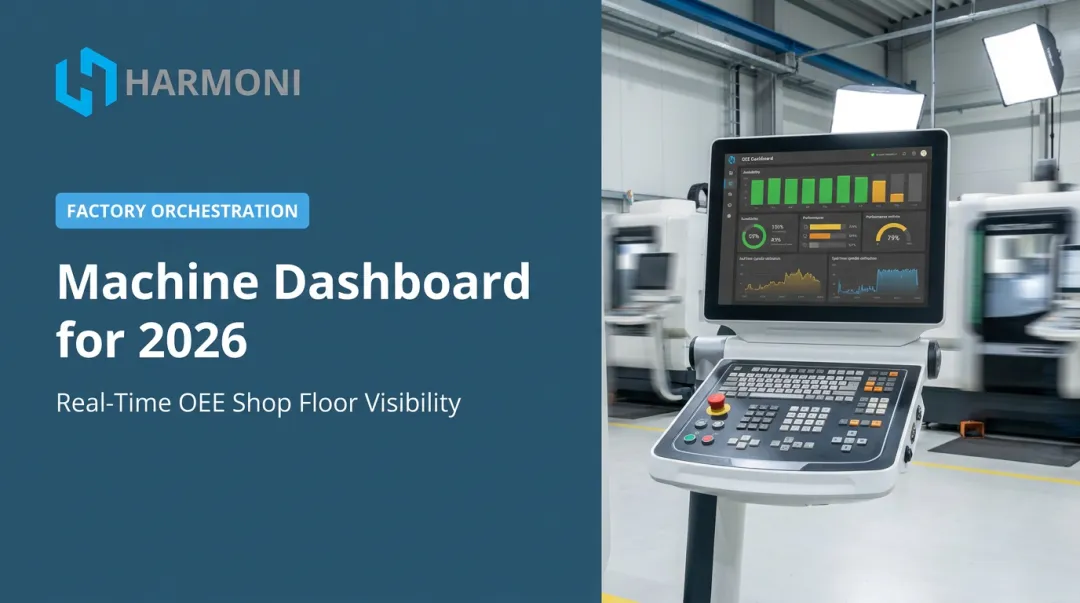
- Real-time dashboards unify machine status, operator activity, and ERP job data in one view so supervisors see problems as they develop
- Engineering revisions propagate to the floor immediately, not at the next shift change
Harmoni deploys in weeks against existing equipment — Haas, Fanuc, Mazak, Siemens, Heidenhain, and older controls are all supported — so shops don't need to replace machines to get real-time data from them. At WessDel, a manufacturing customer, the full installation was complete in under a week, with operators clocking in at their machines from day one.
Lean Strategies That Work in Job Shops
Lean principles apply in job shops, though differently than in high-volume environments. Useful applications include:
- JIT material staging — pulling materials per job rather than maintaining large per-job buffers reduces floor clutter and ties up less cash
- Cross-training operators — reducing dependency on single-skill operators cuts bottlenecks when demand shifts between workcenter types
- Standardized digital work instructions — consistent, machine-side instructions reduce setup variation and first-piece failures across high-mix production
These operational improvements compound when they're backed by real-time scheduling that reflects actual shop conditions — not yesterday's plan.
Dynamic Scheduling and 2026 Technology Trends
Static ERP schedules can't adapt to live conditions. Dynamic scheduling tools let managers resequence jobs based on actual machine availability, operator presence, and real-time job status — which reduces late deliveries and unplanned overtime. Deloitte's 2025 Smart Manufacturing Survey found that only 35% of large manufacturers use advanced production scheduling — leaving most shops exposed to a gap their competitors could close.
Other 2026 priorities:
- Cobots — collaborative robots are gaining traction in job shops for flexible automation of repetitive tasks like deburring and part loading, without requiring full cell dedication; flexible end effectors make them practical for changing work mixes
- IoT machine monitoring — connected equipment feeds predictive maintenance data before failures occur; one machine shop case reported a 46% increase in five-axis utilization after implementing machine monitoring
- AI-assisted quoting — feeding historical actual job performance back into quoting models tightens estimate accuracy over time, directly addressing the gap between quoted and actual cost that erodes margins
Frequently Asked Questions
What is a job shop in manufacturing?
A job shop is a manufacturing facility that produces custom parts or assemblies in small quantities to specific customer specifications. The defining features are high product variety, make-to-order workflows, and flexible equipment organized by function rather than by product line.
What is an example of job shop manufacturing?
Common examples include a CNC machine shop producing a single aerospace bracket to engineering drawings, a tool and die maker building a custom injection mold, or a precision machining shop running a 10-piece lot of surgical implant components. Each job carries different routing, materials, and quality documentation requirements.
What is the difference between OEM and job shop?
OEMs design, brand, and sell their own end products. Job shops are contract manufacturers that produce custom parts to other companies' specifications. Many job shops serve OEMs directly, producing components the OEM cannot run cost-effectively in-house at low volumes.
What is the difference between job shop and batch production?
Batch production runs a set quantity of standardized products before switching to the next run, making workflows relatively predictable. Job shops handle far greater variety: routing, material, and specifications can differ completely from one job to the next.
What are the biggest challenges of running a job shop?
The three biggest challenges are:
- Scheduling — coordinating simultaneous custom orders with different routings and lead times
- Job costing — capturing accurate labor and material costs across highly variable work
- Execution consistency — maintaining quality standards as the job mix constantly shifts