That disconnect has real costs. The right industrial monitoring system directly improves uptime, reduces scrap, and tightens job costing accuracy for mid-to-large manufacturers running CNC, aerospace, defense, and precision operations.
This guide breaks down what industrial monitoring systems actually are, profiles the top platforms worth evaluating in 2026, and gives you a framework for choosing the right fit for your shop floor.
Key Takeaways
- Industrial monitoring systems combine sensors, connectivity, and software for real-time production visibility
- The category spans SCADA, IIoT cloud platforms, condition monitoring tools, and factory orchestration platforms
- Top systems in 2026 integrate with ERP/MES and trigger action, not just alerts
- Harmoni, MachineMetrics, Siemens Insights Hub, Ignition, and Factory AI take five distinct approaches
- Choose based on integration depth and measurable outcomes, not brand recognition alone
Overview of Industrial Monitoring Systems in Manufacturing
An industrial monitoring system is the combination of sensors, connectivity, and software used to track equipment, process, and operator performance in real time.
That's the simple version. In practice, the category breaks into several distinct approaches, each solving a slightly different problem.
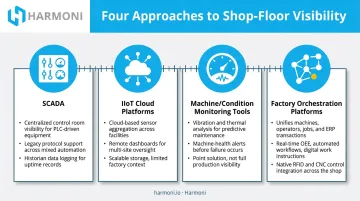
The main types manufacturers deploy today:
- SCADA (Supervisory Control and Data Acquisition): Hardware and software that sends commands and acquires data to monitor and control industrial processes, per ISA's definition
- IIoT cloud platforms: Connect machines, sensors, and plant systems from edge to cloud for asset monitoring across multiple sites
- Machine/condition monitoring tools: Focus on equipment health data, primarily vibration, temperature, and usage patterns, to support maintenance decisions
- Factory orchestration platforms: A newer approach that unifies machine data, operator activity, and ERP workflows into one operational view
All four approaches rely on similar hardware: PLCs, vibration and temperature sensors, RFID tags, gateways, and edge controllers. What separates the platforms is how that raw data gets processed and acted on.
Scale matters here, too. The global IIoT technology market is projected to grow from $751.32 billion in 2026 to $4,392.94 billion by 2034, according to Fortune Business Insights, a 24.7% compound annual growth rate. That momentum is pulling more manufacturers toward connected shop floors every year.
The section below profiles the top systems manufacturers are adopting this year, spanning these different monitoring approaches.
Top Industrial Monitoring Systems for 2026
Selection criteria for this list: real-time data accuracy, ERP/MES integration depth, deployment speed, and proven customer outcomes.
Harmoni
Harmoni is a factory orchestration platform that sits between ERP, MES, machines, and operators. It unifies machine data, operator activity, and ERP workflows into one real-time view, built for mid-to-large manufacturers in CNC, aerospace, defense, and precision manufacturing.
What sets it apart:
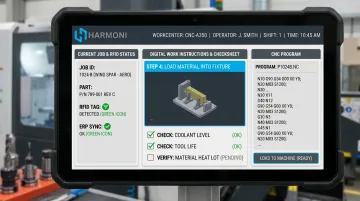
- RFID-based auto-detection identifies operators and jobs at the workcenter without manual login or badge scanning
- Workcenter command centers put digital work instructions, checksheets, and correct CNC programs directly on the operator's screen
- Fast deployment measured in weeks, not months, with one documented shop going live on machine-side ERP transactions in under a week
- Broad machine compatibility, including older equipment running alongside new controllers
At WessDel Manufacturing, a shop producing titanium and beryllium aerospace and defense components, Harmoni integrated with Epicor ERP out of the box. Internal time studies found operators were losing an average of 11 minutes per manual ERP transaction, time Harmoni's RFID automation eliminated almost entirely.
| Category | Details |
|---|---|
| Best For | Mid-to-large manufacturers needing unified visibility across machines, ERP, and labor |
| Key Features | RFID-based auto-detection, real-time dashboards, automated task elimination, job costing accuracy |
| Deployment Time | Weeks, not months, per stated go-live speed |
MachineMetrics
MachineMetrics is a machine monitoring and analytics platform built specifically for CNC and discrete manufacturing shop floors.
It stands out for strong OEM machine connectivity, automated downtime tagging, and production analytics tailored to job shops rather than large enterprise plants. The platform is aimed squarely at shops trying to understand why machines sit idle, not just that they did.
Pricing runs on a volume-based SaaS subscription model. MachineMetrics doesn't publish exact rates, but the company confirms that per-machine cost drops as more machines get connected. Subscriptions include onboarding, training, and unlimited remote support.
| Category | Details |
|---|---|
| Best For | CNC and discrete manufacturers focused on machine utilization data |
| Key Features | Automated downtime tagging, OEE dashboards, machine connectivity across major CNC brands |
| Pricing Model | Volume-based SaaS subscription; quote-based, cost per machine decreases with scale |
Siemens Insights Hub
Siemens Insights Hub (formerly MindSphere) is a cloud-based industrial IoT platform for connecting machines, sensors, and plant systems at scale.
Its strength lies in deep integration with Siemens automation hardware, built-in analytics and AI tooling, and enterprise-grade scalability across multiple plants. This makes it a natural fit for large manufacturers already running Siemens equipment throughout their facilities.
Connectivity options include:
- OPC UA for industrial-device data collection, including events and alarms
- MQTT for secured device connections with certificate-managed onboarding
- REST APIs covering assets, time-series data, files, events, and commanding
- Custom agent development through the MindConnect API
| Category | Details |
|---|---|
| Best For | Large enterprises with Siemens-heavy automation environments |
| Key Features | Cloud IIoT connectivity, edge analytics, application marketplace |
| Technical Specs | OPC UA, MQTT, REST APIs, MindConnect custom agent support |
Ignition by Inductive Automation
Ignition is a widely-used SCADA/HMI platform for real-time process visualization and control across industrial sites.
The standout feature is its licensing model. A single license provides unlimited clients, tags, connections, designers, and projects, a rarity in an industry where per-seat or per-tag pricing usually punishes growth.
Pricing is perpetual and per-server, not subscription-based. The current price list from Inductive Automation shows the platform foundation starting at $1,200, with suites like Application Building running $13,500 and Industrial Historian at $3,500.
Redundant deployments require a second licensed gateway, and annual support plans range from 16% to 24% of retail price.
| Category | Details |
|---|---|
| Best For | Process industries and plants needing flexible SCADA/HMI visualization |
| Key Features | Unlimited client/tag licensing, module-based architecture, broad PLC/device driver support |
| Pricing Model | Perpetual per-server license starting at $1,200; suites priced separately |
Factory AI
Factory AI is an AI-driven predictive maintenance and condition monitoring platform. It layers sensor-agnostic analytics on top of vibration, temperature, and ultrasonic sensors, without requiring proprietary hardware.
The platform excels at anomaly detection that cuts through alert fatigue, direct CMMS/work-order integration, and compatibility with any sensor brand, historian, or SCADA system already in place.
Supported sensor inputs include:
- Vibration sensors and accelerometers
- Temperature sensors and thermal imaging
- Pressure and flow measurements
- Electrical current and voltage sensors
- Oil-analysis and acoustic-emission sensors
- Ultrasonic sensors
| Category | Details |
|---|---|
| Best For | Reliability teams scaling condition-based maintenance programs |
| Key Features | AI anomaly detection, sensor-agnostic integrations, automated work order triggers |
| Technical Specs | Connects to SCADA, historians, PLCs, DCSs, and Apache Kafka; supports 7+ sensor types |
How We Chose the Best Industrial Monitoring Systems
The biggest mistake buyers make is judging systems on hardware specs alone. A platform with impressive sensor accuracy is worthless if it can't push that data into ERP or trigger a work order.
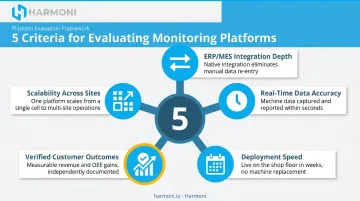
Core evaluation factors used to rank these systems:
- ERP/MES integration depth — does data flow both directions, or just collect in a dashboard?
- Real-time data accuracy — is latency low enough to catch problems as they happen, not after the shift ends?
- Deployment speed — weeks versus months changes the ROI timeline
- Scalability across sites — can the platform grow from one workcenter to an entire facility without a re-architecture?
- Verified customer outcomes — documented time savings, scrap reduction, or labor efficiency gains, not just feature lists
Industry certifications, direct client feedback, published case studies, and overall product diversity all factored into the rankings. That's why this list spans SCADA, cloud IIoT, condition monitoring, and orchestration platforms instead of five variations on the same approach.
Conclusion
The right industrial monitoring system should align with your operational goals, uptime, accuracy, and visibility, not brand recognition.
Start small. Pilot on a critical asset or workcenter first, then evaluate scalability and cost-effectiveness before committing to a facility-wide rollout. This limits risk while still surfacing whether a platform delivers on its promises.
If you're a CNC, aerospace, defense, or precision manufacturer, you need to unify machine, ERP, and operator data into one real-time view. See how Harmoni's factory orchestration platform helps eliminate wasted time and prevent production errors before they hit the shop floor.
Frequently Asked Questions
What is an industrial monitoring system?
It is the combination of sensors, connectivity, and software used to track equipment, process, and operator performance in real time. Modern systems go further, integrating that data with ERP and MES platforms for full operational context.
What are the main types of industrial monitoring systems?
The category spans SCADA for process control and IIoT cloud platforms for multi-site connectivity. It also includes machine and condition monitoring tools for equipment health, plus factory orchestration platforms that unify machines, operators, and ERP data.
What are the most commonly used devices in industrial monitoring systems?
Common hardware includes PLCs, vibration and temperature sensors, RFID tags, gateways, and edge controllers. These components collect and transmit the raw data that monitoring software then analyzes.
What is the best monitoring software for industrial monitoring systems?
There is no one universal answer. It depends on your use case: SCADA platforms like Ignition suit process visualization, while orchestration platforms like Harmoni fit shops needing unified machine, ERP, and labor visibility.
How much does an industrial monitoring system cost in 2026?
Costs vary widely based on sensor count, software licensing model, and integration scope. Ignition, for example, starts at $1,200 per server, while platforms like MachineMetrics use volume-based subscription pricing that decreases per machine as you scale.
Do industrial monitoring systems integrate with ERP and MES platforms?
Yes. Orchestration platforms like Harmoni integrate natively with ERP systems such as Epicor, while cloud IIoT platforms connect through APIs and protocols like OPC UA and MQTT.