
Introduction
Manufacturers today are being squeezed from every direction. Margins are tighter, skilled labor is harder to find, and customers expect faster delivery — all while the pressure to increase output without adding equipment keeps building. Monitoring is usually the first response, and on its own it reports the symptom. The recoverable capacity shows up when machine signals are read with the operator activity and ERP job context around them, so a stop becomes a decision rather than a statistic.
Operating without visibility into what your machines are actually doing makes every one of those problems worse.
Machine monitoring comes up constantly in Industry 4.0 conversations, but the technology itself isn't the point. What matters is what it produces: fewer surprises, faster decisions, and operational problems caught while they can still be fixed rather than after the damage is done.
This article covers why machine monitoring matters in practice, what measurable advantages it delivers across the shop floor, and what manufacturers put at risk when they operate without it.
Key Takeaways
- Machine monitoring replaces guesswork with real-time data — machine status, cycle times, and production output visible as they happen
- Manufacturers with OEE of 80% or better reported 14% average annual financial improvement versus 8.6% for all others
- McKinsey found predictive maintenance reduces machine downtime by 30–50%
- Operating without monitoring means production problems surface after the fact — when correction costs far more
- Monitoring tools only move the needle when shop floor teams have clear visibility, defined responses, and the discipline to close the loop on what the data reveals
What Is Machine Monitoring?
Machine monitoring is the use of sensors, software, and dashboards to continuously track the performance, status, and health of production equipment in real time.
It applies across CNC machines, production lines, and shop floor workcenters. Modern systems capture a full picture of how each machine is actually running — not just whether it's powered on:
- Machine on/off state and cycle times
- Spindle load and power draw
- Vibration and temperature readings
Monitoring is a means to an outcome, not an end in itself. Its purpose is to replace guesswork and delayed end-of-shift reporting with accurate, actionable data. When a production manager can see live machine status instead of waiting for a paper tally at shift's end, they can respond to problems while there's still time to act.
Key Advantages of Machine Monitoring for Manufacturers
The advantages below focus on operational impact — outcomes tied directly to cost, efficiency, quality, and risk. They also compound. Visibility creates the conditions for consistent improvement across maintenance, scheduling, quality control, and labor management.
Advantage 1: Real-Time Production Visibility and OEE Improvement
Real-time visibility means production managers no longer wait for end-of-shift reports to understand how their floor is performing. Machine status, cycle times, and part counts are available as they happen.
Machine monitoring drives this by feeding sensor data continuously into dashboards that calculate OEE — Availability × Performance × Quality — automatically. Paper-based tracking gets replaced. Losses in production time become visible as they occur, not in a post-shift debrief.
Why this matters financially: The 2014 MESA International/LNS Research study found that across 214 manufacturers, the top 11% with OEE of 80% or better reported 14% average annual financial improvement, compared to 8.6% for all other respondents. The average OEE across all respondents was 70.7. Most manufacturers have meaningful room to improve, and that gap translates directly to the bottom line.

Real-world results confirm this. Mitotec Precision reported $1.4M in downtime savings over 11 months after deploying OEE tracking. Global Precision Parts saw machine utilization climb from roughly 18% to 30% after deploying monitoring software.
Harmoni's factory orchestration platform extends this advantage by combining machine data with operator activity and ERP workflows in a single unified dashboard. Raw machine data shows that utilization is low. Harmoni's system surfaces why: a long cycle lag, an operator still clocked onto a completed job, or a scheduling gap between operations.
KPIs impacted:
- OEE score
- Machine utilization rate
- Idle time percentage
- Shift-level throughput
- Scheduled vs. actual production output
When it matters most: High-mix, high-volume environments running multiple machines simultaneously — where production losses compound quickly across shifts. Also critical when manufacturers need to increase capacity without adding equipment.
Advantage 2: Reduced Unplanned Downtime and Smarter Maintenance
Unplanned downtime is among the most disruptive and expensive events a manufacturer can face. Machine monitoring addresses it directly by detecting stopped, idle, or abnormal machine conditions automatically — before an operator has to report a problem.
Continuous data capture allows systems to flag deviations from normal operating patterns: rising vibration, thermal drift, changes in power draw. Maintenance can be scheduled before a failure occurs, shifting teams from reactive firefighting to proactive planning.
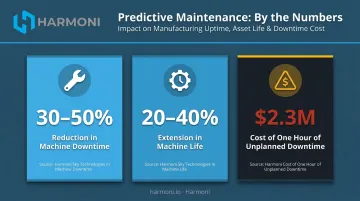
McKinsey's research established that predictive maintenance typically reduces machine downtime by 30–50% and extends machine life by 20–40%. Siemens' 2024 report put the cost of a single hour of unplanned downtime at $2.3M in large automotive plants — one failure event can erase weeks of margin.
For mid-size manufacturers running high-value CNC equipment, the math is different in scale but identical in structure. A failed spindle on a five-axis machining center — with parts lead times stretching weeks — can cascade into missed delivery commitments and emergency overtime. Monitoring shifts these from routine disruptions to preventable exceptions.
KPIs impacted:
- Unplanned downtime hours
- Mean time between failures (MTBF)
- Mean time to repair (MTTR)
- Maintenance cost per machine
- Scheduled vs. emergency maintenance ratio
When it matters most: Facilities running high-value equipment or complex multi-axis CNC machines where repair costs and parts lead times are significant. Also critical in aerospace, defense, and precision manufacturing where equipment failures carry quality and compliance consequences beyond production loss.
Advantage 3: Accurate Job Costing and Production Error Prevention
Machine monitoring gives manufacturers a reliable record of actual cycle times, machine utilization per job, and production output. Most shops currently estimate this data — which means job costs are approximations, not measurements.
By capturing real cycle times and comparing actual performance against planned standards, manufacturers can identify where jobs are running over time, catch process deviations before they produce scrap, and build cost estimates from data rather than assumptions.
The margin impact is easy to miss until it isn't. A 2010 survey of 183 machining businesses found median scrap and rework equaled 2% of sales, with top performers holding it closer to 1.5%. On a $10M revenue operation, that gap means $150,000 to $200,000 in annual defect losses — losses that rarely surface until they appear as unexplained margin compression.
The quality control dimension matters too. When machine performance data reveals inconsistencies mid-job — rather than after a batch is complete — manufacturers can intervene before defects compound. One Harmoni customer reported a 22% scrap reduction in just two months after deploying the platform's monitoring and visibility tools.
WessDel, an aerospace and defense component manufacturer, used Harmoni as their primary shop management tool and achieved a 5x return on ongoing platform costs alongside a 10% reduction in delinquent jobs — outcomes that trace directly back to having accurate, real-time data driving decisions rather than estimates.
KPIs impacted:
- Job cost accuracy
- Scrap rate
- Rework hours
- Quoted vs. actual cycle time variance
- Gross margin per job
When it matters most: Job shops and contract manufacturers running high-mix, low-volume work where each job has a distinct cost structure. Also essential in aerospace and defense manufacturing where scrap costs are high and quality documentation is a compliance requirement.
What Happens When Machine Monitoring Is Missing
Operating without monitoring gives a manufacturer no reliable way to know whether their shop is running efficiently — or hemorrhaging output quietly on every shift.
The consequences compound over time:
- By the time a supervisor notices a machine has been underperforming, a full shift of output may already be compromised.
- Downtime causes go undocumented, so root cause analysis becomes guesswork — and the same failures recur.
- Job costing runs on estimates, letting margin losses accumulate through underpriced jobs and undetected scrap that are nearly impossible to close without data.
- Labor and machine allocation based on intuition rather than live conditions makes it hard to scale reliably or respond to demand changes.
Without visibility, teams spend their time catching up rather than staying ahead. Problems that could have been corrected mid-shift instead trigger post-production rework, missed deadlines, or customer calls. The cost of operating blind doesn't appear on any report — which is precisely what makes it dangerous.
How to Get the Most Value from Machine Monitoring
Monitoring data produces its full value only when it is acted on consistently. Teams need to review what the data shows, connect it to specific decisions, and track whether changes made in response are producing results.
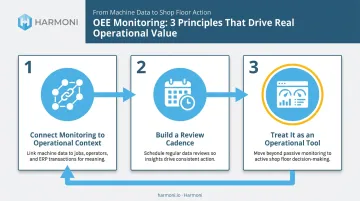
Three principles separate manufacturers who see sustained improvement from those who simply deploy a dashboard:
Connect monitoring to operational context. Machine status data is most powerful when it's linked to job schedules, operator activity, and ERP workflows. Platforms like Harmoni are built for exactly this layer: coordinating machines, operators, and systems in real time within a single unified view. When machine data flows directly into ERP job records, job costing becomes a measurement rather than an estimate.
Build a review cadence. Unreviewed dashboards and unacknowledged alerts add no value. The frequency of review — daily huddles using live floor data, weekly OEE trend reviews — matters as much as the system itself.
Treat it as an operational tool, not a reporting tool. The real measure of success is faster decisions made during production — catching problems before they affect output, not summarizing them afterward.
Conclusion
The importance of machine monitoring lies in what it makes possible: control over production rather than reaction to it. Decisions get faster, surprises get fewer, and improvements compound as monitoring data becomes part of how the floor is managed every day.
The advantages — OEE visibility, downtime reduction, accurate job costing — don't operate independently. They reinforce each other when applied consistently. Manufacturers who embed monitoring into their operational discipline rather than treating it as a one-time deployment are the ones who build measurable, durable performance improvements — not just a one-quarter uptick in uptime.
Frequently Asked Questions
What are the three types of equipment monitoring?
Equipment monitoring falls into three categories: condition monitoring (tracking real-time health indicators like vibration and temperature), performance monitoring (tracking output, cycle time, and OEE), and predictive monitoring (using historical data patterns to anticipate failures). Modern platforms typically combine all three into a single continuous data stream.
What are the five pillars of condition monitoring?
The British Institute of Non-Destructive Testing (BINDT) identifies the principal methods as vibration analysis, thermal imaging, debris/lubricant analysis, acoustic emission monitoring, and ultrasonic testing. Machine monitoring software automates data collection for sensor-based methods, reducing reliance on manual inspection.
How much does machine monitoring software cost?
Most vendors — including MachineMetrics, Datanomix, and Scytec DataXchange — use volume-based pricing tied to machine count, with exact figures available by quote. ROI timelines vary by facility; Mitotec Precision's documented case study reported $1.4M in savings over 11 months.
What data should manufacturers track with machine monitoring?
Core metrics include machine status (running, idle, stopped), cycle time, OEE components, downtime duration and reason codes, part counts, and energy consumption — all of which feed directly into scheduling, job costing, and maintenance decisions.
How does machine monitoring reduce unplanned downtime?
Monitoring detects abnormal operating conditions — unusual vibration, thermal drift, unexpected power draw changes — in real time, enabling maintenance teams to intervene before a failure occurs. This shifts maintenance from reactive emergency response to scheduled, planned work — the foundation of predictive maintenance programs.
What is the difference between machine monitoring and an MES?
Machine monitoring focuses specifically on capturing real-time performance data from equipment. A Manufacturing Execution System (MES) manages broader production workflows — scheduling, work orders, quality, and labor. Many manufacturers use both together, with machine data feeding into MES and ERP systems; Harmoni's factory orchestration platform is designed to connect all three layers in one unified view.