Introduction
Data flows through ERPs and MES systems, but what actually happens on the shop floor often goes untracked in real time. Operators manually log job starts. Equipment sits idle without context. Production errors surface after the shift ends — when the damage is already done.
A 2024 Manufacturing Leadership Council survey found that 70% of manufacturers still collect data manually, which means the majority of shop floors are running on information that's already stale by the time it reaches a decision-maker.
RFID integration closes that gap. By connecting Radio Frequency Identification hardware — tags, readers, antennas — with existing enterprise systems like ERP, MES, or factory orchestration platforms, physical events on the floor automatically trigger digital updates without anyone touching a keyboard.
This guide covers how RFID works, the types of systems available, how integration with manufacturing software happens, the key benefits, and what challenges to plan for before deployment.
Key Takeaways
- RFID connects physical shop floor events to ERP and MES records — no manual entry required
- UHF (Ultra High-Frequency) RFID is the dominant standard in industrial environments
- Integration follows: tag → reader → middleware → ERP/MES action
- Key benefits: real-time job visibility, accurate labor costing, and pre-scrap error prevention
- Plan for three challenges upfront: metal surfaces, change management, and data security
What Is RFID Integration?
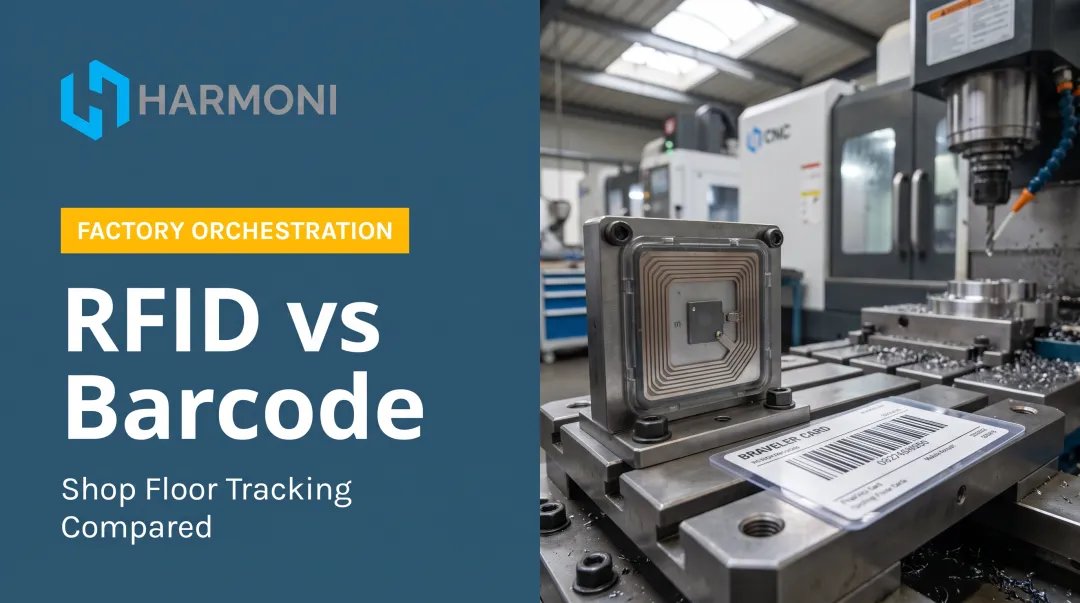
RFID (Radio Frequency Identification) is a wireless technology that uses electromagnetic fields to automatically identify and track tags attached to objects, people, or equipment. Unlike barcodes, it requires no line-of-sight and no manual scanning.
But installing RFID readers is not the same as RFID integration — and that gap is where most shops leave value on the table.
Standalone RFID vs. Integrated RFID
A standalone RFID system logs reads locally — it knows a tag passed a reader, and it stores that fact. An integrated RFID system does something with that fact.
| Capability | Standalone RFID | Integrated RFID |
|---|---|---|
| Data destination | Local log file | ERP, MES, or orchestration platform |
| Trigger capability | None | Updates job status, clocks labor, alerts supervisors |
| Operator action required | Often yes | No |
| Value to production managers | Limited | Real-time operational visibility |
When RFID is properly integrated, a job traveler tag moving past a workcenter reader doesn't just get logged — it updates job status in the ERP, clocks the operator's time, and makes that information visible on a supervisor's dashboard within seconds. No keyboard entry, no terminal interaction, no delay.
The rest of this guide breaks down how that integration works, what it connects to, and what it takes to get there.
How RFID Works: The Core Components
Every RFID system has three fundamental hardware components:
- The tag — stores data (a job ID, employee badge number, part number) and is attached to an object or worn by a person
- The reader/antenna — emits radio waves and captures the signal reflected back from nearby tags
- The backend software — receives, interprets, and acts on the data from readers
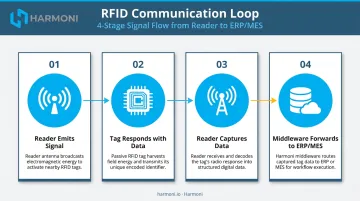
The communication loop works like this: the reader emits a radio frequency signal → nearby tags respond by broadcasting their stored data → the reader captures that data → the middleware or integration layer forwards it to connected software in near real time.
Active vs. Passive RFID Tags
The choice between active and passive tags has real cost and infrastructure implications:
- Passive tags have no battery. They're powered by the reader's electromagnetic field, work at shorter ranges, cost less, and require no maintenance. Most common in manufacturing item tracking.
- Active tags have their own battery and continuously broadcast a signal over longer ranges. Higher cost, but suited for real-time asset location across larger areas like warehouses or yards.
For most shop floor applications — tracking WIP, job travelers, and operator badges at workcenters — passive tags are the practical and cost-effective choice.
RFID Frequency Ranges
| Frequency | Range | Common Use |
|---|---|---|
| LF (125–134 kHz) | Short | Tool check-out, proximity detection |
| HF / NFC (13.56 MHz) | ~1 meter | Item-level tracking at close range |
| UHF (860–960 MHz) | Up to 10+ meters | Work cells, dock doors, industrial environments |
According to GS1, passive UHF (also called RAIN RFID) is the most broadly implemented RFID type across industrial and supply chain deployments, with properly deployed tags readable at distances exceeding 10 meters without line-of-sight. Airbus, Boeing, and Rittal all deploy UHF at scale, making it the de facto standard for manufacturing environments.
Types of RFID Systems and Tags
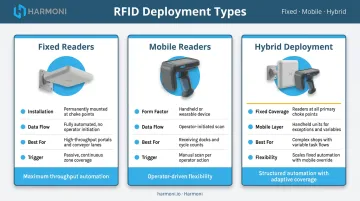
Manufacturers typically encounter two deployment architectures, and most real-world implementations use both.
Fixed Readers
Permanently installed at a specific point — a machine station, entry gate, or dock door — fixed readers automatically capture all reads as people or parts move through. No operator action required, which makes them the backbone of fully automated data capture in high-throughput environments.
Rittal's paint plant is a clear example: 22 fixed UHF readers installed across a 10 km conveyor line continuously feed tag events into SAP ERP, providing live WIP location and triggering automated replenishment signals — all without operators doing anything beyond their normal work.
Mobile Readers
Handheld or wearable devices used by operators to scan items in variable locations. They're well suited for cycle counts, receiving, and any scanning task where a fixed read point isn't practical.
Unlike fixed readers, mobile devices still require an operator to pick up the device and scan — they reduce manual entry but don't eliminate it entirely.
That distinction shapes how the integration is architected:
- Fixed readers enable fully automated data flows — events trigger without human initiation
- Mobile readers streamline data capture but keep the operator in the loop for each scan
- Hybrid deployments use fixed readers at high-throughput choke points and mobile readers for exception handling, receiving, or variable-location tasks
How RFID Integrates with Manufacturing Systems
The integration architecture follows a consistent pattern across industrial deployments:
Tag → Antenna/Reader → Middleware/Integration Layer → ERP or MES
The middleware is where raw tag reads become meaningful events. "Badge #4021 detected at Machine #7" becomes "Operator Jones clocked in on Job #10042 at Op 30" before that event is passed to the ERP via API or direct database connector.
ERP Integration
When an RFID reader detects a job traveler tag at a workcenter, the integration layer can automatically:
- Clock labor time in the ERP
- Update job status and operation sequence
- Log material consumption
Rittal's deployment demonstrates this without any operator terminal interaction — every tagged enclosure crossing a reader updates both middleware and SAP ERP, creating a live record of production-order status that managers can act on immediately rather than waiting for end-of-shift reporting.
MES Integration
Where ERP integration automates transactions, MES integration drives real-time production status rather than periodic updates. RFID feeds enable:
- Triggering work order routing automatically
- Updating part genealogy as components move through operations
- Flagging when a non-conforming part enters a downstream process
LNS Research found that 37% of 1,328 respondents named ineffective measurement of quality metrics as their top obstacle to meeting quality objectives. RFID-driven MES feeds address exactly that, replacing end-of-shift reporting with event-driven data.
Employee and Operator Detection
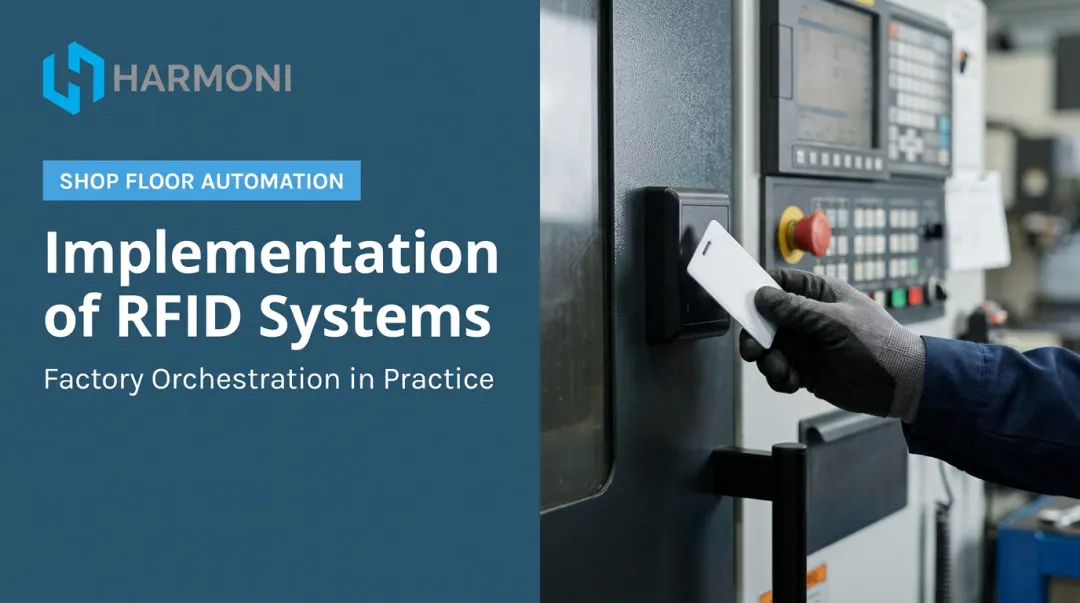
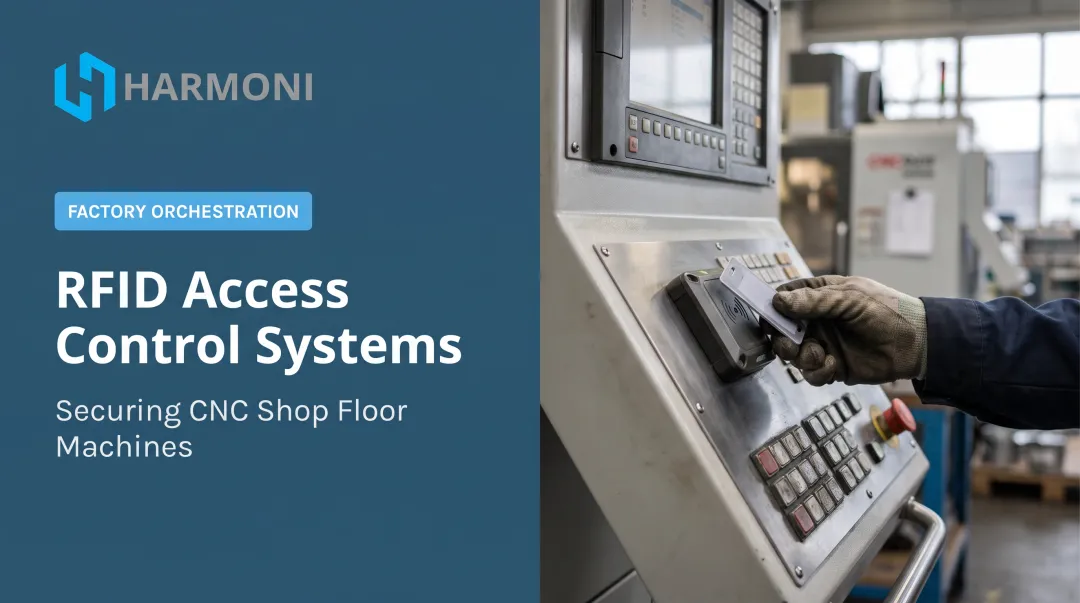
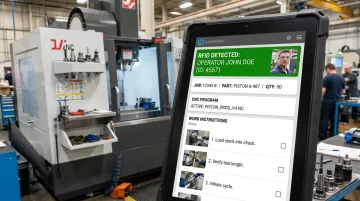
Automatic operator detection at workcenters is where RFID integration delivers some of its most immediate impact. When an employee badge is read by a fixed reader at a machine:
- The correct job, CNC program, and work instructions display automatically
- Labor time begins logging without any manual clock-in
- Buddy-punching risk is removed
- A precise accountability record is created for job costing
Harmoni, a factory orchestration platform used by CNC machining, aerospace, and defense manufacturers, uses this RFID-driven operator detection as the foundation of its workcenter automation. When an operator approaches a machine, Harmoni identifies them via RFID badge, surfaces the correct work instructions and CNC program on the workcenter screen, and begins logging activity — writing that data back to ERP systems like Epicor, Infor, and JobBoss without any manual operator input.
For defense manufacturing customers, Harmoni pairs RFID identification with PIN or biometric secondary authentication to meet ITAR, CMMC, and DFARS access control requirements.
Key Benefits of RFID Integration on the Shop Floor
Real-Time Visibility
RFID integration gives production managers a live view of job status, operator location, and machine utilization without waiting for operators to report. Problems surface while they're happening, not at shift-end review.
Harmoni delivers this visibility through several channels at once:
- Shop floor dashboards accessible from any device
- Workcenter screens showing operators their current assignments
- Andon-style status lights providing physical visual cues on the floor
- Supervisor exception alerts that let managers contact a work cell directly when performance deviates
Elimination of Manual Data Entry
Airbus's Bremen operation demonstrates the scale of what's possible: RFID tags tracking sheet metal through 10 cutting and bending stages replaced 1.5 million manual scans per year. That's a documented workload reduction from a single facility.
When RFID automatically logs job starts, completions, and operator assignments, the compounding cost of manual transcription errors — mis-keyed job numbers, incorrect operation codes, missed time punches — is removed from the equation entirely.
Accurate Job Costing and Labor Accountability
With RFID logging actual time-on-machine and operator presence automatically, the labor data passed to the ERP reflects true production time. This enables:
- More accurate job costing based on real activity, not estimated standards
- Identification of specific operations where time consistently exceeds estimates
- Operator accountability tied to documented production records
Scrap Prevention and Process Control
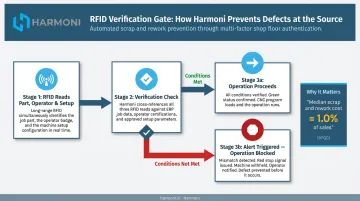
RFID integrated with process logic creates a verification gate before work proceeds. If the correct part, setup, or operator credential hasn't been confirmed, the system can trigger an alert or prevent the next operation from beginning. APQC benchmarking data across 1,008 organizations puts median scrap and rework cost at 1.0% of sales — catching setup errors before they produce bad parts has direct financial impact.
Common Challenges to Plan For
Infrastructure and Environment Compatibility
Metal surfaces reflect UHF radio signals. Liquids absorb them. Dense machinery creates interference that affects read reliability in ways that aren't obvious until you're on the floor.
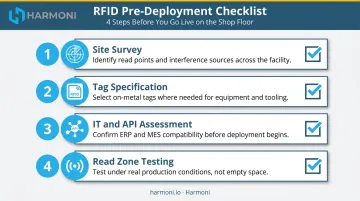
Before deployment:
- Conduct a site survey to identify read-point locations and interference sources
- Specify on-metal tags where equipment or fixturing is involved (Rittal's paint plant used on-metal passive tags rated to 250°C)
- Assess existing IT systems for API compatibility with the integration layer
- Test read zones under actual production conditions, not just in an empty space
Change Management and Adoption
Operators who feel monitored without understanding why will resist. Implementations that skip the communication step create friction that undermines adoption regardless of how well the technology performs.
Effective rollouts pair the technical deployment with:
- Clear explanation of purpose — accountability and visibility, not surveillance
- Practical training that reduces steps rather than adding them
- Fast time-to-value so operators see benefits within their first week
That last point matters more than most teams expect. Harmoni's terminal design is built around it: job detection via RFID automatically surfaces the right program and work instructions, so the system reduces what operators have to do rather than adding a new step.
Data Security
RFID signals can be intercepted. Two distinct security layers need attention:
- Air-interface security: ISO/IEC 29167 defines cryptographic suites for RFID tag-to-reader communications, protecting the radio link itself
- Enterprise integration security: NIST SP 800-98 recommends a system-level approach covering tags, readers, middleware, databases, networks, and access control. Specific controls include encrypted transport, least-privilege access, network segmentation, audit logging, and procedures for lost or compromised tags
For defense manufacturers, Harmoni addresses both layers through RFID-based operator authentication paired with PIN or biometric verification. Additional controls include function-level access restrictions, comprehensive audit logs, and a Government Cloud deployment option for organizations handling Controlled Unclassified Information.
Frequently Asked Questions
What is RFID integration?
RFID integration connects RFID hardware — tags and readers — with enterprise software systems like ERP, MES, or factory orchestration platforms, so that physical events are automatically captured and translated into digital records and workflow actions. Unlike standalone RFID, integrated systems act on data rather than simply logging it.
What is RFID and how does it work?
RFID (Radio Frequency Identification) is a wireless technology where a reader emits radio waves that power or activate a nearby tag, which responds by broadcasting stored data — such as a part number or employee ID. The reader passes that data to connected software systems, triggering updates without any manual input from an operator.
Which software is used for RFID?
RFID data is typically processed through a middleware or integration layer that connects to ERP systems (such as Epicor, Infor, or JobBoss), MES platforms, WMS software, or factory orchestration platforms like Harmoni. The right software depends on what workflows the RFID data needs to trigger — inventory updates, labor clocking, job status changes, or process verification.
What is the difference between active and passive RFID tags?
Passive tags have no battery and are powered by the reader's electromagnetic field at shorter ranges — lower cost, no maintenance, and the most common choice for manufacturing item and WIP tracking. Active tags have their own battery and broadcast continuously over longer ranges, making them better suited for real-time asset location across larger areas.
How does RFID integration benefit manufacturing operations?
RFID integration eliminates manual data entry, enables real-time job and operator visibility, improves labor accountability and job costing accuracy, and lets manufacturers verify setups and credentials before errors produce scrap. Each of these gains builds on the others — cleaner data flows directly into better operational decisions.
What are the common challenges of integrating RFID into existing systems?
Three challenges come up consistently:
- RF interference from metal and machinery requires site surveys and specialized tags before deployment
- IT and API readiness of existing ERP and MES systems must be assessed before integration can begin
- Change management requires clear operator communication so the technology reduces workload rather than adding unfamiliar steps