This isn't a personnel problem. It's a systems problem.
According to Siemens' 2024 downtime analysis, unplanned downtime costs manufacturers anywhere from $150,000 per hour for SMEs to $2.3 million per hour for large automotive plants — and human error is a well-documented contributor to those stoppages.
This article covers the root causes of manufacturing error, what those errors actually cost operations, and the strategies high-performing shops use to reduce mistakes — from process design to real-time factory orchestration.
Key Takeaways
- Human error stems from predictable causes: fatigue, training gaps, poor process design, and missing real-time feedback
- The cost extends far beyond scrap — rework labor, compliance exposure, and customer trust are all affected
- Digital work instructions, ergonomic job design, and targeted training anchor sustainable error reduction programs
- Real-time factory orchestration platforms catch deviations while production is still running — not after the damage is done
- Sustainable improvement requires systems-level changes alongside a culture where operators report errors openly
What Is Human Error in Manufacturing?
In a manufacturing context, human error is any action or inaction by an operator, technician, or supervisor that causes output to deviate from required standards — distinct from mechanical failure or material defects.
Three categories appear most often on the shop floor:
- Skill-based errors — slips and lapses during routine tasks, such as an experienced CNC operator entering the wrong offset value on a familiar part program
- Rule-based errors — applying the wrong procedure, such as following a setup sequence for a similar (but different) part when the correct job traveler wasn't checked
- Knowledge-based errors — incorrect judgment in unfamiliar situations, such as an operator making a tooling decision on a new part program without engineering guidance
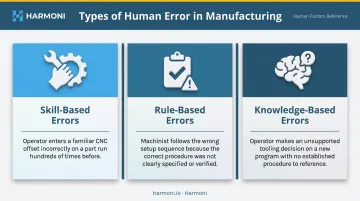
Each of these error types shares one trait: the conditions that produced them were often preventable. Skilled operators remain essential in precision environments — but even experienced people make mistakes when systems leave too much to memory, habit, or judgment under pressure. The practical goal is to design workflows and controls that reduce those conditions, treating error prevention as a systems problem rather than a performance problem.
Root Causes of Human Error on the Shop Floor
Fatigue and Mental Overload
Repetitive tasks, long shifts, and high cognitive load degrade operator attention and judgment over time. NIOSH-affiliated research documents fatigue as an occupational hazard linked to slower reaction times, decision errors, and increased accident risk — effects that compound across extended shifts and overnight rotations.
In CNC environments, this matters because precision tasks don't become more forgiving as a shift wears on.
Training and Knowledge Gaps
Operators who understand only how to run a process — not why a step matters — are more likely to substitute incorrect judgment when something looks unfamiliar. This risk is highest during onboarding, when running new part programs, or after process changes that weren't communicated clearly.
Shops that invest in process-level training — not just procedural walkthroughs — see fewer substitution errors when conditions change.
Poor Process and Workplace Design
Processes designed without accounting for human limitations generate predictable error rates. When the environment itself creates friction, mistakes follow.
Common design-driven error sources include:
- Workstations requiring constant vigilance with no built-in checks
- Ambiguous or inconsistent tooling instructions
- Cluttered setups where the correct tool isn't clearly identifiable
5S discipline and ergonomic workstation layout reduce this category of error by making the correct action the easiest one.
Communication Failures and Information Gaps
Errors multiply when:
- Shift handoffs are verbal and informal
- Job travelers are paper-based or carry outdated revision levels
- Operators lack immediate access to current engineering specs at the machine
The result is operators running jobs from memory or from the nearest available document — which may not be the current revision.
Lack of Real-Time Feedback
In many shops, errors surface only after a batch is complete — by which point multiple parts are already scrapped. Operators without active guidance or live performance feedback have no mechanism to self-correct mid-process. Small deviations compound into large ones before the next inspection point catches them.
The True Cost of Manufacturing Errors
Direct Operational Costs
Unplanned downtime is expensive regardless of cause, but human-error-driven stoppages compound in a specific way. One misloaded program or incorrect setup can trigger hours of rework, machine re-qualification, and lost throughput: far beyond what it takes to fix the original mistake.
Siemens' 2024 analysis puts the upper bound of SME downtime cost at $150,000 per hour. Even a fraction of that figure, repeated across multiple error events per month, has a material impact on job costing and margin.
Quality and Compliance Exposure
In aerospace, defense, and medical device manufacturing, errors that reach downstream customers don't just cost money — the fallout includes non-conformance reports, supplier audits, and potential certification consequences. A 2024 DoD OIG audit of Air Force defective parts found $3 million in unrecovered costs from defective components, along with direct effects on operational readiness.
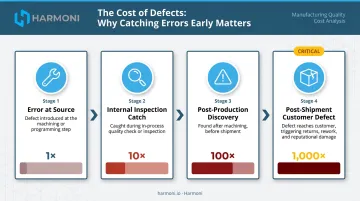
A defect discovered post-shipment costs orders of magnitude more than one caught at the source. ASQ's quality cost accounting framework confirms this through its internal versus external failure cost model — and the gap widens with every tier the defect travels downstream.
Hidden Costs and Second-Order Effects
The less-visible costs are just as significant:
- Reputational damage with key customers who notice delivery and quality patterns
- Operator morale erosion from constant rework firefighting instead of productive machining
- Inaccurate job costing when error-related waste isn't tracked or attributed — making it impossible to identify which jobs or processes are actually profitable
Proven Strategies to Reduce Human Error in Manufacturing
Standardize Processes with Digital Work Instructions
Paper-based instructions create ambiguity. Operators rely on memory, ask colleagues, or work from whatever document is physically nearby — which may be outdated, marked up, or simply wrong.
Digital work instructions eliminate that ambiguity. Operators follow step-by-step guidance tied to the correct job, revision, and machine setup, with no reliance on informal knowledge or memory.
The impact is measurable: a controlled mechanical-assembly study found that switching from paper to digital instructions reduced recorded errors by 83.93% — from 56 total errors down to 9 — while cutting assembly time by nearly 45%. Sample size was small, but the directional finding aligns with what shops report in practice.
When instructions are tied to job sequences, they also create built-in error-proofing: an operator can't confirm step 4 without completing step 3 first.
Design Processes Around Human Limitations
Human factors engineering applied to the shop floor means:
- Minimizing the number of mental calculations required of operators during setup
- Designing tooling fixtures that make incorrect assembly physically difficult or impossible
- Organizing workstations so missing or wrong components are immediately visible
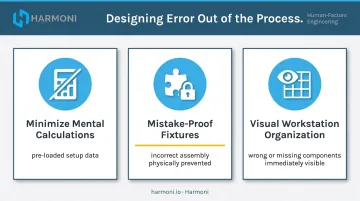
This is the core idea behind poka-yoke — building mistake-prevention into the process itself rather than relying on inspection after the fact. Peer-reviewed research on pick-to-light poka-yoke systems in discrete assembly environments reported a 35% reduction in error rates, demonstrating that physical and digital error-proofing produces measurable results in production settings.
Invest in Targeted Training and Qualification
Training in precision manufacturing must go beyond procedure recitation. Operators who understand why a tolerance matters — what happens downstream if it's missed — make better decisions when something unexpected occurs.
Practical recommendations:
- Use structured qualification gates before assigning operators to high-risk or high-precision operations
- Schedule refresher training after process changes, new part introductions, or post-error reviews
- Document training completion and link it to job authorization in the production system
Strengthen Communication Across Shifts and Departments
Shift handoffs are a predictable vulnerability. Information degrades as it passes verbally from one operator to the next: tolerances get rounded, revision numbers get misremembered, setup details get skipped.
When job status lives in a system rather than in someone's head, handoff risk drops substantially. Practical controls include:
- Structured shift briefings with documented status for each active job
- Digital job status records visible to both outgoing and incoming operators
- Closed-loop communication between engineering and the floor to catch revision mismatches before parts run
Conduct Root Cause Analysis After Every Error
Responding to errors with pressure — "try harder," "be more careful" — doesn't prevent recurrence. It delays it until the next shift, the next job, or the next inspection.
A simple three-step framework:
- Identify the error — what happened and where in the process
- Identify the root cause — use 5 Whys or fishbone analysis to get past the symptom
- Implement a process change — modify the procedure, tooling, instruction, or system to prevent the same error from recurring
Addressing the root cause is the only reliable path to reducing error rates over time.
How Real-Time Technology and Factory Orchestration Prevent Errors
Traditional quality control is reactive — it catches mistakes after production. Modern factory orchestration is proactive: it identifies deviations while production is still running, leaving time to course-correct before scrap happens.
From Manual Steps to Automated Workflows
A significant share of human error on the shop floor happens not during the precision machining itself, but during the manual administrative steps surrounding it: job lookup, time entry, program selection, setup documentation retrieval. These tasks pull mental focus away from the work that actually requires operator attention.
When those steps are automated — through RFID-based job identification, automated CNC program loading, and digital work instruction delivery — operators arrive at the machine with the right program, the right instructions, and the right checksheet already in front of them. The error-prone manual steps are simply removed.
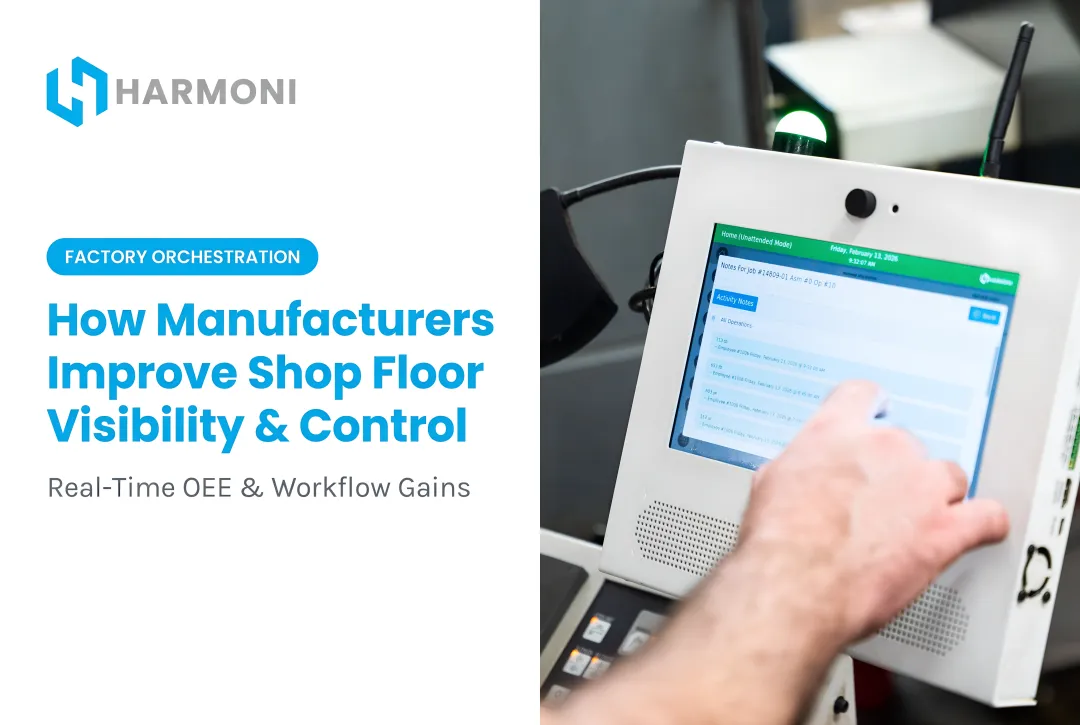
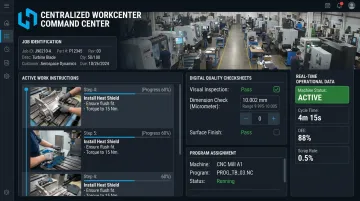
Harmoni's factory orchestration platform is built specifically for this purpose. Using long-range RFID, it automatically detects the nearby employee and active job, then delivers a centralized command center at each workcenter.
Operators get the correct program, current work instructions, digital quality checksheets, and inspection plans — all tied to the specific job, part, and revision. No manual lookups. No memory-dependent steps.
The results from early adopters are concrete. WessDel, a San Jose-based precision shop machining aerospace and defense components in beryllium and titanium alloys, documented 17 productive hours gained per employee per month after implementation — achieved primarily by reducing ERP transaction time from 11 minutes per transaction to seconds. A separate unnamed shop reduced scrap by 22% within two months.
Process Control Before the Machine Starts
Harmoni's process control layer enforces that the right operator is running the right job with the correct program and tooling setup before the machine starts. This addresses setup errors , which drive a disproportionate share of scrap events in CNC environments, at the point where intervention is still possible and costless.
Catching errors before the machine starts is only half the picture. What happens during the run matters just as much.
Real-Time Observability for Supervisors and Plant Managers
Unified dashboards combine machine data, ERP workflow status, and operator activity to give supervisors live visibility into what's actually happening on the floor. A machine running behind cycle time, an out-of-tolerance trend developing across a batch, a job that's stalled — these deviations are visible in real time, not discovered during a post-shift audit.
Harmoni sits between ERP systems, MES platforms, machines, and operators, coordinating all four in a single operational view. Automated alerts notify managers of exceptions directly, without requiring them to walk the floor to find problems. The result: problems get addressed in minutes, not discovered at shift-end when the damage is already done.
Building a Quality-First Culture for Sustainable Improvement
Technology and process design create the conditions for fewer errors. Culture determines whether those conditions are maintained over time.
A quality-first culture has three visible characteristics:
- Errors are reported and analyzed without blame — operators flag problems early because doing so is valued, not punished
- Continuous improvement is shared responsibility — not just a quality department initiative
- Operators feel empowered to stop and escalate when something doesn't look right
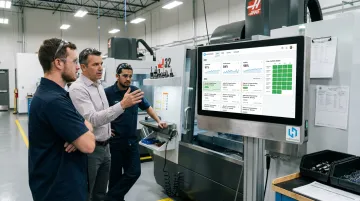
Leadership sets this tone. Supervisors who conduct pre-job briefs, respond to mistakes with root cause analysis rather than pressure, and model process discipline signal to the floor that quality matters more than throughput theater.
The connection to technology is direct. When operators and supervisors can see real-time performance data and trace their decisions to production outcomes, accountability becomes part of the workflow itself. No top-down enforcement required — the data makes it obvious.
A study covering 330 manufacturing plants found that psychological safety is positively associated with improvement capability, with manufacturing complexity moderating the relationship. Shops where people feel safe raising quality concerns are measurably better at identifying and addressing root causes — and that's where error rates actually move.
Frequently Asked Questions
What does manufacturing error mean?
A manufacturing error is any deviation from expected output caused by human action or inaction — distinct from mechanical failure or material defects. It spans errors of procedure, judgment, omission, and communication and can occur anywhere across the production cycle.
How do you reduce manufacturing defects?
The core approach: standardize processes with digital work instructions, design error-proofing into operations, train operators on the why behind each step, and implement real-time monitoring that catches deviations before they become defects. Each layer reinforces the others, and the combination is what produces consistent, measurable results.
What are the most common causes of human error in manufacturing?
The top causes are operator fatigue and cognitive overload, inadequate or incomplete training, ambiguous or outdated work instructions, communication failures during shift handoffs, and the absence of real-time feedback mechanisms on the shop floor.
How does automation reduce human error on the shop floor?
Automation removes error-prone manual steps (job lookup, setup verification, program selection, time entry), freeing operators to focus on precision tasks. It also enforces process sequences so steps can't be skipped or performed out of order — building a structured safety net around the workflow's most mistake-prone points.
What is error-proofing (poka-yoke) in manufacturing?
Poka-yoke is a design philosophy that makes errors difficult or impossible to commit — through physical constraints, digital step enforcement, or automated detection. The goal is to build defect prevention into the process itself rather than relying on end-of-line inspection to catch mistakes once they've occurred.