
That gap matters. Most operations measure scrap by counting rejected units. The real cost includes the labor already invested in those parts, energy consumed, inspection time, disposal, and the production capacity that will never yield a shippable part.
Scrap also isn't inevitable. It's a symptom — of disconnected systems, inconsistent processes, and decisions made without full operational context. This article examines where scrap actually originates and what manufacturers can do about it at each layer: before production begins, during active production, and in the organizational context surrounding it.
Key Takeaways
- Scrap cost goes well beyond material loss — labor, energy, inspection, and lost capacity are all part of the true figure
- Defect cost multiplies the later it's caught — early detection is exponentially cheaper
- Most operations underestimate their scrap cost because they track rejected units, not the full cost chain
- Connecting machine data, operator activity, and job requirements in real time is among the highest-leverage prevention tools available
- Targeting the right layer — decisions, process management, or organizational context — is what makes scrap reduction stick
How Scrap Costs Build Up in Manufacturing
Scrap doesn't arrive as a single line item. It compounds.
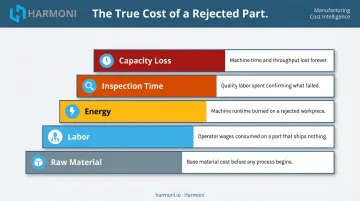
Raw material loss is only the first layer. By the time a part is rejected, it has typically absorbed:
- Labor from every operation performed up to the rejection point
- Energy consumed running those cycles
- Inspection time to identify and document the defect
- Disposal costs for handling non-recoverable material
- Capacity loss — that machine time and operator time cannot be recaptured
The Cost Grows the Later You Catch It
The ASQ cost-of-quality framework — spanning prevention, appraisal, and internal and external failure categories — reflects a well-established principle: defects caught earlier are dramatically cheaper to address than those discovered later.
A part rejected after its first operation costs far less than one rejected after five. Ship that defect to a customer, and the cost multiplies again.
This is why end-of-shift scrap logs are a particularly costly approach. By the time a reject is logged, the conditions that caused it may have run unchecked for hours — producing a full batch of unusable parts.
Visible Scrap vs. Hidden Scrap
Most operations measure visible scrap: rejected units entered into ERP, counted at the end of a run. That number is real but incomplete.
Hidden scrap costs include:
- Rework hours applied to salvageable parts
- Yield losses that quietly reduce throughput without generating a formal reject record
- Capacity consumed processing defective work that will never ship
- Expediting costs incurred to recover delivery commitments after scrap events
Operations that track only unit counts routinely underestimate their true scrap cost. Closing that gap means connecting material, labor, energy, and capacity data in a single unified view — something that requires those data streams to be collected and linked in the first place.
Key Cost Drivers Behind Manufacturing Scrap
Most scrap problems trace back to one of four root causes. Identifying which ones apply to your operation is the first step toward reducing them.
Equipment Condition
NIST research on precision machining is direct: well-maintained machines hold tolerances better and produce less scrap and rework. Equipment operating outside optimal parameters (due to tool wear, thermal drift, or calibration loss) can generate off-spec parts for an entire shift before any human detects the deviation.
The problem is timing. Scheduled preventive maintenance creates service intervals, but equipment condition degrades continuously. A machine that passed its last PM may be out of tolerance by the end of the following week.
Operator Behavior and Process Adherence
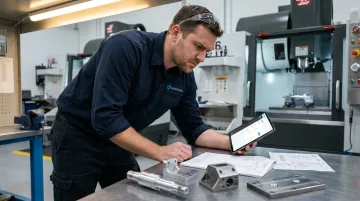
Modern Machine Shop notes that most CNC scrap workpieces trace back to human error — incorrect offset entries, setup miscalculations, and fixture errors. Setup scrap is particularly hard to prevent on complex workpieces where certain surface relationships can't be measured while a part is still clamped.
In high-mix environments, this problem multiplies. Operators switching between dozens of active SKUs face high cognitive load at every changeover. Reliance on memory, paper travelers, or tribal knowledge introduces variability that scales directly with part complexity.
Upstream Decisions
Some scrap conditions are baked in before production starts:
- Tolerances or geometry designed without shop floor input
- Raw material from suppliers with inconsistent dimensional or compositional quality
- Engineering changes that don't reach operators before the next run
None of these are detectable at the machine. They're design and sourcing decisions that create defect-generating conditions regardless of how well the operator executes.
System Fragmentation
When machines, operators, and ERP systems operate in silos, scrap-generating conditions stay invisible. No single view connects process data with job requirements and operator actions. A deviation caught in one system may never surface in another — and by the time it does, the window for intervention has already closed.
Strategies to Reduce Manufacturing Scrap
The strategies below are organized by where they intervene. Applying operational fixes to a design problem — or training fixes to an equipment problem — produces limited results. The layer matters.
Strategies That Change Decisions
These approaches reduce scrap by improving what's decided before or during production setup.
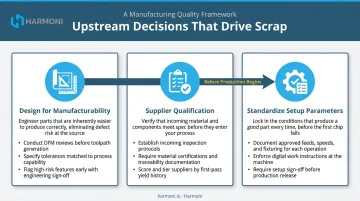
Three decisions upstream of production account for a disproportionate share of preventable scrap:
- Design for manufacturability — Engage manufacturing engineers during product development to flag high-risk tolerances and validate processes before production begins. Products designed without shop floor input frequently include specifications that are difficult to produce consistently.
- Tighten supplier qualification — Establish material quality standards, conduct incoming audits, and hold vendors accountable through procurement. Inconsistent raw material introduces variability that even well-calibrated machines can't compensate for.
- Standardize setup parameters at the job level — Document machine parameters, tooling offsets, and setup verification steps in enforced procedures rather than leaving them to individual operator knowledge. Setup errors are among the most common causes of first-piece scrap.
Strategies That Change How Production Is Managed
These approaches reduce scrap through real-time control and process consistency while production is active.
Shift from reactive reporting to real-time monitoring. End-of-shift scrap logs describe what already happened. When machine data, cycle performance, and quality signals are monitored continuously, supervisors can detect process drift and intervene before a large volume of defective parts accumulates. The earlier the detection, the lower the cost per defect — a direct application of the cost-of-quality framework.
Move from preventive to condition-based maintenance. Scheduled maintenance leaves gaps between service intervals where equipment can drift out of specification undetected. Monitoring vibration, temperature, and real-time machine signals identifies early signs of tool wear or calibration loss before they affect part quality. The goal is catching degradation while it's still a trend, before it becomes a scrap event.
Implement digital work instructions at each workcenter. Paper-based or memory-reliant instructions create a gap between what engineering specifies and what operators execute. Digital, step-by-step instructions linked to part revisions — delivered automatically for the specific job — enforce compliance without depending on individual experience.
Harmoni's factory orchestration platform addresses this directly. Using long-range RFID, it automatically detects the job and machine, then delivers current approved work instructions and loads the correct CNC program and offsets before the cycle starts. This eliminates a common first-piece scrap cause: running a job against an outdated revision or incorrect setup configuration.
Digital checksheets capture in-process quality data at the machine. Exception alerts notify supervisors in real time when deviations occur.
Strategies That Change the Context Around Production
These approaches address the systems and communication structures surrounding production — which, in many operations, are the actual root cause of scrap.
Improve design change management across shifts and departments. Outdated BOMs and uncommunicated engineering changes are systemic scrap causes. When operators produce parts to a superseded specification, the problem is the information system, not the operator. Digital change control that pushes updates to the point of use — combined with structured shift-handoff protocols — closes this gap.
Apply Pareto analysis to target the highest-impact sources. ASQ defines Pareto charts as tools for separating significant defect causes from trivial ones. Scrap reduction resources are finite — spreading them across every defect type produces marginal results. Identifying the highest-volume causes and conducting structured root cause analysis (5 Whys, fishbone diagrams) on those specific issues produces measurable, concentrated improvement. Categorized scrap data drives this analysis; aggregate unit counts don't.
Harmoni captures scrap quantities and reasons at the machine HMI, tagged to the specific machine cycle, operator, and job. Because this data flows into integrated ERP systems and live dashboards, quality teams have the job-level, categorized records needed to run meaningful Pareto analysis rather than working from shift-level summaries.
Build operator-level accountability. Frontline operators are the earliest detectors of quality problems but are often excluded from the improvement process. Providing them with tools to log defect causes in real time, involving them in root cause sessions, and recognizing scrap reduction contributions builds a culture where quality is a shared responsibility — owned at the machine, not just managed downstream.
Conclusion
Reducing scrap requires correctly diagnosing where it originates. The right intervention applied to the wrong layer — operational fixes for a design problem, or training for an equipment problem — produces temporary results.
Manufacturers who consistently achieve low scrap rates treat it as a continuous operational discipline: measuring it accurately, tracing patterns across machines and operators, and addressing root causes before they compound. Shops that make that shift — from logging defects after the fact to catching conditions that produce them — don't just manage scrap. They stop generating it.
Frequently Asked Questions
How do you reduce scrap in manufacturing?
Start by measuring scrap accurately, then trace it to its source: upstream decisions, in-process conditions, or organizational gaps. Targeted interventions include real-time monitoring, standardized work instructions, condition-based maintenance, and root cause analysis focused on the highest-volume defect types.
What is a good scrap rate in manufacturing?
APQC benchmarking data covering 870+ organizations reports that top performers spend 0.6% of sales on scrap and rework, versus 2.2% for bottom performers. "Good" is highly context-dependent — process complexity, material cost, and industry standards all affect the target. Automotive suppliers may face PPM-level requirements from OEM customers, while other sectors use percentage-of-sales benchmarks.
What is the formula for calculating manufacturing scrap rate?
The basic formula is unusable units divided by total units produced. A complete calculation also incorporates rework labor, energy consumed, disposal costs, and reinspection time — tracking only rejected unit counts understates the true cost and its impact on margin and capacity.
What are the most common causes of scrap in manufacturing?
The primary categories are improper setup, equipment operating outside specification, operator error or process inconsistency, incoming material quality variation, and failures in communicating design or engineering changes to the shop floor before production runs.
What is the difference between scrap and rework in manufacturing?
Scrap is material that cannot be recovered and must be discarded. Rework involves additional labor to bring a part back to specification. Both carry real cost, but rework compounds the original defect with added labor — making its total cost often higher than a comparable scrap event.
How does real-time monitoring help reduce manufacturing scrap?
Real-time monitoring detects process deviations as they occur rather than after defective parts have already accumulated. Connecting machine signals, operator activity, and job requirements in a unified view allows supervisors to intervene when a deviation is still a drift, before it becomes a batch of rejected parts.