
This kind of scramble plays out in machine shops and manufacturing plants every day. Operators don't know job priorities. Managers spend more time firefighting than planning. By the time anyone notices a problem, the shift is already over.
Operations production management exists to prevent exactly this. It blends the strategic planning of operations management with the hands-on execution of production management, and manufacturers that get both right run tighter, more profitable operations.
This article breaks down what operations production management actually means, the core functions every production manager handles, the classic "5 P's" framework, and how factory orchestration technology is changing what's possible on the shop floor.
Key Takeaways
- Operations production management unites strategic planning with day-to-day execution of turning materials into finished goods.
- Core functions span planning, scheduling, dispatching, quality control, monitoring, and maintenance.
- The 5 P's (Product, Plant, Process, Programs, People) give new production managers a clear operating model.
- Real-time visibility tools close the gap between planned schedules and actual shop floor execution.
What Is Operations Production Management?
Operations production management is the discipline responsible for planning, coordinating, and controlling the day-to-day transformation of materials, labor, and equipment into finished goods. It sits at the intersection of two related but distinct fields.
Operations management covers the full business system: finance, quality, supply chain, and service delivery all fall under its umbrella. Production management narrows that focus to the manufacturing process itself—how raw materials become a finished part. It covers how that transformation gets planned, scheduled, and controlled.
"Operations production management" describes managing that production function within the broader operations context, applying strategic oversight to the tactical, hour-by-hour reality of running a shop floor. In practice, this means a production manager isn't just building schedules. They're making sure the schedule survives contact with reality: machine breakdowns, late materials, absent operators, and the dozen other things that derail a "perfect" plan by 9 a.m.
What Does an Operations Production Manager Do?
Day to day, an operations production manager typically:
- Builds and adjusts production schedules based on demand and capacity
- Allocates labor, machines, and materials to specific jobs
- Monitors shop-floor performance against targets
- Enforces quality standards and inspection checkpoints
- Coordinates with procurement, planning, and ERP teams to keep data accurate
That mix of scheduling, resource allocation, and cross-team coordination is why most people enter this path on the floor. Many start as a production supervisor, move into a production manager role, and later advance into a director of operations role. A bachelor's degree plus several years of hands-on manufacturing experience is the typical entry point.
According to the U.S. Bureau of Labor Statistics, industrial production managers earned a median annual wage of $121,440 in May 2024. The field employed 241,900 people and adds roughly 17,100 openings a year, with overall job growth projected at a modest 2% through 2034.

With that level of responsibility, the job gets harder as the shop gets more complex. In CNC machining, aerospace, defense, automotive, and healthcare manufacturing, managers now pull data from machines, ERP systems, and operators at the same time. A clipboard and a whiteboard no longer cut it.
Key Functions and Responsibilities of Operations Production Management
Every operations production manager owns six overlapping responsibilities. Together they turn a sales order into a shipped part.
Production Planning and Scheduling. Demand forecasts, realistic schedules, and capacity aligned to expected orders prevent the two costliest mistakes in manufacturing: overproduction that ties up cash in inventory, and shortages that blow through promised ship dates.
Routing and Resource Allocation. This function sets which workstations a job passes through, in what order, and which labor, machines, and materials each step gets. Get routing wrong, and a job sits waiting for a machine that's tied up on something else.
Dispatching and Execution. Issuing work orders and instructions to the floor so operators have the specs, tools, and materials they need before the job starts, not fifteen minutes in once someone realizes the print is missing.
Quality Control and Inspection. Systematic checks run throughout the production cycle—not just at the end—so defects get caught early and expensive rework or scrapped parts stay off the floor.
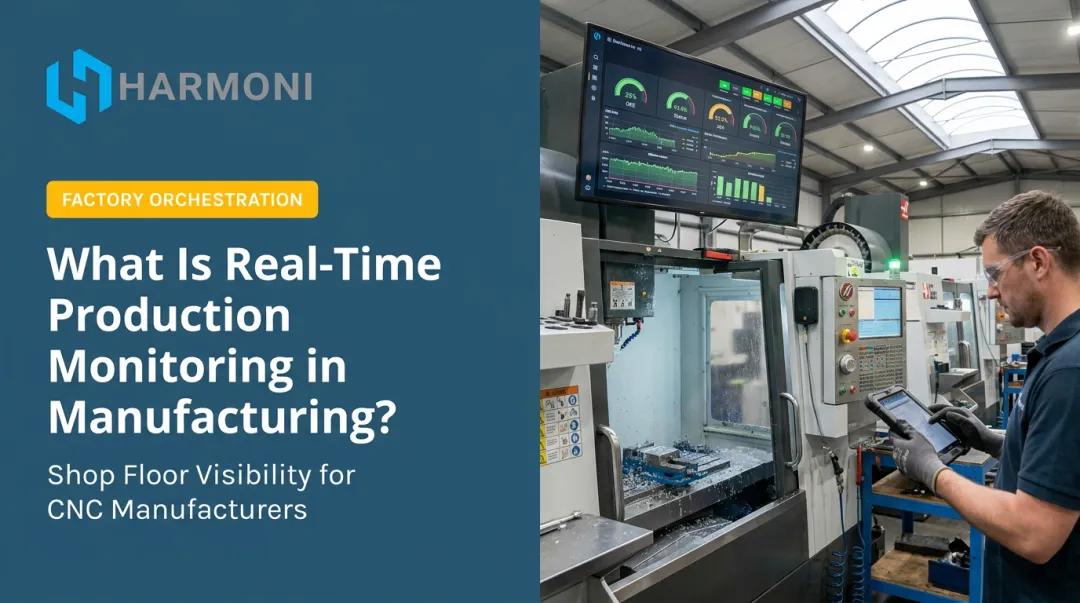
Monitoring and Continuous Improvement. Output rates, downtime, and labor utilization need tracking in real time. Many manufacturers still find problems only after a shift or job ends. That gap between plan and actual remains one of the most persistent execution problems on traditional shop floors.
Maintenance and Cost Control. Preventive maintenance cuts unplanned downtime. Tracking true job costs—labor, machine time, and materials—against the original budget is what makes job costing accurate or unreliable.

Manufacturers that lean on preventive and predictive maintenance report 52.7% less unplanned downtime and 78.5% fewer defects than shops stuck in reactive mode, according to NIST's survey of manufacturing machinery maintenance practices.
The 5 P's of Production Management
New managers often learn a simple framework called the "5 P's" to organize their responsibilities. Sources vary slightly on the exact wording, but the version widely taught in operations management coursework breaks down like this:
| P | What It Covers |
|---|---|
| Product | What's being made, and whether it's designed for manufacturability |
| Plant | The facilities, layout, and equipment used to produce goods |
| Process | The specific methods and technology that convert inputs into outputs |
| Programs | The master schedule that sequences production activities |
| People | The labor and management skills needed to run the operation effectively |
Some frameworks swap "People" for "Procedure," shifting the emphasis toward standardized steps and quality controls instead of labor. Either way, the point is the same: give managers a simple checklist for what they're actually responsible for.
The mapping back to core functions is direct:
- Programs ties straight to scheduling
- Process connects to routing and execution
- People (or Procedure) connects to quality control and consistency across shifts
Learning the framework early shows how those functions work as one system, not a list of unrelated tasks.
Goals, Benefits, and Common Challenges
Operations production management aims to hit output and quality targets while keeping cost and disruption in check. The goals below are what most shops chase—and the challenges are what usually get in the way.
Primary Goals and Benefits
- Higher customer satisfaction through on-time, consistent-quality delivery
- Reduced waste and increased profitability through lean and continuous improvement principles
- Maximized output through optimal use of labor, machines, and materials, without sacrificing quality
Common Challenges Managers Face
- Supply chain disruptions, material shortages, and volatile demand that strain even well-built schedules
- Unplanned equipment downtime and the ongoing difficulty of shifting from reactive to predictive maintenance
- Inconsistent execution across shifts and operators
- Little real-time visibility into what is happening on the floor versus what was planned
That last point tends to be the one production managers complain about most. A schedule can look perfect on paper and still fall apart when no one sees what is happening at the machine until the shift ends.
How Technology and Factory Orchestration Are Transforming Production Management
Traditional production management tools, including ERP systems, MES platforms, and spreadsheets, often operate in silos. The ERP has the plan. The MES has some execution data. The spreadsheet has whatever got typed in from a clipboard at the end of shift.
None of them talk to each other in real time, which is exactly why so many production managers find out about a problem only after it has already cost them a shift.
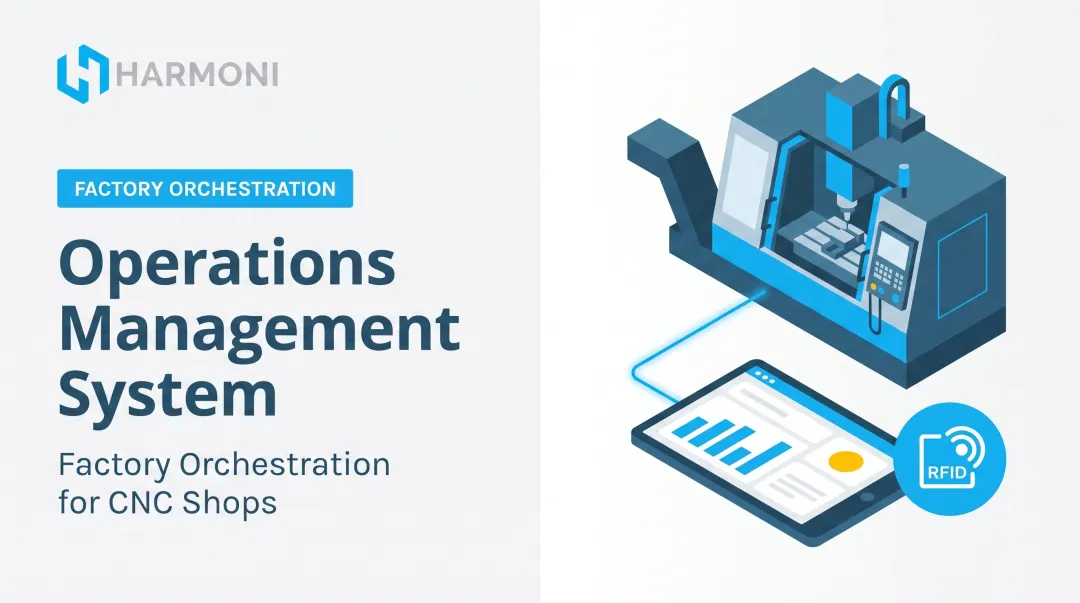
That's the gap a newer category of industrial technology, called factory orchestration, is built to close. Harmoni pioneered this category, sitting between ERP and MES systems, machines, and operators to coordinate execution as it actually happens, not as it was scheduled to happen.
From Static Reports to Real-Time Coordination
A factory orchestration platform like Harmoni combines three data streams into one live view: machine data pulled directly from CNC controls, operator activity tracked through long-range RFID, and ERP workflows including job targets and schedules.
Instead of pulling a report at the end of the day, production managers see which machines are behind schedule, which jobs are trending toward a quality issue, and where labor is actually being spent—all while it's still happening.

Demand for this kind of visibility is accelerating. In Deloitte's 2025 survey of 600 manufacturing executives, 92% said smart manufacturing technology would be the main driver of competitiveness over the next three years, with adopters reporting average gains of 10% to 20% in production output.
What This Looks Like on the Floor
For production management specifically, factory orchestration platforms typically:
- Automate non-productive manual tasks like clocking in, program loading, and paperwork retrieval
- Enforce process control so every operator works from the current approved revision, every time
- Provide observability into labor and machine performance for job costing that reflects reality instead of estimates
This matters most for mid-to-large manufacturers in CNC machining, aerospace, defense, automotive, and healthcare manufacturing, where precision, compliance, and accurate costing carry real financial and regulatory weight.
Platforms like Harmoni integrate with the ERP and machine ecosystems these shops already run, including ABAS, Epicor, Infor, Siemens, Haas, and Mazak, rather than asking them to rip anything out. One beryllium shop that adopted this approach documented a measurable revenue increase from real-time data visibility.
Frequently Asked Questions
What is production operations management?
It's the discipline of planning, coordinating, and controlling the processes that turn raw materials, labor, and equipment into finished goods. It blends strategic operations oversight with the hands-on execution of running a shop floor.
What does an operations production manager do?
They build production schedules, allocate labor and machines, and monitor shop floor performance. Their job is to make sure quality and cost targets are actually met, not just planned for.
What are the 5 P's of production management?
The most widely taught version covers Product, Plant, Process, Programs, and People. Some frameworks swap in "Procedure" instead of People to emphasize standardized quality steps.
What is the difference between operations management and production management?
Operations management covers the entire business system, including finance, supply chain, and service delivery. Production management is a subset focused specifically on manufacturing execution.
What skills are needed for a career in production or operations management?
Strong planning and organizational skills, comfort making decisions from data, clear communication across shifts, and familiarity with real-time production technology.
How is technology changing the way manufacturers manage production today?
Manufacturers are shifting from static schedules and manual tracking toward real-time visibility tools and factory orchestration platforms that connect ERP systems, machines, and operators into one live view.