
Key Takeaways
- Machine condition monitoring tracks equipment parameters like vibration, temperature, and load to detect faults before failure occurs
- It enables condition-based maintenance (CBM), replacing guesswork with data-driven intervention timing
- Vibration analysis is the most widely used technique for rotating equipment; oil analysis, temperature, and pressure monitoring complement it
- Critical assets typically warrant continuous online monitoring; route-based and manual methods work for lower-risk equipment
- Degradation data only drives action when it reaches the operators, jobs, and workflows that depend on that machine
Introduction
An unexpected machine failure does not just stop one machine — it stops the jobs running on it, the operators assigned to it, and the delivery commitments tied to it. The scale of that disruption compounds fast.
ABB's 2025 global industrial survey of 3,600 senior decision-makers found that 83% estimated unplanned downtime costs at least $10,000 per hour — and 44% experienced equipment interruptions at least monthly. For discrete manufacturers, those numbers translate directly into missed shipments and emergency labor costs.
Machine condition monitoring exists to catch problems before they become failures. It continuously tracks equipment health — measuring vibration, temperature, load, and other parameters — so degradation is visible well before it causes a breakdown.
This post covers:
- What condition monitoring is and what it measures
- How different monitoring approaches compare
- How condition monitoring connects to the maintenance strategies manufacturers use to protect production
What Is Machine Condition Monitoring?
Condition monitoring is the ongoing process of measuring specific parameters of machinery — vibration, temperature, oil composition, load, pressure — to detect changes that signal a developing fault before that fault causes failure or downtime.
BINDT defines it around techniques that reveal early deterioration and wear trends — and that scope is what separates condition monitoring from a much simpler idea: basic machine monitoring.
Condition Monitoring vs. Basic Machine Monitoring
Basic machine monitoring answers one question: is the machine running or not? A spindle-on/spindle-off signal, a cycle counter, a production count — these are state indicators. Useful, but binary.
Condition monitoring answers a different set of questions:
- How fast is this component wearing?
- Is this machine running efficiently or laboring harder than it should?
- Has something changed in the vibration signature that points to bearing degradation?
- Is the lubricant still doing its job?
Those questions are why condition monitoring sits at the foundation of predictive maintenance programs — not as a reporting tool, but as an early warning system.
How It Works
Sensors attached to equipment — or technicians with handheld collection devices — capture data on designated parameters. That data is compared against established baselines or alert thresholds. When readings drift outside acceptable ranges or follow a degradation trend, the system triggers an alert.
The critical word is trend. A single high vibration reading may be noise. A rising vibration trend over three weeks, correlated with a gradual temperature increase, is a developing fault. Condition monitoring creates the time-series record that separates a one-off anomaly from a fault worth acting on.
Key Parameters Measured in Machine Condition Monitoring
Different failure modes show up in different signals — and the right monitoring program matches each parameter to the faults that specific equipment is most likely to develop.
Vibration
A 2024 peer-reviewed review of vibration analysis identifies it as the most commonly used predictive maintenance technique for rotating equipment — and for good reason. Motors, pumps, gearboxes, compressors, and CNC spindles all generate vibration signatures that change as components degrade.
Changes in frequency or amplitude can indicate bearing wear, shaft imbalance, or misalignment. High-frequency enveloping techniques can identify bearing damage before it shows up in overall vibration levels, heat, or audible noise — giving maintenance teams a meaningful window to act before the P-F interval closes.

What vibration reveals: bearing wear, imbalance, misalignment, looseness, gear mesh problems
Temperature
Machines operate best within defined thermal ranges. A sustained rise in bearing temperature often signals friction buildup from inadequate lubrication or wear. Infrared thermography can also locate electrical hot spots — overloaded breakers, failing connections — that would not appear in a vibration signature at all.
Temperature monitoring is rarely used alone. Combined with vibration data, it sharpens the diagnosis: vibration identifies the mechanical fault mode, while temperature confirms severity and how far the condition has progressed.
Load and Pressure
In hydraulic and pneumatic systems, pressure monitoring reveals seal degradation, filter loading, and flow restriction. For CNC machining, spindle load or torque monitoring can detect tool wear and breakage — a machine laboring to achieve the same cut it previously performed easily is telling you something has changed.
When load climbs while output stays constant, that trend is worth acting on. It shows up across machine types and often precedes failure by enough time to schedule intervention rather than react to downtime.
Oil and Wear Debris Analysis
As components wear, microscopic particles accumulate in lubricating oil. Analyzing oil composition and debris content — including ferrous particle concentration per ASTM D8120 methodology — identifies which specific components are degrading and how far along the wear process is.
Oil analysis is particularly useful for gearboxes, reciprocating machinery, and hydraulic systems. It complements vibration monitoring rather than replacing it: vibration detects mechanical changes in real time, while oil analysis provides a cumulative wear picture.
Machine Condition Monitoring Approaches
No single approach suits every asset. The right choice depends on how critical the equipment is, what faults it is likely to develop, and whether those faults can develop faster than the monitoring interval.
| Approach | How It Works | Best Fit | Limitation |
|---|---|---|---|
| Manual inspection | Technicians observe, listen, and document at scheduled intervals | Low-criticality, slow-degrading equipment | Intermittent; cannot detect changes between visits |
| Route-based (offline) | Handheld data collectors capture readings on scheduled plant routes | Broad asset coverage at moderate cost | A fault developing between routes may go undetected |
| Online / continuous | Sensors stream real-time data to a central platform; automated alerts when thresholds are exceeded | Critical assets where downtime cost is high | Higher instrumentation cost; requires threshold and alert management |

A 2025 Plant Engineering analysis illustrated the sampling problem : monthly route collection can leave up to 29 days between readings. For any fault that can develop from detectable to failure within that window, route-based monitoring is insufficient.
Online monitoring is the standard for high-consequence assets — bottleneck machines, equipment with no redundancy, and assets where failure affects safety or quality. Route-based inspection covers the rest economically. The practical design question is how to match monitoring depth to asset risk — not whether to apply online monitoring everywhere.
That risk-based logic is driving broad industry investment. Grand View Research estimates the machine condition monitoring market at $3.8B in 2025, growing to $6.6B by 2033 at a 7.0% CAGR — reflecting sustained capital allocation toward smarter monitoring strategies across manufacturing sectors.
Benefits of Machine Condition Monitoring
Reduced Unplanned Downtime
The primary benefit is time to act. When degradation is detected weeks before failure, maintenance teams can schedule the repair during a planned production window, source parts without rush premiums, and coordinate labor without emergency call-ins. Industry estimates consistently put unplanned failure costs at 3–5× more than the equivalent planned repair, once emergency labor, expedited parts, and lost production time are factored in. Converting those failures into planned interventions is where most of the ROI originates.

Better Maintenance Resource Allocation
Without condition data, maintenance teams default to two inefficient patterns:
- Over-maintaining — replacing components that still have significant useful life remaining, wasting parts and labor
- Under-maintaining — missing developing faults because the schedule says the next service is two weeks away
Condition monitoring eliminates both. Labor and parts go to machines that actually need attention, not machines that are simply due on the calendar.
Improved Production Predictability
Machines running within healthy parameters produce more consistent output. Fewer mid-run interruptions mean more accurate throughput predictions, better job scheduling, and tighter delivery commitments. For job shops running high-mix, low-volume work across tight tolerances, that consistency directly affects quality yields and on-time delivery rates.
TBM and CBM Within TPM
Total Productive Maintenance (TPM) — introduced by JIPM in 1971 — is a plant-wide framework aimed at maximizing equipment effectiveness through proactive, employee-driven maintenance. Within that framework, two execution strategies govern how and when maintenance actually happens.
Time-Based Maintenance (TBM)
TBM services or replaces components on a fixed calendar or usage schedule, regardless of actual equipment condition. Schedules are straightforward to plan and execute, which makes TBM easy to manage at scale. The drawback is that it assumes wear follows a predictable age-based pattern — an assumption that rarely holds in practice. The result: healthy components replaced early, and faults that develop between scheduled service intervals go undetected until failure.
Condition-Based Maintenance (CBM)
CBM, as defined in ISO 13372, uses condition monitoring data to trigger maintenance when evidence of deterioration warrants it — not when the calendar says so. Interventions are aligned with actual degradation, not assumed risk.
For critical assets, CBM generally delivers better outcomes than TBM:
- Components run closer to their true end of life, reducing unnecessary replacement
- Faults detected by monitoring are addressed before they cause failure, not after
- Maintenance resources focus on machines that need attention rather than machines that are merely scheduled
That said, TBM and CBM are not mutually exclusive. Many facilities apply TBM to low-criticality equipment (where the cost of monitoring exceeds the cost of scheduled replacement) and CBM to high-consequence assets where condition data justifies the investment.
Beyond Monitoring: Connecting Machine Health Data to Shop Floor Operations
Detecting a developing fault is only half the problem. The other half is what happens next.
A condition monitoring alert tells you that a bearing on Machine 7 is showing elevated vibration. What it does not tell you is which operator is running that machine right now, which job is on the table, whether that job can be paused or reassigned, and what the downstream impact is on the delivery commitment tied to it. Without that context, the alert sits in a monitoring dashboard while production decisions continue to be made reactively.
This is the gap between machine health visibility and operational response.
Platforms like Harmoni address it by connecting machine status to the full operational context of the shop floor. Through long-range RFID identification, Harmoni links each machine in real time to the specific operator at that workcenter and the specific job running on it.
Managers see not just machine status, but who is running it and what they are producing — and can reach that operator directly without leaving their desk.
When machine data is integrated with operator identity, job-level context, and ERP workflows, a condition alert becomes actionable. Harmoni connects natively with Epicor, Infor, JobBoss, ABAS, ODOO, and others, so the response is immediate and tied to real schedule data.
The team can answer three questions the monitoring dashboard alone cannot:
- Which operator needs to be notified, and where are they right now?
- Can this job be paused or reassigned to another machine?
- What does that decision mean for the delivery commitment attached to it?
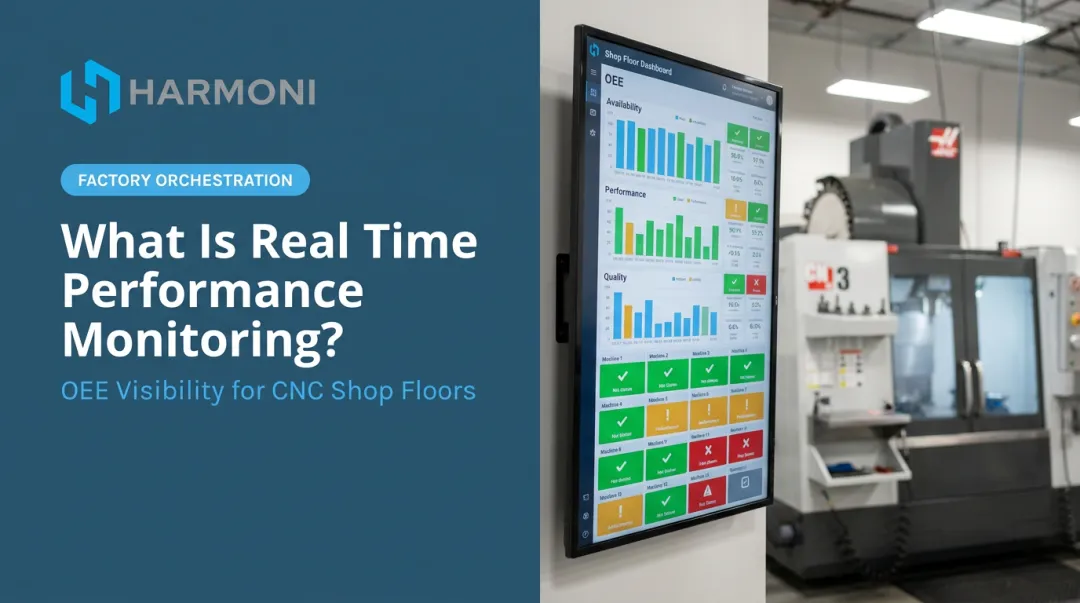
Visual Factory andon-style indicators on the shop floor reflect live OEE conditions — availability, performance, and quality — giving operators and supervisors immediate at-a-glance status without requiring a screen. Exception alerts route to managers, who can respond directly without physically walking the floor.

That is factory orchestration in practice: condition monitoring surfaces the problem, and the operational layer makes the response fast enough to protect the schedule.
Frequently Asked Questions
What is TBM and CBM in TPM?
TBM (Time-Based Maintenance) schedules service at fixed intervals regardless of equipment condition; CBM (Condition-Based Maintenance) triggers maintenance when monitoring data indicates it is needed. Both operate within the Total Productive Maintenance framework, with CBM generally delivering better efficiency for critical assets by responding to actual degradation rather than assumed wear patterns.
What is the difference between condition monitoring and predictive maintenance?
Condition monitoring is the data collection layer that continuously measures machine parameters and tracks change over time. Predictive maintenance is the broader strategy that uses that data to predict remaining useful life and prevent failures. As SKF defines it, predictive maintenance estimates the time before failure occurs; condition monitoring provides the evidence that estimate is built on.
What is online vs. offline condition monitoring?
Online monitoring continuously streams sensor data to a central platform in real time, enabling automated alerts and remote access , which is standard for critical assets. Offline monitoring captures data periodically using handheld tools or spot sensors, which suits lower-criticality equipment but cannot detect faults that develop between collection intervals.
What types of machines benefit most from condition monitoring?
Rotating equipment benefits most: motors, pumps, compressors, gearboxes, fans, and CNC spindles. The strongest candidates are machines that are critical to production flow, expensive to repair, or difficult to access for routine manual inspection — particularly bottleneck assets with no available redundancy.
How does machine condition monitoring reduce downtime?
By detecting degradation early, condition monitoring gives maintenance teams advance notice to schedule repairs during planned windows, source parts without rush costs, and avoid uncontrolled production stoppages. The fault does not disappear, but the response shifts from unplanned emergency to planned intervention.
What is the criticality index in condition monitoring?
The criticality index ranks each asset by its consequence of failure, factoring in production impact, redundancy availability, repair cost, and safety implications. Higher-criticality assets warrant continuous online monitoring; lower-criticality equipment is typically covered by periodic route-based inspection.