The term "smart factory" often gets framed around futuristic technology. The real value, though, shows up in everyday operations: fewer scrapped parts, operators who spend more time cutting metal and less time hunting for setup sheets, and managers who can see problems while they're still fixable.
This article breaks down the specific, measurable benefits of smart factories — and what manufacturers risk by delaying adoption.
Key Takeaways
- A smart factory connects machines, operators, and systems so decisions happen in real time, not after the shift ends
- Real-time visibility, error prevention, and operator efficiency compound — each one makes the others more effective
- Operators aren't replaced; they get better information and fewer low-value interruptions
- Without smart factory coordination, scrap, poor job costing, and inconsistent execution quietly erode margins
- Full value requires connecting machines, operators, and ERP workflows into one unified data layer
What Is a Smart Factory?
NIST defines smart manufacturing as "fully integrated, collaborative manufacturing systems that respond in real time to meet changing demands and conditions in the factory, in the supply network and in customer needs." In plain shop floor terms: a smart factory is one where machines, operators, and systems share data continuously, so decisions are made on live information rather than end-of-shift reports or gut instinct.
Smart factory principles apply across discrete manufacturing including CNC machining, aerospace, defense, automotive, and precision manufacturing — anywhere that variation, complexity, or compliance requirements make manual consistency difficult to sustain.
A smart factory is an operating model, not a technology upgrade. More connected machines are a means to an end. The actual goal is better outcomes: lower scrap, higher throughput, and job costs that reflect what production actually consumed.
Key technologies currently in use across U.S. manufacturers:
- 56% are currently implementing or using automation (Auburn ICAMS 2024)
- 46% of large manufacturers have deployed Industrial IoT (Deloitte 2025)
- 29% have implemented AI/ML at the facility level (Deloitte 2025)
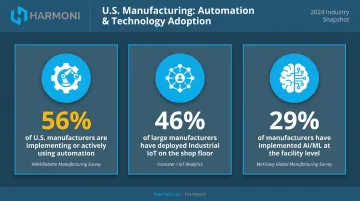
The infrastructure is already in place at a significant share of U.S. facilities. What varies is whether shops are translating that connectivity into measurable operational gains — and that gap is where the real benefits of smart factory operation emerge.
Key Advantages of Smart Factories
The advantages below are outcomes that show up in actual KPIs — tied to cost, quality, labor utilization, and risk. They're also interconnected: visibility enables error prevention, which reduces waste, which improves cost accuracy.
Advantage 1: Real-Time Visibility into Production Performance
In a traditional factory, production performance is understood after the fact — shift reports, end-of-day summaries, or when a defect surfaces at inspection. By that point, the window to intervene has already closed.
Smart factories replace this lag with a live view of what's happening on the floor. Sensors, machine data, and operator inputs are collected continuously and surfaced in unified dashboards showing machine utilization, job status, cycle times, and operator activity as they happen. Platforms like Harmoni's factory orchestration system bring machine data, ERP workflows, and operator activity together in a single view — giving production managers a command-level picture of operations as they unfold, not hours later.
Why it matters:
According to Fluke's 2025 research, 55% of U.S. manufacturers were hit by unplanned downtime in the past year, with capital impact reaching as much as $207 million weekly across the industry. Most of that cost isn't the downtime itself — it's the delay in detecting it.
Real-time visibility changes management posture from reactive firefighting to proactive correction. When a manager can see a job falling behind mid-shift, they can reassign resources, adjust scheduling, or flag an issue before it cascades into a missed delivery. The decision speed advantage is real: catching a problem at 10 a.m. leaves time to act. The same problem surfacing at shift end becomes a missed delivery and a customer conversation.
Coastal Machine and Supply demonstrated this concretely — machine monitoring boosted their five-axis utilization by 46%, according to Modern Machine Shop.
KPIs this advantage directly impacts:
- OEE (Overall Equipment Effectiveness)
- Machine utilization rate
- On-time delivery rate
- Production cycle time
- Labor visibility
When it matters most: High-mix, low-volume environments — common in aerospace and precision machining — where each job is different and a single missed step can trigger cascading quality or scheduling failures.
Advantage 2: Reduction of Production Errors and Scrap
Wrong tooling. Skipped operations. Incorrect setups. These are among the most expensive and persistent problems in precision manufacturing, and they share a common trait: by the time they're caught, the damage is done.
Smart factories reduce errors by enforcing process control at the point of execution — not just in planning documents. The right work instructions, tool lists, and engineering requirements are delivered directly to operators at each workcenter, tied to the specific job, machine, and operation step. The system prevents errors before they happen rather than catching them during final inspection.
The cost case:
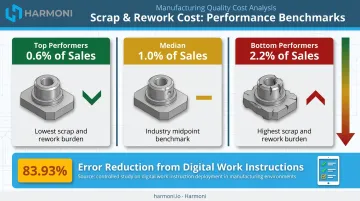
APQC benchmarking data shows median scrap and rework costs at 1.0% of sales and 5.0% of cost of goods sold. Top performers spend 0.6% of sales on scrap and rework; bottom performers spend 2.2%. That spread represents real margin — and it's almost entirely driven by execution consistency.
The cost of a scrap part extends far beyond the material itself. It includes machine time, operator time, rework labor, schedule disruption, and potential delivery failure. In aerospace and defense, where a quality escape can add $300,000 to $700,000 to a single aircraft program (per historical A&D industry data), the stakes are an order of magnitude higher.
Digital work instructions directly reduce error rates. An MDPI Applied Sciences study found that digital work instructions reduced assembly errors by 83.93% — from 56 total errors to 9 — while cutting assembly time by nearly 45%. External assistance requests dropped from 58% of steps to just 2%.
KPIs this advantage directly impacts:
- Scrap rate
- First-pass yield
- Rework costs
- Inspection failure rate
- Job cost variance
When it matters most: High-complexity, high-compliance environments — aerospace, defense, medical device — where a single nonconformance has outsized cost and schedule consequences.
Advantage 3: Elimination of Wasted Operator Time and Non-Productive Tasks
In most manufacturing environments, operators spend a meaningful portion of their shift on activities that don't add value: walking to shared ERP terminals to log time, searching for setup sheets, waiting for instructions, or manually recording quality data on paper. Individually, each task might cost 5–10 minutes. Across multiple operators and multiple shifts, that time adds up fast.
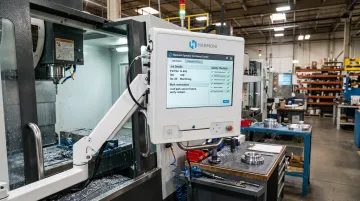
Harmoni's platform addresses this directly through its machine-side operator command center model. Using long-range RFID technology, the system automatically detects which operator is at which machine and which job is active — then triggers a chain of automated actions:
- Correct work instructions and setup sheets appear on the terminal screen automatically
- CNC programs are identified and available to load with a tap — no manual searching
- Labor time is logged directly at the machine, eliminating trips to shared terminals
- Digital quality checksheets replace paper forms, with real-time trend data visible to managers
A time study at WessDel, a Harmoni customer, found that each ERP transaction was taking operators an average of 11 minutes to complete — and operators were performing this task multiple times per shift. Eliminating that waste converted lost time directly into productive machining time, generating measurable ROI before any other benefits were counted.
Why this matters beyond throughput:
When operator activity is captured automatically, supervisors gain an accurate picture of where time is being spent. That visibility supports better scheduling, fairer workload distribution, and faster identification of bottlenecks tied to operator behavior versus machine constraints.
Automating manual steps also reduces cognitive burden — lowering error rates and improving consistency across shifts and workers.
KPIs this advantage directly impacts:
- Operator utilization rate
- Setup time per job
- Labor efficiency ratio
- Throughput per shift
- Job costing accuracy
When it matters most: Facilities with high operator headcount, multiple shifts, or high job changeover frequency — where time lost per operator per shift multiplies across the entire workforce.
What Happens When Smart Factory Principles Are Ignored
Operating without real-time visibility or process control has a compounding cost. Quality escapes go undetected until they reach inspection or the customer. Job costs are estimated rather than known. Supervisors spend their shifts reacting to problems instead of managing toward targets.
The specific symptoms manufacturers experience without smart factory coordination:
- Inconsistent execution across shifts — what one operator does well, another does differently, with no system enforcing the standard
- Rising scrap with no traceable root cause — because no real-time data was captured at the point of failure
- Reactive maintenance and scheduling — failures surface after production completes, when correction is no longer possible
- Inaccurate job costing — estimated hours and material usage rarely match actuals, making it impossible to price jobs correctly or identify which jobs are profitable
- Slow, inconsistent onboarding — when institutional knowledge lives in people's heads rather than systems, bringing new operators up to speed is unpredictable and error-prone
The workforce pressure makes that last point harder to ignore. With 1.9 million manufacturing jobs projected to go unfilled by 2033, the ability to onboard operators quickly and systematically — using documented systems rather than institutional knowledge — determines whether a shop can grow at all.
How to Get the Most Value from a Smart Factory
The full value of a smart factory is only realized when data, process enforcement, and operator coordination are connected across the operation, not siloed by department or technology type. Manufacturers who instrument machines but don't address operator workflows, or who deploy dashboards but don't act on what they show, capture only a fraction of the potential.
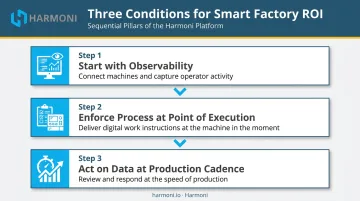
Three conditions that determine return:
Start with observability
Get real-time data flowing from machines and operators before layering on automation or process controls. You need to see what's actually happening before you can improve it consistently. This means connecting machines to live monitoring and capturing operator activity, not just running reports from your ERP.
Enforce process at the point of execution
Digital work instructions and job controls are only effective if they're surfaced at the workcenter in the moment the operator needs them, integrated with the specific job and machine. Instructions stored in a binder or a separate system require the operator to seek them out, and in practice they frequently won't.
Act on data at the cadence of production
A dashboard reviewed once a week doesn't drive operational change — the review cadence has to match the production cadence. Platforms that combine machine data, operator activity, and ERP context (like Harmoni's factory orchestration layer) enable managers to act on real information in real time rather than waiting for batch reporting cycles. Harmoni deploys in weeks with no machine replacement required, connecting to existing CNC controls and integrating with major ERP systems including Epicor, Infor, JobBoss, ABAS, and ODOO.
Conclusion
The benefits of smart factories show up where it counts: OEE, scrap rates, job costing accuracy, and throughput. Real-time visibility, reduced errors, and eliminated operator downtime aren't abstract goals — they're measurable outcomes that get stronger as your shop builds consistent, data-driven habits.
Smart factory adoption isn't a one-time implementation. The manufacturers who see the greatest return treat it as an ongoing discipline — reviewing production data regularly, enforcing process standards, and acting on the variance between planned and actual performance before it compounds into missed margin.
If you want to see what this looks like on your shop floor, request a free demo.
Frequently Asked Questions
What are the benefits of a smart factory?
Smart factories deliver real-time visibility into production, reduced errors and scrap through process control at the point of execution, elimination of non-productive operator time, and improved job costing accuracy. The compounding benefit is that problems are identified and corrected while production is still running — not after the fact.
How does a smart factory differ from a traditional factory?
Traditional factories rely on end-of-shift data, manual processes, and reactive problem-solving. Smart factories connect machines, operators, and systems in real time, enabling proactive decisions, consistent execution across shifts, and accurate performance tracking throughout production rather than after it.
What is the primary goal of a smart factory?
The primary goal is coordinating people, machines, and systems to eliminate waste, prevent errors, and give manufacturers real-time control over shop floor operations — ultimately improving output quality, labor efficiency, and profitability.
How long does it take to see results from smart factory investments?
Results vary by scope, but manufacturers who focus on observability and process control first often see measurable improvements in scrap rates and operator utilization within weeks. Platforms designed for fast deployment, like Harmoni, can be live in existing environments in weeks.
What role do operators play in a smart factory?
Operators remain central. Smart factory technology eliminates low-value administrative tasks — manual time logging, paper quality forms, and hunting down setup documentation — and delivers better information at the point of work, so operators can focus on skilled execution rather than navigating disconnected systems.
Do smart factories require replacing existing ERP or MES systems?
No. A factory orchestration layer sits between ERP, MES, machines, and operators, improving how those systems work together without requiring replacement. Harmoni integrates with existing ERP systems and CNC controls, retrofitting to current equipment regardless of age or manufacturer.