
A smart factory is the answer to that disconnect. It combines real-time data, connected machines, and coordinated software so problems surface while they're happening, not after the invoice goes out. This article breaks down what a smart factory actually is, how it differs from "smart manufacturing" and Industry 4.0, the core technologies that make it work, real examples from discrete manufacturers, and where to start if you're building one.
Key Takeaways
- A smart factory connects machines, operators, and software so decisions happen in real time.
- Smart factory, smart manufacturing, and Industry 4.0 describe a place, a method, and an era.
- IIoT sensors, AI, cloud computing, and digital twins matter, but connecting ERP, MES, and machines matters just as much.
- Starting with a focused pilot beats a plant-wide overhaul for faster, measurable ROI.
What Is a Smart Factory in Manufacturing?
A smart factory is a digitized, highly connected production facility where equipment, software, and operators continuously exchange data to monitor, analyze, and improve operations as they happen. Rather than a single piece of technology, it's an operating environment where machine performance, quality data, and labor activity flow into one system instead of living in separate silos.
Deloitte's widely cited framework describes five traits that define a smart factory (Deloitte, 2017):
- Connected — sensors and systems keep data current across machines, software, and people
- Transparent — real-time visualization turns raw data into visible, usable insight
- Proactive — teams anticipate maintenance and quality issues before they cause downtime
- Optimized — synchronized workflows reduce manual intervention and rework
- Agile — production adapts to schedule or product changes with minimal disruption

Compare that to a traditional shop floor. Reports are retrospective. Machine logs get reviewed at end of shift, if at all. ERP records reflect what a supervisor typed in hours after a job finished, not what actually happened at the spindle. A smart factory closes that gap with a live, cyber-physical feedback loop instead of a paper trail.
Why It Matters for Discrete and Precision Manufacturers
CNC machining shops, aerospace suppliers, defense contractors, and automotive parts makers face pressure points that generic manufacturing advice doesn't address. Tight tolerances leave no room for undetected drift, and complex job costing depends on knowing exactly how long a part actually took, not an estimate.
Coordinating dozens of machine types across a mixed fleet makes manual tracking nearly impossible at scale.
That pressure is showing up in how executives think about the future. In a Deloitte and MAPI survey of more than 600 manufacturing executives, 86% expected smart-factory initiatives to be the main driver of manufacturing competitiveness over the following five years (Deloitte/MAPI, 2019). That's not a fringe opinion anymore. It's close to consensus among the people running these plants.
For a job shop juggling Mazak, Haas, and Fanuc-controlled machines side by side, the case for real-time visibility isn't theoretical. It's the difference between quoting accurately and guessing.
Smart Factory vs. Smart Manufacturing vs. Industry 4.0
These three terms get used interchangeably, but they describe different things.
| Term | What it means | Scope |
|---|---|---|
| Smart factory | A specific, connected physical facility where equipment and systems exchange real-time data | Single plant or site |
| Smart manufacturing | The broader connected methodology and strategy applied across production, supply chain, and demand | Company or network |
| Industry 4.0 | The overarching technological era defined by cyber-physical systems and industrial IoT | Industry-wide paradigm |
NIST defines smart manufacturing as "fully-integrated, collaborative manufacturing systems that respond in real time" not just on the factory floor but across the supply network and customer demand. The World Economic Forum frames Industry 4.0 as the connected-production paradigm that makes all of this possible in the first place.
A simple way to remember it: Industry 4.0 is the era. Smart manufacturing is the approach. A smart factory is the place where that approach gets applied.
Platforms like Harmoni's factory orchestration software operate at that smart-factory layer, connecting machines, operators, and ERP systems in real time on the shop floor.
There's also a newer layer worth knowing: Industry 5.0. The European Commission describes it as a complement to Industry 4.0, one that adds human-centricity, sustainability, and resilience to the approach. The goal is technology that supports and empowers workers rather than replacing them, keeping machinists directly involved in daily operations.
How Does a Smart Factory Work? Core Technologies Explained
At its simplest, a smart factory runs on a loop: sensors and machines capture data, analytics and AI turn that data into insight, and automated systems or operators act on it. Then the loop repeats, continuously refining how the plant runs.
Industrial IoT and Connected Sensors
This is the connectivity foundation. Sensors on CNC equipment, PLCs, and machine controllers capture performance, downtime, and quality data as it happens, rather than waiting for an end-of-shift report. Without this layer, everything downstream (analytics, dashboards, alerts) has nothing to work with.
AI, Machine Learning, and Big Data Analytics
Raw sensor data doesn't mean much on its own. AI and machine learning models convert it into:
- Predictive maintenance alerts before a spindle fails
- Quality anomaly detection that flags drift before parts go out of tolerance
- Process optimization recommendations based on actual cycle patterns
Cloud Computing and Digital Twins
Cloud infrastructure gives teams scalable access to production data from anywhere, not just from a terminal on the shop floor. Digital twins take it a step further, letting engineers simulate a process change or new fixture setup virtually before touching the physical line.
The Missing Layer: Orchestrating People, Machines, and Systems
Here's where most smart factory initiatives stall. Companies invest in sensors, dashboards, and even MES platforms, but ERP data, machine data, and what operators do on the floor stay disconnected from each other. A machine can report it's running while the ERP still shows the wrong job open, because nobody built the layer that keeps them in sync.
This is the gap that factory orchestration addresses. Harmoni, a pioneer of this category, sits between ERP systems, MES, machines, and operators to coordinate all four in real time. Instead of replacing existing ERP or MES systems, it connects them to what's actually happening at each machine.
Benefits and Real-World Examples of Smart Factories
The core benefits manufacturers report after adopting connected shop-floor technology include:
- Reduced downtime through early detection of machine issues
- Fewer production errors caught before parts leave the machine
- Improved labor visibility across shifts and work centers
- Stronger accountability for job status and delays
- Accurate job costing based on actual machine and labor time, not estimates
Independent evidence backs this up. CITIC Dicastal's automotive-parts plant in Morocco deployed more than 40 digital use cases, including AI-enhanced vision inspection and predictive mold maintenance. The result: a 17% improvement in OEE, a 27% increase in labor productivity, and a 31.1% reduction in defects (World Economic Forum, 2025).

What This Looks Like on a Real Shop Floor
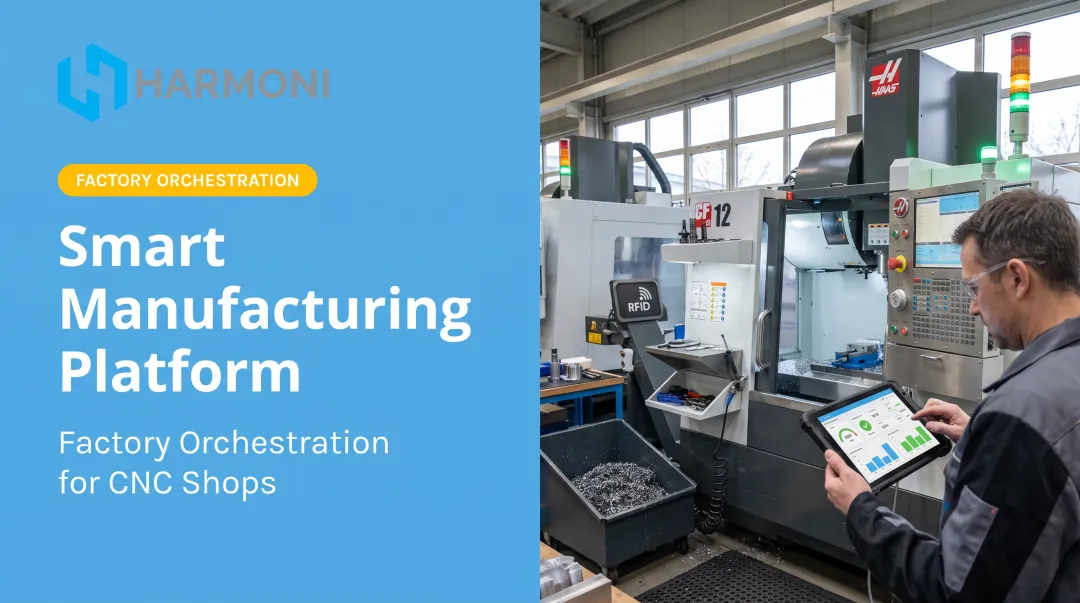
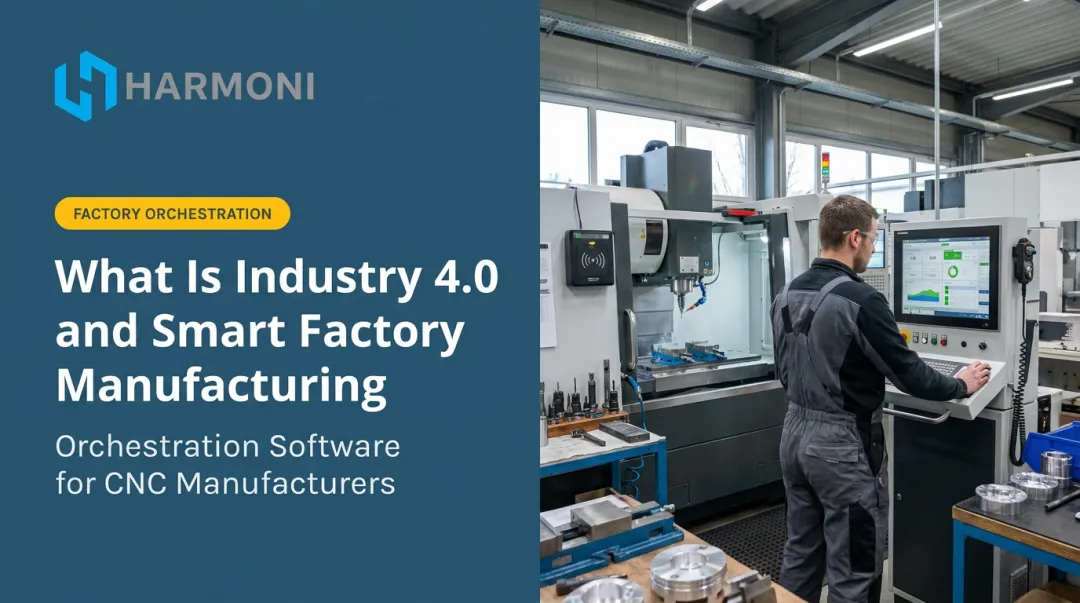
Picture a precision machining shop where RFID-enabled workstations automatically detect which operator and which job are present at a machine. There's no shared terminal, no walking back and forth to clock in. Machines feed real-time status straight to dashboards, and supervisors see performance across every work center without leaving their desk.
This isn't hypothetical. WessDel, a beryllium and titanium alloy shop making aerospace and satellite components, implemented Harmoni's RFID-enabled system and cut ERP transaction time from 11 minutes down to seconds.
That freed up 17 productive hours per employee, per month and delivered a 5X return on ongoing costs with no upfront implementation fee. Delinquent jobs dropped 10%.
At Machine Specialties, Inc. (MSI), a 300-employee aerospace and defense manufacturer, integrating Harmoni with Epicor ERP eliminated paper travelers and nearly eliminated part count errors on high-risk components. The integration also gives managers real-time visibility through status lights across the floor.
Common Adoption Challenges
Most manufacturers hit a few predictable obstacles:
- Data silos: adding more software without connecting it creates new isolated pockets instead of one shared source of truth
- Legacy machine integration: older CNC equipment wasn't built for modern connectivity and often needs a gateway rather than a replacement
- Workforce training: operators and engineers need time to adjust to new workflows, and IT/OT skills gaps are common
Building Toward Your Own Smart Factory: Where to Start
You don't need a plant-wide overhaul to see results. Start smaller and prove value fast.
- Run a baseline assessment. Identify exactly where ERP, MES, machine, and operator data don't talk to each other before layering on advanced analytics or AI.
- Pilot one work center or cell. A single production cell, especially one with a mix of CNC machine types, proves out the approach without disrupting the whole shop.
- Choose a platform built to connect, not replace. Harmoni retrofits to existing machines regardless of age or brand, integrates with ERPs like Epicor, JobBoss, Infor, ABAS, and ODOO, and typically deploys within weeks.

For mid-to-large manufacturers in CNC machining, aerospace, defense, and automotive, real-time visibility without ripping out existing systems is often the fastest path from disconnected data to a coordinated shop floor.
Frequently Asked Questions
How does a smart factory work?
Sensors and machines generate real-time data, analytics or AI interpret that data for patterns and anomalies, and automated systems or operators respond immediately. This loop repeats non-stop, sharpening decisions as more data comes in.
What is the difference between smart factory and smart manufacturing?
Smart manufacturing is the broader connected methodology applied across production, supply chain, and demand. A smart factory is the physical facility where that methodology gets implemented.
What is an example of a smart factory?
A connected CNC shop shows this model in action. RFID-enabled workstations identify operators and jobs automatically, and machines report live status straight to shop floor dashboards that supervisors monitor in real time.
What technologies are used in a smart factory?
Core technologies include IIoT sensors, AI and machine learning, cloud computing, digital twins, and an orchestration or MES layer that connects ERP, machines, and operators together.
What are the benefits of a smart factory?
Manufacturers typically see reduced downtime, fewer production errors, better labor visibility, stronger accountability, and more accurate job costing based on real data instead of estimates.
How long does it take to build a smart factory?
A full transformation timeline depends heavily on site readiness and scope, so there's no universal number. A focused, single-cell pilot, however, can show measurable results within weeks rather than years.