By 2030, 2.1 million U.S. manufacturing jobs could go unfilled, according to the National Association of Manufacturers, making the labor gap one of the industry's most pressing problems.
Industry 4.0 and smart manufacturing emerged as the response to exactly these pressures. This article breaks down what the term actually means, where it came from, the technologies driving it, and the benefits and roadblocks manufacturers face when adopting it.
Here's the catch many manufacturers run into: they invest in IoT sensors, AI tools, and robotics individually, but still can't connect them into one coordinated system on the shop floor. We'll get to why that happens, and what closes the gap.
Key Takeaways
- Industry 4.0 merges IoT, AI, robotics, and big data into connected "smart factories"
- Core technologies include IIoT, AI/ML, robotics, analytics, edge computing, and digital twins
- Smart factories pair automation with real-time visibility to boost quality and efficiency
- Real payoff comes from connecting ERP, MES, machines, and operators in real time
What Is Industry 4.0? Definition, History, and Why It Matters
Industry 4.0 is the fourth industrial revolution. It integrates data, automation, and connected technology so manufacturers can make real-time decisions across production and supply chains. The term is often used interchangeably with "smart manufacturing," though the two aren't identical (more on that below).
German industry and government leaders coined "Industrie 4.0" and introduced it at Hannover Messe in 2011. It described a shift toward cyber-physical systems: intelligent technical systems built from electronics, software, and mechatronics working together. The concept went global in 2016, when Klaus Schwab and the World Economic Forum made it the theme of that year's Davos meeting.
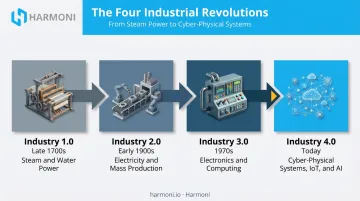
From Steam Power to Cyber-Physical Systems: The Four Industrial Revolutions
Manufacturing has moved through four distinct eras:
- Industry 1.0 (late 1700s): Water and steam-powered mechanization, marked by inventions like the mechanical loom in 1784
- Industry 2.0 (early 1900s): Electricity and division-of-labor mass production, epitomized by the first assembly line around 1870
- Industry 3.0 (1970s): Electronics and computing automate production, starting with the first programmable logic controller in 1969
- Industry 4.0 (today): Cyber-physical systems, IoT, and AI-driven decisions layered on top of everything before it
The speed of change is what truly sets the fourth revolution apart. According to acatech's foundational Industrie 4.0 report, the IT revolution transformed the world more radically in a few decades than the previous 200 years combined. Where earlier shifts took generations to spread across factories, Industry 4.0 technologies are being adopted and iterated on in years, sometimes months.
Industry 4.0 vs. Smart Manufacturing vs. Smart Factory
These three terms get used loosely, but they describe different layers of the same idea:
- Industry 4.0 is the broad movement and philosophy: the "what" and "why"
- Smart manufacturing is the applied strategy a company builds to get there: the "how"
- Smart factory is the physical facility where that strategy runs day to day
The defining shift underneath all three is a move from mass production toward mass customization. Manufacturers increasingly chase an economical "lot size of one" — building a single custom unit as efficiently as they once built a thousand identical ones.
Core Technologies Powering Industry 4.0 and Smart Manufacturing
None of these technologies work in isolation. A smart factory is only "smart" because these pieces talk to each other in real time.
Internet of Things (IoT/IIoT): Sensors embedded in machines and devices communicate constantly, giving plant managers continuous monitoring and control across the floor. Today, roughly a third of manufacturers already use IIoT data specifically to improve plant floor processes.
AI and machine learning: These process shop-floor data for predictive maintenance, automated quality inspection, and process optimization. Computer vision handles visual defect detection; natural language processing supports things like voice-driven work instructions. Together they turn raw sensor noise into decisions.
Robotics and automation: Simple repetitive-task robots still dominate many floors, but the category is splitting into two tiers:
- Traditional robots that repeat fixed motions
- AI-enabled robots that adapt to changing conditions in real time
- Robotic process automation (RPA) that makes rule-based decisions without human input
Big data, analytics, and edge computing: Modern sensors generate more data than centralized servers can process fast enough. Edge computing solves this by processing data closer to where it's generated, cutting latency for time-sensitive operations like CNC control loops.
Digital twins: A digital twin is a virtual replica of a physical asset or process, used to simulate changes before making them on the real machine.
Cybersecurity: As connectivity expands, so does exposure. Manufacturing is now the most targeted industry for cyberattacks, which makes IT-OT security a core design requirement, not an afterthought.
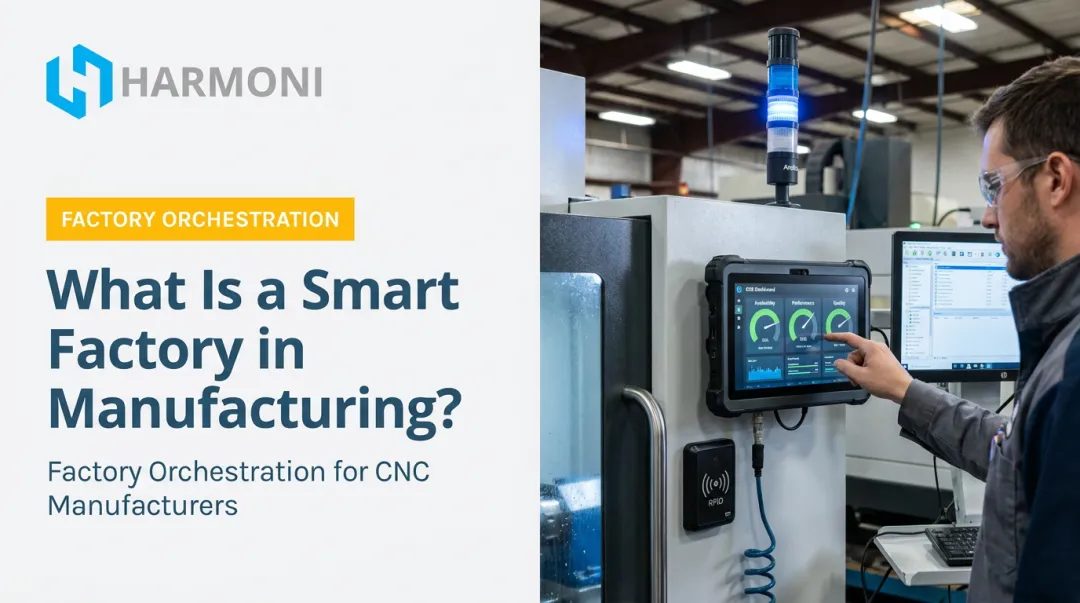
Platforms like Harmoni's factory orchestration layer coordinate these technologies in practice, pulling IIoT data, RFID job identification, and machine signals into one real-time view for the shop floor.
Key Characteristics of a Smart Factory
Strip away the buzzwords, and a smart factory boils down to three characteristics working together:
- Interconnected systems: Machines talk to each other, and to the enterprise systems above them, so IT and OT stop operating as separate worlds.
- Data-driven decision-making: Real-time visibility catches problems while they're happening, not during next week's report review. A spindle running hot or a part drifting out of tolerance triggers immediate action.
- Flexible, adaptive production: The facility switches between product variants and responds to demand swings without lengthy retooling, making lot-size-of-one production economically viable instead of a novelty.
Benefits and Challenges of Industry 4.0 Adoption
Benefits Manufacturers Are Seeing
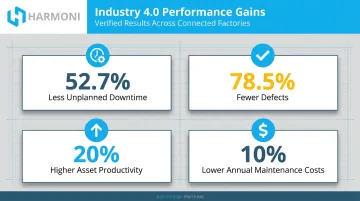
The efficiency gains are real, and they're measurable. Predictive maintenance alone drives some of the biggest wins:
- 52.7% less unplanned downtime on average, based on NIST-surveyed manufacturers
- 78.5% fewer defects among the same survey group
- Up to 20% higher asset productivity and 10% lower annual maintenance costs, per McKinsey's research
AI-driven quality inspection compounds these gains further. McKinsey's research on discrete manufacturing documents Jabil Circuit achieving a 10% production yield increase and a 60% reduction in manual-assembly quality issues after implementing smart manufacturing practices. Beyond defect catching, manufacturers report better labor visibility, tighter accountability, and real cost savings from reduced waste and fewer manual workflow steps.
Common Implementation Challenges
The gains don't come free. Manufacturers consistently run into the same roadblocks:
- High upfront investment, with unclear ROI timelines that make budget approval difficult
- Pilot-to-scale failure: plenty of companies run a successful pilot but can't translate it into a plant-wide rollout
- Legacy system integration, since many shops still run older machines connected to unsupported software
- Workforce skills gaps: nearly half of manufacturers report moderate to significant difficulty filling production roles
- Rising cybersecurity risk as connectivity expands attack surfaces across previously isolated equipment
Bridging Industry 4.0 Strategy and Shop-Floor Execution
Here's the gap most manufacturers hit after the initial rollout: they've bought the ERP upgrade, deployed MES, and installed IoT sensors exactly as the Industry 4.0 roadmap suggested. Yet the shop floor still runs on paper travelers, manual clock-ins, and disconnected spreadsheets. The data exists. It just doesn't talk to itself.
This is the space factory orchestration was built to fill. It's an emerging software layer that sits between ERP, MES, machines, and operators, coordinating all four in real time instead of leaving that coordination to whoever's walking the floor that shift.
Harmoni is one example of this approach in practice. The platform uses long-range RFID to automatically detect which operator is at which machine, working on which job, then combines that with live machine data and ERP workflows into a single dashboard.
Instead of an operator walking to a shared terminal to clock in and log a transaction, that identification happens automatically at the machine.
Harmoni's platform is built around three pillars:
- Automation — RFID-driven workflow automation, native ERP integration, and automated CNC program loading
- Process control — digital work instructions, engineering revision control, and digital quality checksheets
- Observability — real-time OEE monitoring and shop floor dashboards
The results show up quickly:
- WessDel, a beryllium and titanium aerospace shop, recovered 17 productive hours per employee per month and cut delinquent jobs by 10%, according to the company's published case study
- Machine Specialties, Inc., running CNC machining, aerospace, defense, and medical work, nearly eliminated part-count errors and gave managers real-time visibility they'd never had on paper
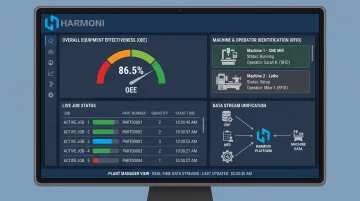
What makes this approach practical rather than aspirational: orchestration platforms like Harmoni typically deploy in weeks, not the months or years often associated with full ERP or MES overhauls, because they retrofit onto existing machines rather than replacing them.
Frequently Asked Questions
What is Industry 4.0 and smart manufacturing?
Industry 4.0 is the fourth industrial revolution, built on cyber-physical systems, IoT, and AI. Smart manufacturing describes the practical strategy companies use to apply those technologies on the actual factory floor.
What are Industry 4.0 technologies for manufacturing?
The main categories are IoT/IIoT, AI and machine learning, robotics, big data analytics, edge computing, and digital twins. Together, they let factories monitor, analyze, and adjust operations in real time.
What is the difference between Industry 4.0 and Industry 5.0?
Industry 4.0 focuses on automation and connectivity across production systems. Industry 5.0 builds on that foundation by adding a human-centric, sustainability-focused layer, emphasizing worker wellbeing alongside efficiency.
What is a smart factory, exactly?
A smart factory is a facility where interconnected systems, sensors, and analytics work together so production decisions happen in real time. It's the physical environment where Industry 4.0 principles actually run.
What are the biggest barriers to adopting Industry 4.0?
The most common barriers are high upfront investment, integrating legacy machines and software, and workforce skills gaps in operating new digital tools. Cybersecurity risk is a close fourth as connectivity expands.
How does factory orchestration fit into Industry 4.0?
Factory orchestration connects existing ERP, MES, and machine investments in real time, rather than replacing them. Platforms like Harmoni serve as this execution layer, helping manufacturers realize the shop-floor benefits Industry 4.0 promises on paper.