That's where things get confusing. CNC and DNC sound almost identical, yet they operate at completely different levels of control. One governs a single machine. The other governs an entire shop floor. Preventable maintenance and downtime issues cost U.S. manufacturers an estimated $119.1 billion in 2016 alone, according to NIST research on manufacturing machinery maintenance, with $18.1 billion tied directly to downtime.
This guide breaks down what CNC and DNC actually mean, where they differ, and how the concept of DNC has grown into something much bigger: factory orchestration.
Key Takeaways
- CNC automates a single machine tool using pre-programmed commands stored locally.
- DNC connects multiple CNC machines to a central server for shared program management.
- Scale is the core distinction: CNC is one-to-one, DNC is one-to-many.
- Factory orchestration builds on DNC to unite machines, people, and ERP systems in real time.
CNC vs. DNC: A Quick Comparison
Before diving into definitions, here's a side-by-side look at how these two systems stack up across the factors that matter most on a shop floor.
| Aspect | CNC | DNC |
|---|---|---|
| Control Scope | Controls a single, individual machine | Manages and communicates with a network of multiple CNC machines |
| Program Storage | Stored locally on the machine's controller memory | Stored centrally on a remote server |
| Connectivity | Can operate standalone, often via USB or manual transfer | Requires a network connection (RS-232, Ethernet) between server and machines |
| Primary Function | Executes machining instructions and automates movement | Manages, transfers, and backs up programs with version control |
| Scalability | Limited; management gets harder with each new machine | Highly scalable across a growing machine count |
Notice the pattern? CNC handles execution on a single machine, while DNC handles coordination across many. Both matter, but they solve different problems.
What is Computer Numerical Control (CNC)?
CNC is the automation of machine tools through computers that execute pre-programmed sequences of commands. It replaced manual control and the older punched-tape NC systems that preceded it, giving machinists a way to run precise, repeatable jobs without constantly adjusting handwheels. FANUC describes CNC as software that automates a cutting process's control, movement, and precision.
That automation delivers three concrete benefits on the shop floor:
- Precision and repeatability — reduces human error and keeps product quality consistent from the first part to the thousandth.
- Complexity — enables geometries that would be nearly impossible to cut by hand.
- Efficiency — speeds up production cycles compared to manual machining, especially on repetitive runs.
From CAD Model to Cut Metal
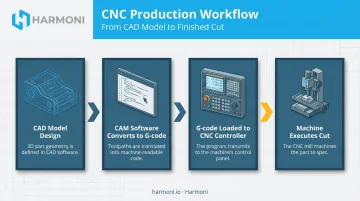
A typical CNC workflow follows a straightforward path: a CAD model gets converted into G-code through CAM software. That G-code is then loaded onto the CNC machine's controller, which runs the job step by step. It's a closed loop: one machine, one program, one operator making sure the setup is correct.
The catch? This works beautifully for a single machine, but it gets messy fast once you're running five, ten, or fifty of them.
What is Direct/Distributed Numerical Control (DNC)?
DNC actually carries two distinct meanings, and mixing them up causes real confusion on the shop floor.
- Direct Numerical Control: "Drip-feeding" a large program from a computer to a CNC machine block-by-block, used when the machine's memory can't hold the entire file at once.
- Distributed Numerical Control: The more common modern meaning: a network connecting a group of CNC machines to a central server for program storage and delivery.
Modern Machine Shop notes that drip-feeding should be treated as a last resort, since restart complications can occur if the connection drops mid-run.
The Problem DNC Solves
Before DNC, shops relied on physically carrying programs to machines on floppy disks, USB drives, or memory cards. This process was slow and error-prone: the wrong file or an outdated revision could end up running on the wrong job.
A 1997 Modern Machine Shop case study documented one drive-train facility's move away from punched-tape handling toward disk-based DNC management for exactly this reason.
DNC brought three core improvements:
- Centralized program management: one secure location, no duplicate or outdated files floating around.
- Improved security and revision control: prevents unauthorized changes and keeps a clear audit history.
- Increased uptime: operators call up programs directly at the machine instead of waiting on a programmer.
Here's how it works in practice: an operator at the machine requests a program by name or job number. The DNC software retrieves it from the central server and sends it to the controller over the network. No walking, no searching, no guesswork.
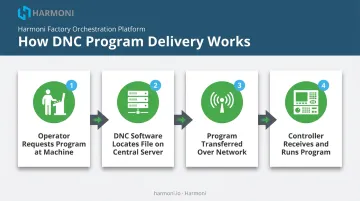
Modern factory orchestration platforms build on this idea. Harmoni, for example, uses RFID to automatically identify the operator and job, then loads the correct program and tool data at the machine.
When to Choose CNC vs. DNC
Choosing between CNC and DNC depends on your shop's operational maturity: what fits your operations right now, not which technology is inherently superior.
Stick with standalone CNC when:
- You're running a small shop with one or two machines.
- Jobs are simple, programs are small, and changes happen rarely.
- Upfront cost is the biggest concern and networking infrastructure isn't in place yet.
Upgrade to DNC when:
- You've got multiple CNC machines and program version control is becoming a real headache.
- You need to run large, complex programs that exceed a machine's onboard memory.
- Security, process control, and a single source of truth for programs have become priorities.
The tipping point usually shows up gradually: a missed revision here, a machine running an outdated program there.
McKinsey research on Industry 4.0 adoption points to downtime reductions of 30% to 50% in connected manufacturing environments, a range that starts to look appealing once you're managing more than a handful of machines by hand.
Modern factory orchestration platforms, including Harmoni, build on that same DNC foundation, adding automated program loading, revision control, and real-time visibility across every connected machine.
The Evolution from DNC to Factory Orchestration
DNC solved a real problem: getting the right program to the right machine. But that's still just file transfer. Competitive manufacturing today needs more than delivery. It needs visibility.
Traditional DNC systems have real limits:
- They're typically one-way, sending files from server to machine with little coming back.
- Real-time performance data, such as cycle times, downtime, and alarms, rarely gets captured.
- Operator activity, setup time, quality checks, and ERP connections are treated as afterthoughts.
Deloitte's 2025 Smart Manufacturing survey found that 78% of surveyed manufacturing executives now allocate more than a fifth of their improvement budgets to smart manufacturing initiatives. That's a clear signal: file transfer alone isn't enough anymore.
What Factory Orchestration Adds
Factory orchestration is the next step past DNC. It coordinates people, machines, and enterprise systems in real time, rather than just moving files between them.
This is the space Harmoni operates in. The platform builds on DNC's foundation but goes further:
- Secure program transfer works the way a DNC system does, while also pulling rich performance data back from the machine.
- RFID-based job identification links machine data to operator activity and ERP workflows, giving every job full context: who ran it, what program, and what happened during the cycle.
- Matching program, work instructions, and part revision to each job happens automatically, catching mismatches before they turn into scrapped parts.
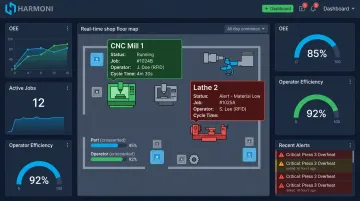
The practical result is real-time visibility into shop floor performance, more consistent execution across shifts, and errors caught before material gets cut, not after. That's a meaningfully different outcome than a DNC system that simply moved a file from point A to point B.
If you're curious what that looks like on your own floor, Harmoni's demo walks through the setup with your existing machines, no replacement hardware required.
Frequently Asked Questions
What does DNC stand for in CNC machining?
DNC stands for either Direct Numerical Control or Distributed Numerical Control. Direct DNC streams a program in real time from an external computer, while Distributed DNC transfers files to and from a machine's local memory over a network.
What is the difference between CNC, NC, and DNC?
NC (Numerical Control) relied on punched tape to direct machine movements. CNC (Computer Numerical Control) added an onboard computer to run a single machine. DNC (Distributed Numerical Control) networks many CNC machines together under one central system.
Can CNC machines work without DNC?
Yes. CNC machines can run as standalone units, with programs loaded manually via USB or other removable media. DNC isn't required, but it adds real efficiency and stronger version control once you're managing multiple machines.
What is "drip-feeding" in a DNC system?
Drip-feeding sends a large CNC program from a computer to the machine one block at a time. It's necessary when the program is too big to fit in the machine's internal memory all at once.
Is DNC still relevant in the age of Industry 4.0?
Absolutely. DNC remains the foundational connectivity layer for Industry 4.0, providing the data flow that modern machine monitoring and factory orchestration platforms depend on to function.