Introduction
Most manufacturers today have invested in ERP systems, IoT sensors, and digital tools. Yet many still can't answer a basic question in real time: What is actually happening on my shop floor right now?
That gap is what this post addresses directly.
The issue isn't a shortage of data. Modern facilities generate enormous volumes of it — from CNC machines, production systems, and operators at every workcenter. The problem is that this data lives in silos: machines, ERP records, spreadsheets, and paper travelers, fragmented in ways that prevent timely decisions.
This post covers what manufacturing visibility actually means, why it matters more than ever, the four dimensions that define it, why most manufacturers still fall short, and what genuine visibility looks like in practice.
Key Takeaways:
- Manufacturing visibility is an operational state — not a single tool or dashboard
- Historical reporting and ERP job statuses are not the same as real-time visibility
- Four dimensions must connect: machine status, operator activity, job progress, and process quality
- 70% of manufacturers still rely on manually entered data as a primary source, per the Manufacturing Leadership Council
- Visibility gaps drive scrap, missed deadlines, and inaccurate job costing — all correctable problems
What Is Manufacturing Visibility?
Manufacturing visibility is the ability to monitor, track, and understand what is happening across the production environment in real time — from machine status and operator activity to job progress, quality outcomes, and resource utilization. It's an operational state — not a single tool or dashboard — where production data reaches the people who need to act on it, fast enough to matter.
Two forms of partial visibility are common, and neither is sufficient:
- Historical reporting — dashboards showing what happened last shift or last week. Useful for trend analysis, useless for catching a problem that's happening right now.
- System-level data in ERP or MES — information that technically exists but never reaches the shop floor in a form operators or supervisors can act on.
What Visibility Actually Requires
True manufacturing visibility requires data from three sources to work together:
- Machines — cycle times, status, output rates, downtime events
- Operators — who is at which workcenter, on which job, doing what
- Business systems — ERP schedules, job targets, cost standards
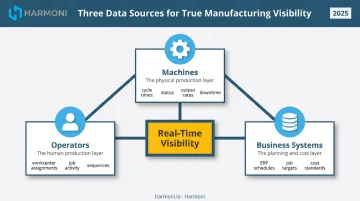
Each layer alone is incomplete. Machine uptime data without operator context can't explain why a machine went idle. Job schedule data without actual cycle time can't confirm whether a delivery commitment is achievable.
Observability vs. Monitoring
Monitoring tells you a machine is running. Observability lets you understand the internal state of your operation from the signals you can see — a meaningful difference in practice.
Consider this scenario: a job is marked "in progress" in the ERP. But on the floor, the machine has been idle for two hours — an operator is waiting on setup instructions that never arrived. Under most current systems, that job is invisible as a problem. It shows green in every report. Under true manufacturing visibility, that gap surfaces immediately.
Manufacturing visibility also differs from supply chain visibility. Supply chain visibility tracks materials and shipments across the broader supplier network — a separate problem entirely.
Shop floor visibility focuses on what's happening inside the four walls of a facility, where decisions are made in minutes, not days.
Why Manufacturing Visibility Matters More Than Ever
The cost of blind spots has grown. NIST research estimated $18.1 billion in annual U.S. manufacturing losses from unplanned downtime alone — and found that establishments in the highest quartile of reactive-maintenance reliance had 3.3x as much downtime and 16x as many defects as those in the lowest quartile.
In precision manufacturing, aerospace, and defense, a quality escape caught after the fact doesn't just mean scrap — it can mean shipping non-conforming parts. A DoD Inspector General audit found the Air Force was unable to recover $3 million for defective parts and paid approximately $200,000 for repairs that should have been covered under contractor warranty. Those are downstream consequences of problems that weren't caught during production.
The Competitive Pressure
Customers expect shorter lead times and on-time delivery. Manufacturers face tighter margins. Without visibility:
- Capacity planning relies on assumptions rather than facts
- Scheduling is built on stale ERP data, not what's actually happening on the floor
- Supervisors spend their day firefighting problems that were already past the point of correction
The pattern is predictable: over-scheduling, missed deadlines, emergency overtime — each one compounding the next.
Visibility and Accountability
Those compounding pressures don't resolve on their own — they need a different operating model. When operators, supervisors, and managers share the same real-time data, problems surface faster and ownership becomes clearer. Gaps get addressed while they're still correctable, not after a shift report reveals the damage. That's the difference between reacting to yesterday's production and actually managing today's.
The Four Dimensions of Real Manufacturing Visibility
Dimension 1 — Machine Visibility
Real-time knowledge of machine status — running, idle, in setup, in fault — along with cycle times and output rates. A machine that appears "scheduled" in the ERP may be sitting idle due to a tooling issue or waiting for material. Without machine-level visibility, planners are working from assumptions.
CNC machine data collection is the foundation here. Platforms like Harmoni connect directly to major CNC controls — Mazak, Haas, Fanuc, Heidenhain, Siemens, DMG MORI, Makino, and Fadal — to surface status and cycle data automatically, without requiring operators to manually log anything.
Machine Specialties, Inc. (MSI), a high-precision aerospace and defense manufacturer, made a telling operational shift after implementing Harmoni: they moved from tracking only spindle time to tracking earned hours — a more meaningful measure of actual job profitability.
Dimension 2 — Operator Visibility
Knowing which operators are at which workcenters, what jobs they're running, how long they've been active, and whether they're following standard work sequences. It's also the layer most manufacturers can't see — because most tools are built around machines, not the people running them.
Most tools capture machine data. Very few capture the human activity that directly shapes quality and throughput.
Consider what this gap costs. WessDel, a precision aerospace machine shop, discovered through formal time studies that each ERP transaction took operators an average of 11 minutes to complete — time spent walking to shared terminals rather than running parts. After implementing Harmoni's RFID-based operator identification, that same transaction dropped to seconds, recovering 17 productive hours per employee per month.
Operator visibility also enables accurate job costing. When labor time is captured automatically at the point of production and linked to specific jobs and machines, actual cost versus quoted cost becomes a live metric — not an end-of-month reconciliation exercise.
Dimension 3 — Job and Work Order Visibility
Real-time tracking of where each job stands against its schedule — not just its ERP status, but its physical location and progress on the floor.
ERP job statuses are often stale. Operators update systems manually and infrequently. A job that was kicked off Tuesday morning may still show "started" in the ERP on Thursday — even if it was completed, paused, or moved to a different machine hours ago. The system of record diverges from operational reality, and no one can tell you which is correct.
Real job and work order visibility means the floor status and the ERP status are the same status, updated automatically as work happens.
Dimension 4 — Process and Quality Visibility
The ability to see whether standard processes are being followed in real time — not just after the fact through final inspection.
Harmoni's digital checksheets capture measurement data at the machine throughout the production run, letting operators and managers watch trends as they develop. When a process starts drifting out of tolerance, the system surfaces it before non-conforming parts are produced.
Paper-based checklists can't do this. By the time a paper form is reviewed, scrap may already exist across multiple cycles.
One Harmoni customer reduced scrap by 22% in just two months through this in-process visibility approach.
Bringing All Four Together
These four dimensions must be unified into a single view to deliver actionable insight. Isolated machine monitoring addresses one layer. Standalone ERP reporting addresses another.
True visibility — the kind that lets a supervisor catch a problem while there's still time to fix it — only emerges when all four layers are connected and interpreted together:
- Machine: Is the equipment actually running, and at what rate?
- Operator: Who is doing what, and is it being done correctly?
- Job: Where does each work order stand against the real schedule?
- Process: Is quality trending in the right direction right now?
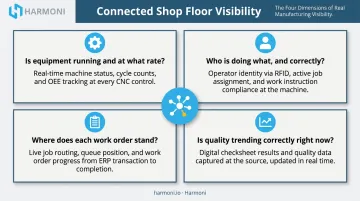
No single layer answers all four questions. Connected, they give you a shop floor you can actually manage.
Why Most Manufacturers Still Struggle with Visibility
Siloed Systems
ERP systems capture transactional data. MES systems capture some production data. Machines generate cycle data. But these systems rarely talk to each other in real time — and operators live between all of them, their activity often captured in none.
The result is a visibility paradox: more software, less clarity. The Manufacturing Leadership Council's 2024 survey found that 53% of manufacturers identified data from different systems or formats as a top challenge — even as 73% reported using ERP systems and 82% reported using shop-floor PLCs or DCS systems as data sources.
Over-Reliance on Manual Data Entry
70% of manufacturers still use manually entered data as a primary manufacturing data source, per the same MLC survey. When operators must manually log job starts, completions, and downtime reasons, data is always delayed, often incomplete, and subject to error. By the time a supervisor sees a problem in a report, the opportunity to correct it in-process has passed.
That's a system design problem, not a discipline problem. When data collection is burdensome, operators prioritize production over paperwork — rationally. The answer is capturing data automatically, at the point where work happens, without adding steps to the operator's day.
Visibility That Lags Reality
Many manufacturers have dashboards. Most show yesterday's data, or last shift's data. Only 13% of manufacturers report collecting 100% of their manufacturing data in real or near-real time, per the MLC survey. 25% collect less than 25% of their data in real time.
In a job shop or precision environment where conditions change hour by hour, a dashboard that's four hours old isn't a visibility tool — it's a history lesson.
The Missing Operator Layer
Digital transformation investments have concentrated on connecting machines to business systems. Operators — the people executing work at each workcenter — have been left out of the data model entirely.
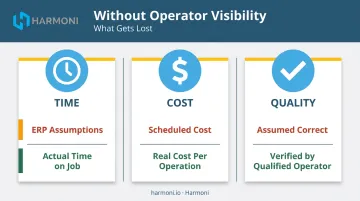
Without capturing what operators are doing, when, and how, manufacturers lose visibility into three critical areas:
- Labor accuracy — actual time on job vs. estimated, not ERP assumptions
- Job costing — real cost per operation based on what happened, not what was scheduled
- Process compliance — confirmation that work was performed correctly, at the right machine, by a qualified operator
What Real Manufacturing Visibility Looks Like in Practice
When visibility is real and complete, the operational experience changes in concrete ways:
- Supervisors see at a glance which jobs are on track and which are falling behind — without walking the floor
- Operators receive clear, current work instructions at their workcenter, automatically matched to the job and revision being run
- When a machine goes down or a job stalls, an alert surfaces immediately — while there's still time to intervene
- Quality problems are identified during production, not discovered after a batch is complete
Achieving this requires more than adding sensors or software. It requires an orchestration layer that connects machines, operators, ERP workflows, and engineering requirements into a unified real-time view.
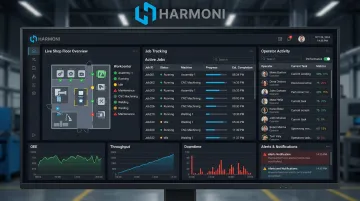
Harmoni's factory orchestration platform was built specifically for this. It sits between ERP systems, MES systems, machines, and operators — combining all four visibility dimensions into one unified view.
Harmoni automatically detects employees and jobs via long-range RFID, surfaces the right information at the right workcenter, and gives supervisors a live window into the entire shop floor from any device.
Documented Results
The outcomes from this approach are measurable, not theoretical:
| Customer | Outcome | Metric |
|---|---|---|
| WessDel | Labor productivity | 17 productive hours gained per employee per month |
| WessDel | On-time delivery | 10% reduction in delinquent jobs |
| WessDel | ROI | 5X return on ongoing Harmoni costs |
| MSI | Error reduction | Near-elimination of part count errors on aerospace/defense components |
| Unnamed shop | Scrap reduction | 22% reduction in 2 months |
The WessDel case — a beryllium alloy aerospace machine shop featured in Modern Machine Shop — illustrates what becomes possible when visibility is both real and complete. A time-tracking process that consumed 11 minutes per transaction was reduced to seconds. Delinquent jobs dropped 10%, and the platform deployed in under a week with no upfront implementation costs.
When visibility is genuine, manufacturers shift from reacting to problems after the fact to catching them while intervention still matters.
Frequently Asked Questions
What does manufacturing visibility mean?
Manufacturing visibility is real-time access to data across your production environment — machine status, operator activity, job progress, and quality outcomes — connected into a single live view. It enables faster decisions and quicker problem resolution before issues compound.
What is SKU level visibility?
SKU level visibility is the ability to track individual product or component inventory in real time across locations. Shop floor manufacturing visibility is different: it tracks how a part is being made — machine state, operator actions, process parameters — not just where finished inventory sits.
How much visibility do you have of your supply chain?
Supply chain visibility tracks materials and shipments across the broader supplier network. Shop floor visibility tracks what's happening inside your facility. Both matter — but manufacturers often invest in supply chain tools while leaving real visibility gaps on the shop floor itself, where production decisions happen in minutes.
What are the most common barriers to manufacturing visibility?
Three barriers appear most frequently: siloed systems that don't share data in real time, manual entry processes that create lag between events and records, and the absence of operator-level data capture. Together, they leave manufacturers reacting to problems rather than preventing them.
What is the difference between an MES and manufacturing visibility?
A Manufacturing Execution System (MES) manages and tracks production workflows. Manufacturing visibility is the broader outcome of having real-time, connected data from machines, operators, and business systems. An MES can contribute to visibility but doesn't automatically deliver it — especially when operator activity or ERP context is missing from the data model.
How does real-time visibility reduce scrap and rework in manufacturing?
Catching deviations during production — not at final inspection — lets teams correct course before defective parts are made. Digital checksheets with trend graphing and RFID-verified job matching give operators the information they need at the moment it matters.