
Flexible manufacturing machine tools often cut metal for less than 50% of the workday, and setup reduction is consistently flagged as one of the biggest opportunities to close that gap. One illustrative model in the same source found that four CNC mills losing just one hour per shift to setup translated to $83,200 a year in lost machine time.
SMED (Single-Minute Exchange of Die) principles are well documented and proven. But results vary widely from shop to shop. That's not because the framework is flawed. It's because success depends on how well operators, tooling, and shop floor coordination are managed, not just how fast someone can swap a fixture.
This guide walks through the exact steps to reduce changeover time, when it matters most, the factors that determine results, common mistakes to avoid, and how real-time shop floor visibility pushes reduction further than manual methods alone.
Key Takeaways
- Changeover time, measured from last good part to first good part, is a direct driver of OEE and throughput
- SMED, separating internal and external tasks and converting internal to external, is the proven foundation for reduction
- Results depend more on standardized instructions, trained operators, and staged materials than on tooling alone
- Most efforts stall from poor baseline measurement, shift-to-shift inconsistency, or zero visibility into where time disappears
- Factory orchestration tools automate the non-productive steps that SMED alone typically can't touch
How to Reduce Changeover Time in Manufacturing
Step 1: Measure and Document the Current Changeover Process
You can't fix what you haven't measured. NIST and the Lean Enterprise Institute both define changeover the same way: the elapsed time between the last good piece of the completed run and the first good piece of the next run that meets spec.
Skip estimates. Time a live changeover using direct observation, video, or machine monitoring data. One CNC-focused approach from Richards Industries involves videotaping one or two full setups, then breaking the recording into timed elements on a spreadsheet before proposing any changes.
Document every micro-task, not just the obvious ones:
- Tool retrieval and staging
- Cleaning and teardown of the prior job
- Part and fixture swaps
- Program loading and offset entry
- Trial parts and quality signoff
Your baseline window should include prep, teardown, adjustment, and first-good-part acceptance. Stopping the clock when the physical tool change ends will give you a number that looks better than reality.
Step 2: Separate Internal and External Elements
Once you have a documented baseline, classify each task:
- Internal: only possible while the machine is stopped
- External: can happen while the previous job is still running
This is where Shigeo Shingo's original SMED framework starts. He first separated the two categories, then converted internal work to external, then streamlined what remained.
Don't do this classification alone in an office. Pull in the operators and maintenance techs who run the changeover every day.
They'll catch tasks that look internal on paper but can actually happen earlier. They'll also flag internal work that's been miscategorized as external for years without anyone questioning it.
Step 3: Convert Internal Tasks to External Wherever Possible
This is the highest-leverage step in the entire process. Every task you move outside the machine-stopped window is time you get back permanently.
Common conversions in CNC environments:
- Pre-stage tools, fixtures, and PM kits before the machine stops
- Set tool offsets offline instead of using the spindle to establish them
- Configure adjustable parameters ahead of time
- Use quick-connect hardware and pre-built subassemblies to shrink whatever internal work remains
Factory orchestration platforms such as Harmoni push this further by automating CNC program loading and offset data transfer before the changeover starts, removing manual re-entry as a source of internal downtime.
The impact at the tool level can be dramatic. One documented example: offline boring-bar adjustment cut a single tool-setting operation from 15 minutes to under 1 minute. A length-only tool setup dropped from 5 minutes to under 1 minute.
Those are tool-level wins, not full changeover benchmarks. But they show how much internal time is often just unnecessary waiting.
Other shops have found gains by outsourcing cutting-tool sharpening, moving gauges closer to the line, and rebalancing tasks between operators so no single person becomes the bottleneck.
Step 4: Standardize and Document the New Procedure
A faster changeover that only one operator can execute is a fragile workaround, not a real improvement.
Build a standard operating procedure or digital work instruction set that defines:
- Exact task sequence for each changeover type
- Machine settings, offsets, and tool numbers
- Time targets per step
Then roll it out across every shift and every identical line. Variability between operators is one of the most common reasons a great pilot result never sticks at the plant level.
Step 5: Track, Verify, and Continuously Improve
Changeover reduction runs as an ongoing measurement cycle, not a one-time project with an end date. Use time-stamped production data to compare new changeover times against your baseline, then keep watching for wherever the next bottleneck shows up.
Real-time OEE tracking, the kind built into platforms like Harmoni, captures this data automatically instead of relying on manual stopwatch checks.

Documented results vary depending on scope, but they show the pattern holds up:
| Case | Result | Scope |
|---|---|---|
| Richards Industries CNC shop | Average setup fell from 50 minutes (2002) to 27 minutes (2004) | Repeated weekly kaizen events using video analysis |
| ORS Bearings turning line | Total setup time fell from 1,418 to 930 minutes (34.42% improvement) | 17-machine line, automotive and appliance parts |
| Italian precision-parts SME | Setup time fell 8-8.5%; machine downtime fell 22-30% | 221 changeovers on multi-spindle cam lathes |
The Richards Industries case documented by Modern Machine Shop reflects sustained gains, not a single lucky result. Those numbers came from repeated, disciplined measurement over two years.
When Should You Prioritize Changeover Time Reduction?
Changeover reduction delivers the highest return in high-mix, low-volume environments, think job shops and precision CNC operations running frequent small-batch jobs. When you're switching setups multiple times a day, even modest per-changeover savings scale into real capacity.
Prioritize it hard when:
- Changeover variability is directly causing missed delivery dates
- Job costing is inaccurate because true changeover time isn't captured
- Scrap spikes during production ramp-up after a changeover
- You're running 10+ setups per machine per year with meaningful setup-hour reductions available
One vendor-published scenario makes the math concrete: 20 machines, each running 10 setups per year, with setup time cut from 8 hours to 4 hours. That single change releases 800 sellable machine-hours annually, with no new equipment or headcount.
By contrast, it matters less on dedicated single-product lines that rarely change over. If a line runs the same part for months at a time, heavy SMED investment produces diminishing returns. Put your energy where the changeovers actually happen.
Key Factors That Affect Changeover Time Reduction Results
SMED gives you the framework. Your results still depend on how well you control these four variables.
Standardization of Work Instructions
Inconsistent instructions turn every changeover into a one-off puzzle instead of a repeatable task. Standardized SOPs, delivered as digital work instructions at the machine, create the baseline you need for continuous improvement. Without them, you're re-solving the same problem every shift.
Operator Training and Familiarity
Operators who rarely perform a given changeover, or who never got proper training on it, spend extra time relearning steps each time they run it. Cross-trained, practiced operators consistently hit or beat target times because the sequence is muscle memory, not a guessing game.
Tooling and Material Readiness (Kitting)
Missing or misplaced tools and materials are one of the most common sources of changeover delay. Pre-staged kits and shadow boards eliminate search time almost entirely. This is exactly the kind of internal-to-external conversion SMED calls for, but it only works if kitting is disciplined and consistent.
Coordination Between ERP/Scheduling and the Shop Floor
Setups often can't begin until job data, specs, or upstream material are confirmed. When handoffs between ERP systems, job routing, and the operator break down, "internal" time stretches out even if the mechanical setup itself is fast. This is the factor most SMED programs underestimate, and it's exactly where orchestration platforms like Harmoni add value by feeding ERP data directly to the machine.

Common Mistakes to Avoid When Reducing Changeover Time
Even well-intentioned changeover programs stall for predictable reasons:
- Skipping baseline measurement. Jumping straight to fixes without knowing where time is lost means you're guessing, not improving.
- Treating it as a one-time kaizen event. Setup reduction only sticks when it's an ongoing measurement and improvement cycle, not a single week-long push.
- Leaving operators and maintenance staff out. They run changeovers daily and know which fixes work on the floor.
- Fixing tooling while ignoring coordination gaps. Mechanical improvements don't help if the setup can't start on time because ERP data, specs, or materials aren't confirmed yet.
This coordination gap is exactly where a factory orchestration platform like Harmoni closes the loop, syncing ERP data, specs, and machine status in real time.
How Real-Time Visibility and Factory Orchestration Take Changeover Reduction Further
SMED has a blind spot. Even a well-designed SOP fails if an operator can't quickly find the right job, the current engineering revision, or the correct machine settings once they're standing at the workcenter. That waiting time doesn't show up in a traditional internal/external analysis, but it's real, and it adds up across every shift.
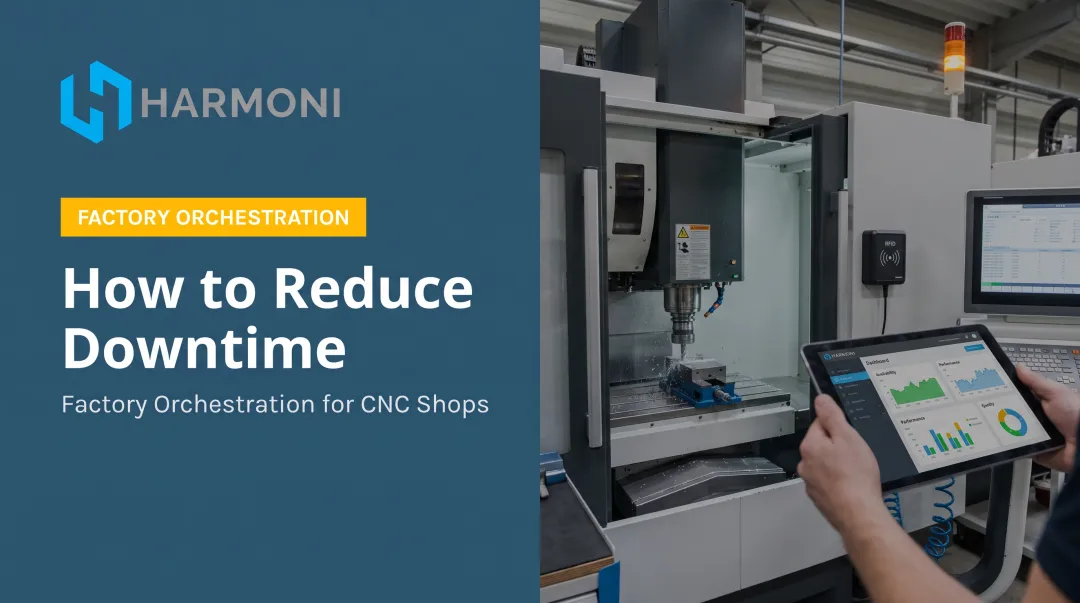
This is the gap factory orchestration platforms are built to close. Harmoni sits between ERP, MES, machines, and operators, using long-range RFID to automatically detect nearby employees and jobs.
When an operator badges into a workcenter, the platform automatically surfaces the correct work instructions, CNC program, and job details. There's no walking the floor to find a traveler or hunting for the latest print revision.
Catching Delays as They Happen
That real-time visibility extends past the badge-in moment. Traditional changeover analysis relies on after-the-fact review, often surfacing problems during a shift-end meeting when the chance to fix them has already passed. Harmoni's real-time dashboards combine machine data with operator activity so delays get flagged the moment they happen, letting a supervisor step in mid-shift instead of reading about a slow changeover in tomorrow's report.
Automating the Steps SMED Can't Fix
Job lookups, paperwork, and spec searches rarely show up in a formal internal/external breakdown, but they eat real time between the last good part and the first. Automated program loading and digital work instructions remove that waiting almost entirely, which is often where changeover gains plateau after the initial SMED push.
For mid-to-large manufacturers in CNC, aerospace, and precision manufacturing, this translates into:
- Improves labor visibility across every shift
- Delivers consistent execution regardless of who's running the machine
- Produces job costing that reflects true changeover time, not estimated setup time
If your team has already run the SMED playbook and hit a wall, that's usually a sign the remaining time loss is coordination, not mechanics. You can request a demo to see how the platform handles job identification and work instruction delivery at the workcenter.

Frequently Asked Questions
What is meant by changeover time?
Changeover time is the period from the last good part of one production run to the first good part meeting spec in the next. It includes cleanup, setup, and startup, not just the mechanical tool change.
What is the difference between changeover time and setup time?
Setup time is a subset of changeover time, referring specifically to configuring a single machine. Changeover also includes run-down of the previous job, run-up, and quality verification of the new one.
What is a good changeover time target for manufacturers?
SMED's classic goal is under 10 minutes, meaning single-digit minutes rather than a literal one minute. Realistic targets vary by industry and equipment complexity, so use your own baseline as the starting point.
How is changeover time different from unplanned downtime?
Changeover is planned downtime tied to intentionally switching products. Unplanned downtime results from equipment failures or unexpected stoppages that weren't scheduled.
Can changeover time ever be reduced to zero?
Not in a true sense. Zero changeover generally requires dedicating a machine or line to a single product, which trades away flexibility and limits preventive maintenance windows.
What role does technology play in reducing changeover time?
Factory orchestration platforms like Harmoni automate machine monitoring, digital work instructions, and job tracking, cutting the manual delays, such as job lookups and paperwork, that SMED analysis alone tends to miss.