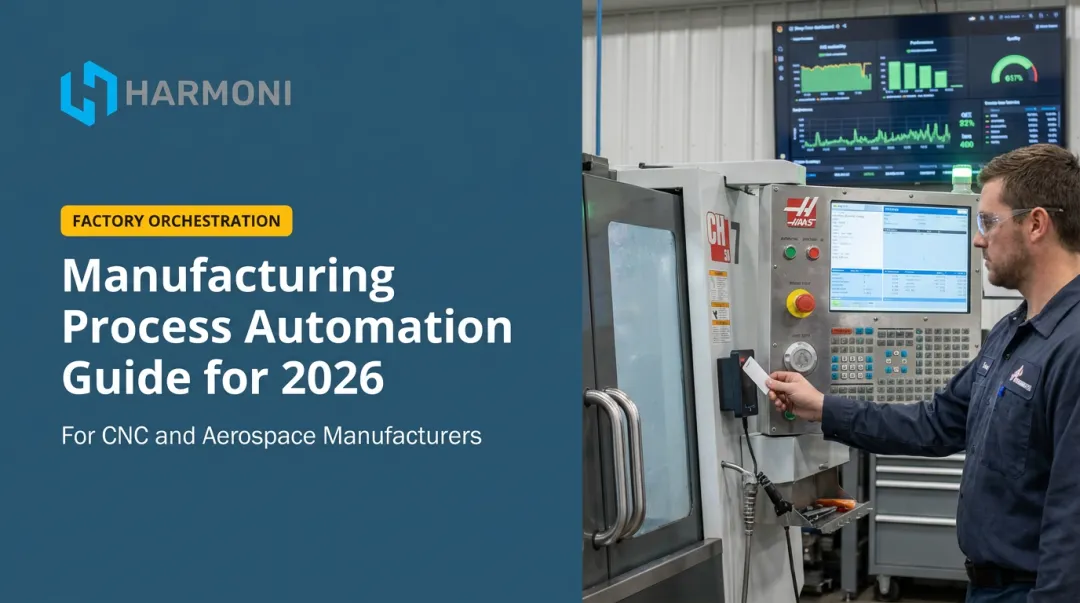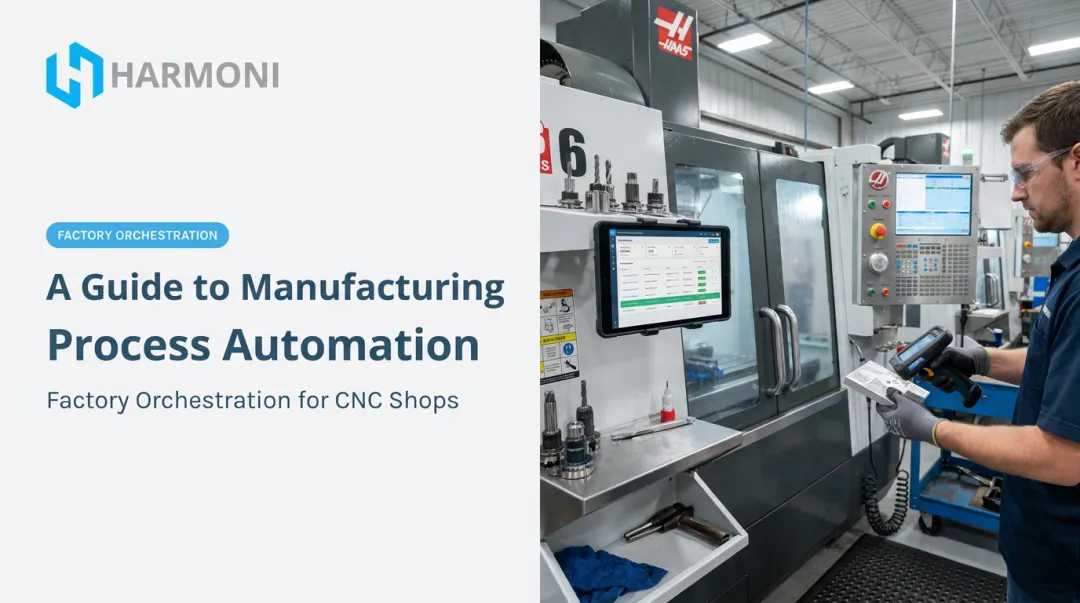

The numbers back this up. Siemens estimates that unplanned downtime costs an average large industrial plant $253 million per year across the sectors it studied. That figure applies to large facilities specifically, but the pattern holds at smaller scale too: every minute a machine sits idle, or an operator hunts for a work instruction, is a minute that never comes back.
Manufacturing workflows are the backbone of consistent production. This article breaks down what they are, where they typically break, and how mid-to-large manufacturers, especially CNC shops, aerospace suppliers, automotive component makers, and defense contractors, are modernizing execution without ripping out their ERP or MES.
Key Takeaways
- Manufacturing workflows guide people and machines through planning, scheduling, execution, and control.
- Poor system integration and communication gaps drain time, money, and quality.
- Process mapping and lean principles lay the groundwork for automation and system integration.
- Factory orchestration links ERP, MES, machines, and operators to catch problems in real time.
What Are Manufacturing Workflows?
A manufacturing workflow is the organized sequence of steps that carries a product from raw material to finished good. It covers planning what needs to happen, scheduling when it happens, executing the work, monitoring how it's going, and controlling the outcome when things drift off course.
Get this sequence right and you get consistent output, lower costs, and clear accountability. Get it wrong, and you get the root cause of common shop floor problems: idle machines, confused handoffs, and margin erosion nobody can quite explain.
The 5 Core Components of a Manufacturing Workflow
Every workflow, regardless of industry, moves through five stages:
- Planning - Defining what needs to be produced, in what quantity, and by when.
- Scheduling - Assigning specific jobs to specific machines, shifts, and operators.
- Executing - Running the actual production, from setup through the final cut or weld.
- Monitoring - Tracking progress, machine status, and quality in real time.
- Controlling - Adjusting the plan when something goes off track, whether that's a late delivery or a tolerance issue.

Each stage feeds directly into the next. A scheduling error compounds into an execution delay; a monitoring blind spot turns into a control failure. Weakness in one stage rarely stays contained.
The 7 Flows of Manufacturing
Lean manufacturing frames the shop floor around seven simultaneous flows that must move together for production to run smoothly:
- Raw material
- Work-in-process
- Finished goods
- Operators
- Machines
- Information
- Engineering
The point isn't to optimize one flow in isolation. A shop that speeds up machine flow while information flow stays stuck in paper travelers hasn't solved anything, it's just moved the bottleneck. Real improvement means coordinating people, machines, systems, and engineering requirements at the same time.
Understanding these flows is the first step. The next is seeing how they are structured into different operational models based on production strategy and customer demand.
Common Manufacturing Workflow Models
Workflows are typically structured around three interconnected frameworks:
- Production Control Model: Determines whether work starts based on a forecast ("push") or actual customer demand ("pull").
| Model | How it Works |
|---|---|
| Push | Produces to forecast in large batches, moving inventory downstream. |
| Pull | Downstream demand signals trigger upstream production. |
| Continuous Flow | Moves single units or small batches through steps without stopping. |
- Shop Configuration: Describes the physical layout, such as a flexible job shop for custom work, a batch production cell, or a dedicated assembly line for high-volume parts.
- Order Fulfillment Strategy: Defines when production begins relative to a customer order—from make-to-stock to engineer-to-order. A CNC shop building a custom part operates very differently than one stocking standard components.
Common Challenges That Slow Down Manufacturing Workflows
Most manufacturers don't lose time to one dramatic failure. They lose it in small, repeated increments that never make it onto a P&L line by themselves.
Bottlenecks and unplanned downtime top the list. Machine failures, material delays, and changeover time all create backlogs that ripple downstream.
An ABB survey of 3,600 senior industrial decision-makers found that 83% put the cost of unplanned downtime at $10,000 per hour or more. Another 76% said it can reach $500,000 per hour in extreme cases, and even a few hours a month adds up fast.
Communication and data gaps between departments compound the problem. When ERP, MES, and machine systems don't talk to each other, information lives in silos:
- Schedulers work from outdated job status
- Operators wait for engineering answers instead of getting them at the machine
- Quality data sits disconnected from the job it describes
Lack of real-time visibility ties both of these together. Without live insight into operator activity and machine status, most manufacturers discover problems after the fact. That discovery often comes during a scrap review, a missed shipment, or a frustrated customer call, rather than while the issue is still fixable on the shop floor.
Proven Strategies to Improve Your Manufacturing Workflows
Fixing workflow problems starts with visibility, not software. Here's the sequence that works:
- Map your current workflows. Build a process map or flowchart of how jobs actually move, not how the org chart says they should. This surfaces delays that nobody officially owns.
- Track KPIs before and after changes. Cycle time, on-time delivery, and scrap rate show whether a change paid off.
- Apply lean principles. Standard operating procedures, waste reduction, and continuous improvement reduce variability between operators and shifts.
- Integrate ERP, MES, and machine data. Information needs to flow in real time, not get re-entered by hand into three systems.
- Invest in operator training. New tools only work if the people running them trust the data and know how to use it.
- Build in labor visibility. Knowing who's working on what job, and when, improves job costing accuracy and reduces wasted time.

Each step helps on its own, but the real gains show up when they're combined. Deloitte's 2025 survey of 600 large US manufacturers found that companies running smart-manufacturing programs reported average gains of 10% to 20% in production output and 7% to 20% in employee productivity. Those numbers reflect a broad mix of technologies and practices, not a single tool, which is exactly the point: mapping, lean discipline, and system integration have to work together.
How Automation and Factory Orchestration Transform Manufacturing Workflows
Traditional workflow automation, think RPA scripts or scheduled batch jobs, handles narrow, repeatable tasks. It's useful, but it doesn't coordinate the messy, real-time reality of a shop floor where a machine goes down or an operator calls in sick right as an engineering revision lands mid-shift.
Factory orchestration works differently. Instead of automating one task in isolation, it actively coordinates people, machines, systems, and engineering requirements as conditions change, in real time.
Technologies like RFID and IoT sensors make this possible without adding manual data entry:
- RFID badges automatically detect which operator is at which workcenter
- IoT sensors capture machine status and cycle data continuously
- Dashboards surface this information live, instead of in a weekly report
Combining machine data with operator activity and ERP/MES workflows gives leaders full context, not isolated metrics. A low OEE number, on its own, doesn't tell you why. Layered data does: was the machine idle, was the operator missing, or was the ERP's cycle time estimate simply wrong?
The payoff shows up in fewer non-productive manual steps and less scrap, since problems get caught while they're still fixable, not after the job ships.
How Harmoni's Factory Orchestration Platform Fits In
Harmoni was built specifically to sit between ERP systems, MES systems, machines, and operators, without replacing any of them.
The platform runs on three pillars:
- Automation - RFID-driven ERP transactions and automated CNC program loading run through machine-side command centers, eliminating manual data entry
- Process control - Digital work instructions and engineering revision control tie the right job to the right program, backed by digital quality checksheets
- Observability - Real-time machine data, OEE monitoring across availability, performance, and quality, and shop floor dashboards
These pillars play out in real shop-floor numbers. At WessDel, a beryllium alloy machine shop running Epicor Kinetic, manual time-tracking transactions were taking an average of 11 minutes each at shared terminals. After deploying Harmoni's RFID-based clocking, that dropped to seconds, generating roughly 17 productive hours per employee per month.

Harmoni's long-range RFID also automatically detects nearby employees and jobs at each workcenter, feeding that data into a centralized command center without operators lifting a finger.
It integrates natively with the ERP, CNC, and machine tool systems already common in precision manufacturing, including Epicor, Infor, ECI JobBoss, Fanuc, Haas, and Mazak. Deployment typically takes weeks rather than the months a full MES or ERP overhaul would require. If you want to see how it fits your shop, book a free demo.
Frequently Asked Questions
What are manufacturing workflows?
A manufacturing workflow is the organized sequence of planning, scheduling, execution, monitoring, and control steps that guides people and machines through production. It's what turns raw material into a finished, shippable part.
What are the 7 flows of manufacturing?
The seven flows are raw material, work-in-process, finished goods, operators, machines, information, and engineering. Together, they represent everything that has to move in sync on a shop floor.
What are the four types of manufacturing workflows?
Job shop, batch, assembly line, and continuous flow are the primary workflow types. Job shop and batch tend to fit pull or make-to-order environments, while assembly line and continuous flow typically suit push, high-volume production.
What are the four types of manufacturing processes?
The four standard manufacturing process types are make-to-stock, make-to-order, assemble-to-order, and engineer-to-order. Each determines when in the process a customer order actually enters the workflow.
How does automation improve manufacturing workflows?
Automation removes manual data entry and non-productive tasks like walking to shared terminals, which improves accuracy and frees up operator time. It also gives leaders real-time visibility into production performance instead of a delayed, after-the-fact report.
How long does it take to implement an automated workflow or orchestration system?
Modern orchestration platforms like Harmoni are designed to deploy in a matter of weeks, since they retrofit onto existing equipment and ERP systems rather than replacing them. That's a fraction of the timeline typical of a full MES or ERP overhaul.