
For mid-to-large manufacturers running aerospace parts, automotive components, or precision machined work, this distinction isn't academic. Confuse the two, and you end up with unclear accountability, defects that slip through, and a quality team stuck reacting to problems instead of preventing them.
This article breaks down what each term actually means, compares them side-by-side, and shows how manufacturers are connecting inspection data to real-time quality control systems instead of treating them as separate checkboxes.
Key Takeaways
- Quality inspection checks a specific part or batch against a spec at one point in time
- Quality control is the ongoing system that uses data to prevent recurring defects
- Inspection catches problems; control stops them from happening again
- Linking inspection data to real-time visibility tools cuts scrap and rework beyond either alone
Quality Inspection vs Quality Control: Quick Comparison
Here's the fastest way to see where each function starts and stops:
| Factor | Quality Inspection | Quality Control |
|---|---|---|
| Primary Focus | Verifying a specific unit or batch against a defined spec | Managing standards, training, and corrective action across the operation |
| Timing | Discrete checkpoints (pre-production, in-process, final) | Continuous, spans the entire production lifecycle |
| Feedback Loop | One-way check, often no built-in root-cause reporting | Closed loop — results route back to operators and managers |
| Who Performs It | Inspectors, technicians, third-party auditors | Cross-functional: quality team, operators, supervisors, engineering |
| Outcome | Accept/reject decision on a unit or batch | Sustained conformance and continuous improvement |
The short version: inspection is a snapshot. Quality control is the system that makes sure that snapshot actually improves the next hundred parts, not just the one in front of you.
What Is Quality Inspection?
Quality inspection is the act of examining, measuring, or testing a product's characteristics against a specified benchmark to confirm it conforms. That's the ASQ definition, and ISO frames it the same way — inspection is a "determination of conformity" that results in a pass or fail.
For high-tolerance environments like CNC machining and aerospace, this isn't a formality. A part that's off by a few thousandths of an inch can mean a failed assembly or a scrapped batch. Many shops apply acceptance sampling standards like ISO 2859-1 to decide how many units in a lot need checking before the whole batch is accepted or rejected.
Why Timing Matters
Catching a defect early costs a fraction of catching it late. According to NASA's Technical Reports Server, the commonly cited "1:10:100 rule" puts a cost multiplier on this: a defect caught in design costs roughly 1 unit to fix, 10 units if caught during fabrication, and 100 units if it escapes to test or the customer.
It's a rule of thumb, not a guaranteed ratio, but the direction holds across manufacturing — catch it later, pay more.
Most shops run inspection at three or four stages:
- Pre-production — verifying incoming materials and initial setup
- In-process — mid-run checks while the job is still on the machine
- Final/pre-shipment — last check before the part leaves the building
- Container/loading — verifying quantities and packing before it ships

Use Cases of Quality Inspection
Inspection carries the most weight in regulated, high-consequence industries — aerospace components, medical devices, automotive safety parts — where a missed defect creates a compliance issue, not just a warranty claim.
One documented example: automotive supplier Cequent Transportation Accessories implemented detailed control plans, work instructions, and in-process checks across its supplier network. Over three years, overall supplier rejected parts-per-million dropped from 33,555 to under 300 monthly, and internal PPM fell from 1,102 to 172, according to Quality Magazine's case study. That's the kind of result a structured checklist and consistent inspection cadence can produce.
What Is Quality Control?
Quality control, per ISO 9000, is the "part of quality management focused on fulfilling quality requirements." Where inspection asks "does this part meet spec," quality control asks "how do we make sure every part meets spec, consistently, without someone catching it after the fact."
QC is what turns individual inspection results into operational discipline. It's the standards, training programs, and corrective-action loops that make good parts the default outcome, not the lucky one.
Manufacturers typically lean on one or more established methodologies depending on maturity:
- SPC (Statistical Process Control) — using control charts to separate normal variation from a real process problem
- Six Sigma — a data-driven method for reducing variation and defects
- TQM (Total Quality Management) — a company-wide approach engaging every employee in continuous improvement
Why Real-Time Visibility Changes the Equation
Here's where a lot of QC programs fall short: the inspection data exists, but it lives in a binder, a spreadsheet, or a system nobody checks until end-of-shift. By the time a supervisor sees a trend, twenty more parts have already been cut.
Effective quality control depends on catching drift while it's happening. This is where a platform like Harmoni fits in. Rather than replacing an ERP or MES, Harmoni sits between them and the shop floor, giving supervisors live dashboards built from three data streams:
- Machine data pulled directly from CNC controls (Mazak, Haas, Fanuc, Heidenhain, Siemens, and others)
- Job and part data synced from ERP systems like Epicor, JobBoss, Infor, and Odoo
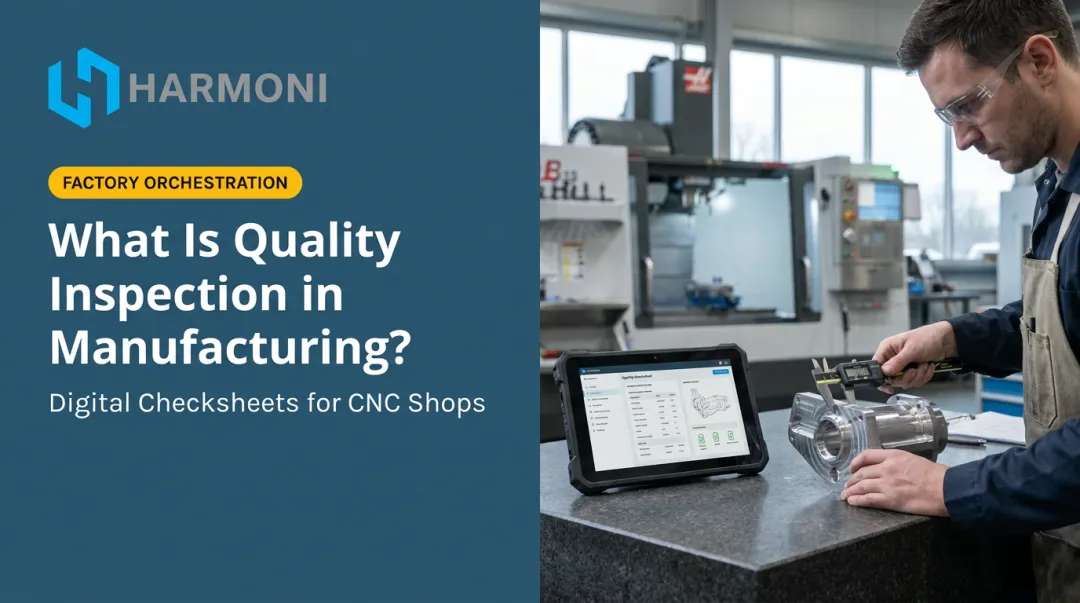
- Operator input captured at the machine, including good/scrap/discrepant part counts and digital checksheet measurements

When measurements are entered digitally, including through Bluetooth-connected gaging tools, supervisors can see trend graphs in real time. They catch a process drifting toward out-of-tolerance before it produces scrap, instead of finding out during final inspection.
Use Cases of Quality Control
That same real-time visibility matters even more in industries where documentation and traceability are part of the product itself. Medical device and defense manufacturing operate under this reality daily, where a missing record creates a compliance gap that can halt shipments or trigger an audit.
QC touches the entire value chain:
- Supplier management — scorecards and audits that hold vendors to the same standard as internal production
- In-process monitoring — SPC and real-time checks during the run, not just at the end
- Continuous improvement — root-cause analysis that feeds back into training and process changes
The Cequent example above didn't stop at inspection. Their broader QC program, combining control plans, FMEA, and supplier scorecards with real-time inspection feedback, got 97.5% of product moving through their plants without rework, per the same Quality Magazine report. That's the payoff when inspection data actually informs the system around it, rather than sitting in a log nobody revisits.
How Quality Inspection and Quality Control Work Together
Neither function does much good alone. Inspection generates the data points. Quality control is the system that acts on them. Skip one, and the other loses most of its value.
The right approach depends on production complexity and risk tolerance:
| Approach | Best Fit |
|---|---|
| Inspection-only checkpoints | Low-complexity, high-volume runs with stable, well-understood processes; low-mix production where variation risk is minimal |
| Full QC system | Regulated environments (aerospace, medical, defense); high-mix, low-volume, tight-tolerance work (the kind most CNC job shops run every day) |
A Real-World Example of Connecting the Two
Houston-based Pinnacle Machine Works used to record thousands of dimensional and visual inspection points by hand. It worked, technically, but it was too slow to support real-time SPC or catch a process drifting before it produced bad parts.
The shop introduced electronic gaging, wireless measurement transmission, and SPC software to consolidate inspection results and analyze them as they came in. According to Modern Machine Shop's coverage of the project, the results included:
- Reject rate dropping from 3% to 1.3%
- A 45% increase in overall shop productivity
- Over $180,000 in avoided lost-material cost
- Payback on the investment in under one year

That's the pattern: manual, disconnected inspection logs stayed a bottleneck until they were connected to a system that could act on the data immediately.
This is the exact gap Harmoni's factory orchestration platform is built to close — unifying machine, ERP, and operator data so a quality issue surfaces on a supervisor's screen the moment it starts, not during a shift review three hours later. If you want to see what that looks like on your own floor, Harmoni's team can walk through it in a live demo.
Conclusion
Quality inspection and quality control work together as one system. Inspection answers "does this part meet spec." Quality control answers "how do we keep every part meeting spec, run after run."
Manufacturers who connect the two, feeding inspection results directly into a live operational feedback loop, consistently see fewer errors, tighter labor accountability, and job costing that reflects reality instead of guesswork. Harmoni's factory orchestration platform makes that connection near-instant, turning inspection data into real-time visibility instead of something you discover after the fact. See how it works with a free demo at harmoni.io/demo.
Frequently Asked Questions
What are the key responsibilities of a quality control inspector?
They establish inspection standards, perform tests and measurements against spec, document results, and report defects to supervisors so corrective action can happen quickly.
What are the 4 types of quality inspection?
Pre-production, in-process, final/pre-shipment, and container loading inspection. Each applies at a different stage of production, from raw materials to the finished product leaving the building.
What is a quality control (QC) checklist?
It's a standardized document listing the criteria, tolerances, and steps inspectors follow to verify conformity at a given production stage. Digital versions replace paper forms with real-time data entry.
What is the difference between quality control and quality assurance?
Quality assurance is proactive, focused on designing processes to prevent defects before they happen. Quality control is more reactive, verifying that finished output meets the standard.
Why is quality control important in manufacturing?
It reduces scrap and rework costs, protects brand reputation, keeps you compliant with industry regulations, and directly improves customer satisfaction and repeat business.
Can quality inspection happen without a quality control system?
Yes, but it's limited. Without a feedback loop back into a broader QC system, inspection catches the same defects repeatedly since nobody's addressing why they're happening in the first place.