Introduction
A single missed message on a factory floor is not just an inconvenience. It can mean a scrapped part, a failed inspection, an injured worker, or a shipment that doesn't leave the dock on time. In an office, a miscommunication means a delayed email thread. On the shop floor, it means physical consequences that show up immediately in your cost of quality.
Manufacturing has a structural communication problem that most generic workplace advice cannot address. Management and frontline operators occupy different physical and informational worlds — separated by noise, shift schedules, and organizational distance. That distance is where errors multiply, operators disengage, and revenue walks out the door as scrap and downtime.
This article covers why communication breaks down in manufacturing environments specifically, what it costs in measurable terms, and what actually works — from cultural habits and process disciplines to the technology that connects operators, machines, and management in real time.
Key Takeaways
- Poor communication directly causes production errors, scrap, safety incidents, and inaccurate job costing
- The factory floor's physical structure creates barriers that generic communication advice cannot solve
- Effective manufacturing communication requires cultural commitment, defined processes, and real-time information systems working together
- Two-way channels that let operators flag issues immediately matter as much as top-down information flow
- Unified machine data, ERP workflows, and operator activity turn communication into continuous operational awareness
Why Effective Communication in Manufacturing Matters
Most manufacturers accept communication friction as a cost of doing business. The data suggests that's an expensive assumption.
Gallup's cross-industry analysis of over 112,000 business units found 41% fewer quality defects among highly engaged workgroups compared to their least-engaged counterparts. Engagement and communication quality are closely linked — workers who receive consistent, useful information are more invested in outcomes. And Gallup's 2025 State of the Global Workplace report estimates global disengagement costs $10 trillion annually, roughly 9% of global GDP.
Manufacturing isn't immune. In a Manufacturing Institute study of 578 employees across five manufacturers, only 63% were satisfied with communication and just 66% with recognition — leaving significant room for improvement in the industries where precision and timing matter most.
That gap has real consequences. Communication quality in manufacturing affects five interconnected areas:
- Safety — unclear instructions and delayed hazard alerts create injury risk
- Production efficiency — operators without accurate real-time information make slower, worse decisions
- Quality and error reduction — missed specs, verbal misunderstandings, and outdated work instructions drive defects
- Employee engagement and retention — workers who feel uninformed disengage, then leave
- Customer satisfaction — communication failures upstream become missed deadlines and quality escapes downstream
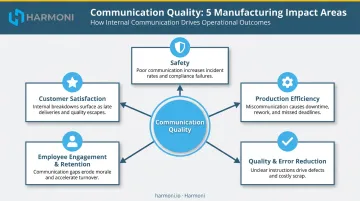
Unlike office environments, these failures are immediate and tangible — showing up in scrap bins and customer complaints, not in a meeting the following week.
Why Communication Breaks Down on the Factory Floor
The factory floor is architecturally hostile to communication — and the barriers are more specific than most managers realize.
The Physical and Structural Problem
Large production environments make face-to-face communication impractical. Most operators don't have a company-issued device, a shared desk, or a quiet place to read a policy update. Health and safety protocols limit personal device use near machinery. And multiple shifts fragment information continuity — what one team knows at end-of-day often stays with them when they clock out.
A Parsable survey of 1,400 frontline manufacturing workers across five countries found that 81% still relied on paper-based processes and only 41% had been provided mobile technology. Just 22% used digital tools to communicate, with most relying on verbal, in-person conversation. That's the current baseline for most shops.
The Management Distance Problem
Frontline operators sit furthest from company decision-makers — organizationally and often physically. They receive the least communication yet are directly responsible for execution. When an Axios HQ survey examined alignment between leaders and employees (including 139 manufacturing respondents), the gaps were stark:
- Leaders who believed they provided sufficient context: 77%
- Employees who agreed: 46%
- Leaders who believed goals were easy to find: 70%
- Employees who agreed: 46%
A 31-point disconnect between what leaders think workers understand and what workers actually receive is not a minor miscommunication — it's a structural execution risk.
Shift Handover as a Hidden Failure Point
When a shift ends, critical context must transfer: job status, machine condition, quality flags, in-progress work. In most plants, that transfer happens verbally — or not at all. Incoming operators start cold, repeat mistakes the previous shift already encountered, and lose time reconstructing context that should have been documented and waiting for them.
Handover failures are especially damaging because their consequences are delayed. An error that enters production at the start of a shift often isn't caught until inspection — hours and multiple parts later.
The "Corporate Speak" Problem
When management does communicate with frontline workers, the messaging is often written for a quarterly business review rather than a machine operator. Workers don't need organizational strategy headlines. They need answers to practical questions:
- What is my priority job right now?
- Where is this order in the queue?
- Was the last part I made acceptable?
When those questions go unanswered, operators make judgment calls. Some of those calls are wrong. A communication failure at the start of a shift can quietly compound into scrap, rework, and distorted job costing by the time anyone catches it.
Strategies to Improve Communication in Manufacturing
Improving manufacturing communication requires action across culture, process, and the systems that support both. No single fix closes the gap on its own.
Establish Clear Communication Standards
Most plants have no explicit communication expectations. No defined cadence. No escalation protocol. No minimum standard for what a shift supervisor must communicate before handing off.
The first step is defining what "good" looks like:
- Daily pre-shift huddles — 15 minutes or less, structured around safety, quality, production status, and priorities (a format recommended by both the Illinois Manufacturing Excellence Center and IndustryWeek)
- Shift handover templates — written records of job status, quality flags, machine condition, and open issues
- Escalation decision trees — so operators and supervisors know exactly when and how to escalate a concern rather than absorbing it silently
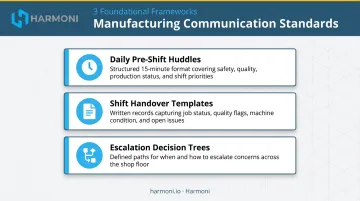
These aren't bureaucratic extras. They're the minimum infrastructure for a shop floor where information flows reliably.
Create Two-Way Communication Channels
Frontline workers are typically the first to notice a machine anomaly, a quality deviation, or a process problem. Without structured channels, that information stays on the floor instead of reaching someone who can act on it.
Practical mechanisms include:
- Designated feedback methods at each workcenter (digital or physical)
- Regular one-on-one check-ins between supervisors and operators
- Anonymous reporting options for safety concerns or process issues
The goal is to make it easy and expected for floor employees to communicate upward — and to make sure those communications reach someone who can act.
Prioritize Consistency Over Intensity
A single all-hands meeting followed by weeks of silence does little. Employees build trust in communication when they can anticipate it. A steady, predictable cadence builds more confidence than periodic large-scale initiatives. Practical anchors for that cadence include:
- Daily pre-shift huddles at a fixed time
- Visible KPI boards updated each shift
- Documented follow-through on every issue raised by operators
Train Supervisors as the Communication Bridge
Frontline supervisors translate strategy into daily action and surface ground-level issues upward — making them the most critical communication link in the operation. Most, however, receive training on technical tasks rather than on how to communicate clearly under production pressure.
Supervisor development should include:
- How to run a structured pre-shift huddle
- How to deliver performance feedback without triggering defensiveness
- When to escalate versus solve independently
Management walking the floor regularly, not just during crises, reinforces this culture. Direct conversation between plant leaders and operators surfaces the kind of information that formal channels — and even digital systems — routinely miss without that human foundation in place.
Building a Culture of Communication from the Top Down
Process improvements fail without cultural backing. And communication culture starts with what leadership models, not what it mandates.
If plant managers communicate inconsistently, selectively, or only when problems escalate, supervisors learn to do the same. The gap between strategy and execution widens one silent shift at a time.
The Manufacturing Institute study found that among employees who did not feel valued, only 30% were satisfied and 25% would recommend their company — compared to 97% motivation and satisfaction among those who did feel valued. Employees who reported unfair treatment were nearly ten times more likely to intend to leave within a year (19% vs. 2%). Recognition isn't a soft initiative — it's a retention lever.
Those retention numbers point to something deeper: psychological safety. Amy Edmondson's foundational research on 51 work teams in a manufacturing organization found that team psychological safety directly supported learning behavior and team performance. Workers raise concerns faster, report issues earlier, and catch problems before they compound — but only when they trust that speaking up won't result in blame.
Inclusive communication is equally critical in U.S. manufacturing. The Bureau of Labor Statistics reports that foreign-born workers represent 19.1% of the total U.S. civilian labor force, with a substantial share in manufacturing. When work instructions, safety alerts, and quality specs are only available in English, nearly one in five workers is operating with incomplete information.
Plants serious about quality treat the following as operational requirements — not optional accommodations:
- Multilingual signage at workstations and safety-critical areas
- Visual work instructions that reduce language dependency
- Translation support for engineering changes and quality specs
How Technology Bridges the Manufacturing Communication Gap
Even the strongest cultural and process commitments hit a ceiling when the information itself is slow, incomplete, or buried in paper.
Real-Time Information at the Workcenter
When operators rely on paper travelers, verbal handoffs, or a walk across the floor to find a supervisor, information lag is built into every decision they make. By the time a problem is identified, multiple parts may already be affected.
Digital workcenter displays change this. When job status, quality specs, machine alerts, and production targets are available at an operator's station — accurate and current — the "I didn't know" error largely disappears. Deloitte's 2025 Smart Manufacturing Survey of 600 large-manufacturer executives found self-reported post-implementation gains of 10%–20% in production output and 7%–20% in employee productivity following smart manufacturing investments. The connection between better information access and better operational outcomes is consistent across the data.
At the individual machine level, monitoring visibility drives equally measurable results. Modern Machine Shop documented a 46% increase in machine utilization at Coastal Machine and Supply following the installation of machine monitoring on a five-axis mill — attributed directly to the visibility the system created. That kind of gain doesn't come from working harder; it comes from knowing what's actually happening at each machine, in real time.
Harmoni: Factory Orchestration Built for This Problem
Harmoni's factory orchestration platform addresses this challenge directly. Rather than adding another standalone dashboard, Harmoni sits between ERP systems, machines, and operators to create a unified operational picture in real time.
Key capabilities that address manufacturing communication gaps:
- Pulls machine performance, ERP job data, and operator activity into one unified dashboard — accessible from any device, so supervisors track production progress without leaving their desk
- Automatically identifies the operator and active job via long-range RFID the moment they approach a workcenter — triggering work instructions, quality checksheets, and CNC programs with no manual lookup
- Captures labor hours and machine cycle times automatically and pushes them to the ERP (Epicor, Infor, JobBoss, and others) — eliminating the manual entry errors that distort job costing data
- Delivers job-specific work instructions and quality checksheets at the machine, replacing verbal handoffs and paper travelers entirely
- Sends real-time exception alerts when something goes off-tolerance — supervisors can call the work cell immediately without leaving their desk
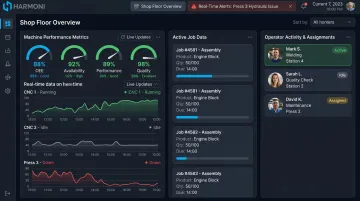
Job costing data is where the gap shows up fast. WessDel found that operators were spending an average of 11 minutes per ERP transaction at shared terminals away from their machines. With Harmoni's RFID automation, those transactions happen at the workcenter — eliminating wasted time and improving data accuracy simultaneously.
The accuracy gains go further than labor entry. Machine Specialties, Inc. (MSI), a high-precision aerospace and defense manufacturer, shifted from tracking only spindle time to capturing earned hours for fuller profitability insight — a direct result of closing the information gap between operators, machines, and ERP.
Finding a problem while production is running means a quick correction. Finding it afterward means a scrap event. Real-time anomaly alerts give supervisors time to intervene before a single bad part becomes a batch of them.
Frequently Asked Questions
How can manufacturing teams bridge communication gaps on the factory floor?
The most effective approach combines structured two-way channels (workcenter feedback mechanisms, supervisor check-ins, shift handover templates) with a consistent cadence like daily huddles and floor KPI boards. Real-time digital displays close the loop by delivering accurate job and machine information directly to operators at their stations, so they never have to search for it.
Why is communication important in manufacturing?
Poor communication in manufacturing has direct operational consequences: production errors, scrap, safety incidents, employee disengagement, and missed shipments. Strong communication is both a safety requirement and a competitive advantage in an environment where precision and timing determine whether a part ships or gets scrapped.
What are the 5 C's of communication?
The 5 C's — Clear, Concise, Correct, Complete, and Courteous — are especially relevant in manufacturing, where misinterpreted instructions or incomplete quality specs can directly cause defects. Each quality checkpoint on a digital checksheet, for example, should meet all five standards to be actionable.
What are the 4 types of communication?
The four types are verbal, nonverbal, written, and visual. Manufacturing environments rely heavily on visual communication — dashboards, color-coded andon lights, signage — because verbal communication is often impractical on loud production floors where operators may be running machines or wearing hearing protection.
What are common communication barriers in manufacturing?
Common barriers include physical distance across large floor spaces, shift fragmentation with poor handover processes, language and literacy diversity, and limited digital infrastructure for frontline workers. The most persistent gap is the disconnect between management-level messaging and the practical daily questions operators actually need answered.
How does technology improve communication on the shop floor?
Technology eliminates information lag by delivering accurate job and machine data directly to operators at their workcenters. Factory orchestration platforms like Harmoni integrate ERP and machine data in one place, giving supervisors real-time visibility without needing to walk the floor for a status update.