Introduction
Most mid-to-large manufacturers run on a collection of disconnected systems — ERPs scheduling jobs, MES platforms tracking work orders, and machines generating data that never reaches either. When those systems can't communicate, the shop floor runs on stale information.
The consequences show up fast:
- Operators make decisions based on yesterday's data
- Quality problems surface only after defective parts have moved through production
- Job costs come back wrong because actual machine time was never captured accurately
McKinsey's research on discrete manufacturing shows that Industry 4.0 use cases are associated with potential throughput increases of 10–30% and labor productivity gains of 15–30% — but only when systems are actually connected.
Manufacturing systems integration (MSI) is the strategic solution to this fragmentation. This guide covers what MSI is, the key systems it connects, the four integration types, the core benefits, common challenges, and how to build an integration strategy that delivers results.
Key Takeaways
- MSI connects machines, ERP, MES, IoT devices, and operators into a single, coordinated production environment
- The four primary integration types are horizontal, vertical, end-to-end (digital thread), and point-to-point
- Real-time data connectivity breaks down production silos and puts decision-making information in operators' hands as events happen
- Successful MSI starts with clear business goals and a phased rollout — with an orchestration layer connecting system data to what operators actually do on the floor
What Is Manufacturing Systems Integration?
Manufacturing systems integration is the process of connecting and synchronizing machines, software, data flows, and human interfaces across a manufacturing environment so they function as a unified production system rather than isolated components.
Data Connectivity vs. True Integration
Data connectivity means systems can share information. Integration means that information triggers coordinated action across machines, operators, and enterprise systems in real time.
A machine that sends cycle time data to a dashboard has connectivity. A machine whose cycle time data automatically updates job cost records in ERP, surfaces a quality alert in MES, and notifies the operator at the workcenter — that's integration.
The ISA-95 Framework
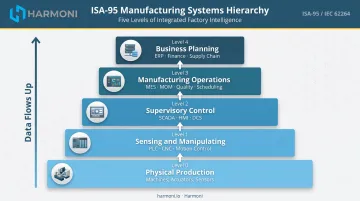
The ISA-95 standard (also published as IEC 62264) is the industry-standard model that defines how enterprise and operational systems should interact. It organizes manufacturing systems into five levels:
| ISA-95 Level | Function | Typical Systems |
|---|---|---|
| Level 4 | Business planning and logistics | ERP |
| Level 3 | Manufacturing operations management | MES, MOM |
| Level 2 | Supervisory control | SCADA, HMI |
| Level 1 | Sensing and manipulating production | PLCs, CNC controls |
| Level 0 | Physical production process | Machines, fixtures, materials |
ISA-95 gives manufacturers a structured blueprint for where data lives and how it should flow — making it the standard starting point for MSI architecture planning.
What MSI Is Not
MSI is not a one-time data migration, a single software purchase, or purely an IT initiative. It is an ongoing, governed data flow that must evolve as the manufacturing environment changes.
That continuity is what makes the digital thread possible — the seamless flow of data from product engineering through production and delivery. MSI is the infrastructure that ensures every system in that chain shares the same operational context.
Key Systems That Manufacturing Systems Integration Connects
A mature MSI architecture connects multiple system layers. Here's how each one fits:
ERP (Enterprise Resource Planning)
ERP manages demand, inventory, costs, and scheduling at the business level. Without integration, ERP plans are disconnected from shop floor reality — causing capacity mismatches, inaccurate job costing, and scheduling decisions based on stale data.
MES (Manufacturing Execution System)
MES tracks production orders, work-in-progress, quality events, and machine status at the operational layer. MES is only as effective as the data it receives from machines and sends back to ERP. When that machine data is incomplete, production reports become unreliable and quality escapes go undetected until it's too late.
IIoT Sensors, CNCs, and PLCs
These systems generate the raw machine-level data — cycle times, utilization, alarms, spindle hours — that everything above them depends on. Without upward data flow into MES and ERP, this information stays trapped at the machine level, invisible to the people who need it.
The Factory Orchestration Layer
This is the critical bridge between enterprise systems and the physical shop floor. It coordinates operators, machines, and engineering requirements in real time — ensuring that integrated data actually drives consistent execution, not just reports.
Platforms like Harmoni occupy this layer, sitting between ERP systems, MES platforms, CNC controls, and operators to combine machine data with operator activity and ERP workflows — delivering operational context that neither ERP nor MES can provide on their own, without replacing either.
Other Connected Systems
The orchestration layer doesn't stop at ERP and MES. A mature integration architecture also pulls in:
- QMS (quality management) for defect tracking and inspection workflows
- SCM (supply chain) for material flow and vendor data
- PLM/CAD/CAM for product lifecycle and engineering revision control
- SCADA/HMI for supervisory control and equipment monitoring
The Four Types of Manufacturing System Integration
Horizontal Integration
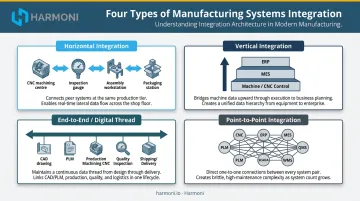
Horizontal integration connects systems and processes laterally across the factory floor — linking CNC machining cells, inspection equipment, assembly stations, and packaging lines so production data flows from one stage to the next without manual handoffs or transcription errors between workcenters.
ISA-95 supports horizontal integration through standardized operations models, message services, and master-data profiles — giving manufacturers a reusable architecture for cross-cell data exchange.
Vertical Integration
Vertical integration connects operational shop floor data upward to enterprise systems — from machines and MES at Levels 1–3 all the way to ERP at Level 4. This enables plant leadership to see live production status, costs, and quality metrics without waiting for end-of-shift reports.
The LeClaire Manufacturing case illustrates the potential here: after implementing machine monitoring, monitored vertical-CNC utilization rose from 11% to 49% — a 38-percentage-point increase driven by visibility that previously didn't exist.
End-to-End Integration (Digital Thread)
End-to-end integration creates a full-lifecycle data flow from product design (CAD, PLM) through production, logistics, and customer delivery. The DoD defines the digital thread as connecting authoritative data and digital models to provide actionable information to decision-makers throughout a system's lifecycle.
This complete traceability is non-negotiable in regulated industries — aerospace, defense, and medical device manufacturing all require audit trails and genealogy records that only end-to-end integration makes practical.
Point-to-Point Integration
Point-to-point integration directly connects individual systems to each other. It's the fastest approach to implement, but it becomes brittle and unmanageable as the system count grows. Its core limitations compound quickly:
- Each new system requires a new direct connection to every other system it must communicate with
- Any change to one system risks breaking others downstream
- Troubleshooting failures means tracing problems across a tangled web of custom links
- Total integration complexity scales with the square of connected systems, not linearly
Point-to-point works as an early-stage shortcut. For manufacturers running more than a handful of connected systems, it's a liability — not a long-term architecture.
Why MSI Matters: Core Benefits for Mid-to-Large Manufacturers
Real-Time Shop Floor Visibility
Integrated systems give managers and operators a unified view of machine status, job progress, quality alerts, and operator activity as they happen. Problems surface and get resolved during production, before the shift ends.
McKinsey's discrete manufacturing research associates real-time connectivity use cases with potential throughput gains of 10–30% and machine downtime reductions of 30–50%. These ranges aren't guaranteed by integration alone, but they reflect what becomes possible when data flows in real time.
Elimination of Manual Errors and Wasted Operator Time
Disconnected systems force operators into non-productive loops:
- Manually transcribing job data from ERP printouts
- Cross-referencing paper travelers against physical parts
- Interpreting conflicting instructions from multiple sources
- Walking across the plant to check job status or find a supervisor
Integration eliminates these steps. Operators receive job data, work instructions, and quality checksheets automatically at the workcenter — enabling them to focus on execution rather than information-gathering. In precision manufacturing environments, a single setup error can scrap a high-value part worth thousands of dollars in material and machining time.
Accurate Job Costing and Financial Control
When ERP, MES, and machine data are integrated, manufacturers can capture actual labor time, machine utilization, and material consumption at the job level. Estimated job costs get replaced with factual figures.
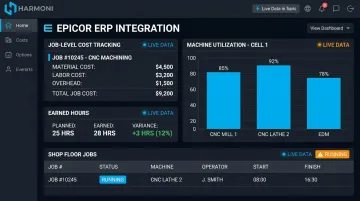
Quoting accuracy, margin analysis, and capacity planning all depend on reliable cost data. Most shops are making those decisions on estimates rather than actuals. Machine Specialties, Inc., a high-precision aerospace and defense manufacturer, used Harmoni's integration with Epicor ERP to shift from tracking only spindle time to capturing earned hours. That shift gave their management team genuine profitability visibility at the job level.
Labor Leverage in a Tight Workforce
The Manufacturing Institute and Deloitte project a net need for as many as 3.8 million US manufacturing workers between 2024 and 2033. With fewer experienced operators available, manufacturers need integration to:
- Standardize processes so less-experienced operators can follow system-driven guidance
- Automate routine decision-making at the workcenter
- Reduce skill dependency that leads to inconsistent quality during turnover
Integration doesn't replace skilled workers. It makes existing workers more effective and protects process knowledge from disappearing when experienced operators leave.
Common MSI Challenges and How to Address Them
Legacy Systems and Data Silos
Most manufacturers operate a mix of legacy machines, older ERP platforms, and standalone tools that were never designed to communicate. Critical production information stays trapped inside individual systems.
The solution isn't necessarily replacing legacy equipment. Middleware, APIs, and orchestration layers can bridge legacy systems without disruption, connecting older CNCs and on-premise ERPs to a unified data environment. Harmoni, for instance, retrofits to existing equipment regardless of age or manufacturer, deploying in weeks with no machine replacement required.
Master Data Inconsistency
Integration amplifies existing data quality problems. If part numbers, routing steps, or cost centers are named differently across ERP, MES, and machine programs, automated data flows will produce incorrect — and sometimes dangerous — results.
Master data harmonization must happen before or alongside integration efforts. That means aligning:
- Bill of materials structures
- Routing step nomenclature
- Part number conventions across systems
- Cost center definitions
Cybersecurity and OT Exposure
Solving data consistency problems opens the door to the next challenge: security. Connecting shop floor operational technology (OT) to enterprise IT systems expands the attack surface, and previously isolated machines become network-accessible.
Relevant compliance frameworks include:
| Framework | Scope |
|---|---|
| NIST SP 800-82 Rev. 3 | OT topologies, threats, and safeguards |
| NIST CSF 2.0 | Organization-wide cybersecurity risk management |
| ISA/IEC 62443 | Industrial automation and control system lifecycle |
| CMMC | DoD contractors handling FCI or CUI |
Zero-trust architecture, role-based access controls, and encrypted data transmission are baseline requirements — not optional additions — when designing integration architecture that connects OT to enterprise systems.
Steps to Build an Effective Manufacturing Systems Integration Strategy
1. Define outcomes before selecting technology
Start by identifying the specific operational KPIs you need to move — OEE improvement, scrap rate reduction, on-time delivery, job costing accuracy. Then select integration tools that demonstrably address those outcomes. Integrating for integration's sake produces dashboards, not results.
2. Assess your current integration baseline
Before any implementation, document:
- Which systems you have at each ISA-95 level
- What data currently flows between them (and what doesn't)
- Where the highest-impact gaps exist
- What master data cleanup is needed before automation will work
3. Start with a high-impact pilot, then scale
Begin with a single production line, workcenter cluster, or product family. Validate connectivity, measure results against your target KPIs, and surface implementation issues in a controlled environment before rolling out plant-wide.
Platforms built for phased deployment — like Harmoni, which connects to existing CNC equipment and ERPs without machine replacement — can go live in weeks and deliver measurable results quickly. That makes the business case for broader rollout far easier to build.
4. Build toward an orchestration model, not just connectivity
The final goal of MSI is a coordinated execution environment — one where machines, operators, and enterprise systems all act on the same real-time information simultaneously. Passing data between systems is a step along the way, not the destination.
Factory orchestration — where people, machines, and systems are coordinated rather than just connected — is the maturity level at which integration delivers its highest value.
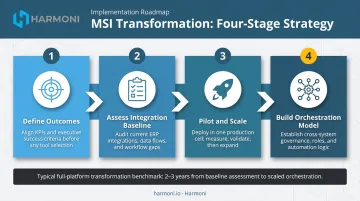
McKinsey notes that full manufacturing digital transformations typically take two to three years from baseline to P&L impact. A phased approach that starts delivering value in weeks is how manufacturers get there without burning out on a multi-year program that never ships.
Frequently Asked Questions
What is system integration in manufacturing?
Manufacturing system integration is the process of connecting machines, software (ERP, MES, IIoT), and human interfaces into a unified production environment. Data flows automatically across systems, enabling real-time decision-making and coordinated operations rather than manual handoffs between disconnected tools.
What are the four types of system integration?
The four types are horizontal (lateral connections across shop floor processes), vertical (machine data flowing up to enterprise systems), end-to-end or digital thread (product design through delivery), and point-to-point (direct system-to-system connections). Each type fits a different integration scope and architectural requirement.
What is the difference between ERP and MES in manufacturing integration?
ERP manages business-level data — demand, costs, inventory, and scheduling. MES manages operational execution on the shop floor — work orders, machine status, and quality. MSI ensures these two layers share data in real time, closing the gap between business plans and what actually happens in production.
What are the biggest challenges of manufacturing system integration?
The main challenges are legacy system incompatibility, inconsistent master data across platforms, cybersecurity risks from connecting OT and IT systems, and the organizational challenge of aligning IT, operations, and engineering teams around a shared integration roadmap.
How long does a manufacturing system integration project typically take?
Simple connections can be completed in weeks; enterprise-wide programs span months to years. McKinsey estimates full manufacturing digital transformations take two to three years from baseline to P&L impact. Phased, pilot-first approaches help manufacturers capture value earlier while keeping implementation risk manageable.
What is a factory orchestration platform and how does it relate to MSI?
A factory orchestration platform sits between ERP/MES systems and the shop floor to coordinate operators, machines, and engineering requirements in real time. It extends MSI by ensuring integrated data drives consistent execution across people and machines, going beyond simple system-to-system data exchange.