Introduction
Most manufacturers know they have waste. The harder problem is seeing exactly where it lives — in the pauses between processes, in the extra steps operators take to find information, in the inventory sitting idle between departments.
Research from the Lean Enterprise Research Centre (LERC) puts numbers to this problem: in a typical physical-product environment, only 5% of activity adds customer value, 35% is necessary but non-value-adding, and 60% is pure waste. That ratio is striking. It means the majority of what happens on most shop floors doesn't move a product closer to what the customer is paying for.
Lean manufacturing is the systematic response to that problem — a proven philosophy built around defining what customers actually value, then eliminating everything else. Understanding how it works — and how to apply it — is what this article is about.
It covers lean's definition and history, its five core principles, the seven (plus one) wastes, essential tools, implementation realities, and how modern technology helps manufacturers execute lean where it counts most: on the shop floor.
Key Takeaways
- Lean manufacturing targets waste: any activity that consumes resources without adding customer value
- The five lean principles form a continuous improvement cycle, not a one-time checklist
- Eight waste categories (DOWNTIME) give practitioners a framework for identifying and naming loss
- Lean tools like VSM, 5S, and Kanban work together to create stable, visible, pull-driven production
- Real-time shop floor visibility extends lean's reach by surfacing waste as it happens, not after the shift ends
What Is Lean Manufacturing?
Lean manufacturing is a management philosophy and production system focused on maximizing customer value by systematically identifying and eliminating waste — defined as any activity that consumes resources without creating value from the customer's perspective.
That last phrase matters. Value is defined by the customer, not the manufacturer — so any step that doesn't contribute to what they want and are willing to pay for is a candidate for elimination.
Origins: The Toyota Production System
After World War II, Toyota faced severe constraints: limited capital, no space for large inventories, and scarce natural resources. The high-volume, batch-based model Henry Ford had perfected in Dearborn simply didn't fit.
Taiichi Ohno, who led TPS development through the 1950s and 1960s, built a fundamentally different system. Where Ford ran massive production runs between separated departments, Toyota developed one-piece flow — products advancing one at a time through adjacent, product-aligned cells. The result: shorter lead times, lower work-in-process inventory, and faster exposure of defects.
Toyota's thinking built on Frederick Winslow Taylor's scientific management and Ford's flow logic. But it went further — embedding continuous improvement into daily operations and addressing culture and management systems alongside physical layout.
How "Lean" Entered the Western Vocabulary
Three milestones brought lean into the Western mainstream:
- John Krafcik coined "lean production" in his 1988 Sloan Management Review article "Triumph of the Lean Production System"
- James Womack and Daniel Jones popularized lean thinking in their 1990 book The Machine That Changed the World
- Their 1996 Lean Thinking formally defined the five-principle framework that practitioners still use today
By the end of the 1990s, "lean" had displaced "JIT manufacturing" as the dominant term in Western manufacturing.
Understanding what lean replaced — not just in name, but in practice — makes the contrast with traditional batch-and-queue production clearer.
Lean vs. Traditional Batch-and-Queue
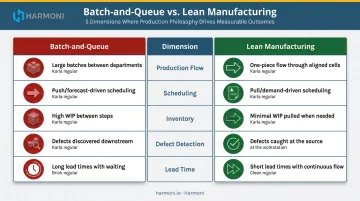
| Dimension | Batch-and-Queue | Lean |
|---|---|---|
| Production flow | Large batches between departments | One-piece flow through product-aligned cells |
| Scheduling | Push (forecast-driven) | Pull (demand-driven) |
| Inventory | High WIP between steps | Minimal WIP; pulled only when needed |
| Defect detection | Discovered downstream, often late | Caught at the source |
| Lead time | Long, with waiting built in | Short, with continuous flow |
The 5 Core Principles of Lean Manufacturing
Womack and Jones defined these five principles in Lean Thinking as the conceptual backbone of any lean implementation — not a one-time checklist, but a continuous cycle.
1. Define Value
Start with the customer. Value is what they want, need, and will pay for. Every production activity that doesn't contribute to that definition is a candidate for elimination. This deceptively simple step forces manufacturers to question processes they've run for years.
2. Map the Value Stream
Identify every step involved in delivering a product from raw material to customer. Value Stream Mapping (VSM) is the primary tool here. It visually distinguishes which steps create value from which steps are waste, and builds the foundation for targeted elimination. You can't improve what you haven't mapped.
3. Create Flow
Once waste steps are identified, make the product flow continuously through the remaining value-added steps — no batching, no waiting, no unnecessary stops. The results are compounding:
- Reduces lead times and increases throughput
- Exposes quality problems faster, since defects surface quickly in continuous flow
- Prevents defects from hiding inside large batches where they accumulate undetected
4. Establish Pull
Rather than producing based on forecasts (push), lean systems produce only what is needed, when it is needed, in the quantity demanded. Just-in-Time (JIT) is the philosophical framework; Kanban is the operational mechanism — a signaling system that authorizes production or withdrawal only when downstream demand exists.
5. Pursue Perfection
Lean is a culture of continuous improvement — Kaizen — where every employee at every level participates in identifying and eliminating waste. It has no end date and no finish line.
This is the hardest principle to sustain and the most important for long-term results. Organizations that treat lean as a one-time initiative invariably regress.
The 7 Wastes of Lean Manufacturing (Muda)
Muda is the Japanese TPS term for waste. Taiichi Ohno categorized the original seven waste types as the primary targets for elimination on the shop floor.
The Original Seven
| Waste | Definition | Shop Floor Example |
|---|---|---|
| Overproduction | Producing more than needed, or ahead of demand | Running a machine to keep utilization high when no order exists |
| Waiting | Idle time from poor synchronization or stoppages | Operators standing while a setup is completed on the next machine |
| Transportation | Unnecessary movement of materials or products | Moving parts across the facility twice before they reach the next operation |
| Overprocessing | Steps or effort beyond what the customer requires | Finishing a surface to a tolerance tighter than the spec demands |
| Inventory | Excess raw materials, WIP, or finished goods sitting idle | Pallets of semi-finished parts queued between departments |
| Motion | Unnecessary movement of people | Operators walking to a shared terminal to look up a work instruction |
| Defects | Errors requiring rework or causing rejection | Scrapped parts from a wrong program loaded to a machine |
The 8th Waste: Non-Utilized Talent
Added after Ohno's original seven, Non-Utilized Talent — also called unused employee knowledge or creativity — recognizes that organizations waste value when operators closest to the process aren't involved in solving its problems. This waste is especially visible in modern manufacturing environments where front-line workers hold detailed process knowledge that management never accesses.
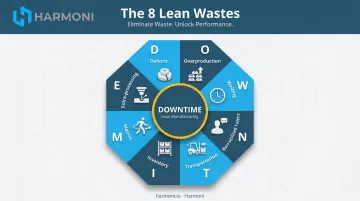
A useful memory aid: DOWNTIME — Defects, Overproduction, Waiting, Non-utilized talent, Transportation, Inventory, Motion, Extra-processing.
How Wastes Compound
Wastes rarely occur in isolation. Overproduction is considered especially serious because producing before demand exists creates inventory, which requires storage and handling (transportation), which creates conditions where defects go undetected longer. Eliminating one waste creates ripple effects, and allowing one to persist often sustains several others.
Identifying waste requires direct observation: walking the process, talking to operators, and comparing what's actually happening against what the standard routing assumes. That gap between assumption and reality is where most waste hides.
Common Lean Manufacturing Tools
Lean tools are the tactical methods used to implement the five principles. The tools are not lean themselves — they're means to an end. The combination that works depends on the waste patterns your value stream analysis reveals.
Three Foundational Tools
Value Stream Mapping (VSM) diagrams every material and information flow step from order to delivery, distinguishing value creation from waste. Start here — shared visibility into the current state is what makes every subsequent improvement decision defensible.
5S — Sort, Set in Order, Shine, Standardize, Sustain — is the workplace organization methodology that creates the stable, visual environment required for everything else to work. A 2022 case study in a plastic bag manufacturing facility found that 5S implementation reduced tool-search time from 30 to 5 minutes over 20 weeks, alongside measurable reductions in total operating time.
Kaizen Events are short, focused improvement sprints — typically around five days — that drive rapid change while building a culture of participation. They work because they put operators at the center of the improvement process, not on the sidelines of it.
Supporting Tools That Extend the System
Once VSM and 5S are in place, these tools address specific waste patterns the analysis surfaces:
- Kanban — visual or electronic pull-scheduling that caps production at actual downstream demand, preventing overproduction
- SMED (Single-Minute Exchange of Die) — reduces changeover times; a 2018 pharmaceutical project cut major changeover time by 30% over 12 months at a bottleneck operation
- Jidoka — builds quality in by authorizing machines and operators to stop production the moment a defect is detected; one of TPS's two foundational pillars alongside JIT
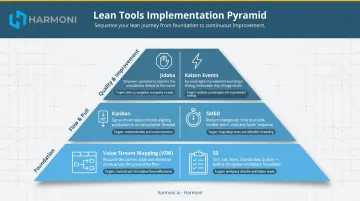
VSM shows you where waste lives. 5S removes the instability that hides it. Everything else builds from there.
How to Implement Lean Manufacturing
Start With Stability
Successful lean implementation requires operational stability first. The Lean Enterprise Institute defines basic stability through the 4Ms — Man, Machine, Material, Method. Without a reliable workforce, well-maintained equipment, consistent material quality, and standardized work methods, lean tools won't hold. You can't build continuous improvement on an unstable foundation.
Lean Is a Cultural Transformation
Lean tools alone don't sustain results — the culture has to follow. Leadership must model lean behavior, making decisions at the level closest to the work rather than from the executive suite. Front-line operators are closest to the process and typically have the best improvement ideas. Organizations that implement tools while ignoring this dynamic see early gains erode quickly.
Real Trade-Offs to Plan For
Lean has real limitations that leaders should understand:
- Supply chain fragility — JIT's minimal inventory buffers create vulnerability during disruptions. After COVID-19 exposed this risk, 93% of senior supply-chain executives indicated plans to increase resilience and flexibility
- Worker strain — research in automotive environments has associated lean production with intensified work pace; the tradeoff between efficiency and operator wellbeing requires active management
- No universal playbook — a 2022 systematic review confirmed that lean tools are often adopted inconsistently, with wide variation in outcomes across industries and shop types
Lean Manufacturing in the Modern Factory: The Role of Technology
Digital tools haven't changed lean principles — they've made them more executable. The technology stack doing that work includes:
- IoT sensors that enable real-time monitoring of machine performance
- ERP systems that improve information flow across the value chain
- Data analytics that surface predictive insights rather than after-the-fact reports
According to Deloitte's 2025 Smart Manufacturing Survey, 57% of large manufacturers have adopted data analytics and 46% have adopted industrial IoT at the facility level — with reported improvements of 10%-20% in output and 10%-15% in unlocked capacity.
The Execution Gap
Many manufacturers have lean initiatives on paper. Fewer execute them consistently day-to-day. The gap shows up in familiar ways: operators searching for work instructions, machines sitting idle while a setup waits for a program, problems discovered in end-of-shift reviews rather than as they occur.
Real-time shop floor visibility — knowing what is happening at each workcenter right now — is the missing link for most lean programs. Without it, waste accumulates between observations.
Technology as a Lean Enabler
Platforms like Harmoni's factory orchestration solution address this execution gap by coordinating people, machines, ERP systems, and engineering requirements in real time. Rather than replacing lean principles, the technology makes them actionable at the operator level — where lean either succeeds or fails.
In practice, this looks like:
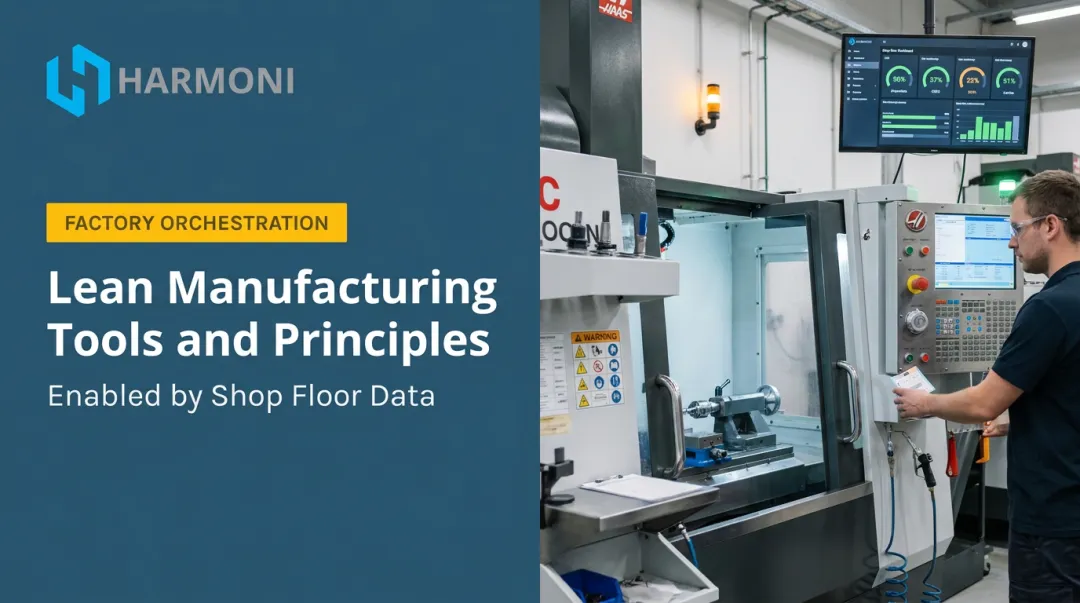
- Live OEE dashboards that surface equipment losses as they occur
- RFID-based job and operator identification that eliminates manual data entry at the machine
- Digital work instructions and automated CNC program loading that ensure operators have the right information at the right workstation
- Machine-side command centers that give operators clear direction without leaving their stations
WessDel, a precision machining operation using Harmoni, documented that ERP transactions alone were consuming an average of 11 minutes per operator per transaction. Automating those transactions at the machine converted wasted time into productive uptime — 17 additional productive hours per employee per month. That's lean thinking applied through digital execution.
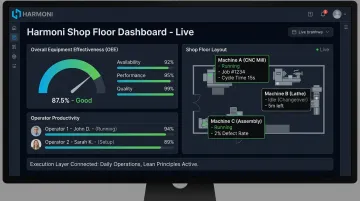
Technology doesn't replace the lean management system. It makes lean's core demands — real-time visibility, immediate problem response, consistent process execution — something most shop floors can actually deliver, consistently, every shift.
Frequently Asked Questions
What does lean manufacturing mean?
Lean manufacturing is a management philosophy focused on eliminating waste — any activity that consumes resources without adding value from the customer's perspective. Rooted in Toyota's Production System, it delivers more value using fewer resources.
What are the key principles of lean manufacturing?
Womack and Jones defined five principles in Lean Thinking (1996): Define Value, Map the Value Stream, Create Flow, Establish Pull, and Pursue Perfection. Together, these principles form a continuous improvement cycle where each pass surfaces new waste to address.
What is the Toyota Production System (TPS)?
TPS is the original lean framework developed by Toyota after WWII, built on two pillars: Just-in-Time production and Jidoka (stopping production automatically when defects are detected). It is the direct ancestor of what Western manufacturers call lean manufacturing.
What are the 7 wastes of lean manufacturing?
The seven wastes are Overproduction, Waiting, Transportation, Overprocessing, Inventory, Motion, and Defects — categorized by Taiichi Ohno within TPS. An eighth waste, Non-Utilized Talent, is widely recognized today. The DOWNTIME acronym covers all eight.
What is the difference between lean manufacturing and Six Sigma?
Lean focuses on eliminating waste and improving flow speed. Six Sigma focuses on reducing process variation and defects using statistical methods. Lean Six Sigma combines both, targeting flow efficiency and variation reduction in tandem.