
This is daily life for discrete manufacturers. Many manufacturers struggle with coordinating people, machines, and systems across complex assemblies, and the gap between what's planned and what's actually happening on the floor creates real costs.
This article defines discrete manufacturing, compares it to process manufacturing, and breaks down the elements and challenges that shape how these shops run.
Key Takeaways
- Discrete manufacturing produces distinct, countable items—cars, electronics, machinery—that can often be taken apart
- Process manufacturing blends raw materials into irreversible outputs like chemicals or food
- BOMs, routings, and work orders form the backbone of discrete production management
- Real-time visibility across ERP, MES, machines, and operators reduces errors and downtime
What Is Discrete Manufacturing?
Discrete manufacturing produces distinct, individually identifiable units assembled from separate components. Unlike a batch of chemicals, these products can typically be taken apart back into their original pieces.
Products get measured in units, not volume or weight. A finished airplane wing or a smartphone can be traced through production using a serial number, which is critical for warranty claims and quality audits.
Common industries include:
- Automotive
- Aerospace and defense
- Electronics
- Machinery
- Medical devices
- CNC machining
Discrete manufacturers typically run one of these production models:
- Make-to-stock (MTS)
- Make-to-order (MTO)
- Assemble-to-order / configure-to-order (ATO/CTO)
- Engineer-to-order (ETO)
The model a shop chooses shapes everything downstream, from inventory strategy to scheduling.
According to NIST's 2024 Annual Report on the U.S. Manufacturing Economy, discrete technology manufacturing—covering computers, transportation equipment, machinery, and electronics—accounted for 39% of U.S. manufacturing in 2023, contributing value added equal to 3.7% of GDP in 2022.
Common Characteristics
Discrete manufacturing environments share several traits:
- Component-based production built from individual parts and sub-assemblies
- Workstation or line-based assembly, often with multiple stops per unit
- Frequent changeovers as jobs and part numbers rotate through machines
- Serialized outputs for traceability
- Heavy reliance on CAD and digital design integration
Discrete vs. Process Manufacturing: What's the Difference?
Ask yourself one question: can the finished product be disassembled back into its original components? If yes, you're looking at discrete manufacturing. If no, you're looking at process manufacturing.
An APICS Fox River Chapter presentation draws this exact distinction. Process manufacturing relies on formulas and recipes to produce bulk goods that can't be reversed into their original ingredients. Discrete manufacturing relies on bills of material and routings to build identifiable, separable units.
| Factor | Discrete Manufacturing | Process Manufacturing |
|---|---|---|
| Output type | Countable units | Bulk volume/weight |
| Inputs | Components, sub-assemblies | Raw materials, ingredients |
| Planning method | BOMs and routings | Formulas and recipes |
| Workflow | Assembly, machining, inspection | Mixing, blending, reacting |
| Example products | Cars, aircraft, electronics | Chemicals, food, pharmaceuticals |
Reality gets messier than the table suggests. A car combines discrete assembly with process elements like paint and fluids. A bottled beverage involves process manufacturing for the liquid and discrete packaging steps for the bottle and label.
Make-to-order shows up far more often in discrete manufacturing, where custom configurations are common. Process manufacturing leans toward make-to-stock, since bulk production usually targets forecasted demand rather than individual orders.
Examples and Types of Discrete Manufacturing
Discrete manufacturing shows up everywhere once you start looking:
- Automobiles and automotive components
- Aircraft and aerospace parts
- Smartphones and consumer electronics
- Appliances
- Furniture
- CNC-machined precision components Production layouts generally fall into two camps:
- Assembly lines suit high-volume, low-variety production, such as consumer electronics running the same design thousands of times
- Job shops suit high-mix, low-volume work, where each job might require a different setup, tooling, and routing Most modern discrete plants don't fit neatly into either category anymore. A 2023 peer-reviewed review found that high-mix, low-volume production typically happens in job-shop environments with dynamic, variable routing sequences. This hybrid reality demands scheduling flexibility that rigid, line-based systems can't deliver.

Key Elements That Drive Discrete Manufacturing Operations
Three elements drive execution on any discrete shop floor.
Bill of Materials (BOM). This is the hierarchical list of every part and sub-assembly needed to build a finished unit. A BOM for an aerospace bracket might include raw stock, fasteners, and sub-components sourced from multiple suppliers.
Production routing. This defines the sequence of operations—machining, assembly, and inspection—that a unit follows through the plant. Routing determines which machines a job touches and in what order.
Work orders. This is the execution layer. Work order management turns the BOM and routing into trackable shop floor instructions that operators actually follow.

Traceability ties it all together. Serial numbers and lot codes matter for:
- Quality control investigations
- Product recalls
- Regulatory compliance (especially in aerospace, defense, and medical devices)
Downtime remains a persistent drag on all of this. NIST's 2023 Annual Report on the U.S. Manufacturing Economy found that downtime equaled 8.3% of planned production time, worth an estimated $245 billion across discrete manufacturing sectors. Poor scheduling and excessive changeovers are frequent contributors to that lost time.
Common Challenges Facing Discrete Manufacturers
Discrete manufacturers deal with a specific set of operational headaches:
- Supply chain volatility. Multi-tier component sourcing means a single delayed part can stall an entire assembly.
- Complex, variant-heavy BOMs. Frequent engineering changes strain both planning teams and shop-floor execution.
- Data fragmentation. Information scattered across ERP, MES, machines, and operators leads to disconnected decision-making.
These issues rarely stay contained. They compound into wasted operator time, inconsistent execution, and inaccurate job costing.
WessDel, Inc., a San Jose manufacturer of aerospace and defense components made from titanium and beryllium alloys, faced exactly this kind of data gap. Operators entered time twice, once in their Epicor Kinetic ERP and once in a separate machine-monitoring system.
Time studies showed operators spent an average of 11 minutes completing each ERP transaction, time that added up fast across a busy shop.
Improving Discrete Manufacturing Execution with Real-Time Orchestration
Traditional ERP and MES systems often can't capture what's actually happening on the shop floor in real time. They tell you what was planned. They don't always tell you what's happening right now, at this machine, with this operator.
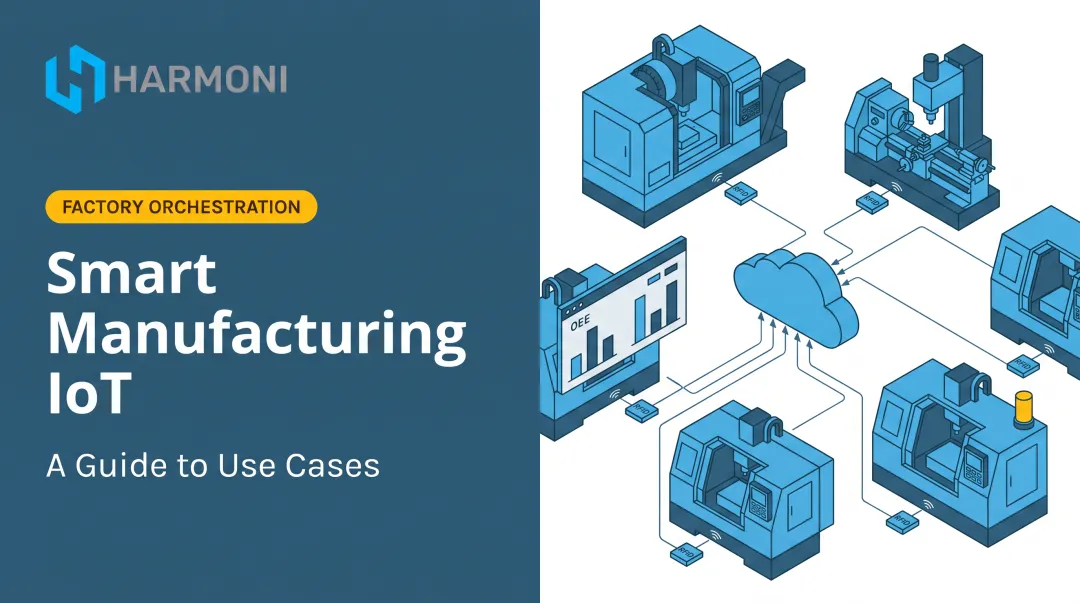
That gap is where a factory orchestration layer comes in. It sits between ERP, MES, machines, and operators, coordinating work as it happens instead of reconstructing it afterward.
Harmoni was built to close that gap. It combines machine data, operator activity, and ERP workflows into unified, role-based dashboards so managers see OEE, utilization, downtime, job costing, labor productivity, and quality in one view—without hunting across three systems.
Harmoni also automates tasks that used to eat operator time:
- RFID-based job and operator detection at each workcenter
- Centralized command centers that pull up work instructions automatically
- Machine-based job clocking that eliminates duplicate time entry
- Exception alerts that notify managers the moment a work cell needs attention

For mid-to-large discrete manufacturers in CNC machining, aerospace, defense, and automotive, this shift matters. Instead of finding out about a scrapped part or a missed deadline after the fact, teams catch it while it's still fixable.
Frequently Asked Questions
What is an example of a discrete manufacturing process?
Automotive assembly is a classic example. Individual components like engines, chassis parts, and electronics move through a defined routing until they combine into a finished vehicle that can be taken apart.
What is the difference between discrete manufacturing and process (continuous) manufacturing?
Discrete manufacturing produces countable units that can be disassembled using BOMs and routings. Process manufacturing creates non-reversible bulk outputs, like chemicals or food, using formulas and recipes.
What are the main types of manufacturing?
Manufacturing generally splits into discrete, batch process, and continuous process types. Many real-world products, like a car with painted panels, combine discrete and process elements into hybrid models.
What does discrete mean in manufacturing?
"Discrete" refers to individually identifiable, countable units built from separate components. These units can typically be disassembled back into their original parts.
Why is traceability important in discrete manufacturing?
Traceability, through serial numbers and lot codes, supports quality control, product recalls, warranty management, and regulatory compliance. It's especially critical in aerospace, defense, and medical device manufacturing.
How can manufacturers reduce production errors in discrete manufacturing?
Real-time visibility, standardized routings, and orchestration platforms like Harmoni help catch issues while production is happening, not after. This prevents scrap, rework, and inaccurate job costing before they add up.