Real-time data gets discussed constantly — usually in the context of digital transformation. But the actual value isn't abstract. It shows up at 10 a.m. on a Tuesday when a supervisor sees that a five-axis machine has been idle for 40 minutes and can do something about it now — rather than reading about it in the end-of-shift report.
This article covers what real-time data actually makes possible in manufacturing operations: the specific advantages, what it costs to operate without it, and how to extract maximum value from it.
Key Takeaways
- Real-time data compresses the gap between a problem occurring and someone fixing it — from hours to minutes.
- Unified visibility across machines, operators, and ERP systems eliminates the need to chase status updates manually.
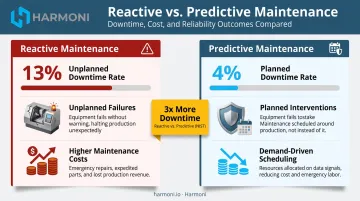
- Manufacturers operating on reactive maintenance face 3x more downtime than those using predictive approaches, per NIST data.
- Defects caught at the workcenter affect one part; defects caught after a batch run can affect dozens.
- Real-time data only drives lasting improvement when it's connected across systems, not isolated in a standalone dashboard.
What Is Real-Time Data in Manufacturing?
MESA describes real-time manufacturing data as time-stamped, time-varying information used for process control and trend analysis — where each data point reflects the current state of an operation and changes continuously as production progresses. In practice, that means data from machines, operators, and production systems is captured continuously and available for action within seconds or minutes of an event on the shop floor.
Where Real-Time Data Applies
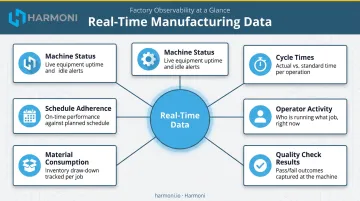
Real-time data covers the full operational picture of a manufacturing environment:
- Machine status — running, idle, faulted, in-cycle
- Cycle times — actual versus target, per operation
- Operator activity — job assignment, time at workcenter, progress against schedule
- Quality check results — dimensional data, inspection outcomes, operator-reported anomalies
- Material consumption — parts produced, scrap generated
- Schedule adherence — where each job stands against its due date
What makes real-time data operationally valuable is speed and accuracy together. It compresses the gap between a problem occurring and someone acting on it — replacing end-of-shift reports and floor-walking guesswork with accurate information at the exact moment a decision needs to be made.
Three Key Advantages of Real-Time Data in Manufacturing
The advantages below are grounded in outcomes manufacturers actually track: uptime, scrap rate, labor efficiency, job cost accuracy, and on-time delivery. Each advantage also compounds — visibility enables faster decisions, faster decisions enable better maintenance, and better maintenance enables consistent quality.
Advantage 1: Unified Operational Visibility Across Machines, Operators, and Systems
Unified visibility means having a single, current picture of what's happening across every workcenter. Not just whether a machine is running — but which job it's running, which operator is at the station, where that job sits against schedule, and whether anything is off-spec.
What changes with real-time data:
- Sensors and machine integrations report status continuously
- Operator activity is captured via RFID or check-in events
- ERP and scheduling data provide the job context
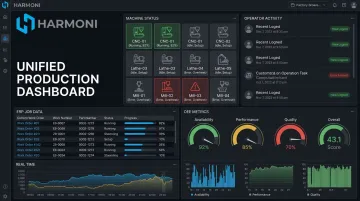
When these streams are brought together in a unified dashboard, managers stop relying on shift reports, floor walks, or operator memory. The gap between what's happening and what management knows is happening — which in most shops without automation is measured in hours — drops to near-zero.
A concrete example: Coastal Machine and Supply, an aerospace and defense shop, introduced real-time stoppage alerts and job tracking on a DMG MORI five-axis machine. The result was a 46% increase in machine utilization — driven entirely by the ability to see and respond to idle time as it happened, including during lights-out operations.
All Metals Fabricating, a contract manufacturer serving aerospace and defense customers, reported a 60% utilization increase in the first three months and 152% over two years after management shifted from relying on operator explanations to analyzing real-time monitoring trends.
KPIs directly impacted:
- OEE (Overall Equipment Effectiveness)
- Labor utilization rate
- On-time job completion
- Job cost accuracy
- Schedule adherence
When this matters most: Unified visibility has the highest impact in multi-machine, multi-operator environments where no single person can physically see the entire floor — especially shops running simultaneous jobs across 10+ workcenters or operating across multiple shifts.
For precision manufacturers in aerospace and defense, this visibility also supports traceability — knowing exactly who ran which job, on which machine, and when, without relying on paper logs.
Harmoni's factory orchestration platform addresses this directly. Its real-time dashboards bring machine data, ERP workflows, and operator activity together in a single view, giving production teams operational context without toggling between systems.
The WessDel case study — an aerospace and defense shop machining titanium and beryllium alloy components — documented 17 productive hours gained per employee per month and a 10% reduction in delinquent jobs after implementing the platform.
Advantage 2: Predictive Maintenance and the Elimination of Unplanned Downtime
Predictive maintenance means using real-time signals from equipment — cycle time deviation, tool wear indicators, abnormal operating patterns — to schedule maintenance before a failure occurs, rather than after.
Without real-time monitoring, most shops run on scheduled preventive maintenance intervals. The problem: machines are sometimes serviced when they don't need it, and sometimes fail before their scheduled service date. Real-time data makes maintenance demand-driven rather than calendar-driven.
A NIST survey of U.S. discrete manufacturers found that establishments in the highest quartile for reactive maintenance reliance experienced 13.0% downtime versus 4.0% in the lowest quartile — more than three times the rate. The same study estimated $119.1 billion in preventable annual maintenance losses across U.S. manufacturing, including $18.1 billion in direct downtime costs.
How it works in practice:
- Continuous monitoring flags deviations from normal operating ranges
- Automated alerts give maintenance teams time to act during planned downtime windows
- Cycle time data identifies machines beginning to drift before a hard failure
Unplanned downtime doesn't just stop one machine — it backs up jobs downstream, forces operators to stand idle, and can cascade into missed customer deliveries across multiple orders.
KPIs directly impacted:
- Unplanned downtime frequency
- Mean time between failures (MTBF)
- Mean time to repair (MTTR)
- Maintenance cost per machine
- Overall equipment availability
When this matters most: This advantage is especially high-value in shops where equipment runs near capacity, machine repair lead times are long, or a single machine is a bottleneck for multiple downstream operations — conditions that are common in CNC machining and precision aerospace manufacturing.
Advantage 3: In-Process Quality Control and Active Scrap Prevention
In-process quality control means detecting defects and process deviations while a part is still being produced — not after the batch is complete and the damage is already done.
A defect caught at the workcenter affects one part. The same defect found after a batch run of 50 can result in scrapping all 50, reworking hours of labor, and potentially missing a customer delivery date.
The mechanism: Quality signals are captured at the point of production and immediately compared against engineering specifications:
- Dimensional measurement data from in-process inspection
- Tool offset and wear alerts
- Operator-reported anomalies via digital checksheets
- Cycle time deviations that suggest process drift
When a deviation is detected in real time, production can be paused or corrected before additional scrap accumulates.
When scrap and rework are captured in real time against specific jobs and operators, manufacturers gain accurate insight into true job cost — not just the ERP's pre-production estimate. MSI, a high-precision aerospace, defense, and medical parts manufacturer with over 300 employees, nearly eliminated part count errors on complex, high-risk parts after implementing Harmoni — a direct reduction in scrap exposure on their most consequential work.
Harmoni's engineering revision control feature is also relevant here: the platform ties the correct job, part, and revision to the correct CNC program, reducing the risk of operators running a job against outdated documentation — one of the most common and costly sources of scrap in revision-sensitive production environments.
KPIs directly impacted:
- First-pass yield
- Scrap rate
- Rework hours
- Cost of poor quality (COPQ)
- Job cost variance
When this matters most: In-process quality control delivers the highest ROI in environments with tight tolerances, high material costs, or strong regulatory requirements — specifically aerospace, defense, and healthcare manufacturing, where a single nonconforming part can trigger significant downstream consequences.
What Happens When Real-Time Data Is Missing
Most manufacturers without real-time data operate from end-of-shift summaries, morning stand-up meetings, or floor walks. All of these describe what happened — not what is happening. By the time anyone acts, the problem has fully materialized.
The operational consequences stack up:
- Downtime blindness: Managers don't know when a machine goes idle, how long it's been down, or why — and significant capacity is already lost before anyone investigates.
- Higher scrap exposure: Defects caught hours after they occur waste far more material and labor than defects caught in the moment. NIST data shows the highest reactive-maintenance quartile experienced 3.3% defect rates versus 0.2% in the lowest — a 16x difference.
- Reactive firefighting: Management time goes toward investigating problems that already happened, not preventing the next one.
- Inaccurate job costing: Manual time entry is inconsistent and delayed. Labor inefficiency, untracked scrap, and unrecorded rework create chronic margin erosion with no clear cause to fix.
Each of these problems compounds the others. A machine goes down, a defect runs undetected, and by the time the shift report surfaces the data, the damage to delivery schedules and job margins is already done.
How to Get the Most Value from Real-Time Data
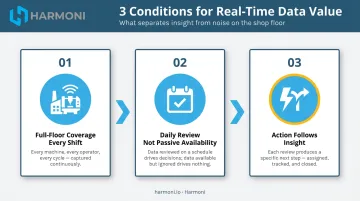
Real-time data delivers its full value only when it's connected across the right sources, reviewed consistently, and — critically — acted upon. Three conditions determine whether it works:
1. Full-floor coverage, every shift Monitoring only select machines or specific audit windows gives a skewed picture. Continuous, floor-wide data collection is what allows manufacturers to trust the trends they're seeing — not just the snapshots.
2. Daily review, not passive availability Real-time dashboards should drive production standup meetings — not just sit open in a browser tab. Managers who check data against targets daily catch emerging patterns before they compound into missed deliveries or quality escapes.
3. Action follows insight Knowing a machine ran at 60% utilization yesterday is worthless if nobody asks why. Real-time data is a decision-making input. If insights are consistently gathered but rarely acted on, the system is serving itself — not the operation.
Harmoni's factory orchestration platform supports all three conditions. RFID-driven job identification eliminates manual data entry at the workcenter, supervisor dashboards surface live OEE and machine status without anyone pulling a report, and bi-directional ERP integration keeps job records current as production happens. Operators spend less time logging — managers spend more time deciding.
Conclusion
Real-time data in manufacturing is fundamentally a control and consistency conversation. Manufacturers who know what's happening on their floor as it happens are better positioned to meet delivery commitments, control costs, and prevent problems from escalating before they become expensive.
The three advantages — unified visibility, predictive maintenance, and in-process quality control — compound over time when applied consistently. The WessDel case study shows what that looks like in practice: connecting data across machines, operators, and ERP produced measurable results:
- 17 productive hours gained per employee
- 10% reduction in delinquent jobs
- 5x return on ongoing platform costs
Those numbers came from replacing a fragmented operational picture with a connected one — not from any single feature in isolation.
Real-time data works as an ongoing operational practice, not a one-time implementation. It requires consistent collection, regular review, and a culture of acting on what the data reveals. The floor doesn't run itself. But when operators, supervisors, and planners all work from the same accurate, current information, the decisions they make — and the problems they avoid — are measurably different.
Frequently Asked Questions
Which system is best for real-time data processing in manufacturing?
The best system depends on operational context. MES platforms and factory orchestration platforms handle shop floor processing; SCADA systems suit process control environments. Either way, the priority is a system that connects machines, operators, and business systems in one unified view — not one that monitors those elements separately.
What is an example of a real-time monitoring system in manufacturing?
A practical example is a shop floor dashboard that displays machine status, active job assignments, operator activity, and OEE simultaneously — alerting supervisors the moment a machine goes idle, a cycle time exceeds target, or a job falls behind schedule.
What is an example of real-time data processing on the shop floor?
A CNC machine sends cycle time data to a central system after every part. The system compares that time against the target and flags a deviation immediately — allowing the operator or supervisor to investigate before the problem compounds across the remaining run.
What are examples of real-time data in manufacturing?
Concrete examples include: machine run/idle/fault status, operator login and job assignment, part counts and cycle times per operation, tool wear alerts, and quality inspection results captured at the workcenter.
How does real-time data improve quality control in manufacturing?
Real-time quality data catches defects at the point of production rather than at final inspection, reducing scrap and rework. It also enables root cause analysis while the process condition that caused the defect is still reproducible and correctable.
Can real-time data support predictive maintenance?
Yes. Continuous monitoring of performance indicators — cycle time deviation, alarm codes, operating patterns — helps maintenance teams identify equipment showing early signs of wear. The result is planned, lower-cost interventions rather than reactive emergency repairs.