Introduction
Most manufacturers know the frustration: the ERP shows a job as scheduled, but nobody on the floor knows its actual status. A machine has been running bad parts for two hours, but that won't surface until the end-of-shift quality check. An operator spends 11 minutes per transaction navigating ERP screens — time that isn't cutting metal or adding value. Lean platforms are designed to close exactly that gap.
According to Deloitte's 2025 Smart Manufacturing Survey, 78% of manufacturers now allocate more than 20% of their improvement budgets to smart-manufacturing initiatives — and 92% expect these investments to drive competitiveness over the next three years. The pressure to connect people, machines, and processes in real time has never been greater.
This guide explains what lean platforms are, how they apply lean manufacturing principles through modern digital technology, and what to look for when evaluating one for your operation.
Key Takeaways
- A lean platform bridges ERP planning and shop floor execution by coordinating people, machines, and processes in real time
- Lean platforms apply Toyota Production System principles (waste elimination, just-in-time information, continuous improvement) through digital technology
- They act as an orchestration layer above ERP and MES systems, not a replacement for them
- High-mix, low-volume manufacturers in CNC machining, aerospace, and defense tend to see the greatest impact
- Well-designed platforms deploy in weeks, not months, and deliver measurable improvements quickly
What Is a Lean Platform?
Most manufacturers know what lean means on the shop floor. A lean platform applies those same principles — waste elimination, continuous flow, real-time visibility — to the digital layer that coordinates people, machines, systems, and processes across a manufacturing environment.
The Origins: Toyota's Production System
Lean thinking traces back to Toyota in the 1950s and 1960s, when Taiichi Ohno, backed by Eiji Toyoda, developed the Toyota Production System (TPS). Ohno's work introduced three foundational ideas that remain central to lean today:
- Muda (waste elimination) — removing non-value-added activity from production
- Just-in-time — delivering exactly what's needed, exactly when it's needed
- Kaizen (continuous improvement) — iterative improvement cycles that sustain and build on gains over time
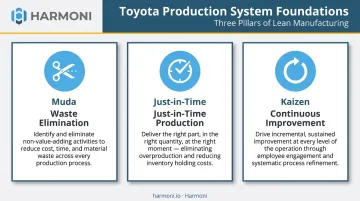
These principles were built for physical production environments. A lean platform takes the same philosophy and applies it to the digital coordination layer governing how information flows across a modern shop floor.
What Makes a Platform "Lean" in Practice
The term gets used loosely. In manufacturing, three related concepts are worth separating out:
- Lean management software — typically focused on tracking kaizen ideas or improvement projects
- Lean data platforms — a data engineering concept applied to pipeline architecture
- Manufacturing lean platform — a broader orchestration layer that acts on real-time operational data
A manufacturing lean platform earns the label by doing specific things: removing friction between systems, eliminating manual handoffs, reducing non-value-added operator steps, and surfacing only the information workers need to execute correctly. The distinction matters — a platform that doesn't actively reduce waste and improve flow is performing visibility, not lean operations.
Core Lean Principles Behind Manufacturing Platforms
Lean platforms aren't just software that mentions lean on a marketing page. Each core lean principle should manifest in a specific, measurable capability.
Eliminate Waste (Muda)
The most visible waste on a shop floor is operator time spent on non-value-added activity — searching for job instructions, manually logging data, navigating ERP screens. These aren't small inefficiencies.
In one documented case, Harmoni found that ERP transactions were consuming an average of 11 minutes per transaction per operator. After deployment, that dropped to seconds — recovering 17 productive hours per employee per month. That's muda elimination in practice, enforced systematically rather than relying on individual discipline.
Manufacturing Leadership Council research found that 70% of manufacturers still collect some data manually and 68% use spreadsheets for at least some analysis — which means waste elimination remains largely unrealized in most facilities.
Amplify Learning Through Real-Time Data
Lean's PDCA cycle only works if teams have accurate, timely feedback. Waiting for end-of-shift reports to discover a process deviation isn't continuous improvement — it's retrospective damage assessment.
Lean platforms generate continuous feedback loops: machine performance data, operator activity, quality outcomes. Real results from lighthouse manufacturing sites illustrate the potential — Foxconn's real-time root-cause visualization was associated with a 90% reduction in unplanned downtime, while Hisense Hitachi's real-time shift-handover assistant correlated with a 16% OEE improvement.
Deliver Just-in-Time Information
The JIT concept isn't only about material flow. It applies equally to information. Operators shouldn't have to hunt for the right work instruction, program revision, or quality checklist — that information should arrive at the workstation exactly when they need it.
Lean platforms push the right job instructions, process parameters, and alerts to operators at the right step, automatically. Harmoni's approach, for example, uses RFID matching to ensure operators receive the correct documentation and CNC program for the job in front of them — without any manual lookup.
Empower the Team and Optimize the Whole System
Effective lean platforms don't optimize one machine or one department in isolation. They connect ERP workflows, machine data, operator activity, and engineering requirements into a single coordinated view. That connection is what separates lean platforms from point solutions.
In practice, this means:
- Operators get a command center at their workstation — instructions, alerts, and quality steps delivered automatically
- Leaders see the full value stream in real time, not shift-end summaries
- Routine decisions execute at the floor level, without supervisor intervention at every step
- Engineering changes propagate to every affected workstation immediately, not through paper packets
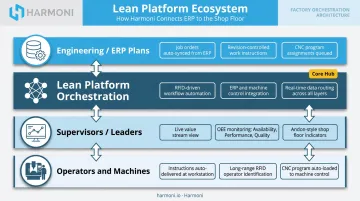
The goal isn't just efficiency at a single machine. It's a system where every layer — machines, people, ERP, and engineering — operates from the same current information.
Key Capabilities of a Lean Platform
Not all platforms that claim lean principles deliver them. These are the capabilities that distinguish a genuine lean platform from a monitoring tool with a lean label.
Real-Time Production Visibility
Lean platforms aggregate machine data, operator activity, and job status into unified dashboards that show what's happening now — not what happened yesterday. This matters because only 56% of manufacturers collect at least half their data in real or near-real time, according to Manufacturing Leadership Council research.
Effective visibility means supervisors can see every machine's efficiency and production progress from any device, act on deviations while they're occurring, and contact the specific work cell operator directly when something falls out of range.
Process Control and Standardization
Real-time visibility shows what's happening — process control determines what should happen. A lean platform enforces correct work procedures by presenting digital work instructions, setup requirements, and quality checklists at the right step, before an error can produce scrap or rework.
McKinsey research found that Jabil's tablet-based interactive work instructions produced a 10% yield increase and 60% fewer manual-assembly quality issues in a defined comparison period. Correct information, delivered at the point of execution, prevents defects rather than detecting them afterward.
Automation of Non-Productive Tasks
In lean manufacturing, manual and repetitive steps are waste. A lean platform automates the tasks that consume operator time without adding production value:
- Logs clock-in/out and job identification via RFID — no keyboard required
- Loads the correct CNC program, settings, and offsets automatically based on job ID
- Reports machine status and alerts without operator intervention
- Replaces paper-based quality and maintenance workflows with digital checksheets
Harmoni, for example, uses long-range RFID to automatically detect nearby employees and jobs, removing the manual touchpoints that accumulate into hours of lost productive time each month.
Integration Across ERP, MES, and Machine Systems
A lean platform sits between existing systems — ERP, MES, CNCs, and other equipment — and acts as an orchestration layer. Per ISA-95, ERP operates at Level 4 (business planning and logistics) while MES operates at Level 3 (manufacturing operations management). Lean platforms bridge these layers with the physical machines and operators at Levels 0-2.
Harmoni connects across this full stack without requiring machine replacement:
| Layer | Supported Systems |
|---|---|
| ERP | Epicor, Infor, Infor Visual, ECI JobBoss / JobBoss2, ABAS, ODOO |
| CNC Controls | Mazak, Haas, Fanuc, Heidenhain, Siemens, DMG MORI, Makino, Fadal |
The WessDel implementation connected to both new and legacy machines in under a week.
Lean Platforms vs. Traditional MES and ERP Systems
Understanding where a lean platform fits requires understanding what ERP and MES systems are actually designed to do.
| System | Primary Function | Limitation for Lean Execution |
|---|---|---|
| ERP | Planning, scheduling, financial data | Records what happened, not what's happening |
| MES | Production orders, routing, operations management | Varies in operator-facing coordination and real-time machine integration |
| Lean Platform | Real-time orchestration of operators, machines, and workflows | Purpose-built for this layer — not a replacement for ERP or MES |
ERP systems are designed for planning and record-keeping. They capture transactions after the fact, meaning the planning layer never has an accurate, real-time picture of production status. The gap between what ERP shows and what's actually happening on the floor is where costly decisions get made on stale data.
MES systems manage production orders and routing. They've evolved significantly toward real-time data and integration — yet the operator-facing coordination layer, ensuring the right information reaches the right person at the right moment at the workcenter, often remains a gap.
That gap is where a lean platform operates. Rather than replacing ERP or MES, it improves how those systems translate into actual shop floor execution: connecting system-generated plans to the operators and machines carrying them out.
The Benefits of Adopting a Lean Platform
Lean platforms deliver measurable gains across three areas that matter most on the shop floor: error reduction, labor efficiency, and response speed.
Reduced Production Errors and Scrap
By enforcing process control at the point of execution — delivering correct instructions, matching jobs to the right programs and revisions, and catching deviations in real time — lean platforms cut the frequency and cost of mistakes before they reach scrap.
Improved Labor Efficiency and Accountability
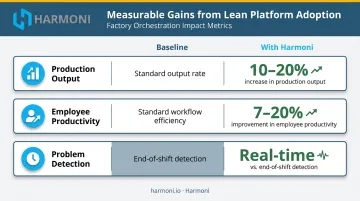
Lean platforms eliminate wasted operator time and create a transparent record of activity that supports accurate job costing. Deloitte's smart-manufacturing research found consistent gains across multi-initiative programs:
- 10–20% increase in production output
- 7–20% improvement in employee productivity
- Better labor visibility cited as a recurring contributor in both cases
Faster Problem Identification and Resolution
Lean platforms shift issue detection from lagging to leading. Instead of discovering a defect during final inspection or at shift end, supervisors receive alerts while the issue is still occurring. Catching a problem at the machine costs a fraction of catching it at the shipping dock — where rework, expedite fees, and customer returns compound the original mistake many times over.
What to Look for When Choosing a Lean Platform
Not every platform marketed as "lean" actually reduces waste at the operational level. Focus your evaluation on three factors:
- Integration depth: The platform should connect with your existing ERP, MES, and machine controls without extensive custom development. Harmoni, for example, integrates out of the box with major ERP systems and a wide range of CNC controls — including Mazak, Haas, Fanuc, and Siemens — used across precision and high-mix environments. Broader native compatibility means faster time to actionable data.
- Speed to value: Avoid vendors requiring multi-year implementation timelines. Harmoni completed WessDel's machine connections in under a week, with no upfront implementation costs and measurable ROI from day one. Weeks to deployment, not years, is the standard to hold platforms to.
- Operator-centered design: Adoption dies at the machine if operators find the interface frustrating. WessDel's president noted that "even operators love using it — they appreciate the automation." That kind of feedback reflects workstation-specific interfaces that surface the right information at the right moment, without requiring operators to navigate complex software built for IT teams.
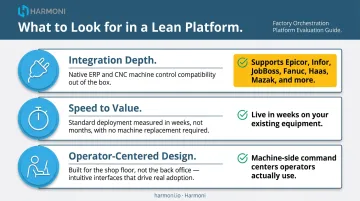
If a platform checks all three boxes, it's positioned to deliver the operational discipline lean manufacturing requires — not just in theory, but on the shop floor every shift.
Frequently Asked Questions
What is a lean platform?
A lean platform is a digital operational system that applies lean manufacturing principles — waste elimination, just-in-time information delivery, and real-time visibility — to coordinate people, machines, and processes in a manufacturing environment. It acts as the operational layer connecting plans to execution.
How does a lean platform differ from an MES or ERP system?
ERP systems manage planning and financial data after the fact. MES systems handle scheduling and routing. A lean platform is the orchestration layer that bridges both with real-time shop floor execution — connecting operators, machines, and workflows as production actually unfolds.
What are the core principles of a lean platform?
Lean platforms apply Toyota Production System principles digitally: eliminating waste (muda), delivering just-in-time information to operators, and surfacing errors as they happen. The goal is optimizing the whole production system — not just individual machines or departments.
What types of manufacturers benefit most from lean platforms?
Mid-to-large manufacturers in high-precision or high-mix low-volume environments — CNC machining, aerospace, defense, precision manufacturing — see the greatest impact. Complex workflows, frequent changeovers, and high costs of error are exactly what lean platforms are built to address.
How quickly can a lean platform show measurable results?
Unlike large ERP implementations, well-designed lean platforms deploy in weeks. Measurable improvements in operator efficiency, error reduction, and production visibility typically appear shortly after go-live — not quarters or years later.
Can a lean platform integrate with existing ERP and machine systems?
Most modern lean platforms integrate with existing ERP systems and a wide range of machine controllers, acting as an orchestration layer rather than a replacement. Harmoni, for example, supports major ERP platforms and CNC controls without requiring any machine replacement.