That problem is exactly what Identity and Access Management (IAM) is built to solve.
IAM is the cybersecurity framework that controls who can access an organization's systems, data, and resources—and under what conditions. This article covers what IAM is, how its four core pillars work, why it matters for modern organizations, and how these principles apply in manufacturing and operational technology (OT) environments where the stakes extend beyond data loss to production errors and safety incidents.
Key Takeaways
- IAM verifies who users are (authentication) and governs what they're permitted to access (authorization)
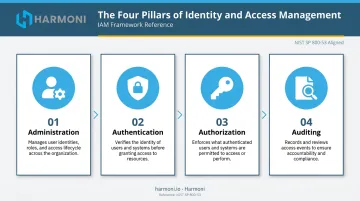
- The four operational pillars of IAM are Administration, Authentication, Authorization, and Auditing
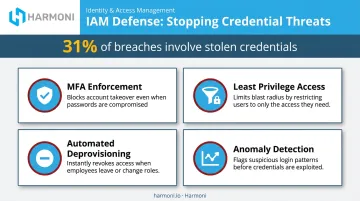
- Stolen credentials appeared in 31% of breaches over Verizon's 10-year dataset, making IAM a direct line of defense against the most common attack vector
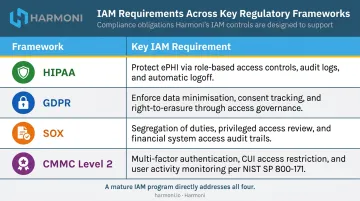
- IAM directly supports compliance frameworks including HIPAA, GDPR, SOX, and CMMC
- In manufacturing, IAM extends to the shop floor—controlling which operators can run which machines, access job instructions, and load CNC programs
What Is Identity and Access Management (IAM)?
NIST defines IAM as ensuring that the right people and things have the right access to the right resources at the right time. In practice, it's a cybersecurity discipline that manages digital identities and governs who—or what—can reach which systems, applications, data, and resources. For manufacturers operating under CMMC, ITAR, or DoD requirements, that governance extends to the shop floor itself — controlling who accesses CNC programs, sensitive engineering documents, and production systems.
IAM covers both human users (employees, contractors, vendors) and non-human entities (IoT devices, APIs, automated systems). That scope matters more than ever: IBM estimates machine identities now outnumber human identities by more than 40:1 in enterprise networks.
Two Core Components
IAM combines two distinct functions:
- Identity Management — Establishing and maintaining a verified digital identity for each user or entity in a central directory. Think of it as the authoritative record of who exists in your environment.
- Access Management — Using that verified identity to determine what resources each entity is permitted to reach, and at what level of privilege.
The two functions are inseparable. A directory that can't enforce access rules is just a list — and access controls built on unverified identities are controls you can't actually trust.
IAM Is a Framework, Not a Product
IAM isn't a single tool you purchase and install. It's a management framework — policies, processes, and technologies working together. IAM is distinct from identity security: IAM governs and enforces access, while identity security layers real-time threat detection on top — responding when those controls are bypassed or abused.
The Four Core Pillars of IAM
Every mature IAM program is built around four operational functions. These map directly to NIST SP 800-53 Rev. 5 controls (AC-2, IA-2, AC-3, AU-2/AU-12). Most practitioners call them the four pillars: Administration, Authentication, Authorization, and Auditing.
Pillar 1: Administration (Identity Lifecycle Management)
Administration covers the full lifecycle of a digital identity—from creation when someone joins an organization, through updates as roles change, to secure removal when they leave.
This matters because stale permissions are a real attack vector. CISA documented an incident where a threat actor used a former employee's account—never properly deprovisioned—to access a state government organization. That's not a sophisticated attack; it's a lifecycle management failure.
Modern IAM tools automate provisioning and deprovisioning, which reduces both the lag between a role change and its reflection in the system and the human error that manual processes introduce.
Pillar 2: Authentication
Authentication answers one question: Is this person actually who they claim to be?
The progression from basic username/password to modern authentication methods reflects how thoroughly passwords have failed as a sole control. Stolen credentials appeared in 31% of breaches across Verizon's 10-year dataset—and in web application attacks specifically, that figure climbs to 77%.
Modern authentication options include:
- Multi-factor authentication (MFA) — Requires two or more verification factors (password + phone code, for example)
- Biometrics — Fingerprint, facial recognition, or retinal scan
- Single Sign-On (SSO) — One verified login grants access across multiple connected systems
- Passwordless authentication — Hardware keys, passkeys, or device-based verification replace passwords entirely
Microsoft found that modern MFA reduces identity-compromise risk by 99.2%. Yet enterprise MFA adoption sits at only 41%—meaning most organizations are leaving that protection on the table.
Pillar 3: Authorization
Authentication verifies identity. Authorization determines what that verified identity is allowed to do.
The most common framework is Role-Based Access Control (RBAC): users receive only the permissions their job function requires. An accounts payable clerk can access invoicing systems but not payroll data. A shop floor operator can view their assigned job instructions but not engineering master files.
Closely related is the Principle of Least Privilege (POLP)—grant only the minimum access needed to complete a task. This limits the blast radius when accounts are compromised: a stolen credential for a low-privilege account can't reach high-value systems.
Pillar 4: Auditing
Auditing means monitoring, logging, and reviewing how identities and access rights are actually being used—flagging anomalies, generating compliance-ready audit trails, and confirming the other three pillars are functioning as intended.
Without auditing, excellent authentication and authorization policies can exist on paper while violations go undetected in practice. Audit logs provide the documented evidence regulators require under frameworks like NIST, SOC 2, and CMMC—and give security teams the forensic trail to determine exactly what happened after a breach.
Why IAM Is Critical for Modern Organizations
The traditional security model—"inside the firewall equals trusted"—no longer holds. Hybrid work, cloud adoption, and expanding networks of connected devices have dissolved the perimeter. Gartner forecast worldwide public cloud spending to reach $675.4 billion in 2024, up from $561.1 billion in 2023. Every workload moved to the cloud is a new identity that needs governed access.
The Credential Threat Is Real
IBM's X-Force Threat Intelligence Index found that use of stolen credentials to abuse valid accounts increased 71% year over year, representing 30% of all incidents X-Force responded to in 2023. Attackers no longer need to force entry — they use credentials already in hand to move through systems undetected.
IAM directly addresses this by:
- Enforcing MFA so stolen passwords alone aren't enough
- Applying least privilege so compromised low-privilege accounts can't reach critical systems
- Automating deprovisioning so orphaned accounts don't linger as open doors
- Detecting anomalous access patterns before damage escalates
The Non-Human Identity Problem
Credential risk extends beyond human users. IBM estimates machine identities outnumber human identities by more than 40:1. Microsoft found that 51% of workload identities were inactive and only 2.6% of their assigned permissions were actually used—an overlooked attack surface embedded in most enterprise environments.
APIs, IoT devices, automated workflows, and AI agents all require governed identities. IAM frameworks that treat only human users as in-scope are missing the majority of the identity population they need to manage.
Key Benefits of Implementing an IAM System
A well-implemented IAM program pays off in three distinct areas: security, operational efficiency, and compliance. Each addresses a different pressure point that organizations face when managing who can access what.
Security
- Consistent access enforcement reduces attack surface across the organization
- MFA makes stolen credentials significantly less useful to attackers
- Least-privilege access limits damage from any single compromised account
- IAM is the foundational layer of Zero Trust security architecture
Operational Efficiency
- SSO eliminates password sprawl across applications, reducing friction for end users and IT alike
- A Microsoft-commissioned Forrester study found that self-service reset, SSO, and MFA combined can cut password-related helpdesk tickets by 90%
- Automated provisioning accelerates onboarding
- Automated deprovisioning closes the manual offboarding gap that leaves former employees' access active
Compliance
- IAM generates the audit trails, access controls, and policy documentation that regulators require
- Relevant frameworks where IAM is directly implicated:
| Framework | Relevant Requirement |
|---|---|
| HIPAA | 45 CFR 164.312 requires access controls, unique user ID, audit controls, and authentication |
| GDPR | Articles 5 and 32 require risk-appropriate technical and organizational security measures |
| SOX | Section 404 requires internal controls over financial reporting |
| CMMC Level 2 | Explicit access control and MFA requirements for systems handling CUI |
IAM in Manufacturing and OT Environments
IAM conversations usually center on IT infrastructure—networks, cloud apps, enterprise software. But the same principles apply to manufacturing and operational technology (OT) environments, and the stakes are higher: a poorly controlled access decision in a machining shop doesn't just risk data exposure. It can produce a scrapped aerospace component, a safety incident, or a CMMC audit failure.
The OT Identity Challenge
OT environments—CNC machines, PLCs, ERP systems, MES platforms, shop floor terminals—were historically isolated from corporate networks. That's no longer true. Increased connectivity has expanded the identity attack surface into environments that often lack the access controls that IT takes for granted.
Dragos documented 1,693 ransomware attacks targeting industrial organizations in 2024, an 87% increase over 2023. The convergence of IT and OT networks is creating exactly the access management gaps that attackers exploit.
Manufacturers face specific IAM challenges that don't map neatly to enterprise IT:
- Large numbers of shop floor workers rotating between workcenters—often with shared terminals
- Controlling which operators can run which machines or access which job instructions
- Ensuring ERP and MES data is only accessible to authorized roles
- Managing access for contractors and visitors who need temporary, scoped access
IAM Principles Applied at the Machine Level
In manufacturing, identity management principles translate directly to the shop floor. Operators can be assigned digital identities tied to their role and certifications, with access to specific machines, jobs, and process steps governed accordingly.
Harmoni's factory orchestration platform takes this approach using long-range RFID technology. When an operator approaches a Harmoni terminal, the system automatically identifies who they are and what job they're working on, then surfaces only the work instructions, CNC programs, and quality checksheets that the operator is authorized to access.
For jobs requiring heightened security (aerospace, defense, military components), the platform enforces multi-factor authentication combining RFID badge identification with facial recognition at each sensitive action:
- Clocking in and out of a job
- Starting or pausing a work order
- Viewing restricted work instructions
- Loading a CNC program
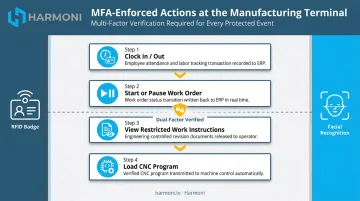
This applies access control principles directly at the machine level—a layer that traditional IT-based IAM systems aren't designed to reach.
CMMC Requirements for Defense Manufacturers
Compliance-driven manufacturers face especially specific identity requirements. CMMC Level 2 mandates explicit controls for systems handling Controlled Unclassified Information (CUI), including:
- AC.L2-3.1.1 — Limit system access to authorized users and devices
- AC.L2-3.1.5 — Apply least privilege to privileged accounts and security functions
- IA.L2-3.5.3 — Use MFA for local and network access to privileged accounts
NIST SP 800-82 Rev. 3 applies these same account management, authentication, and audit controls to OT—while recognizing real-world constraints like safety requirements, legacy device limitations, and availability priorities. An IAM framework that stops at the office network leaves the shop floor exposed—which is precisely where compliance auditors and attackers focus next.
IAM Tools, Technologies, and Standards
Core Technologies
| Technology | What It Does |
|---|---|
| MFA | Adds verification beyond passwords—combines credentials with phone codes, biometrics, or hardware keys |
| SSO | One verified login provides access across multiple connected systems |
| PAM (Privileged Access Management) | Applies extra controls, session monitoring, and just-in-time access to high-privilege accounts |
| RBAC | Governs permissions based on job function—users get only what their role requires |
Two open standards underpin interoperability across IAM tools:
- SAML 2.0 (Security Assertion Markup Language) — Enables SSO and identity federation across platforms
- SCIM (System for Cross-Domain Identity Management) — Standardizes how identity data moves between systems for automated provisioning and deprovisioning
Cloud IAM and Adaptive Authentication
Cloud-based IAM platforms (Identity-as-a-Service / IDaaS) are gaining ground as a way to reduce infrastructure overhead and support distributed workforces. Modern platforms increasingly incorporate adaptive authentication: AI-assisted evaluation of login risk signals—location, device health, behavior patterns—that adjusts verification requirements in real time based on assessed risk level.
Implementation Considerations
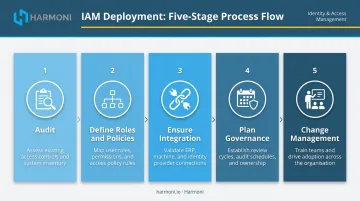
Selecting the right tools is only half the equation. A phased deployment approach reduces risk and keeps governance from being bolted on as an afterthought:
- Audit first — Document every user, device, and system that requires access before deploying any tools
- Define roles and policies — Establish least-privilege access policies before configuring the system; don't retrofit governance onto a running deployment
- Ensure integration — Confirm the IAM solution connects with existing ERP, cloud, and on-premises systems
- Plan for governance — Build ongoing access reviews, deprovisioning workflows, and audit log monitoring into operations from day one
- Invest in change management — User training and stakeholder buy-in determine adoption rates as much as technical implementation quality
Frequently Asked Questions
What does identity and access management (IAM) do?
IAM verifies the identity of every user or device attempting to access an organization's systems, then enforces policies governing what each verified identity is permitted to do. It prevents unauthorized access while keeping friction low for authorized users working within their permitted scope.
What is an example of an identity and access management system?
Microsoft Entra ID (formerly Azure Active Directory) and Okta are widely used IAM platforms. Both allow organizations to manage user identities, enforce MFA, enable SSO across applications, and control access permissions from a central console.
What are the four pillars of IAM?
- Administration: Creating and managing digital identities
- Authentication: Verifying who a user is
- Authorization: Determining what that user is permitted to access
- Auditing: Monitoring and logging access activity for security and compliance
What is the difference between authentication and authorization?
Authentication answers "Who are you?" — verifying identity through passwords, MFA, or biometrics. Authorization answers "What are you allowed to do?": determining which resources and actions that verified identity can reach. In practice, authentication gets you in the door; authorization controls which rooms you can enter.
How does IAM help with regulatory compliance?
IAM enforces access controls, generates audit trails documenting who accessed what and when, and automates the policy enforcement that regulators require. HIPAA, CMMC, SOX, and GDPR all contain requirements that a mature IAM program directly addresses.