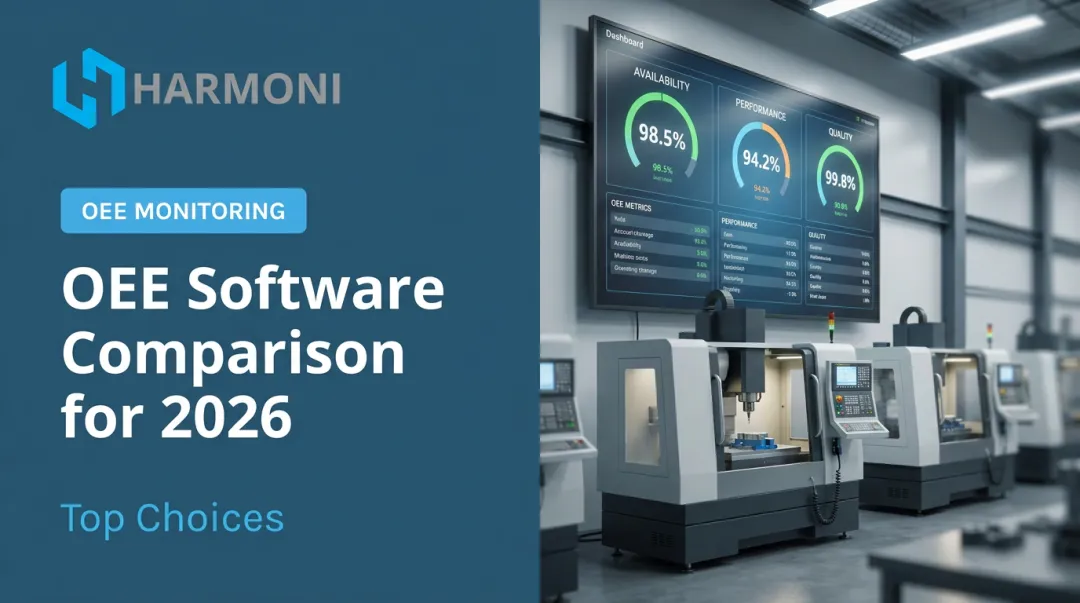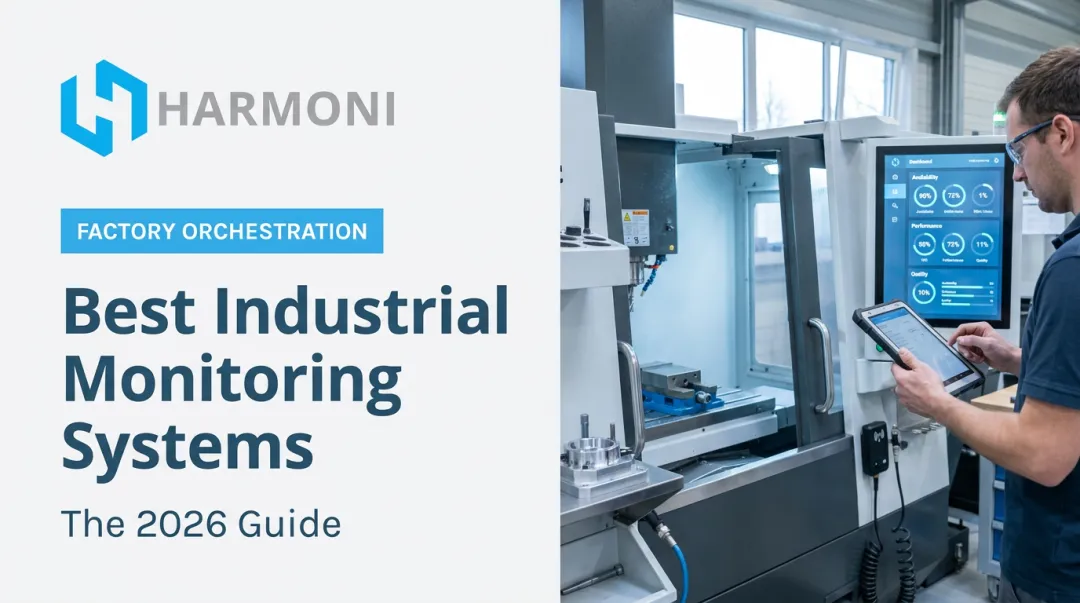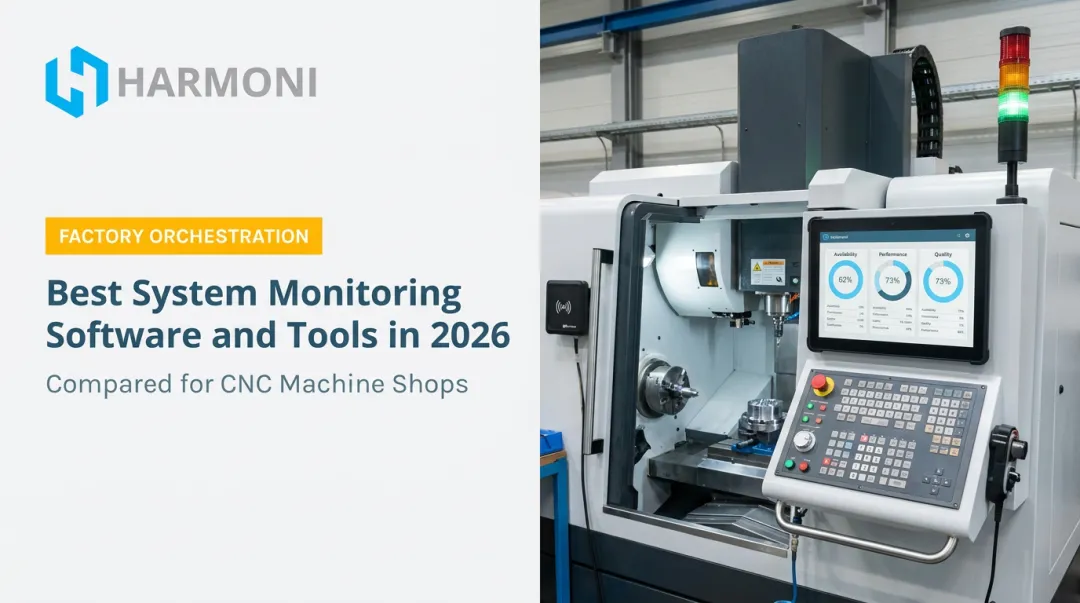
Real-time machine monitoring software exists to close that gap. The best platforms go further — connecting machine signals to operator activity, job status, and ERP workflows so teams can act immediately, not after the morning report.
This guide compares five leading platforms for 2026: Harmoni, MachineMetrics, Scytec DataXchange, Tulip, and Vorne XL. It covers what separates strong solutions from weak ones and how to match a platform to your specific operational context.
Key Takeaways
- Real-time machine monitoring replaces manual shift-end reporting with continuous, live shop floor visibility
- The strongest platforms connect machine data to operator activity and ERP workflows, not dashboards alone
- Evaluate solutions on five factors: machine connectivity, ERP integration depth, alert latency, operator UX, and deployment speed
- Each of the five platforms reviewed here represents a distinct approach suited to different operational needs
- Prioritize solutions that deliver measurable improvement within weeks, not months of configuration
What Is Real-Time Machine Monitoring Software?
Real-time machine monitoring software is an IIoT-enabled platform that automatically collects machine status (running, idle, fault), cycle counts, downtime events, and process parameters from shop floor equipment — making that data visible within seconds, not hours. The core problem it solves is the time gap between a machine event and operator or management awareness.
The data path is straightforward:
- Machine or PLC → captures raw signals and process parameters
- Edge device or gateway → translates and transmits data in real time
- Software platform → aggregates, contextualizes, and stores events
- Live dashboard → surfaces actionable status to operators and management
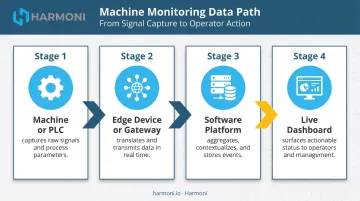
Modern platforms use standards like MTConnect and OPC UA for CNC connectivity, while retrofit gateways handle legacy equipment without PLC modifications.
The scale of the gap this solves is significant. According to a 2023 SME and Laserfiche study, 62% of manufacturers experienced delays in equipment effectiveness and capacity utilization — driven by manual tracking and delayed data access.
That pressure has pushed the category beyond passive dashboards. The most competitive platforms now connect machine signals to operator workflows and ERP transactions — so a spindle fault at 2 AM triggers a response, not just a log entry. The comparison below covers where each platform falls on that spectrum.
Best Real-Time Machine Monitoring Software: Top 5 Picks for 2026
These five platforms were selected based on real-time data capability, machine connectivity, ERP integration, operator usability, and fit for mid-to-large manufacturing environments.
Harmoni
Harmoni is a factory orchestration platform built for mid-to-large manufacturers, positioned between ERP systems, MES platforms, machines, and operators to improve shop floor execution in real time. It connects to CNC machine brands including Fanuc, Haas, Mazak, Siemens, Heidenhain, DMG MORI, and Fadal, and integrates with ERPs including Epicor, JobBoss, Infor, ABAS, and ODOO.
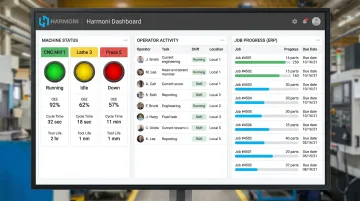
Where conventional machine monitoring tools stop at uptime data, Harmoni covers the full picture: machine status, operator activity, job progress, and ERP workflow — in one unified view.
Its three core pillars work together:
- Automation — Long-range RFID automatically identifies operators and jobs at the machine, loads the correct CNC program, delivers work instructions, and logs labor to the ERP. No badge swipes, no keyboard entry. At WessDel, a manual time-tracking step that took 11 minutes per transaction was reduced to seconds — generating 17 productive hours gained per employee per month and a 5x return on ongoing Harmoni costs.
- Process control — Digital work instructions, quality checksheets, and engineering revision control enforce correct procedures at every workcenter. The system ensures operators work from current-revision documents, reducing scrap risk from outdated programs or setups.
- Observability — Real-time dashboards unify machine data, operator activity, and ERP job status in one view. Visual Factory andon-style indicator lights give floor-level awareness the moment conditions change. At Machine Specialties, Inc. (MSI), the platform nearly eliminated part count errors on complex aerospace and defense components after deployment in early 2024.
| Attribute | Details |
|---|---|
| Key Features | Real-time dashboards unifying machine, operator, and ERP data; RFID-based operator and job detection; automated CNC program loading; digital work instructions and quality checksheets; Visual Factory andon lights; ERP and MES integration layer |
| Best Fit For | Mid-to-large manufacturers in CNC machining, aerospace, defense, precision manufacturing, and automotive needing coordinated visibility across people, machines, and systems — not just machine uptime data |
| Deployment & Pricing | Deploys in weeks; contact Harmoni at sales@harmoni.io or (888) 341-4097 for pricing |
MachineMetrics
MachineMetrics is an IIoT machine monitoring platform focused on CNC and discrete manufacturing, with strong connectivity to Fanuc, Siemens, Heidenhain, and other controllers via MTConnect and OPC UA. Contract machining shops use it primarily for real-time OEE visibility and machine analytics.
Core differentiators include:
- Deep machine-level data capture with automatic cycle extraction
- Real-time OEE dashboards and downtime categorization
- Predictive maintenance add-ons
- REST API for ERP connections
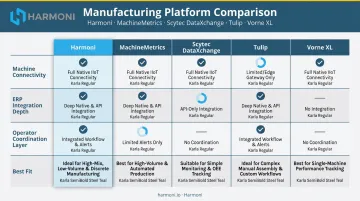
MachineMetrics functions primarily as a system of record. It delivers strong analytics, but there is no native operator coordination layer or ERP workflow integration that pushes data back into work orders automatically.
For shops that need machine analytics and are already handling ERP and operator coordination through other systems, it's a strong fit. For teams that need those layers connected, it requires additional integration work.
| Attribute | Details |
|---|---|
| Key Features | Real-time OEE, cycle time extraction, downtime tracking, predictive maintenance alerts, REST API for ERP integration |
| Best Fit For | CNC shops and discrete manufacturers prioritizing machine-level analytics and automated cycle time capture |
| Deployment & Pricing | Per-machine monthly SaaS subscription; visit machinemetrics.com/pricing for current rates |
Scytec DataXchange
Scytec DataXchange is an established machine monitoring platform known for broad compatibility with legacy and mixed machine fleets, supporting DNC, MTConnect, and PLC-based connectivity. Job shops and contract manufacturers running older CNCs alongside newer equipment are its primary customer base.
DataXchange's strength is retrofit environments. It can connect machines that lack Ethernet or OPC UA interfaces using DNC adapters and digital signal taps, without requiring PLC modifications. That makes it one of the more accessible options for shops running older equipment.
The tradeoffs: the UI is less modern than newer SaaS platforms, and analytics depth is lighter than CNC-focused competitors. Real-time alerting is available, but the platform is better positioned as a connectivity and runtime-capture solution than a deep analytical engine.
| Attribute | Details |
|---|---|
| Key Features | DNC, MTConnect, and PLC connectivity; runtime capture; downtime alerts; historical reporting; legacy machine support |
| Best Fit For | Job shops and mixed-fleet manufacturers with legacy CNCs where retrofit connectivity is the primary challenge |
| Deployment & Pricing | Site or machine-level licensing; visit scytec.com/pricing for current rates |
Tulip
Tulip is a low-code manufacturing operations platform that supports machine monitoring through edge gateways and connector plugins, enabling teams to build custom operator-facing apps alongside production dashboards. It is used by manufacturers who want highly configurable shop floor interfaces without writing custom software.
The platform excels at operator UX and workflow customization. Teams can design tailored process guides, quality forms, and dashboards that match specific production workflows — a genuine differentiator for operations with unique or complex assembly steps.
The tradeoff is configuration investment. Automatic cycle time extraction requires additional integration work, and the platform functions more as an MES/app builder than a dedicated real-time machine monitor. Manufacturers who need out-of-the-box machine visibility quickly may find the configuration overhead significant.
| Attribute | Details |
|---|---|
| Key Features | Low-code app builder, edge gateway machine connectivity, customizable operator apps, OEE dashboards, API integrations |
| Best Fit For | Manufacturers that need highly customized operator interfaces and are willing to invest configuration time to build tailored monitoring workflows |
| Deployment & Pricing | Per-platform or per-seat pricing; visit tulip.co/plans for current rates; implementation timelines vary by configuration scope |
Vorne XL
Vorne XL is a hardware-centric OEE and production monitoring system that delivers real-time visual feedback at the machine level through physical scoreboards and dashboards. Setup is typically measured in days rather than weeks.
The value is simplicity and speed. For facilities that need immediate floor-level awareness and OEE scoring, Vorne XL delivers that without a complex deployment. Operators and supervisors can see machine states and production rates in real time without any software configuration.
Where it falls short: no ERP integration, no native operator coordination, no maintenance workflow links, and limited multi-site management. It's a solid starting point for facilities piloting real-time awareness, but it isn't a full operational monitoring solution for complex manufacturers.
| Attribute | Details |
|---|---|
| Key Features | Physical scoreboards, real-time OEE display, machine uptime tracking, downtime alerts, shift reporting |
| Best Fit For | Smaller facilities or pilot deployments where immediate visual floor awareness is the primary goal and deep ERP integration is not yet required |
| Deployment & Pricing | One-time hardware purchase with optional support plan; visit vorne.com/products/models for current pricing |
How We Chose the Best Real-Time Machine Monitoring Software
Selections were based on how well each platform addresses actual operational problems — not feature checklists or brand recognition. The most common buyer mistake is choosing a solution based on dashboard aesthetics rather than asking: Can it connect to my specific machines? Does it integrate with my ERP? Will my operators actually use it?
Machine Connectivity and Protocol Support
A platform must support the specific controllers in your fleet. Solutions that require PLC programming changes or lack native adapters for common CNC brands add cost and delay before a single data point is collected.
Check compatibility for the controllers your shop actually runs:
- Fanuc (0i, 30i, 31i, 32i)
- Haas / NGC
- Mazak / Mazatrol
- Siemens / Sinumerik
- Heidenhain
- DMG MORI, Makino, Fadal
Verify against your actual machine list before committing to any vendor — not the vendor's general compatibility claims.
ERP and MES Integration Depth
Machine monitoring alone generates data, not decisions. Platforms that push job status, cycle counts, and downtime data into ERP workflows automatically enable accurate job costing, scheduling, and capacity planning.
According to a 2025 Dassault Systèmes-commissioned survey reported by IndustryWeek, 20% of manufacturers frequently make bad decisions due to data they do not have, trust, or can access — a gap that ERP-integrated monitoring directly addresses. Ask vendors for specific connector documentation for your ERP system, not just general API claims.
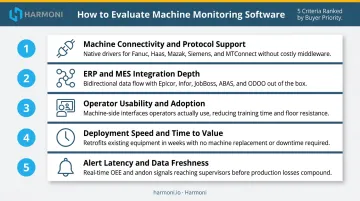
Operator Usability and Adoption
Real-time visibility is only valuable if operators actually use the system. Platforms that require multi-step data entry or lengthy training reduce throughput rather than improving it. Look for solutions with minimal operator input requirements and intuitive interfaces at each workcenter.
The strongest adoption rates come from implementations that eliminate manual steps entirely — for example, RFID-based identification that auto-detects the operator and active job without any manual entry.
Deployment Speed and Time to Value
Long implementation timelines erode ROI before the first insight is captured. Prioritize vendors that offer staged deployments and can demonstrate measurable results within the first month.
Research from Deloitte's 2025 Smart Manufacturing and Operations Survey found manufacturers who deployed IIoT solutions saw an average 10–20% improvement in production output — but only when implementations moved fast enough to generate early wins that kept teams engaged.
Conclusion
The right real-time machine monitoring software is the one that matches how your shop floor actually operates — connecting machines, operators, and business systems in a way that produces decisions, not just dashboards.
Before committing to any platform, evaluate it against your specific machine types, ERP environment, and operator workflows. Run a structured pilot on a representative set of 3–10 machines to validate connectivity and integration before a full rollout. Pay close attention to integration reliability and data latency during the pilot — those two factors predict real-world performance more accurately than any demo.
For manufacturers who need more than monitoring, Harmoni's factory orchestration platform connects machines, operators, jobs, and ERP transactions into a single unified system — with RFID-driven automation, native ERP integration, and deployment measured in weeks, not months. Contact the team at sales@harmoni.io or (888) 341-4097 to learn more, or book a free demo at harmoni.io/demo.
Frequently Asked Questions
What is real-time machine monitoring software?
Real-time machine monitoring software is an IIoT-enabled platform that collects and displays machine status, cycle data, and downtime events within seconds — replacing shift-end reporting with continuous visibility. It connects physical machines to digital dashboards through edge devices and standard protocols like MTConnect and OPC UA.
How does real-time machine monitoring software integrate with ERP systems?
Most platforms integrate via REST APIs or pre-built ERP connectors, pushing cycle times, part counts, and downtime data into work orders in near real time. Integration depth varies — some platforms offer read-only data pulls, while others like Harmoni support bi-directional data flow with Epicor, Infor, JobBoss, and ODOO.
What metrics should real-time machine monitoring software track?
The core metric set includes: OEE (availability, performance, quality), actual vs. standard cycle time, downtime events with reason codes, part counts (good vs. scrap), and MTBF/MTTR for maintenance planning. More advanced platforms also surface earned hours, job costing variance, and operator-level productivity data.
What is the difference between machine monitoring software and a factory orchestration platform?
Machine monitoring software captures what machines are doing — runtime, downtime, cycle counts, OEE. A factory orchestration platform like Harmoni coordinates machines, operators, ERP workflows, and engineering requirements together — bridging the gap between data visibility and operational execution.
How long does it typically take to implement real-time machine monitoring software?
Hardware-centric tools like Vorne XL can be live in days. SaaS platforms typically deploy in two to six weeks; full orchestration platforms with ERP integration may take four to eight weeks. Starting with a pilot on 3–10 machines is the fastest way to validate connectivity before a full rollout.
Can real-time machine monitoring software work with older or legacy CNC machines?
Yes. Most platforms support legacy machines through retrofit adapters, digital I/O gateways, or DNC interfaces that tap existing electrical signals without modifying PLC programs. Data depth is typically limited to basic machine states and cycle counts — but that's usually enough to establish baseline visibility and surface real utilization gaps.