
Introduction
CNC machining doesn't tolerate ambiguity. Tight tolerances, multi-step setups, and coordinated handoffs between programmers, operators, and quality teams mean that informal instruction (verbal explanations, scribbled notes, remembered procedures) creates a direct path to scrap and rework. Formalising it helps, but a document still only describes the job — it cannot confirm the right revision reached the control or that it matched the work the ERP released, and that gap between the written setup and the executed one is where the scrap actually appears.
The gap is well-documented. The FDA's 2025 warning letter to Exactech found that one work instruction lacked step-by-step in-process inspection directions, another didn't define production controls, and the company's machining scrap logs showed recurring entries: "wrong offset," "tool broke," "worn tool."
Those aren't machinist failures. They're documentation failures.
This guide covers what CNC work instructions should contain, when they're necessary, and how to structure and deliver them so operators can actually follow them on the shop floor — not just in theory.
Key Takeaways
- Complete CNC work instructions span every phase — pre-start, setup, in-process monitoring, and shutdown
- Verbal shift handoffs are among the highest-risk gaps in shop floor documentation — written instructions close that gap
- In regulated industries, work instructions are quality records — not optional
- Digital delivery at the workcenter eliminates outdated printouts and memory reliance
- Program revisions, tooling changes, and process updates each require a matching instruction update
When CNC Operations Need Formal Work Instructions
Most shops treat work instructions as a new-operator problem. They're not.
Formal work instructions are necessary any time a job involves:
- New part numbers or first-time setups on an existing machine
- Revised programs or tooling since the last production run
- Multi-shift production where one operator hands off to another
- High-tolerance or regulated parts in aerospace, defense, or medical manufacturing
- Jobs with prior scrap history or documented quality escapes
The scenarios where instructions get skipped are often the most dangerous. Repeat jobs get run without checking whether anything changed. Short-run jobs seem simple enough to do from memory. A machinist hands off a job to the next shift with only the program file — no fixture notes, no offset history, no context about what the previous run revealed. That missing context is where scrap, nonconformances, and audit findings originate.
GM's IATF customer-specific requirements address this directly, calling for standardized work covering what, how, and why — with quality checks on each shift and documented feedback between shifts. Shift handoffs are a required control point, not an informal courtesy.
What CNC Machine Work Instructions Should Cover
Effective work instructions follow the same sequence as the operation. Instructions that skip phases — omitting pre-start checks or shutdown procedures, for example — produce incomplete operator behavior that multiplies across shifts and production runs.
Machine Pre-Start and Workspace Preparation
Before power-on, operators need to verify:
- Coolant and oil levels are within acceptable ranges
- Air supply pressure meets machine specifications
- The workspace is clear of debris, unused tooling, or fixtures from prior jobs
- Required PPE is in place for the material and operation
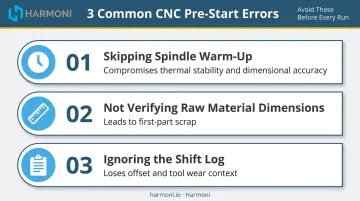
The most common pre-start errors that cascade into production problems:
- Skipping the warm-up cycle — Haas specifies a 20-minute spindle warm-up after more than four idle days; skipping this affects thermal stability and dimensional accuracy
- Not verifying raw material dimensions against the job traveler before fixturing
- Ignoring the shift log — if the previous operator flagged an offset adjustment or tool wear issue, that context is critical before the next cycle starts
Startup, Homing, and Control Initialization
The work instruction must define the startup sequence explicitly:
- Power on the machine before the CNC control
- Run the reference/home cycle before any jogging or program loading
- Verify axis position readouts match known home coordinates
- Confirm no active alarms before loading any program
Out-of-sequence startups on certain controllers can cause positioning errors that aren't immediately visible. The instruction should specify the expected state of control panel indicators after a correct initialization — not assume operators know what "ready" looks like on an unfamiliar controller.
Tooling, Fixturing, and Program Setup
Ambiguity in this phase is the single most common source of first-part scrap. Document each of the following explicitly:
- Tool load order by station number
- Tool length offset (TLO) setting procedure for the specific machine control
- Fixture or vise position and torque specifications
- Part datum location and work coordinate offset (WCO) confirmation method
The mandatory dry run step deserves its own line in the instruction. Running the program with the spindle off and the Z-axis elevated verifies tool paths and feed/speed logic before any cutting begins. The instruction should specify the required clearance height and what to check during the dry run — not just write "perform dry run" and leave interpretation to the operator.
In-Process Monitoring and Quality Checkpoints
This section separates a work instruction from a simple checklist.
During cutting, operators need documented criteria for:
- Spindle load — acceptable range and what triggers a pause
- Chip color and form — indicators of improper cutting conditions that visual inspection alone won't catch early enough
- Coolant flow adequacy — confirmed visually or by pressure gauge, depending on the machine
For gauging, the instruction should define:
- Which features to measure and with which instruments
- Measurement frequency (every part, every 8th part, at defined intervals)
- The dimensional result that triggers a hold versus an offset adjustment
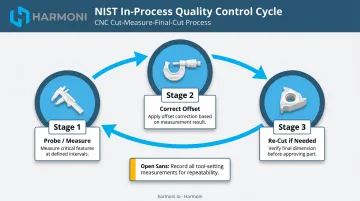
NIST's on-machine measurement guidance outlines a cut/measure/final-cut cycle — probe, correct offset, re-cut if needed — and recommends recording tool-setting measurements under repeatability testing. Build that cycle into the instruction explicitly so operators aren't left to interpret the sequence on their own.
Shutdown and Post-Run Documentation
The shutdown sequence matters for machine health and safety:
- Stop the spindle and allow it to come to a full stop before opening the enclosure
- Remove finished parts and fixtures
- Clear chips from the machine and chip conveyor
- Power down in correct order — CNC control before main breaker
Post-run documentation the operator should complete:
- Actual cycle times recorded against the estimated cycle
- Offset adjustments made during the run (what was adjusted, by how much)
- Tool wear or breakage flagged for the next setup
- Job traveler signed off with completion status
That completed record gives programmers and process engineers the data they need to tighten cycle times, catch tool wear trends early, and update instructions before the next run repeats the same problems.
Where CNC Work Instructions Are Applied in Practice
CNC work instructions are most critical at four specific moments:
| Moment | Risk Without Documentation |
|---|---|
| Before setup begins | Operator makes setup decisions without engineering intent |
| Shift changeover | Incoming operator loses context from prior run |
| New operator training | Knowledge transfer depends on tribal expertise |
| Rerunning a job after a long gap | Process drift goes undetected without a documented baseline |
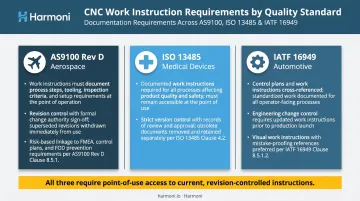
At each of these moments, undocumented knowledge is most likely to be lost — or never transferred at all. In regulated industries, that risk carries external audit implications, because work instructions aren't just operational guides; they're quality records.
- AS9100 Rev D (Aerospace): Requires point-of-use access to current documents, version history, setup diagrams, and controlled change records — with first-production verification explicitly named.
- ISO 13485 (Medical Devices): FDA's MDSAP audit approach maps production control to clauses 7.5.1 and 7.6; auditors compare instructions against actual practice and verify approval and effective-date records.
- IATF 16949 (Automotive): Special characteristics must appear in operator instructions, and standardized work must address what, how, and why for each controlled operation.
Best Practices for Creating and Delivering Effective CNC Work Instructions
Build Visual Documentation Into Every Instruction
Text-only instructions create ambiguity, particularly for fixturing and multi-operation parts. Every work instruction should include:
- Setup photographs taken from the operator's perspective
- Annotated part diagrams with datum locations and critical features marked
- Tool assembly images where multiple inserts or holders could be confused
Visual references eliminate interpretation errors that text cannot prevent.
Write at the Operator's Level, Not the Programmer's
A work instruction that assumes G-code literacy fails when given to a setup operator who doesn't have it. The instruction should specify what the operator should see, hear, and measure at each step — not what the program is doing internally. This is the distinction between an instruction that supports execution and one that only makes sense in retrospect.
Version Control Is Non-Negotiable
Every program revision, tooling change, or process update must trigger a corresponding instruction update. The version number must be visible on the document itself. Outdated instructions in circulation are more dangerous than no instructions — they create false confidence that the documented process is current when it isn't.
Deliver Instructions Digitally at the Workcenter
Paper-based instructions have a well-documented failure mode: Modern Machine Shop identifies old revisions, cryptic notes, half-written instructions, and lost documents as chronic problems with paper travelers. Machine-side digital access is the direct fix.
Harmoni's platform addresses this using long-range RFID to identify the operator and the active job, then automatically surfaces the correct, revision-controlled work instruction at the machine terminal — no manual searching, no printing, no version reconciliation required. Documented customer outcomes include:
- 22% scrap reduction within two months of implementation, with work instruction accuracy cited as a direct contributor
- Near-elimination of part count errors at a major aerospace and medical parts manufacturer after deploying Harmoni across the shop floor
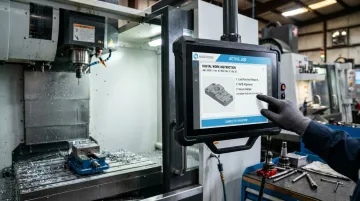
Harmoni's shop communications feature also gives operators a direct channel to engineering — voice, video, or messaging from the machine terminal — so unclear steps can be flagged and resolved in real time rather than worked around.
Establish a Formal Feedback Loop
Operators should have a defined mechanism to flag unclear steps, missing information, or process deviations back to programmers and engineers. This isn't a suggestion box — it's a structured workflow. Shops that build this into their process catch documentation gaps before they become recurring scrap — not after the fact.
Conclusion
CNC work instructions aren't administrative overhead. They're the mechanism by which engineering intent gets transferred to the shop floor reliably — across operators, across shifts, and across production runs that may happen months apart. The quality of your instructions determines whether your process produces consistent results or depends on individual knowledge that walks out the door at shift change.
Audit your current instructions against the phases covered here. Any phase without a documented standard exposes your operation to scrap, unplanned downtime, and throughput loss. Start closing those gaps. And if operators are still pulling instructions from a shared drive or a binder, consider whether the delivery method is undermining the standards you've already built — platforms like Harmoni deliver digital work instructions directly to the machine side, keeping the right version in front of the right operator at the right time.
Frequently Asked Questions
What should be included in a CNC machine work instruction?
A complete instruction covers pre-start checks, tool and fixture setup, program parameters, in-process quality checkpoints, and shutdown procedures, plus post-run documentation requirements. Instructions that cover only the cutting phase leave the phases most prone to human error undocumented.
Who is responsible for creating CNC work instructions?
CNC programmers typically author the technical content (tool lists, parameters, program notes), while process engineers or supervisors own quality checkpoints and safety requirements. The most reliable instructions come from both contributing, not from either working alone.
How often should CNC work instructions be updated?
Any time the program, tooling, material, fixturing, or quality requirements change, the instruction must be updated before the next run. Shops should also audit active instructions on a defined cycle: annually at minimum, or immediately following any quality escape tied to that job.
What is the difference between a CNC work instruction and a G-code program?
A G-code program tells the machine what to do. A work instruction tells the operator what to do before, during, and after the machine runs. Both are required for a repeatable process, but only the work instruction governs human behavior, and that's where most setup errors originate.
Is it easy to learn how to use a CNC machine?
Operating a CNC machine has a real learning curve, particularly around offsets, tooling decisions, and parameter settings. Well-written work instructions reduce the time it takes new operators to run a job safely and correctly. The BLS classifies machinists as requiring long-term on-the-job training, but structured documentation compresses that curve significantly.
How can manufacturers ensure operators follow CNC work instructions consistently?
Consistency comes down to access, accountability, and automation. Instructions need to be at the point of use — not in a binder at the supervisor's desk. Mandatory checkpoints with operator sign-off create accountability. Digital platforms that surface the current instruction automatically when a job starts remove the decision of whether to look it up at all.